

Method, priorities and criteria for turning the initial idea into a concrete wedding project
At first everything seems simple: a date to imagine, a style you like, a few saved images, the desire to bring the right people together in a place that makes sense. Then, as soon as the idea of the wedding stops being abstract, very concrete questions emerge. Who really decides? Where do you start without creating confusion? Which choices need to be made before talking about setups, palettes, or scenic details? This is exactly where the operational priorities before moving into planningcome into play
: not as a bureaucratic step, but as a useful filter to turn an emotional intention into a readable, coherent, and manageable project.
Why operational priorities before moving into planning prevent cascading mistakes
Le operational priorities before moving into planning When a couple starts talking about the wedding, often the first impulse is to look for inspiration. That’s normal. The problem arises when inspiration comes before structural decisions. In that case, every subsequent choice risks resting on unstable foundations: a venue evaluated without knowing the realistic number of guests, a period hypothesized without having checked the availability of key people, a format imagined without clarifying the level of family involvement.
they serve precisely this purpose: putting in order what conditions all subsequent decisions. They are not a rigid list that is the same for everyone, but a system of priorities.
- A useful criterion is to distinguish between:foundational decisions
- , which change the framework of the project;adaptive decisions
, which can be refined later without compromising the whole.
For example, the indicative number of guests, the type of experience desired, and the organizational scope fall under foundational decisions. The graphic tone of the invitations or the precise definition of certain aesthetic details belong instead to the adaptive phase.
Understanding this difference reduces two frequent risks: investing time in secondary aspects and having to go back when constraints not considered at the beginning emerge.
From desire to a concrete wedding project: the questions to clarify right away
Even before building a timeline, it’s worth pausing on some questions that carry real weight. They are not theoretical: they affect feasibility, the tone of the event, and the quality of the experience for guests.
What kind of wedding do you want to live, not just show
Many couples start from an image. It’s more useful to start from a lived scene. Do you want an intimate day, with unhurried timing and relationships at the center? Or a more structured event, with moments spread out and broader direction? This distinction immediately guides the choice of place, logistics, and pace. A practical criterion: try to describe the wedding in three words that relate to the experience, not the aesthetics. For example: intimate, convivial, bright orelegant, fluid, welcoming
. If incompatible words emerge, it means the project still needs to be brought into focus.
Who are the guests who really matter in the design of the event
A practical detail often overlooked: don’t think only in terms of a list, but in terms of the guests’ expectedbehavior. A celebration with people coming from different cities or countries requires clearer timing, hosting, and communication than a wedding with a predominantly local audience.
What is the couple’s decision-making scope
One of the most delicate points concerns the decision-making process. If choices are shared with family members or other involved figures, it’s useful to clarify right away who has a say in what. Not to stiffen the dialogue, but to avoid overlaps and continuous second-guessing.
A simple method is to divide decisions into three groups:
- those that belong only to the couple;
- those for which discussion is expected;
- those that require final validation by more than one person.
This initial clarity greatly lightens the subsequent operational phase.
Operational priorities before moving into planning: the correct order of choices
When it comes to method, the point isn’t to do everything right away, but to do first what conditions the rest. A concrete wedding project almost always comes from a well-constructed logical sequence.
1. Define the event format
Before the venue and before the style, the format must be defined. Will it be a single day or an experience spread over multiple moments? Will the heart of the event be the ceremony, conviviality, guest hospitality, or a combination of these elements?
This step is decisive because it changes the type of spaces to look for, the level of coordination required, and the setup of the entire project.
2. Establish a realistic time window
There’s no need to set an exact date right away if it isn’t clear first what period is truly feasible. A well-considered time window helps assess availability, travel, and organizational sustainability without becoming rigid too early.
The criterion here is simple: better a time choice consistent with the project than an evocative date that’s not very functional.
3. Build an initial guest map
You don’t need to have the final list, but a division into circles is very useful. For example:
- essential guests;
- likely guests;
- guests to be confirmed based on the chosen format.
This map prevents evaluating spaces or solutions in an abstract way and helps understand the level of hosting required.
4. Clarify the acceptable level of organizational complexity
Not all couples want the same level of structure. Some prefer a linear event, with few steps and essential direction, while others imagine a more constructed experience. No choice is absolutely better: what matters is consistency with energy, time, and expectations.
A concrete decision criterion: if a solution is very appealing but requires continuous logistical exceptions, it should be evaluated more carefully. Unmanaged complexity tends to surface precisely at key moments.
5. Only afterwards, move on to the operational selection
When these points are clear, planning stops being scattered. At that point, looking for venues, setting the work schedule, and defining supplier priorities becomes an orderly activity, not a chase.
Practical aspects that couples underestimate at the beginning
There are elements that rarely appear in the first conversations, but that greatly influence the real project. Ignoring them doesn’t eliminate them: it only pushes them further down the line, when they have a bigger impact.
The gap between imagination and feasibility
A wedding can be beautiful even without matching the first mental image that sparked it. In fact, the most successful projects often arise when the initial idea is translated into a workable language. The point is not to give up, but to understand which aspects of the idea are truly essential and which are instead secondary.
A useful exercise: ask yourselves what should not be missing for the day to truly feel like you. If the answer concerns atmosphere, relationships, and the quality of shared time, the project already has a more solid foundation than it seems.
The weight of logistics on guests
When guests have to organize travel, accommodation, and arrival times, logistics becomes part of the experience. It’s not a backdrop. It’s one of the elements that determine the perceived level of comfort.
For this reason, it’s worth evaluating from the start:
- how easy it will be for guests to find their way;
- whether the day’s transitions are intuitive;
- what information they will need to receive in advance;
- whether the event’s pace is compatible with the type of audience expected.
An elegant project on paper can feel tiring if it doesn’t take these aspects into account.
Consistency between the venue and the style of hospitality
It’s not enough to choose a fascinating destination. You need to understand whether that context truly supports the kind of welcome you want to offer. This is especially true when you imagine a wedding with guests arriving from elsewhere or with a stay that extends beyond just the day of the event.
If you are considering a strong territorial context, with its own identity, landscape, and rhythm, it is useful to also explore the nature of the experience. A Destination wedding sicily guide can help you better read the relationship between setting, hospitality, and organization, especially when the destination is not just a backdrop but an integral part of the project.
When the context truly influences the project: the case of Destination wedding sicily
Talking about Destination wedding Sicily does not mean only choosing a desired destination. It means dealing with a wedding in which the place enters operational decisions from the very beginning. Sicily, for example, is not a neutral frame: it has a distinct presence, made up of light, timing, travel, landscapes, hospitality, and very strong emotional expectations.
This has a practical consequence: the project must be conceived by keeping together guest experience e organizational structure. If the couple imagines an immersive wedding, with people arriving from far away and experiencing the trip as part of the event, then the initial priorities change. You don’t start with the setup, but with the hospitality framework, the clarity of the steps, and the relationship between places and timing.
In a context like this, it’s worth asking yourself some very concrete questions:
- will guests experience the destination as a short experience or as a more structured stay;
- does the wedding require a single organizational hub or several distributed moments;
- does the couple want to highlight the area discreetly or make it the protagonist;
- will the pace of the event be relaxed or more constructed and paced.
These choices guide everything else. For those considering a destination wedding, it can also be useful to start from the page Destination wedding Sicily, so as to connect the initial idea to a more concrete framework of needs and possibilities.
Useful links to move from the idea to selecting the right choices
When the foundations have been clarified, in-depth content becomes truly useful because it isn’t read in a scattered way. Before that, instead, it risks adding options without offering criteria.
The correct step is this: first you define the project, then you look for the tools to support it. This applies to the venue, the operational calendar, the tone of the experience, and the overall coordination.
If your scenario includes guests arriving from elsewhere, a recognizable destination, and the desire to build an event that is not just a single day but a coherent story, it makes sense to explore the content dedicated to the reference category. This way, every subsequent choice rests on criteria that have already been clarified, instead of arising from trial and error.
Turning the initial idea into a readable wedding project
A wedding idea becomes concrete when it stops being a set of suggestions and starts responding to an order. You don’t need to have everything defined right away. You need to understand which decisions come first, which can wait, and which elements must remain consistent from the beginning through the execution phase. The operational priorities before moving into planning are meant precisely for this: to provide structure without taking away identity.
If you are looking for a reference to better understand the relationship between vision, destination, and organization, ChiaraB Events’ dedicated category can be a good starting point to orient your choices with greater clarity, especially when the wedding takes shape in a destination context.
FAQ
What are the first decisions to make before planning the wedding?
Before the actual planning begins, it is advisable to clarify the event format, time window, approximate number of guests, the role of the families in decision-making, and the level of organizational complexity the couple wants to take on.
Why is it useful to define operational priorities before choosing the location and style?
Because location and style depend on deeper choices: the type of experience desired, the composition of the guests, timing, logistics, and the couple's goals. Without these foundations, you risk evaluating options that aren't consistent.
How can you tell if a wedding idea is really feasible?
An idea is more readable when it manages to hold together desire, hospitality, and organization. The practical criterion is to check whether the project remains coherent even when considering travel, the rhythm of the day, the guests' profile, and the decision-making process.
What changes in the initial priorities of a destination wedding in Sicily?
In a destination wedding, the location immediately becomes part of the operational decisions. You need to assess guest hospitality, length of stay, ease of travel, the structure of the event’s moments, and the balance between experiencing the area and organizational feasibility.
From the blog
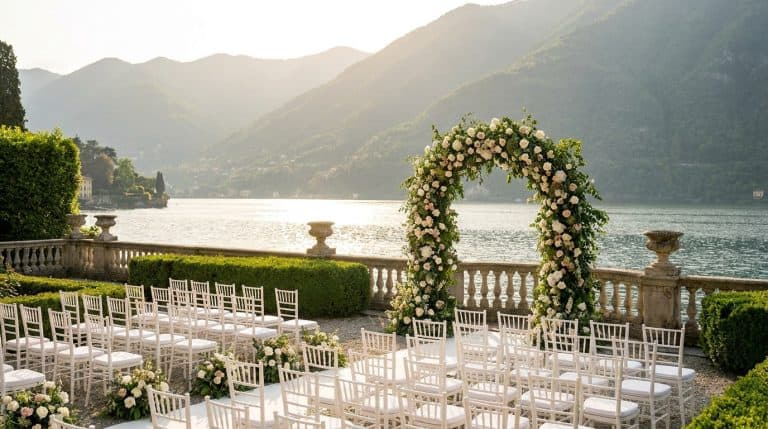 Wedding
Dream Wedding on Lake Como - The Most Exclusive Locations
A wedding on Lake Como is an idea that combines iconic scenery, top-level hospitality, and a naturally cinematic atmosphere. […]
Read more Tips
Tips
Wedding Ideas: Trends and Tips for a Perfect Wedding
Organizing a wedding today means choosing among endless possibilities without losing sight of what really matters: telling your […]
Read more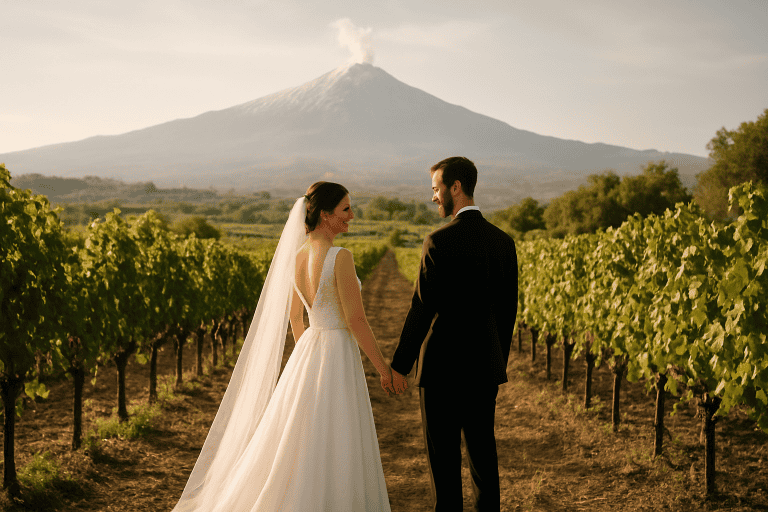 Sicily
Etna Wedding among vineyards: how to manage climate, dresses and plan B
Why a wedding on Etna among the vineyards really works (if you plan it well) A wedding on Etna among the vineyards does not […]
Read more