




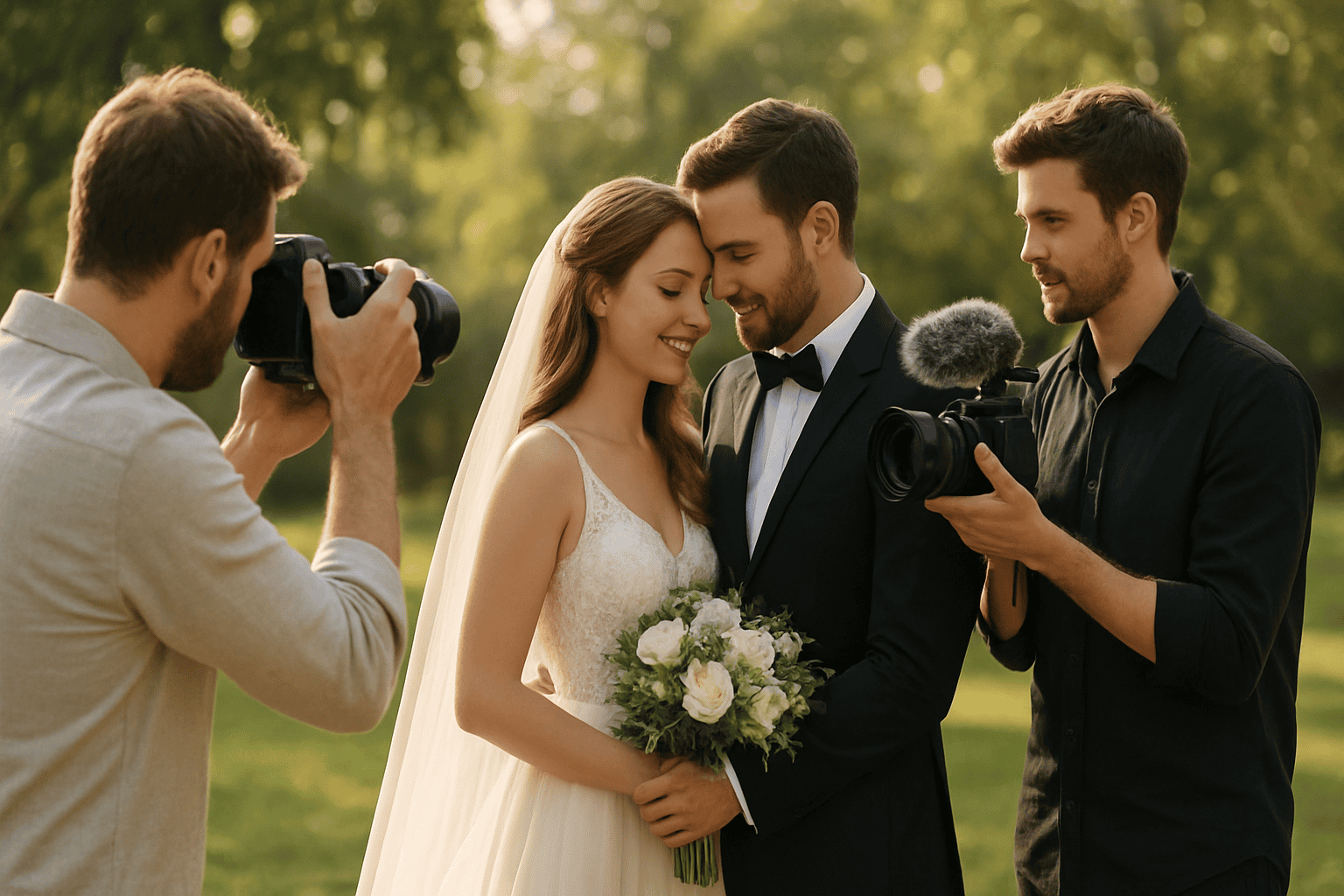
Wedding photo video storytelling: editorial or reportage?
When you choose wedding photographer and video team, the question is not just “who takes better shots?”, but what kind of story do you want to see again in ten years. The wedding photo video storytelling is the thread that connects images, rhythm, details, and moments: it can be built like a story editorial (curated, guided, with a cinematic look) or like a reportage (spontaneous, observational, faithful to the real flow of the day).
There is no absolutely “right” choice: there is the choice most consistent with your personality, the location, and the experience you want to give your guests. Also the wedding video changes a lot depending on the approach: it can become a film with planned scenes and controlled lighting, or an intimate story that captures glances and voices without interfering.
Goal and style: how to align photographer and videomaker with your vision
Before talking about poses, drones, or film duration, clarify the goal: what atmosphere do you want to remember? The storytelling style influences everything: from the schedule of the day to time management, up to the choice of the most photogenic spaces.
Editorial storytelling: aesthetics, control, and “magazine” images
The editorial approach aims for a refined and intentionalresult. The team guides some phases (especially preparation, portraits, and details) to get clean images, precise compositions, and favorable lighting. In wedding video, the editorial tends to favor fluid camera movements, constructed scenes, and a more “cinematic” narration.
- Ideal if: you love a polished look, want iconic portraits, wish to highlight styling and design.
- Attention to: requires dedicated time and discreet but present direction.
Storytelling reportage: spontaneity, emotions, and truth of the moment
The reportage is an observationalstory: the photographer and videomaker follow what happens, intervening only when absolutely necessary. It works great for those who want to relive the day as it was: laughter, unexpected events, hugs, tears, and micro-moments that often go unnoticed.
- Ideal if: you feel comfortable without posing, want an authentic and dynamic memory.
- Attention to: the outcome depends greatly on the actual light and the logistics of the spaces.
Luxury, intimate or destination: the setting changes the narrative
An editorial storytelling can maximize the value of a luxury-style wedding, with important setups and scenic locations. Reportage, on the other hand, often highlights intimate weddings, where relationships and gestures are the protagonists. If you are organizing an event out of town or abroad, the “travel” component also becomes part of the story: arrivals, landscapes, local rituals. For those who love this type of experience, a Insight: Destination wedding (Wikipedia).
Timing and logistics: what to expect from editorial vs reportage
The difference between editorial and reportage is not only aesthetic: it affects timeline, movements, and even how you will experience some moments. Clarifying these aspects with your wedding photographer and with the person creating the wedding video avoids friction and races against time.
How much “direction time” is really needed
In editorial storytelling, some blocks of the day are planned with more precision: details (dress, invitations, rings), couple portraits, photos with family, shots against the light or in a specific room. In reportage, instead, the work is to anticipate capture the moments: the team observes, moves discreetly, and captures what happens without stopping the action.
A good practical rule: if you want editorial images but don’t want to feel “posed” for hours, you can ask for a hybrid approach: reportage for most of the day, with short and well-positioned windows for guided portraits.
Light, spaces, and movements: the three factors that change the outcome
- Light: editorial tends to seek the best light; reportage welcomes and interprets it.
- Spaces: tidy and spacious rooms help both, but in editorial they almost become a set.
- Movements: more transfers mean less useful time for shots and filming; careful direction is needed.
If the location has distant areas (suite, garden, hall, church), consider a timeline that reduces travel. Even a few minutes saved can turn into a “good” sunset for portraits and filming.
Step-by-step planning for photos and videos: from vision to timeline
Planning should not take away spontaneity: it should protect it. When photos and wedding video are planned together, the result is more coherent and you are more present, because you don’t have to decide everything on the spot.
Realistic timeline (from 12 to 2 months): what to define and when
- 12–9 months: choose the style (editorial/reportage/hybrid) and gather visual references. Share with the team what you like and what you don’t.
- 8–6 months: define the structure of the day (ceremony, reception, any extra moments). If there are movements, estimate them realistically.
- 5–3 months: create a “must have” list (people, moments, details). Agree on how to manage portraits and group photos without interrupting the party too much.
- 2 months: finalize the timeline with safety margins. If you want specific shots (for example letters, first look, audio of vows), align with the videomaker.
Checklist of essential suppliers for smooth storytelling
Storytelling works when suppliers work in synergy. It’s not necessary to “control” every move: it’s necessary that everyone knows the priority of the story.
- Wedding planner/coordination: manages timing, entrances, unforeseen events, and communications.
- Make-up & hair: realistic timings and scheduled touch-ups (essential for close-up portraits and videos).
- Florist and setups: define the scenic points (ceremony, table, welcome).
- Music and entertainment: influence the rhythm and “climactic” moments of the story.
- Location manager: access points, available areas, alternatives in case of weather.
Guest management and transfers: how not to “break” the rhythm of the story
A well-edited story comes from a smoothly flowing day. Too many dead times or long waits break the energy and make it harder to maintain an engaging narrative in wedding video.
If you expect transfers, consider:
- a clear meeting point for guests;
- simple communications (times, maps, parking);
- an “entertainment plan” for those waiting (welcome drink, soft music, guestbook corner).
Creative priorities: where to invest time (not budget) to maximize the effect
This is not about figures, but about priorities. Many couples invest energy in details that appear marginal in photos and videos, and neglect elements that actually change the quality of storytelling.
Items that really affect the visual result
- Time for portraits: even 15–25 well-placed minutes can make a difference.
- A tidy room for preparation: reduces distractions and improves editorial and reportage quality.
- Light points and atmosphere: candles, warm lights, table arrangement deeply influence the wedding video.
- Audio of key moments: vows, speeches, toasts. Good audio makes the film more emotional and “real”.
Where to invest for a scenic effect consistent with the storytelling
If you aim for an editorial cut, create at least two “natural sets”: one for the ceremony and one for portraits/party. If you prefer reportage, focus on the real experience: authentic moments, interactions, surprises designed for the guests. In both cases, consistency is everything: few strong elements beat many disconnected elements.
Mistakes that complicate photos and videos (and increase stress)
- Too tight timeline: if each block is timed to the minute, even a minimal delay can cause you to miss the best light.
- Portraits at the wrong time: taking them when guests are experiencing an important moment creates absences and tension.
- “Forbidden” spaces at the last minute: some locations limit areas or times; clarify access and alternatives beforehand.
- Endless photo list: better an essential list (indispensable people) and creative freedom for the rest.
Plan B and risk management: protect storytelling without stiffening it
The biggest risk is not rain: it’s not having a beautiful alternative. A well-thought Plan B allows your wedding photographer and the team wedding video to maintain narrative quality even if the scenario changes.
Weather and alternative solutions that remain photogenic
If the ceremony is outdoors, ask in advance:
- where the ceremony moves to in case of rain; how it is set up
- come viene allestito the interior space (arch, seats, carpet, lights);
- what light there is (windows, chandeliers, possibility to create atmosphere).
An effective Plan B is not a “fallback”: it is a second set design consistent with the chosen style.
Location constraints: hours, areas, and operational rules
Some locations have limits on music, access, use of certain areas, or setup times. There is no need to go into technicalities: just know what is possible and what is not, so you don’t find out at the last minute that the best spot is unusable. If you are evaluating additional services or options of the location, check the product sheet or in the documentation provided by the facility.
Contracts and deposits: clarity on deliveries and style
To avoid misunderstandings, make sure the contract clearly states:
- agreed style (editorial, reportage, or hybrid);
- what is delivered (for example: gallery, film, any extras) and in what format;
- delivery times and selection/editing process;
- management of requests (essential moments, key people).
This is not a “cold” topic: it is what protects your creative vision.
Guest experience and storytelling: when hospitality also improves photos and videos
A well-lived wedding is a well-told wedding. If guests feel comfortable, they interact more, smile more, and more spontaneous moments are created: the reportage benefits from this, but the editorial also finds real energy to transform into powerful images.
Welcome moment, activities, and small rituals
To enrich photo and video storytelling, think of a welcome that “opens” the story:
- welcome drink with soft music;
- message corner (audio or written) for the bride and groom;
- light activities if guests come from afar (short tour, tasting, relaxation moment).
These elements create natural scenes, also useful for editing the wedding video and to give context to the day.
Transport, shuttles, and parking: less friction, more smiles
Logistics is not just organization: it’s atmosphere. If guests don’t know where to go or arrive stressed, the energy drops. Clear management of shuttles and parking reduces delays and makes it easier to stick to the timeline, especially when photos and videos need to follow precise moments (entrance, ceremony, golden hour, cake cutting).
Clear directions and wedding website: the invisible direction
A wedding website or a single document with essential information helps everyone: schedules, dress code, maps, contacts, notes on transfers. It’s an “invisible direction” that frees up time and attention for what matters: living the day. If you are in the general planning phase, you can start from this guide on How to organise a wedding and then tailor the choices on the style of photos and videos.
Choosing wedding photographer and wedding video: practical questions to ask before signing
To understand if a professional is really suitable for your storytelling, don’t stop at the portfolio: ask questions that reveal method, sensitivity, and adaptability.
- How would you describe your style between editorial and reportage? Can you show me a complete wedding similar to ours?
- How do you manage portraits: guided, quick, at specific moments?
- How do you work with light indoors and in the evening? What spaces do you prefer for preparation?
- How do photo and video collaborate at the same event to avoid getting in each other’s way?
- What are the moments you recommend protecting in the timeline to get the best result?
The answers will tell you if the team knows how to build a coherent story, respecting your naturalness and the rhythm of the day.
A hybrid approach: the smart compromise for many couples
Many couples find they don’t want to choose “either/or”. A hybrid approach can be the most balanced solution:
- Reportage for preparation, ceremony, cocktail, party: real emotions and unrepeatable moments.
- Editorial for couple portraits and details: iconic images, carefully composed.
The secret is to agree when e where to insert the guided parts, so as not to interrupt the party and not make you feel “in production”.
CTA: build a storytelling consistent with the experience you want to create
If you want photos and wedding video to truly tell your day (without stress and without improvisation), the difference is made by solid organizational direction: timeline, logistics, Plan B and supplier coordination. Explore resources and ideas in the section dedicated to How to organise a wedding on Chiara B Events and start planning an event that is beautiful to live and wonderful to relive.
FAQ
What is the difference between editorial storytelling and reportage in weddings?
The editorial is more guided and curated: it includes planned scenes and portraits for a “magazine” look. The reportage is more spontaneous: the photographer and videomaker document what happens with minimal interventions, focusing on emotions and real moments.
Is it possible to have both editorial photos and a reportage-style wedding video?
Yes, many couples choose a hybrid approach: portraits and details in an editorial style (in short time windows) and the rest of the day in reportage, thus maintaining naturalness and rhythm.
How much does the timeline affect the quality of wedding photos and videos?
It has a huge impact: a timeline with margins prevents rushing and allows you to take advantage of the best light, manage portraits without taking time away from guests, and maintain narrative continuity in the video.
What should I ask the wedding photographer to understand if they suit my style?
Ask how they describe their style (editorial/reportage/hybrid), to show you a complete wedding similar to yours, how they handle portraits and how they work indoors and in the evening. It is also useful to understand how they collaborate with the video team to avoid getting in each other's way.
How to manage the weather Plan B without ruining the storytelling?
The Plan B must be thought of as a second set design: defined interior space, consistent setup, and pleasant lighting. Agreeing in advance where the ceremony will be moved and how the area will be prepared allows photos and videos to maintain quality and consistency.
Do guests really influence wedding photo video storytelling?
Yes: well-organized hospitality (welcome, clear directions, smooth transportation) reduces stress and waiting times, increases spontaneous interactions, and enriches the story, especially for reports and videos.
