




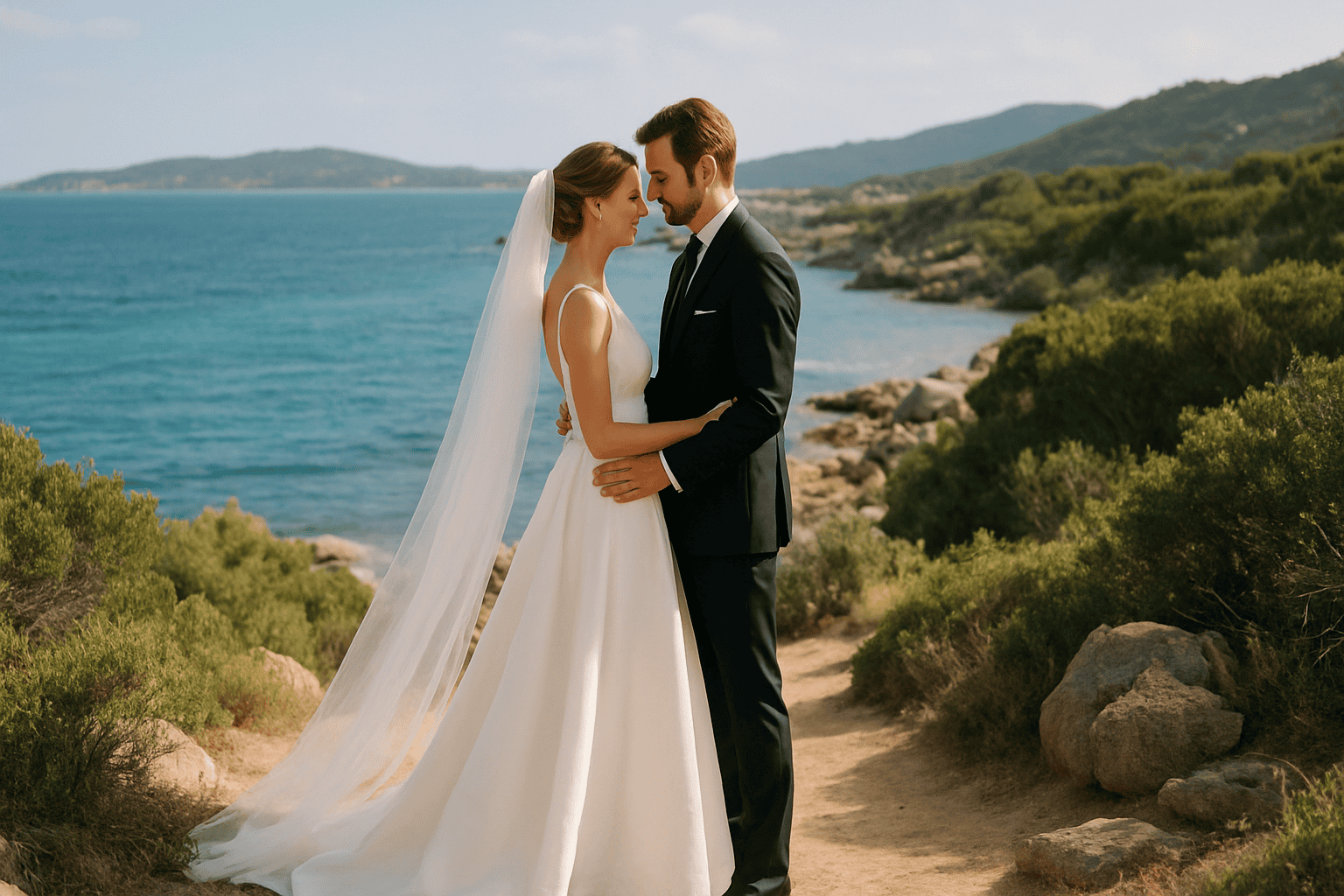
Costa Smeralda wedding privacy: why choose a reserved and curated format
A Costa Smeralda wedding is not just a style choice: it is a project of hospitality, image, and coordination. Those who dream of Sardinia for their “destination wedding” often look for three very specific things: privacyan impeccable aesthetic and the feeling that every detail is “simple” for the guests, even when there is a complex direction behind it.
When the focus is on costa smeralda wedding privacy it becomes an operational priority: it means controlling access and flows, limiting external interference, protecting the couple's and guests' times and spaces. In an iconic and highly sought-after context, privacy is not improvised: it is planned with locations, staff, and suppliers.
If you want a broader context on the territory, you can start from In-depth: Costa Smeralda (Wikipedia) and then translate the inspiration into practical choices: suitable locations, sustainable logistics, and a team that knows how to manage times, access, and communications.
Goal and style: luxury, intimate, destination (without rigidity)
The most requested format in Costa Smeralda tends towards a balance: atmosphere luxury but not ostentatious, moments intimate even with many guests, and a “destination” imprint that enhances Sardinia without turning the wedding into a tiring tour.
To get there, it is advisable to define immediately:
- Number and profile of guests (families, friends, international mix).
- Event style (minimal chic, Mediterranean, classic, contemporary).
- Desired level of privacy (exclusive spaces, reserved timing, photo/video management).
- Weekend rhythm (one day or multiple coordinated appointments).
Timing and logistics: what to really expect
In Sardinia, and particularly in Costa Smeralda, logistics matters as much as aesthetics. Transfers, access, distances between accommodations and locations, availability of services at certain times: all this influences success. Planning well means avoiding bottlenecks (simultaneous arrivals, waiting times, disorganized transfers) and protect the guests' peace of mind.
An effective approach is to think in “flows”: who arrives when, where they park or are dropped off, which route they follow, who welcomes them, and how each step is communicated.
Step-by-step planning for a wedding in Costa Smeralda
Planning works when it is concrete: a few key decisions made early and a sequence of guided micro-choices. The point is not to fill an endless checklist, but to build a system in which every supplier knows what they have to do, when and with what constraints.
Realistic timeline: from vision to operational coordination
Every event has its story, but a “realistic” timeline in Costa Smeralda tends to follow this rhythm:
- 12–9 months before: concept definition, location selection, blocking strategic dates, first draft of budget and priorities.
- 9–6 months before: choice of main suppliers (catering/banqueting, photo/video, music), setting up guest logistics and accommodations.
- 6–4 months before: design project (flowers, lighting, table setting), inspections, definition of flows and timing.
- 4–2 months before: operational confirmations, transport plan, communications to guests, ceremony details and special moments.
- Last weeks: final call sheet, supplier coordination, technical rehearsals, weather plan B, staff briefing.
The advantage of this breakdown is that it allows you to protect the truly “costly” decisions (in terms of time and stress) and leave the rest to a phase when everything is clearer.
Essential supplier checklist: who is really needed (and when)
To manage the Sardinia wedding suppliers well, it is advisable to distinguish between “core team” and “support”. The core team impacts experience, aesthetics, and timing; the support completes and refines.
Typical core team:
- Location and operational contact
- Catering/banqueting and service
- Wedding planner/coordination
- Photos and videos
- Music/entertainment
Support (depending on the project):
- Floral design and styling
- Lighting design
- Transport and hospitality
- Special setups and scenographies
- Beauty team and dressing assistance
The criterion is not “adding”, but simplify: fewer steps, more clarity. A lean and well-coordinated team often makes the event smoother and more elegant.
Guest management and transfers: the invisible direction that changes everything
In a destination wedding, the perceived quality depends greatly on what guests do not have to do: look for directions, understand where to go, wait without knowing what is happening. Guest management is a job done in advance: gathering needs, clear communications, and a transfer system consistent with the schedule.
Some choices that help:
- Staggered arrivals or recommended check-in windows.
- Clear meeting points simple and recognizable.
- Hostess or dedicated staff at critical moments (welcome, ceremony, end of evening).
- Brief communications (essential messages, maps, schedules).
Costa Smeralda Budget: how to define priorities without losing control
The theme Costa Smeralda budget must be approached methodically, not anxiously. In this destination, the most important variable is not “how much to spend”, but where to invest to achieve the desired effect and keep the event manageable.
A budget works when it is a map: it tells you what is essential, what is negotiable, and what is superfluous in relation to your goal (privacy, atmosphere, guest comfort, aesthetics).
Main items: what really weighs in planning
Without going into figures, the main categories that most influence a wedding in Costa Smeralda are:
- Location and spaces (including constraints, schedules, usable areas).
- Food & beverage and related service.
- Setups: flowers, furnishings, table settings, scenography.
- Audio, lighting and production (fundamental for atmosphere and timing).
- Logistics: transfers, hospitality, flow management.
- Creative team: photo/video and entertainment.
The key point is that these items are not independent: a choice about the location can simplify (or complicate) logistics, setups, and production.
Where to invest to maximize the scenic effect (without excess)
In Costa Smeralda, the scenic effect often comes from a mix of natural context e direction. Investing well means enhancing what already exists and building a coherent framework, avoiding “fighting” with the location.
Generally, they work very well:
- Lighting designed to transform spaces from sunset to evening.
- Targeted setups on focal points (ceremony, head table or tables, party area).
- Guest experience: welcome, comfort, smooth movement.
- Music with a schedule built around the rhythm of the day.
When the investment is driven by a clear priority, the event feels more “elevated” even without overloading every corner.
Mistakes that increase costs (and how to avoid them)
Some typical mistakes inflate the budget without improving the experience. Here are some, with smarter alternatives:
- Late decisions: lead to forced choices and less efficient solutions. Better to lock in the pillars early.
- Too many disconnected suppliers: more steps, more risks. Better a single coordination and shared briefs.
- Too dense program: more transfers and more downtime. Better a few well-designed moments.
- Setups not consistent with the spaces: require corrections and adjustments. Better to design “site-specific”.
A good method is to ask, for each item: “Does it really increase the quality perceived by the guests?” If the answer is uncertain, it’s better to reconsider the priority.
Plan B and risk management in Sardinia: weather, constraints, and agreements
An event in an iconic destination requires risk management up to the task. It’s not pessimism: it’s care. The plan B must not be an “ugly” version of plan A, but an alternative In luxury, the scenic effect is not just “big”: it is with style, already considered in design and timing.
Weather and alternative solutions: elegance even when the wind changes
In Sardinia, the weather can change quickly, and some elements (wind, humidity, evening temperature drops) affect comfort and setups. The best work is the one that goes unnoticed: a ready solution, communicated to the team, with clear responsibilities.
An effective plan B includes:
- Alternative spaces already reserved or prepared.
- Flexible timing (micro-shifts manageable without stress).
- Technical choices compatible with multiple scenarios (lighting, audio, layout).
- Quick communication to guests and suppliers, with a single control point.
Permissions and constraints of the location: what to clarify beforehand
Every location has rules and limits: hours, accessible areas, music management, technical loads, access for vehicles and staff. There is no need to go into regulatory aspects here: what matters is to clarify in writing what is possible and what is not, and to build the project around those constraints.
Before confirming, check with the location:
- Spaces usable at every stage (ceremony, aperitif, dinner, party)
- Conditions for setups and takedowns
- Access for suppliers and loading/unloading times
- Restrictions on music and entertainment
If a detail is not certain, check the product sheet or in the location/supplier documentation before setting up the project.
Contracts and deposits: how to protect the project (without complicating it)
Contract management is part of the coordination: it helps avoid misunderstandings and makes suppliers’ work smoother. The goal is to have clear agreements on deliverables, timing, responsibilities, and conditions in case of changes.
In practice, it is useful that each supplier has:
- Written brief with style, palette, objectives, and constraints
- Shared timing (call sheet or operational timeline)
- Single point of contact for approvals and decisions
Guest experience in Costa Smeralda: hospitality, transportation, and communication
A wedding in Costa Smeralda truly succeeds when guests feel welcomed and guided, without losing the sense of freedom. Hospitality is the difference between a “nice” event and an event that remains memorable for its care.
Welcome moment, activities, and hospitality: creating a coherent weekend
If the event lasts several days, it’s worth thinking of a common thread: an informal welcome, a moment to discover the area, and the wedding day as the climax. Even with just one day, a well-designed welcome helps break the ice and set the tone.
Some setup ideas (without turning them into obligations):
- Welcome moment with essential directions and a gesture of hospitality.
- Optional activities for those arriving early (light pace, guided bookings).
- Discreet assistance for special needs (families, international guests).
The rule is simple: better a few clear proposals than a full but confusing program.
Transportation, shuttles, and parking: the part no one should notice
Transportation logistics is one of the areas where quality perception is decided. If guests arrive relaxed and on time, everything seems more elegant. If they arrive late or stressed, even the most beautiful setup loses impact.
For smooth management:
- Define a single plan (shuttles, cars, meeting points) and communicate it simply.
- Reduce variables: fewer options, more control.
- Provide supervision during peak moments (ceremony arrival, end of party).
When the project aims at privacy, transfers also become a tool for discretion: managing access and timing helps avoid overlaps and unwanted presences.
Clear directions and wedding website: elegant communication, zero chaos
Communication to guests must be consistent with the style: essential, pleasant to read, immediate. A wedding website (or an information hub) can gather everything needed: schedules, dress code, maps, useful contacts, and practical suggestions.
To avoid confusion, include:
- Schedules and locations in a simple format
- Maps and arrival points (with directions on parking or drop-off)
- Reference contact for logistical questions
- Style notes (without endless lists)
If you are starting to structure the project, a comprehensive guide can help you organize from the start: How to organise a wedding.
Organizing wedding suppliers in Sardinia: coordination, brief, and privacy
Managing the Sardinia wedding suppliers is the point where a wedding becomes a “production” in the best sense: a discreet direction that allows the couple to enjoy the day without having to solve problems. In Costa Smeralda, this is doubly true because locations and logistics often require a higher level of coordination.
Single brief and consistent style: fewer revisions, more quality
To avoid different interpretations of the same concept, a single brief shared with the main suppliers is essential: palette, materials, mood, priorities (privacy, comfort, timing), and what to avoid. A well-made brief reduces revisions and makes it easier to maintain consistency among flowers, lighting, graphics, and table settings.
Call sheet and timing: who needs to be where, and when
The call sheet is the “map” of the day: arrivals, setups, rehearsals, key moments, contacts, and responsibilities. It doesn’t need to be complicated, but it must be clear. When everyone works on the same timeline, delays and overlaps decrease.
Operational privacy: access, photo/video, and management of sensitive moments
If the priority is costa smeralda wedding privacyprivacy
- privacy must be translated into practical actions. Some examples: Controlled access
- Reserved areas for the couple's preparation and breaks.
- Photo/video management with clear indications on what can be filmed and when.
- Internal communication between suppliers to avoid unnecessary “announcements” in front of guests.
Privacy should not take away spontaneity: it should only protect important moments and make the experience more comfortable.
Commercial request: how to choose the right team for a Costa Smeralda wedding
When evaluating professional support, don’t stop at the images: ask how logistics are managed, how suppliers are coordinated, and how privacy is protected. A team suitable for Costa Smeralda knows how to work discreetly, anticipate critical issues, and maintain aesthetic consistency even in the presence of constraints.
CTA: if you want to turn the idea into a concrete and stress-free project, explore the path dedicated to How to organise a wedding with Chiara B Events: from concept to event direction, with attention to privacy, budget, and supplier coordination in Sardinia.
FAQ
How is privacy ensured at a Costa Smeralda wedding?
Privacy is achieved with operational management: defined access and schedules, reserved areas for preparation and breaks, guest flow management, and clear instructions for photos/videos and staff. It is useful to have a single point of contact coordinating the location and suppliers.
What are the priorities for managing the Costa Smeralda budget without waste?
First define priorities (guest comfort, evening atmosphere, design), then invest in elements that truly change perception: lighting, production, flows, and focal points of the setup. Avoid late decisions and uncoordinated suppliers, which cause revisions and complications.
How are wedding suppliers in Sardinia selected and coordinated for an event in Costa Smeralda?
Choose a solid core team (location, catering, photo/video, music, coordination) and create a unique brief with shared timing (call sheet). Consistency among suppliers is achieved with a central contact person, targeted inspections, and clear responsibilities for setups, rehearsals, and guest management.
Is a plan B needed for a wedding in Sardinia even in high season?
Yes, because wind and weather changes can affect the ceremony and setups. An effective plan B includes already prepared alternative spaces, compatible technical choices (audio/lights/layout), and quick communication to guests without causing confusion.
What is the easiest way to communicate logistics and schedules to guests?
Centralize information in one place (wedding website or information hub) with schedules, maps, arrival points, contact reference, and essential notes. Keep messages brief and consistent with the event style.
