




How the period affects costs and availability in Capri: high season vs shoulder season
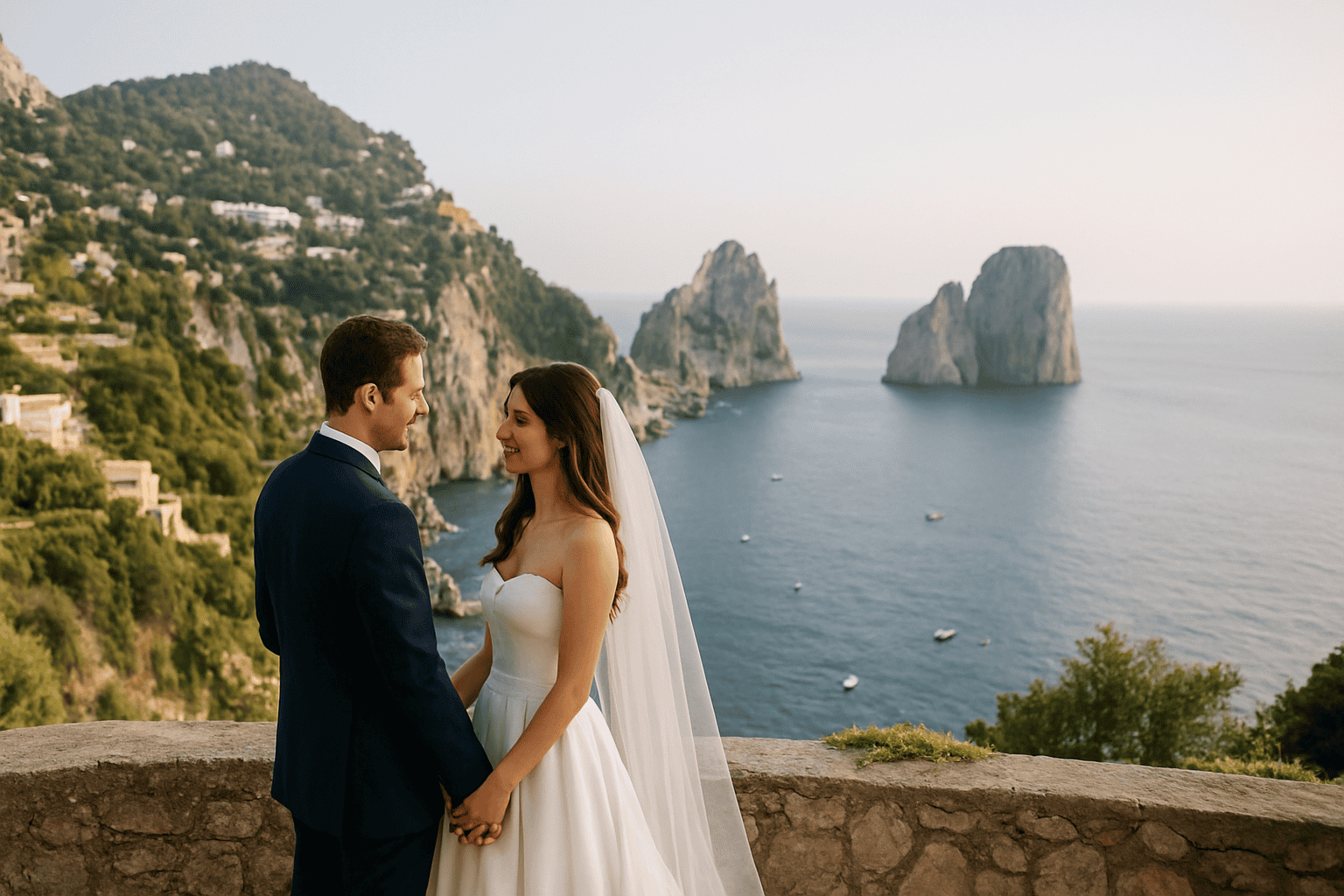
Capri high season vs shoulder season: why the period really changes costs and availability
When it comes to destination weddings, Capri is a choice that combines iconic views, top-level hospitality and an unforgettable atmosphere. But there is one variable that, more than others, influences the overall experience: the period. It’s not just a matter of weather or lighting in photos: the availability of venues, suppliers, logistics timing, and consequently, the perception (and management) of destination wedding budget. Furthermore, choosing the Amalfi Coast for a reduced budget can prove to be an excellent alternative, offering breathtaking scenery at lower costs. During less crowded periods, it is also possible to negotiate better rates with suppliers, ensuring quality service without compromising the experience. This allows for creating an unforgettable wedding even for those who wish to keep expenses under control.
In this guide we compare Capri high season e shoulder season with a practical approach: what to expect, where bottlenecks occur, how to set priorities and which choices help keep the project consistent without chasing last-minute solutions. If you want a broader overview of the island’s context and possibilities, you can start from Wedding in Capri: guide.
How much the period affects wedding costs Capri period: real dynamics between demand and logistics
The question “wedding costs Capri period” is legitimate, but the answer is not a table: it’s a set of dynamics. In Capri, the period mainly affects availability e organizational complexity. In high season demand is higher, schedules fill up quickly and logistics (transport, delivery times, operational windows) tend to be more rigid. In the shoulder season, instead, you often gain flexibility and choice options, with a positive impact on planning efficiency.
High season: when availability becomes the first “budget item”
In Capri high season the difference is made by the calendar: some dates are booked well in advance and the best options (for view, privacy, access) quickly decrease. This can create a chain effect:
- fewer equivalent alternatives if a venue or supplier is not available;
- faster decisions to avoid losing strategic slots;
- greater logistical pressure on transfers and setup times.
The point is not “spending more regardless,” but that in high season it is easier to have to choose solutions that fit into the calendar, not necessarily those you would have selected with total freedom.
Shoulder season: more margin to customize without rushing
The shoulder season can offer a concrete advantage: more room to maneuver. This often means:
- more chances to find available dates for locations and creative teams;
- greater possibility to build a tailor-made project, with more relaxed timing;
- potentially more straightforward logistics, with fewer overlapping events.
It is also the ideal context for those who want an intimate and curatedexperience, with attention to detail and a less “high tide” pace. In any case, the final result depends on the creative idea and direction: the period is a lever, not the only factor.
Step-by-step planning in Capri: timeline and choices that change between high season and shoulder season
Capri requires planning that takes into account transfers, access, and setup times. In high season, it is useful to think as if each phase had a narrower “window”; in shoulder season, you can often work with more flexibility. Below you find a reasoned timeline that helps not to leave the most delicate areas uncovered.
Realistic timeline: from 12 to 2 months (with differences in pace)
12–10 months before: definition of the concept and locking the pillars (date, location, guest structure). In high season, this phase is often decisive to avoid later compromises. In shoulder season, you can still evaluate more options without losing quality.
9–7 months before: selection of key suppliers (catering, photo/video, flowers, music, beauty). In Capri, the availability of the team makes the difference: if you have a specific professional in mind, move early especially in the most requested periods.
6–4 months before: definition of logistics (transfers, daily timing, any side events). Much of the guests’ comfort is decided here: in high season it is essential to foresee alternatives and time buffers.
3–2 months before: finalization of details (setups, schedules, communications to guests, wedding website). In this phase, clarity beats complexity: few well-written pieces of information reduce errors and stress.
Essential supplier checklist: what to lock in first
To reduce the risk of “impossible fits,” it is advisable to prioritize what has lower substitutability and greater impact on the project:
- Location and alternative plan (if provided);
- Coordination and event management (wedding planner or production team);
- Catering and service management;
- Photo/video (the style is hardly replicable);
- Floral design and setups;
- Music (live or DJ) and audio management.
If you are building your operational path, a useful track to adapt to your case is Organizing a wedding: checklist. In Capri, the checklist is not just a list: it is a way to protect the project from logistical variables.
Guest management and transfers: the difference between “beautiful” and “smooth”
In a destination wedding, the guest experiences it from the first message to the return. In Capri, this is even more true because movements affect the rhythm of the day. In high season it can be useful to:
- anticipate staggered arrival times to avoid peaks;
- reduce the number of location changes in the same day;
- insert buffer between ceremony, aperitif and dinner.
In shoulder season, it is often easier to maintain an elegant and relaxed timing, but it remains essential to clearly communicate meeting points and times.
Destination wedding budget in Capri: smart priorities between high season and shoulder season
The destination wedding budget it is not just “how much to spend,” but how to distribute resources to achieve a result consistent with the concept. In Capri, the period matters because it changes the availability of equivalent choices and the ease with which setups and timings are managed. The best strategy is to define a priority order before falling in love with details that then become difficult to sustain or realize.
Main expense items: where the period weighs the most
Without going into figures, there are areas where the high season tends to create more pressure (due to demand or complexity):
- Location and hospitality: availability and comparable options;
- Logistics: transfers, timing, operational windows for setups and deliveries;
- Creative team: full schedules and less flexibility for inspections or changes;
- Side events: welcome, brunch, boat moment (if planned) to fit into the calendar.
In shoulder season, you often gain in organizational margin, which can result in a cleaner project less subject to indirect costs (emergencies, last-minute changes, temporary solutions).
Where to invest to maximize the scenic effect (without chasing excess)
Capri is scenic by nature: the secret is to enhance what already exists. In many projects, investing in:
- choice of light (time and orientation) for ceremony and dinner;
- targeted floral design: few focal points, well positioned;
- coherent and refined mise en place, without overloading; as emotional direction (well-constructed key moments).
- music In high season, focusing on high-impact but low-management complexity elements helps maintain control. In shoulder season, you can allow more experimentation, but always with one rule: every choice must have a scenic or narrative reason.
Common mistakes that increase costs (and how to avoid them)
in a single day: increase times, transfers, and risk of delays.
- Too many location changes on key elements: in high season they reduce alternatives and force compromises.
- Late decisions Non “site-specific” setups
- : beautiful ideas on paper that do not interact with spaces, access, and real timing.: idee bellissime su carta che non dialogano con spazi, accessi e tempi reali.
- Insufficient guest communication: last minute questions and misalignments generate operational stress.
A good method is to work in blocks: first structure (timing, spaces, flows), then aesthetics (palette, materials), finally details (signage, stationery, small extras).
Plan B and risk management in Capri: weather, constraints, and contracts based on the period
Capri is wonderful, but like any destination it requires a professional approach to risk management. The period influences the likelihood of having to activate alternatives and, above all, the availability of valid options if a change of course is needed. The goal is not to “fear the weather,” but to design an event that remains elegant even if something changes.
Weather and alternative solutions: designing without losing style
An effective Plan B is not a “reduced” copy of Plan A: it is a different but coherent version. It works when:
- it is defined early (not the week of the event);
- it has a setup direction designed for the alternative space;
- it includes a clear timing for decision and communication.
In high season, the difficulty can be finding alternative spaces with the same availability and compatible operational windows. In shoulder season, sometimes it is easier to reserve options or build an integrated indoor/outdoor plan.
Permissions and constraints of the location: what to always check
Every location has rules and constraints (access, hours, sound levels, usable areas). There is no single rule valid for the entire island: check the product sheet or in the location documentation what the operational conditions and applicable limits are. This point is crucial because it affects:
- choice of the band or audio setup;
- setup and teardown times;
- possibility to move dinner or ceremony to alternative areas.
Contracts and deposits: clarity before enthusiasm
At any time, but especially in high season, it is important that contracts are clear about:
- cancellation and rescheduling policy;
- deadlines for confirmations and changes;
- liability in case of logistical changes;
- Plan B conditions (if applicable).
Contractual transparency is not meant to rigidify the project: it serves to protect the couple's peace of mind and the quality of the experience.
Guest experience in Capri: hospitality, transportation, and communication (high season vs shoulder season)
Capri is a destination that guests remember for years. For this reason, it is useful to design the experience as a story: arrival, welcome, event, free time, farewells. The period changes the “volume” of the island: in high season it is more lively and intense; in the shoulder season it can feel more intimate and contemplative. Both atmospheres can be perfect if consistent with the wedding style.
Welcome moment, activities, and hospitality: creating a natural rhythm
A well-thought-out welcome lightens the wedding day and helps guests orient themselves. Some ideas (to adapt to your project) that work well:
- welcome message with essential directions and useful contacts;
- informal pre-wedding moment to encourage connections among guests;
- small “Capri-style” activities that don’t require running or complex scheduling.
In high season, the keyword is simplicity: fewer movements, more quality. In the shoulder season, you can include experiences more spread out over time, without compressing the schedule.
Transportation, shuttles, parking: reducing friction and waiting times
Logistics should not be visible, but it must work. To improve the guest experience:
- define meeting points unique and easy to recognize;
- send clear schedules repeatedly through multiple channels (email, wedding website, message);
- provide a contact person for guests during transfer moments.
In high season, allowing wider margins between key moments reduces the risk of chain delays. In the shoulder season, you can maintain a more linear rhythm, but without assuming everyone moves at the same speed.
Clear directions and wedding website: fewer questions, more relaxation
A wedding website (or a well-structured digital document) is a simple tool that avoids dozens of messages. It should include:
- schedule with schedules and dress code;
- how to get there and how to get around;
- contacts for emergencies and assistance;
- practical FAQs (weather, recommended shoes, travel times).
If you want to better frame the identity of the island and its context, you can find a general overview here: Further reading: Capri (Wikipedia). For the event, however, practical translation counts: few, precise, updated information.
When to choose Capri high season and when to opt for the shoulder season
There is no “right” choice for everyone: there is the choice most consistent with your style and your priorities. To guide you, think about three questions:
- What kind of atmosphere do you want? Lively, social, energetic (high season) or more intimate and relaxed (shoulder).
- How important is a specific date or a specific location to you? If they are non-negotiable, high season requires more advance planning and more decisiveness.
- How much do you want to protect the flexibility of the project? The shoulder often facilitates changes and customizations without a rush.
In summary: high season can be perfect if you love the island’s energy and are ready to plan well in advance; the shoulder is ideal if you seek creative margin, a softer pace and a smoother management of logistics and availability.
Professional support to choose the right period (and build a consistent budget)
If you are considering wedding costs Capri period and you want to understand how the calendar really impacts availability, logistics and priorities, working with an experienced direction helps you turn preferences into a concrete plan. Chiara B Events can guide you in choosing between Capri high season and shoulder, setting up a destination wedding budget consistent with your style and with the experience you want to offer your guests. Learn more in the dedicated section and start building your project with a clear and realistic vision.
FAQ
How far in advance should a wedding be booked in Capri during the high season?
In high season it is advisable to move well in advance, because popular locations and suppliers fill up quickly. The ideal timing depends on the date, number of guests, and complexity of the project: for a realistic estimate, check availability and priorities with your planner.
Is the shoulder season suitable for a luxury-style destination wedding in Capri?
Yes: the shoulder season can be perfect for a luxury and intimate wedding, because it often offers greater flexibility in schedule and logistics. The result depends mainly on concept, direction, and choice of creative partners.
Which aspects of the destination wedding budget change the most between high season and shoulder season?
Usually, changes mainly involve location and team availability, operational window rigidity, and logistical complexity. These factors can influence choices and alternative solutions more than individual items considered in isolation.
How do you manage a Plan B in Capri without losing the scenic effect?
An effective Plan B is designed in parallel with Plan A: it is not a “reduced” version, but a coherent interpretation in an alternative space. It is important to define decision timing, staging direction, and communication to guests in advance.
Is it better to concentrate everything in one day or to plan multiple moments (welcome, brunch) in Capri?
It depends on the pace you want and the logistics. In high season, it often works to simplify and reduce travel; in the shoulder season, it can be easier to spread the experience over multiple moments. The best choice is the one that keeps guests comfortable and the timing smooth.
What should a wedding website for a wedding in Capri include?
Schedule with times, dress code, directions on how to arrive and get around, meeting points, useful contacts, and answers to practical questions. Brief and updated information reduces last-minute messages and improves the guest experience.
