
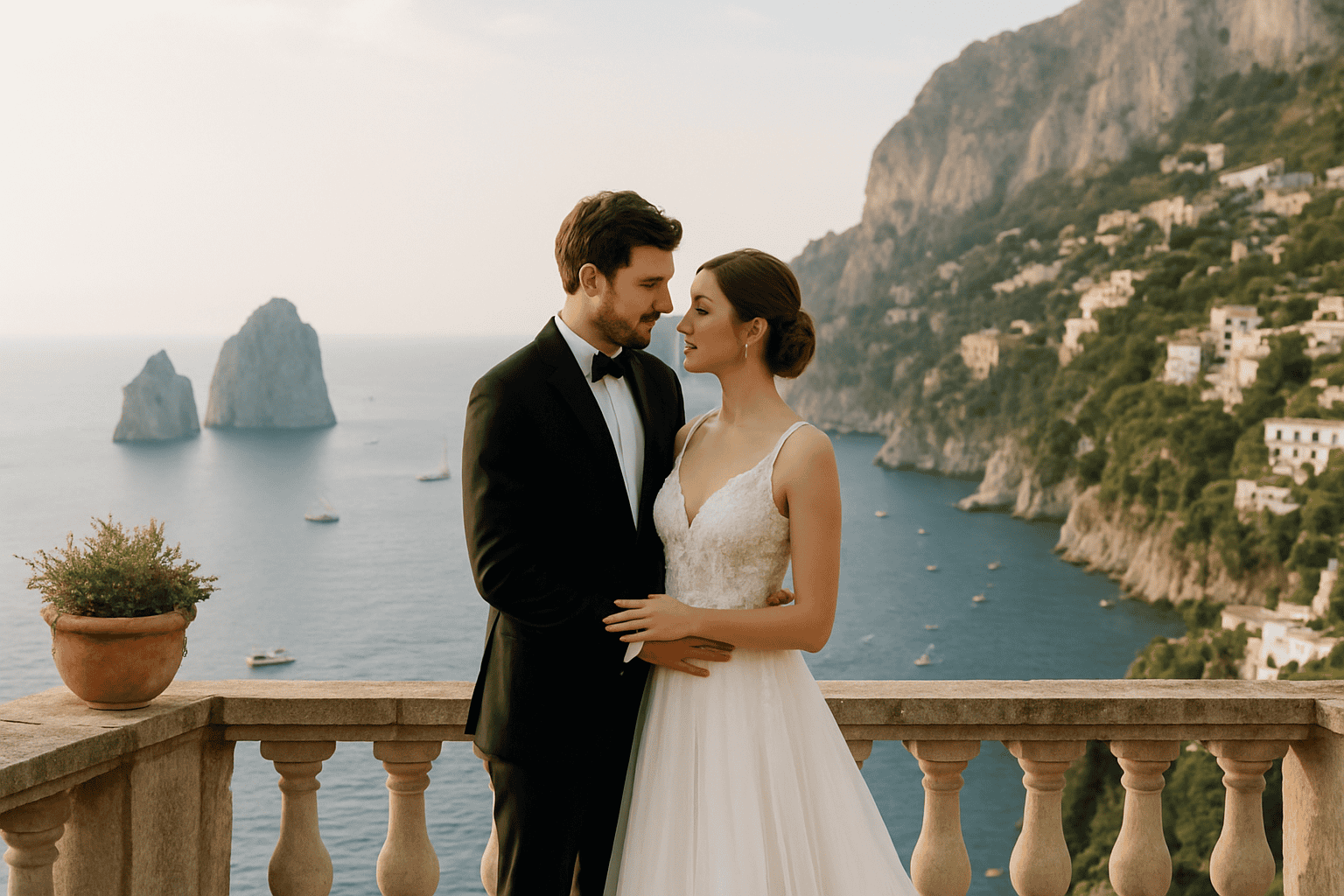
Capri vs Coast: when one or the other is convenient for budget and style
Capri vs Amalfi Coast for a wedding: what really changes between style and logistics
When it comes to destination wedding in Italy, Capri and the Amalfi Coast are two icons that seem to promise the same thing: Mediterranean light, cinematic views, high-level hospitality, and that natural elegance that makes every detail memorable. In reality, choosing between island and coast is not just a matter of “beauty” (which is very high in both cases), but of style, pace, logistics and priorities.
If you are considering a capri vs amalfi coast wedding, the most useful approach is to think like a creative director would: first define the atmosphere you want, then build a coherent project with timing, transfers and destination wedding budget. The result is not “spending more or less”, but spending better to get the effect you want, avoiding surprises.
Capri tends to enhance a wedding mood intimate, exclusive and concentrated (few moments but very curated), while the Amalfi Coast often lends itself to an itinerant and narrative experience (more stops, more views, more changes of scenery). In both cases, the Italian wedding style can be interpreted in a contemporary, classic, minimal, garden, Mediterranean or luxury key: the difference lies in how the location naturally “pushes” certain choices.
To help you get your bearings, a general context about the island can also be useful: In-depth: Capri (Wikipedia).
Capri or Coast: objective, style and realistic timing of a destination wedding
Objective and style: luxury, intimate, destination (without forcing the location)
Before comparing vendors and venues, clarify what kind of experience what you want people to experience. Capri and the Coast can host sophisticated weddings, but in different ways:
- Capri: perfect if you dream of a wedding with “boutique” energy, a few iconic elements (a view, a terrace, a scenic dinner) and a sense of natural exclusivity. It works very well for intimate celebrations or for events where the goal is to make guests feel “inside a movie”, without too many moves.
- Amalfi Coast: ideal if you want a more “on the road” story, with different stops and an aesthetic that changes between villages, viewpoints, stairways and sea views. It suits programs with more moments (welcome, ceremony, after party) spread out, while maintaining a strong Mediterranean identity.
The point isn’t which one is more beautiful, but which one best amplifies your Italian wedding style: minimal chic, romantic garden, classic elegance, modern editorial or authentic Mediterranean.
What to expect in terms of timing and logistics
A destination wedding isn’t planned only “by the calendar”: it’s planned above all based on logistics. Capri requires an island mindset: arrivals, luggage, sea transfers, and very careful time management. The Coast, instead, requires a coastal mindset: short distances on the map can become long in practice, and managing travel needs to be designed as part of the experience.
In both cases, it’s worth setting from the start:
- A clear perimeter of locations and moments (how many days, how many stops, how many “scenes”).
- A single direction (even just to coordinate arrivals and vendors’ timing).
- A guest communication plan simple and consistent: fewer “scattered” messages, more centralized and up-to-date information.
Step-by-step planning for Capri and the Amalfi Coast
Realistic timeline: from 12 to 2 months (with different priorities)
The ideal timeline depends on the period, the number of guests, and the type of event. In general, for a destination wedding it’s best to think in blocks, so you can adapt the strategy both to Capri and to the Amalfi Coast.
12–9 months before
- Definition of concept and style (palette, mood, level of formality).
- Choice of area: Capri “single base” or the Coast with multiple stops.
- Location selection and availability check (for specific details, check the product sheet or in the vendor’s proposal).
8–6 months before
- Booking key vendors: catering/banqueting, photo/video, floral design, music.
- First draft of guest journey: arrival, check-in, welcome, wedding day, farewells.
- Preliminary definition of transfers (Capri: sea and micro-movements; Coast: routes and schedules).
5–3 months before
- Detailed setup and lighting design (fundamental for the scenic “shot”).
- Menu and beverage experience consistent with the style (more “essential Mediterranean” or more “fine dining”).
- Wedding stationery and guest communications.
2 months before
- Final confirmation of the schedule and timing.
- Definition of the plan B and operational alternatives.
- Complete briefing to suppliers and a full run-through of the flow (even just on paper, but with realistic times).
Essential supplier checklist (and what changes between island and coast)
The supplier list is similar, but priorities change.
- Planner/coordination: in Capri it is often decisive for synchronizing arrivals and setups; on the Amalfi Coast it is crucial for managing stops and transfers.
- Transport: in Capri, sea routes and micro-logistics come into play; on the Amalfi Coast, schedules, pick-up points, and buffer time matter.
- Set-ups and lighting: in both destinations, light “creates” the atmosphere. The lighting design is not an extra: it is part of the style.
- Photo/video: choose a team capable of working with tight rhythms and panoramic locations, without slowing down the experience.
A practical tip: create a single document with contacts, schedules, maps and notes. It reduces last-minute questions and makes the event smoother.
Guest management and transfers: the difference you feel (and remember)
In the comparison capri vs amalfi coast wedding, guest management is often the real dividing line. Guests won’t remember only the view: they’ll remember whether everything was simple.
- Capri: aim for a “compact” experience. Few moves, clear directions, well-spaced moments. The goal is to let them experience the island without stress.
- Amalfi Coast: if you plan different stops, make them part of the story. Every move must have a purpose (not just “because that’s how it’s done”).
In both destinations, the rule is: fewer choices for guests, more comfort. If they have to decide everything on their own, friction points increase.
Destination wedding budget: smart priorities between Capri and the Amalfi Coast
Main items to consider (without getting into prices)
Talking about destination wedding budget does not mean doing the math in public, but understanding where the investment is concentrated and what can make the project “go off the rails.” The main categories that weigh the most, both in Capri and on the Amalfi Coast, are:
- Location and spaces (including any set-ups and access logistics).
- Catering/banqueting and service management.
- Floral arrangements and design (quantity and complexity matter more than the style itself).
- Transport and coordination (often underestimated, but crucial for the experience).
- Music and entertainment (from an elegant mood to a party).
- Photo/video and storytelling.
The difference between Capri and the Amalfi Coast is not “what’s needed,” but how much logistics enters into the project. Capri tends to require more “interlocking” planning; the Amalfi Coast requires more “route-based” planning.
Where to invest to maximize the scenic impact (Capri focus)
If your focus is Capri, the scenic impact often comes from a combination of three choices:
- A strong viewpoint: a terrace, an overlook, a setting that “speaks” for itself. When the frame is powerful, you can afford a more essential and contemporary design.
- Timing of the light: the transition between golden hour and evening is a narrative moment. Planning the ceremony, aperitif, and dinner well changes the perceived result.
- Lighting design: candles, light points, string lights, accents. It’s not just aesthetics: it guides the eye and makes the scene warm, intimate, and photogenic.
This approach is consistent with an Italian wedding style elegant and modern: few elements, but chosen with precision. If instead you love a more opulent aesthetic, the secret is to keep the direction clean: one strong idea (not ten ideas at once).
Mistakes that increase costs (and how to avoid them)
Without talking numbers, there are dynamics that can make the budget grow in a hard-to-control way. Here are the most common:
- Overly fragmented schedule: too many stops in too little time increase complexity and staffing needs.
- Late decisions: changing the layout or concept close to the event can generate operational extras.
- Design inconsistent with the location: setups that “fight” with the space require more structure and adjustments.
- Unplanned transfers: if guests move around in a disorderly way, you need to step in with last-minute solutions.
The solution is simple (not easy): define priorities. If you want a super scenic wedding, protect the items that create the scene. If you want a relaxed experience, protect logistics and hospitality.
Plan B and risk management in Capri and on the Amalfi Coast
Weather and alternatives: how to stay true to the style
Plan B shouldn’t be a “sad” version of Plan A. It should be a coherent variant with the same style, ready to step in without jolts.
- Define in advance which moments change (ceremony, aperitif, dinner, party) and which remain unchanged.
- Plan a solution that maintains the same atmosphere: if the concept is minimal chic, the alternative must be too.
- Share the “version B” with photos/videos and the creative team to avoid improvisation.
Capri, with its island nature, rewards Plan Bs conceived as alternative sets already ready. On the Coast, it’s often better to plan for buffer times and dynamic management of movements.
Permissions and constraints of the location: what to ask before signing
Each venue has operational rules that affect the project (setup times, access, technical limits, music management, service areas). It’s not a “bureaucratic” issue: it’s an issue of design and feasibility.
Before confirming, always ask:
- Access and routes for suppliers and guests.
- Support spaces (backstage, preparation, storage).
- Indoor options or covered areas for plan B.
- Technical limitations (power, lighting points, setup constraints): if a detail is not certain, check the product sheet or in the venue’s technical document.
Contracts and deposits: clarity before enthusiasm
A destination wedding works when everything is clear beforehand. Contracts, change conditions, cancellation policy, and unexpected-issue management must be read carefully, because they affect your room to maneuver.
In particular, make sure the following are defined:
- deadlines and confirmation methods;
- what is included each service (and what is excluded);
- setup/breakdown times and operational responsibilities;
- plan B management works (spaces, timelines, any extra costs).
This is not an invitation to distrust: it’s a way to protect the project and maintain the style you imagined.
Guest experience in Capri: impeccable welcome, transfers, and communication
Welcome moment, activities and hospitality (without overloading the schedule)
Capri is perfect for creating a guest experience that feels natural, not “programmed”. The best hospitality is the kind that leaves room for enjoyment, but with an invisible guide.
Ideas that work well, especially if you want an elegant and relaxed event:
- Welcome moment simple but well cared for (a clear meeting point, a convenient time, a welcome gesture consistent with the concept).
- Light activities before the wedding day (free time with curated suggestions, not a packed agenda).
- Clear dress code and inspirational: it helps photos and reduces questions.
On the Amalfi Coast, instead, hospitality often also comes through the storytelling of the places: small details that connect one stop to the next make guests feel like they’re on a journey.
Transportation, shuttles, parking: the direction you don’t see
If guests have to figure out on their own how to get around, the risk is that they arrive late or tired. For a destination wedding, the feeling of luxury is often absence of friction.
For Capri, the priority is:
- define meeting points intuitive;
- avoid continuous location changes on the same day;
- plan for coordination that manages timing and flows.
For the Amalfi Coast, the priority is:
- create a timeline with buffer time that is realistic;
- reduce multiple pick-ups;
- communicate clearly what is included and what is on your own.
Clear directions and wedding website: fewer messages, more order
A wedding website (or an equivalent information hub) is a style tool, not just a practical one. If done well, it supports the event’s image and reduces communication noise.
Essential content:
- Program with times and addresses.
- How to get there and how to get around (with simple instructions).
- Guest FAQ (dress code, weather, useful contacts).
- Coordination contacts for the day of the event.
If you want a complete guide and an overview of timing, choices, and coordination, you can start here: How to organise a wedding. It’s an excellent reference point for setting up a coherent project, especially when the destination requires precise direction.
Practical questions to choose between Capri and the Amalfi Coast (before you fall in love with a photo)
Before deciding, try to answer these questions honestly. They’re simple, but very revealing:
- Do I want a concentrated event (few moments, perfect) or a “multi-stop” event (more scenes, more movement)?
- Is my goal intimacy o high energy party vibes?
- How much does it matter to me that guests experience the destination independently, and how much do I want to guide them?
- Mine Italian wedding style is it more minimal-editorial or more romantic and decorative?
- Am I willing to design the logistics as part of the experience (and not as a “technical detail”)?
Capri often wins when the keyword is exclusivity and the direction is “all-in-one”. The Amalfi Coast often wins when you want a wedding that feels like a journey, con più scenari e più momenti da raccontare.
CTA, with more settings and more moments to tell. How to organise a wedding : If you’re considering Capri and want to turn inspirations and moodboards into a concrete project (with timeline, guest logistics, and a coherent aesthetic), rely on professional direction: on ChiaraB Events you’ll find resources and dedicated support to
FAQ
Capri or the Amalfi Coast: which choice is more suitable for an intimate wedding?
In general, Capri greatly enhances intimate weddings because the experience can remain focused on a few iconic moments and on “compact” logistics. The Amalfi Coast can work very well even for small events, but it tends to make a story told in stages among villages and different venues feel more natural.
In the comparison Capri vs Amalfi Coast wedding, what impacts the destination wedding budget the most?
More than the destination itself, what matters are the program choices and complexity: number of stages, transfers, setup times, and the level of design/setups. An event with many scenes and location changes requires more coordination and can increase operational complexity.
Which Italian wedding style best matches Capri?
Capri lends itself very well to an elegant and contemporary style, often minimal-editorial, where the view and the light become part of the design. A romantic and decorative style also works, but it performs best when it maintains clean direction and a dominant creative idea.
How to manage the weather plan B without ruining the atmosphere?
Plan B must be designed as a coherent variant of Plan A: same colors, same aesthetic intent, an alternative layout already thought through and shared with suppliers. If an operational detail is not certain, check the product sheet or the venue's technical proposal.
Is it better to have multiple events (welcome, wedding day, after party) or focus on just one day?
It depends on the goal: more events create an immersive experience, but increase the need for direction, coordination, and guest communication. A single well-structured day can be more essential and impactful, especially if you want to focus on an intimate and highly curated atmosphere.
From the blog
 Capri
Capri
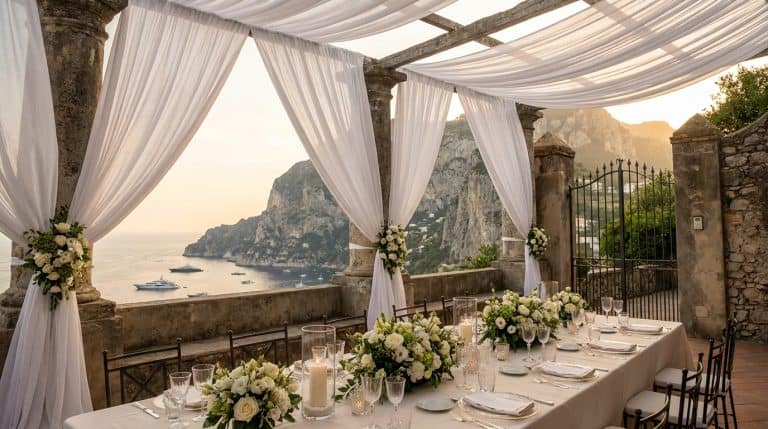
Wedding in Capri with total privacy: how to choose a villa or hotel and manage access
Wedding privacy in Capri: what it really means and why it changes everything Capri is an iconic destination: vertical landscapes, Mediterranean light, services […]
Read more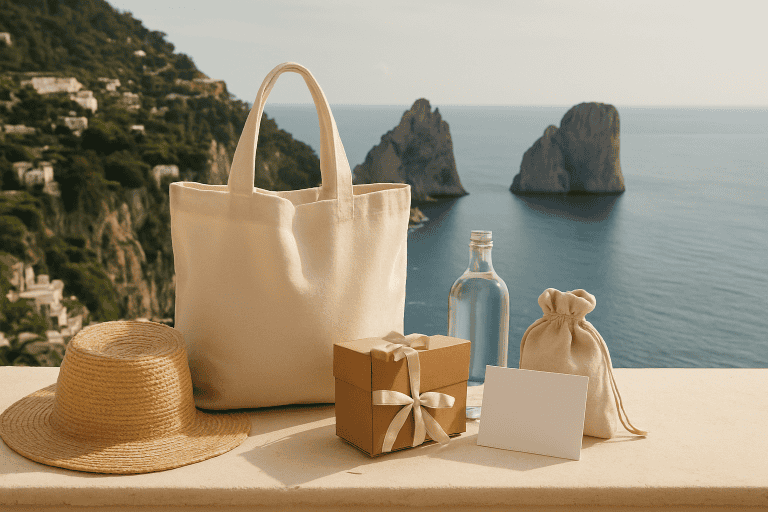 Capri
Capri
Welcome bag for guests in Capri: what to include and how to personalize it
Welcome bag Capri: why it really improves the guest experience A well-thought-out welcome bag Capri is not just a “gift”: […]
Read more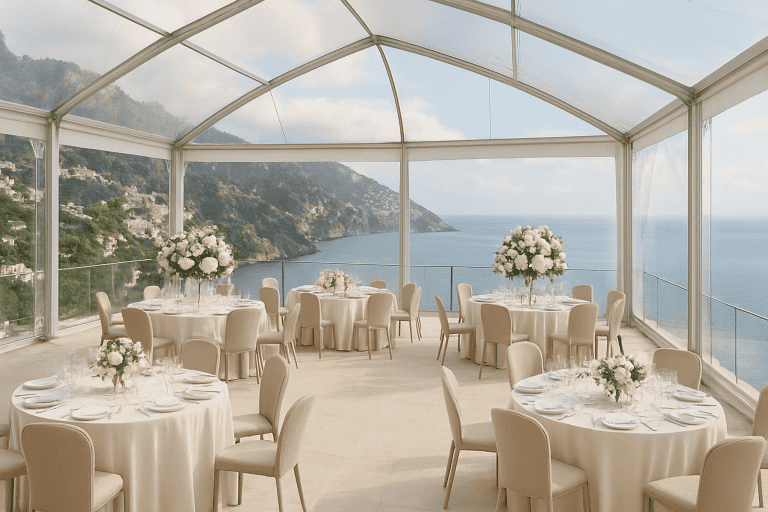 Amalfi Coast
Weather Plan B on the Coast: chic indoor and transparent tensile structures
Plan B weather Amalfi Coast: elegance without compromises On the Amalfi Coast the weather can change quickly: a breeze that […]
Read more