
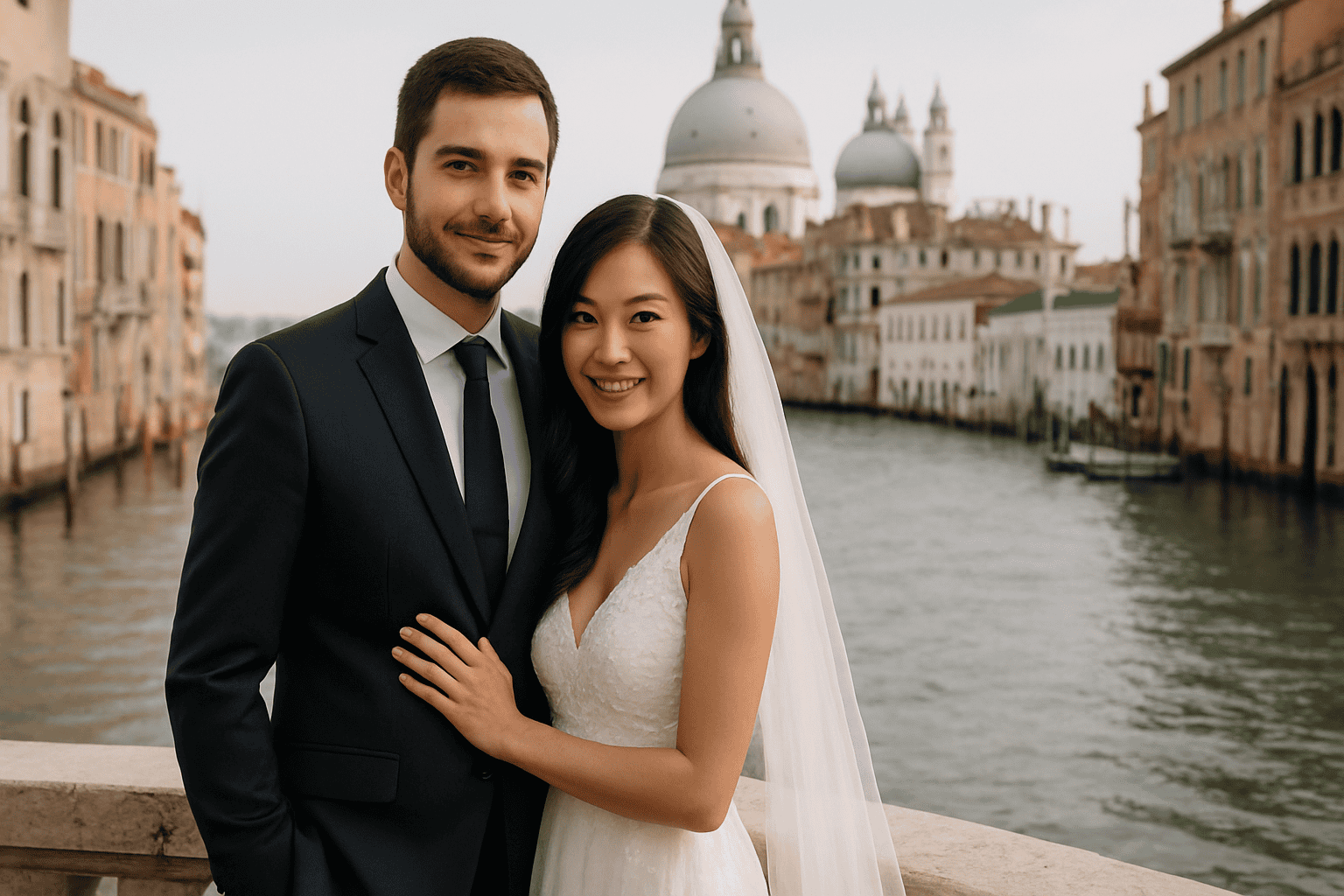
Civil ceremony in Venice: practical steps and documents for foreign couples
Civil ceremony in Venice: what really makes a “simple” wedding for foreign couples
Organising a civil ceremony at Venice when you don't live in Italy it can seem like an obstacle course: language, timing, documents, appointments, and logistics in a city unique in the world. The good news is that, with an orderly approach and clear direction, the process becomes linear and even enjoyable.
This article was created to help foreign couples in Venice to find their way through practical steps, organizational choices and materials to prepare, with a specific focus on civil ceremony Venice documents and on what is worth planning in advance to avoid unexpected issues.
Venice, in fact, is not “just any destination”: every move requires dedicated time, some accesses may have specific rules and the perception of the experience (for you and for your guests) depends greatly on the quality of the logistics. For a broader context about the city and its territory, you can read Further reading: Venice (Wikipedia).
Goal and style: destination, intimate, curated
Many couples choose Venice for a civil marriage in style destinationstyle: a few selected guests, an elegant atmosphere, natural photographic moments and a day that flows without rushing. In this scenario, the key word is consistency: location, timing, transfers, music and welcome must tell the same story.
What to expect in terms of timing and logistics (without stress)
For a civil marriage in Italy with non-resident couples, time is divided into two tracks:
- administrative part (documents, checks, any translations and appointments);
- event part (vendors, location, guests, transfers, weather plan).
The key is to have them proceed in parallel: while documents are being gathered, you secure the date and build the day with a realistic timeline.
Step-by-step planning for a civil wedding in Venice
Below you will find a practical structure, designed for those coming from abroad and wanting a smooth ceremony. Timelines may vary depending on the period and availability: for this reason, when a detail depends on local rules or procedures, the advice is to check with the competent authority or with the professional who is assisting you.
Realistic timeline (from 12 to 2 months): what to do and when
About 12–9 months before
- Define date and style (intimate, classic, minimal, elegant).
- Select area and setting: historic center, islands, or a more “green” backdrop.
- Start gathering information on civil ceremony Venice documents and on the issuance timelines in your country.
About 8–6 months before
- Lock in the location and set the day (ceremony, photos, toast, reception).
- Confirm key vendors (photo/video, flowers, music, beauty).
- Set a first draft of guest logistics: where they stay, how they arrive, how they get around.
About 5–3 months before
- Finalize the guest list and needs (children, mobility, intolerances).
- Define a weather plan and the backup solution for the ceremony and photos.
- Refine the paperwork part: translations, legalizations, any powers of attorney. If a requirement is not certain, check with the competent office.
About 2 months before
- Confirm final schedules and transfers (for you and for the guests).
- Share clear directions: meeting points, timings, dress code, useful contacts.
- Review “day X” minute by minute with whoever is coordinating the event.
Essential vendor checklist (for foreign couples)
For a civil wedding in Venice, the vendor list can be extensive, but some roles become truly strategic when organizing from afar:
- Coordination (wedding planner or event manager): direction, timing, contacts, problem solving.
- Photo/Video: not only quality, but also the ability to manage travel and Venetian light.
- Flowers and setups: essentialness and visual impact, without weighing down logistics.
- Music: a choice consistent with the location and schedule, with a practical set-up.
- Hair & make-up: managing timing and pace, especially if you’re getting ready in a hotel.
If you’re building your operational plan, a complete outline like Organizing a wedding: checklistcan help you,
, useful so you don’t forget details that, from a distance, risk slipping through.
Guest management and transfers: the difference between “nice” and “unforgettable”
- group accommodations in areas convenient to the key points of the day;
- to organize dedicated transfers at the most delicate moments (arrival, ceremony, return);
- anticipate buffer times for photos and travel, without compressing the schedule.
Venice civil ceremony documents: what to prepare and how to avoid snags
The paperwork side is often what worries non-Italian couples the most. In general, for a civil marriage in Italy personal documents may be required, certifications of your marital status and, in some cases, translations o legalizations. Since requirements can change depending on citizenship, residence and country of origin, it is essential to check with the Municipality and/or the competent Consulate which documents are necessary in your specific case.
Typical documents required (practical overview)
Normally, the document request revolves around:
- identity documents valid (passport or equivalent);
- birth certificate or equivalent extracts;
- marital status certificates (for example, attesting freedom to marry or absence of impediments);
- any documents relating to previous marriages (if applicable), indicating the current status;
- official translations and, when required, legalization or equivalent procedures.
If a document is issued in a language other than Italian, a translation is often required: the type of translation accepted and any certification depend on the authority receiving the application. Here too: check before proceeding, to avoid having to redo everything.
Timelines: why it pays to get moving early
Timelines don’t depend only on Italy: the issuance times in your country, office schedules, and appointment availability also matter. A practical tip is to create a shared (digital) folder with:
- clear scans of the documents;
- translated versions and original versions;
- issue dates and expiration dates;
- office contacts and notes on any appointments.
This approach reduces errors and speeds up checks, especially when the couple is abroad.
Witnesses, interpreter and signatures: practical aspects to clarify
In a civil ceremony, some organizational elements may require extra attention for the foreign couples Venice:
- witnesses: the number and requirements may vary; it’s useful to confirm in advance who will be present and with which documents;
- language: if you don’t speak Italian, language support may be necessary; check with the competent office how to handle this aspect correctly;
- signatures and times: punctuality is essential; plan your arrival with some buffer and a clear meeting point.
Budget and priorities for a civil wedding in Venice (without waste)
When it comes to budget, the difference is made by the ability to choose priorities consistent with the Venetian context. It’s not a matter of “doing more”, but of investing in the items that truly increase perceived quality and reduce stress and unexpected issues.
Main items to consider (realistically)
Without going into figures, the areas that have the biggest impact, especially for those coming from abroad, are:
- location and spaces (ceremony and reception);
- logistics (transfers, timing, coordination);
- photo/video (also for managing timelines and lighting);
- setting up (flowers, table setting, scenic elements);
- hospitality (welcome, dedicated moments, communications to guests).
Where to invest to maximize the visual impact (with elegance)
Venice offers incredibly powerful natural backdrops: canals, palaces, calli, reflections. To enhance them, it often works to:
- choose a timeline with favorable light for the ceremony and photos;
- focus on a few design elements well thought out (rather than many disconnected details);
- take care of arrival and exit from the ceremony: they are the most remembered and photographed moments.
A “clean” and coherent event looks more refined and is often also easier to manage.
Typical mistakes that increase costs (and how to avoid them)
- overly fragmented transfers: too many stops multiply time and complexity.
- schedules with no buffer: if everything is “to the minute”, a single delay is enough to create a domino effect.
- aesthetic choices that are not compatible with the location (access, spaces, setup times).
- late communication to guests: it generates last-minute questions and requests that are difficult to manage.
Plan B and risk management: weather, constraints and contracts in Venice
A well-designed wedding is not the one that is “perfect on paper”, but the one that remains harmonious even when something changes. In Venice, risk management is an integral part of the quality of the experience.
Weather: alternative solutions that don’t feel like fallbacks
Plan B should be conceived with the same care as Plan A. Some guidelines:
- choose an alternative aesthetically consistent (not just “covered”);
- check spaces and transition times between different set-ups;
- prepare a simple communication for guests, to send only if necessary.
When Plan B is beautiful, it doesn’t feel like a compromise: it becomes a style variation.
Permissions and constraints of the location: what to ask before confirming
Each venue may have specific rules: schedules, access, music, set-ups, technical limits. Before confirming, it’s useful to clarify:
- entry/exit times and set-up times;
- rules on music and amplification;
- available spaces in case of variable weather;
- access arrangements for suppliers and guests.
If a condition isn’t clear or varies by season, check the venue’s official information.
Contracts and deposits: how to protect peace of mind (not just the budget)
For couples planning from abroad, contracts are also a tool for reassurance. Some good practices:
- ask for a written summary of what is included and what isn’t;
- clearly define timing, deliveries, and responsibilities;
- agree on what happens in case of date changes or weather (when applicable).
Transparent management reduces misunderstandings and makes it easier to coordinate suppliers.
Guest experience in Venice: welcome, transport, and clear communications
For many foreign couples Venice, guests arrive from different countries and experience the city as a trip. Taking care of hospitality means turning the event into a complete experience, without overloading the day.
Welcome moment, activities and hospitality (without overfilling)
An effective idea is to think about small “framing” moments:
- a route with shelters welcome drink informal to bring guests together and shake off jet lag;
- a guided walk or a light activity for those arriving the day before;
- a welcome message with practical tips (clothing, comfortable shoes, travel times).
Better a few well-organized activities than a packed and scattered schedule.
Transport, shuttles and parking: how to truly simplify
Mobility is one of the most delicate points. To avoid confusion:
- define clear meeting points and easy to find;
- share schedules and contacts in a single document;
- if there are guests with specific needs, plan dedicated solutions.
When logistics are clear, guests arrive relaxed and ready to enjoy the ceremony.
Clear directions and wedding website: fewer questions, more atmosphere
A wedding website (or a well-made PDF) can become your “operations hub”. What to include:
- day-of schedule with realistic timings;
- addresses and maps, with notes on how to get around;
- dress code and practical advice;
- reference contact (not necessarily the couple).
This reduces last-minute messages and leaves you more space to live the moment.
Style alternatives: when to consider other Italian destinations (without losing the magic)
If you’re exploring Italy for a civil ceremony and want to compare different atmospheres, it can be helpful to look at other iconic destinations too. For example, if you’re drawn to a natural elegance between water and views, you can take a look at Wedding on Lake Como: guide. Comparing options helps you understand what truly represents you before finalizing choices and logistics.
Useful links to navigate civil marriage in Italy
If you’d like a broader overview of the topic, with a practical and well-organized approach, you can also find dedicated resources here: Civil marriage: guide. It’s a good starting point to connect the paperwork side with event planning.
Organizing a civil ceremony in Venice as a foreign couple: direction makes the difference
A civil ceremony in Venice truly works when documents, timing and hospitality are conceived as a single project. For couples coming from abroad, the value lies in clarity: knowing what’s needed, when to do it, and how to build a day that flows without friction.
If you want to turn your idea into a concrete plan, with support that combines aesthetics, logistics and management of the practical steps, discover ChiaraB Events’ approach in the section dedicated to civil marriage: we can help you set up an elegant direction consistent with Venice, from welcoming guests to the details of the ceremony.
FAQ
What documents are needed for a civil ceremony in Venice if we are a foreign couple?
Generally, identity documents, registry certificates, and certificates regarding marital status are required; translations are often also needed and, in some cases, legalizations or equivalent procedures. Since the requirements may vary depending on citizenship and country of origin, it is important to check with the Municipality and/or the competent Consulate for the updated list of the necessary documents.
How long in advance is it advisable to start preparing the documents for a civil marriage in Italy?
It is advisable to move well in advance because the timelines depend both on the Italian offices and on the issuance times in the country of origin, as well as on any translations and verifications. A practical approach is to start collecting the documents while you lock in the date and set the event timeline, so that bureaucracy and organization can proceed in parallel.
If we don't speak Italian, do we need an interpreter during the civil ceremony in Venice?
Language support may be necessary if the spouses do not understand Italian, but the arrangements depend on the instructions of the competent office and the type of ceremony. It is advisable to clarify this point in advance, together with the requirements for witnesses and documents, to avoid last-minute changes.
How to manage guest logistics in Venice without complicating the day?
It works well to reduce travel, define unique meeting points, and include time buffers between the ceremony, photos, and reception. It’s also useful to centralize information (times, maps, contacts) on a wedding website or in a single document, so guests have clear directions and last-minute requests are reduced.
Is it essential to have a plan B for weather and unexpected events in Venice?
Yes, it is strongly recommended. Plan B should be designed with the same care as Plan A, choosing an alternative consistent with the style of the event and checking the venue's spaces, timing, and rules in advance. This way, even in the event of changes, the experience remains smooth and well taken care of.
From the blog
 Venice
Wedding photos in Venice without crowds: schedules, itineraries and permits
Wedding photos in Venice without crowds: why focus on times and itineraries Venice is a natural setting: narrow alleys, bridges, reflections […]
Read more Venice
Reception in a Venetian palace: how it works between access, catering, and constraints
Venetian palace reception: why it is a choice that requires method A Venetian palace reception has an immediate charm: frescoed halls, […]
Read more Venice
Murano and Burano for the pre-wedding: ideas for welcome tour and aperitif
Murano and Burano for the pre-wedding: why choose a welcome tour among islands and aperitif A pre-wedding in the lagoon does not […]
Read more