
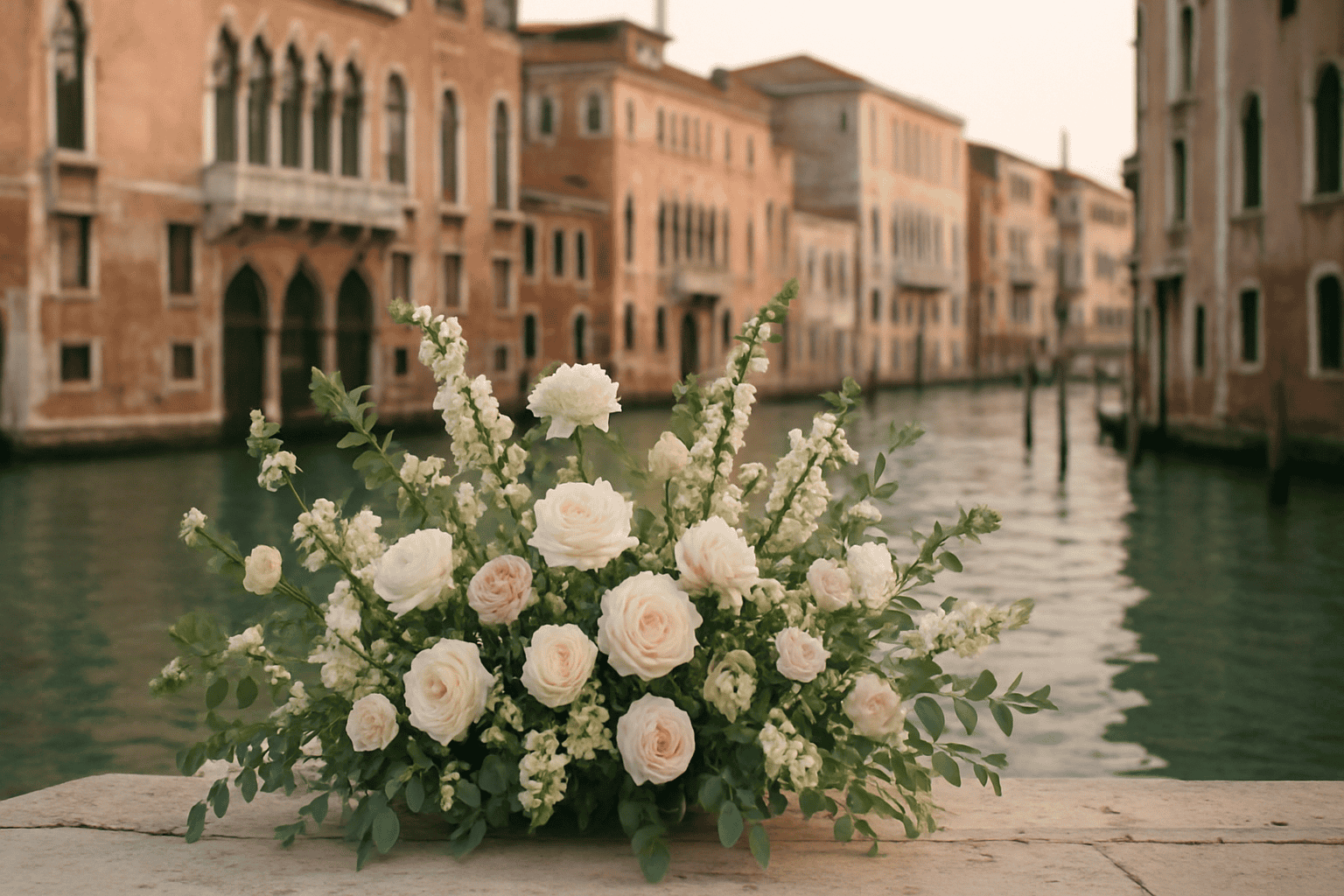
Floral arrangements in Venice: how to enhance historic spaces without overdoing it
Floral arrangements in Venice: the balance between history, light and restraint
Venice demands respect: every glimpse already has a strong character, every building tells a story, every church or cloister has proportions designed to guide the gaze. In this context, the floral arrangements Venice really work when they don’t “cover” the architecture, but accompany it. The most elegant result comes from a simple principle: enhance without competing. It means choosing volumes, palettes and scents consistent with the setting, letting stuccoes, marbles, frescoes, Istrian stone and reflections on the water play their part.
If you are imagining wedding flowers Venice in a historic setting (palace, frescoed hall, terrace on the Grand Canal, secret garden or cloister), the useful question is not “how many flowers are needed?”, but which flowers and where. The wedding design Venice the most successful works by focal points: entrances, altar or ceremony table, centerpieces designed for conversation, an iconic installation for the shot, and details that guide guests without invading the spaces.
For an overview of the context and its peculiarities, you can consult Further reading: Venice (Wikipedia), also useful for understanding the variety of islands, sestieri and settings that influence logistics and style.
Floral arrangements Venice: style, goal and stress-free logistics
Goal and style: luxury, intimate, destination (without excess)
In a scenic city like Venice, the goal is not to “fill”, but to create an atmosphere. Before choosing flowers and colors, clarify the tone of the event:
- Essential luxury: few elements, quality materials, clean lines; flowers become accents and not walls.
- Intimate and poetic: soft compositions, dusty palettes, candles and “up-close” details that are noticed in conversation and in photos.
- Destination with Venetian identity: discreet references to the city (glass, textiles, aquatic tones), without turning the theme into a caricature.
In practice, the wedding design Venice works when every element has a role: to mark a passage, frame a view, give rhythm to a long room, or soften a very “material” environment (stone, dark wood, stuccoes). If a venue is already rich, it is often more effective to reduce the quantity and increase consistency between palette, heights and textures.
What to expect in terms of timing and logistics
The floral arrangements Venice require careful direction because movements are not linear as in other cities: bridges, narrow calli, water access, loading/unloading times and routes to coordinate precisely. It’s not a problem: it’s a design parameter. Planning makes the difference.
Some practical aspects to consider right away:
- Access: check with the venue where suppliers can arrive and by what means.
- Timings: define realistic setup and teardown windows, avoiding overlaps with other events.
- Preservation: depending on the season, consider cool and shaded spaces to keep the flowers at their best.
- Guest routes: the setup must be beautiful, but also “readable” and comfortable: no obstructions in passageways, pay attention to steps and corridors.
An often underestimated tip: in a city where the light changes quickly between water and stone, it’s useful to think about how the flowers will be photographed (backlighting, reflections, shadows). A good floral design is not just aesthetics: it’s also managing volumes and light points.
Step-by-step planning for wedding flowers in Venice
Realistic timeline (from 12 to 2 months)
The ideal timeline depends on complexity and season, but an orderly outline helps you make decisions calmly and avoid impulsive choices. Here’s a typical path:
- 12–10 months: define style, palette and mood; choose the venue and set the overall concept.
- 9–7 months: first proposals of wedding design Venice; study of focal points (ceremony, tables, entrance, photo moment).
- 6–4 months: confirm key suppliers; define materials (vases, candles, supports) and setup logistics.
- 3 months: review the project based on times, spaces, number of guests; define a backup plan for weather or venue changes.
- 2 months: final confirmation of quantities and placements; operational briefing with the venue and team.
If you want a broader view of the overall event organization, it may be useful to consult Wedding in Venice: guide, so you can integrate flowers, logistics and timing into a single coherent framework.
Essential supplier checklist
To make wedding flowers Venice and the setup harmonious, coordination among different roles is needed. In general, the essential checklist includes:
- Floral designer: defines arrangements, palette, seasonality and visual impact.
- Wedding planner / coordination: manages timing, access, communications and unforeseen issues.
- Location manager: clarifies constraints, usable spaces and internal rules.
- Lighting / lighting technician: essential in historic halls or evening spaces; light can enhance or “flatten” the flowers.
- Photo/Video: useful for a comparison to understand framing and iconic spots.
The point isn’t having “many” suppliers, but getting them to work together. A floral setup can be perfect on paper and turn out less effective if lighting, tables, and pathways haven’t been planned together.
Guest management and transfers (so you don’t sacrifice the design)
In a Venetian project, transfers are part of the experience. If guests arrive by boat or walk through calli and bridges, the flowers can become elegant signage: small accents at the entrance, a well-placed welcome corner, a photo spot that doesn’t obstruct the flow. When pathways are narrow, it’s better to avoid installations that stick out too much or are fragile.
A good rule of thumb: usability first, then the wow effect. The wow effect will come anyway, if the space remains comfortable and natural.
Priorities and smart choices for a coherent Venice wedding design
Main items to consider (without wasting energy)
Without going into financial details, it’s useful to know which areas absorb the most design attention in the floral arrangements Venice:
- Ceremony installation: arch, ground arrangements, decoration of seating or table area.
- Tables and mise en place: centerpieces, vertical elements, candles and holders.
- Entrance and welcome: first impression, often photographed and memorable.
- Details: bouquet, boutonnieres, small accents on place cards or lounge areas.
The secret is to choose a few key moments and make them impeccable, instead of spreading flowers everywhere evenly. In a historic venue, uniformity can become visual noise.
Where to invest to maximize the scenic effect (without “too much”)
If you want a refined result, focus on what guests experience and remember. Some “high-impact” choices in Venetian style:
- An iconic spot: a statement arrangement in a strategic area (for example near a view or a portal), designed for photos and welcoming.
- Calibrated heights: centerpieces that don’t block the view; alternating between low and medium to create rhythm.
- A palette in dialogue with the venue: in frescoed rooms or with important textiles, better tones that harmonize instead of contrasting aggressively.
- Textures and materials: not just flowers; greenery, branches, natural elements, and coherent containers can also elevate the project.
In the wedding design Venice, often elegance comes from a precise color choice and from compositions that respect proportions. If the setting is already theatrical, a “whispered” design feels more contemporary and more photogenic.
Mistakes that increase complexity (and ruin the effect)
Some mistakes aren’t “wrong” in absolute terms, but in historic contexts they can make the setup less harmonious or harder to manage:
- Excessive volumes in small spaces: the effect can become oppressive and impractical.
- Too many palettes together: in detail-rich environments, adding many colors creates confusion.
- Multiple focal points: if everything is the star, nothing truly is.
- Poor coherence between flowers and furnishings: chairs, tablecloths, candles, and flowers must speak the same language.
A good method is to start with a question: what is the scene we want to remember? From there, you build the rest by subtraction.
Plan B and risk management for floral setups in Venice
Weather: alternative solutions without changing style
Between water, wind, and humidity, the weather can change quickly. Plan B must not be a “reduced” and sad version: it must be a coherent variant. Some useful strategies:
- Modular design: arrangements that can be moved easily from outdoors to indoors.
- Stable materials: supports and bases that hold up well even with quick moves.
- A palette that works in both lighting conditions: the same palette can look different between sunlight and indoor light; testing or checking with someone who knows the location helps.
If the venue offers alternative spaces (rooms, porticos, covered areas), it’s worth imagining right away a parallel set-up with the same key elements, so you don’t have to reinvent everything at the last minute.
Venue constraints: protect the historic value
Historic venues often have internal rules about what can be placed, fixed, or moved. Instead of seeing them as limits, treat them as a guide to good taste: if you can’t “attach” or “cover,” you’ll be led to create cleaner, more respectful arrangements. For specific details (for example anchoring points or restricted areas), check the product sheet or in the venue’s operating guidelines, so as to avoid surprises.
An effective approach is to design with freestanding structures and with protected supports, choosing solutions that don’t require invasive interventions. The result, often, is also more elegant.
Agreements, deposits, and changes of plan: clarity above all
When it comes to flowers and set-ups, clarity is part of the design. It’s useful for the project to include:
- A placement map: what goes where, with priorities and alternatives.
- Timings and responsibilities: who comes in, when, and who signs off on completion.
- Change management: how last-minute changes are handled (number of tables, spaces, weather).
In a complex city, peace of mind is built with operational details. This frees up energy for the creative part, where you really make the difference.
Guest experience: flowers, routes and Venetian-style welcome
Welcome moment, activities and hospitality
Guests remember how they felt, even before what they saw. A project of wedding design Venice can improve the experience with measured gestures:
- Welcome corner: a tidy, photogenic spot, with small-scale but well-cared-for flowers.
- Elegant signage: clear directions integrated into the design, without being intrusive.
- Break moments: lounge areas where the arrangements are lower and “conversation-level”.
In historic settings, it is often more effective to work on scent and proximity: flowers chosen for their delicacy and for how they are perceived up close, without saturating the environment.
Transport, shuttles, parking: when logistics become part of the story
Venice is experienced in motion. For this reason, logistics should be conceived as a chapter of the event: if guests have to change means of transport, cross a bridge or follow a route, every step can be made smoother with simple directions and with a design that does not get in the way. Small floral details in strategic points help to guide without “shouting”.
If you want an operational outline to coordinate all the steps, it can be useful to have at hand Organizing a wedding: checklist, so as to integrate transport, timing and suppliers in an orderly way.
Clear directions and wedding website: fewer questions, more atmosphere
When information is clear, guests relax and the atmosphere improves. A wedding website or a well-structured communication system reduces last-minute requests and allows the design to stand out without distractions. In particular, in Venice it is useful to clarify:
- How to get there and where to meet.
- Travel times between the moments of the day.
- Dress code consistent with the location and routes (for example paving, steps, outdoors).
A well-communicated event seems easier to experience. And when everything flows, even the floral arrangements Venice turn out more natural, because they don’t have to “compensate” for confused management.
Practical questions for choosing wedding flowers in Venice without excess
Before defining the floral project, it can help to ask yourself some guiding questions:
- What is the architectural element I want to keep as the protagonist? (a staircase, a fresco, a water view)
- What are the three points that guests will see most often? (entrance, ceremony, table)
- What light will I have? (day, sunset, evening; indoor/outdoor)
- What kind of photos do I want? (editorial, candid, classic)
- How comfortable do the tables need to be? (conversation, service, visibility)
These questions help turn inspiration into a real project, avoiding the “catalog” effect and building a wedding design Venice consistent with the city and with your story.
A floral project that respects Venice and tells your story
When it comes to floral arrangements Venice, the most sophisticated choice is often the most measured: a few well-placed gestures, a palette that dialogues with the location, and logistics designed to let the day flow without friction. If you want support that combines aesthetics, coordination, and sensitivity for historic spaces, the ChiaraB Events team can help you build a tailor-made project: discover the section dedicated to the Wedding in Venice: guide and start imagining a setup that enhances the city without overdoing it.
FAQ
Which flowers are best suited for a wedding in Venice at a historic venue?
In general, varieties with a natural and refined look work well, with palettes consistent with the venue’s colors. The choice depends on season, light, and spaces: consult with the floral designer and check availability and performance based on the time of year.
How can you avoid floral arrangements looking excessive in a Venetian palace?
Work by focal points (entrance, ceremony, tables) and let the architecture breathe. Better a few well-placed elements, calibrated heights and a harmonious palette, avoiding too many colors and too many “protagonists” in the same room.
Do you need a plan B for the flowers if the ceremony is outdoors in Venice?
Yes: wind, humidity and weather changes can have an impact. An effective plan B maintains the same style with a modular design, movable compositions and an alternative set-up already planned in a covered or indoor space.
How is the logistics of floral arrangements managed in Venice?
It is essential to plan access, loading/unloading times, and routes, often also by water. Defining a placement map and a shared timing with locations and suppliers reduces unforeseen events and stress.
What are the most common mistakes in wedding design in Venice?
The most common are: volumes that are too large in small spaces, palettes that are too complex in already decorated environments, too many focal points, and poor coherence between flowers, furnishings, and lighting. A subtractive approach usually works better.
From the blog
 Venice
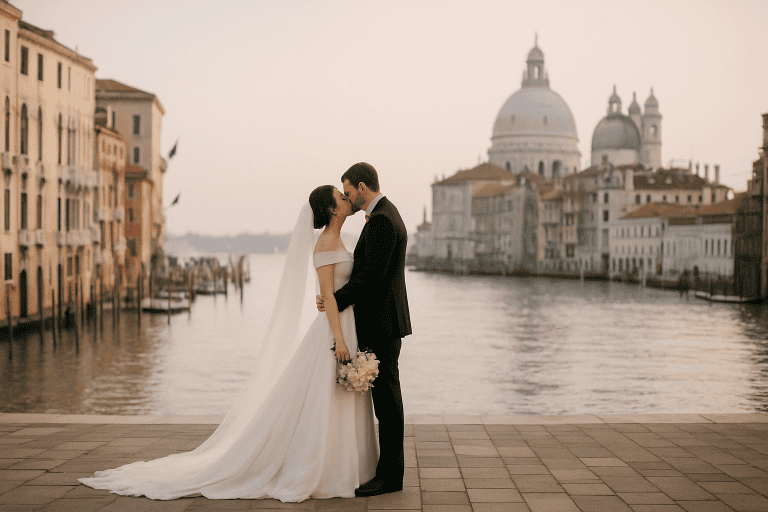
Wedding photos in Venice without crowds: schedules, itineraries and permits
Wedding photos in Venice without crowds: why focus on times and itineraries Venice is a natural setting: narrow alleys, bridges, reflections […]
Read more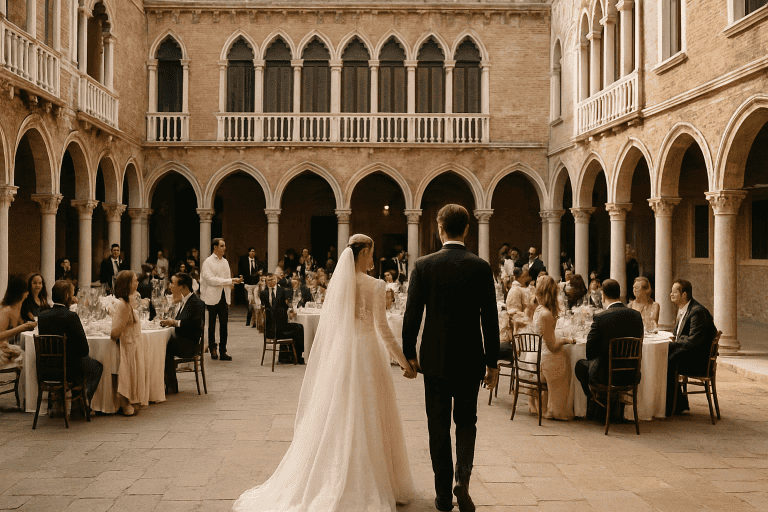 Venice
Reception in a Venetian palace: how it works between access, catering, and constraints
Venetian palace reception: why it is a choice that requires method A Venetian palace reception has an immediate charm: frescoed halls, […]
Read more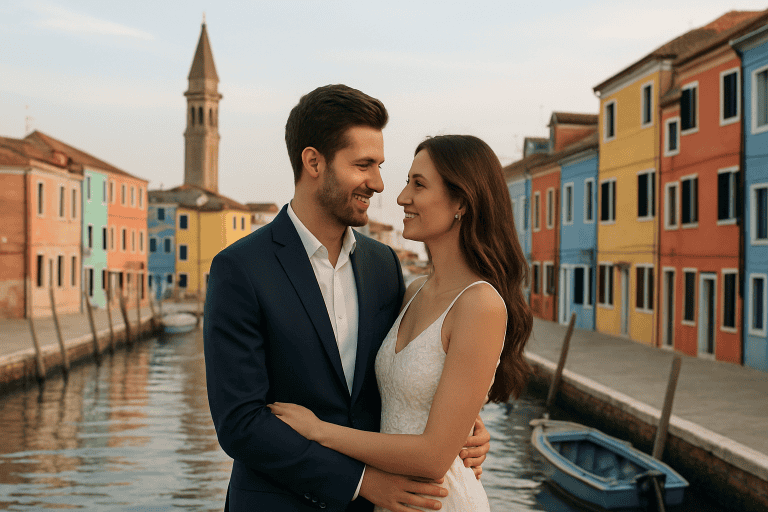 Venice
Murano and Burano for the pre-wedding: ideas for welcome tour and aperitif
Murano and Burano for the pre-wedding: why choose a welcome tour among islands and aperitif A pre-wedding in the lagoon does not […]
Read more