

Destination Wedding Planner - What Changes and How It Works
A destination wedding it is not “just” a wedding in a place different from where you live: it is a project that involves logistics, hospitality, local vendors, travel times, and an overall experience designed for the guests. In this scenario, the role of the wedding planner for destination weddings changes approach, tools, and priorities compared to traditional planning. The goal is not only to coordinate an event, but to build a smooth journey: from choosing the destination to returning home, with particular attention to remote management.
If you are considering getting married far away, or if you already have a location in mind, this guide helps you understand what really changes, how the planner’s work functions and which aspects to clarify right away to avoid surprises along the way.
Wedding planner for destination weddings: what changes compared to a “local” wedding
The main difference is that, in a destination wedding, the planning must work even when the couple cannot be physically present for frequent site visits, tastings, and meetings. For this reason, the wedding planner becomes a kind of “operational extension” on site.
In practice, three elements change:
- Remote management: calls, reports, structured updates, and sharing materials become central.
- Coordination of multiple connected services: not only the ceremony and reception, but also transfers, accommodation, timing of arrivals/departures.
- Choices guided by the context: climate, seasonality, vendor availability, the destination’s style, and local customs affect every decision.
A wedding planner specialized in destination weddings therefore works with a “production” mindset: they create a system that holds up even in case of unforeseen events, and that allows the couple to make informed decisions without having to always be on site.
How destination wedding planning works, step by step
Every project has its variables, but the workflow often follows a clear structure. Understanding the phases helps assess timelines, priorities, and responsibilities.
1) Defining vision, style, and priorities
Even before talking about details, the direction is aligned: atmosphere, style, level of formality, desired experience for the guests. Here the “non-negotiables” are also defined (for example: sunset ceremony, outdoor dinner, weekend with side events).
2) Choosing the destination and the venue
The destination is not just a backdrop: it influences logistics, mood, and feasibility. An experienced planner helps evaluate realistic options consistent with the project, avoiding choices that are “beautiful on paper” but complicated to manage.
If you want to learn more about how to evaluate a venue in a practical way, you can consult this guide to choosing the venue.
3) Selecting local vendors and defining the team
In a destination wedding, the vendor network is often local (or mixed). The wedding planner takes care of:
- research and a shortlist consistent with style and expectations;
- operational alignment (timing, spaces, access, setup);
- coordination among different roles, avoiding overlaps and organizational “gaps”.
When a detail depends on specific services, it is always useful check the product sheet or in the informational materials provided by the vendor (for example: what a given package includes, what the operating conditions are, what options are available).
4) Designing the wedding experience (not just the wedding day)
A destination wedding often unfolds over multiple moments: welcome, ceremony, reception, possibly a brunch or final farewells. The planner builds a coherent journey, with a schedule that takes into account travel and real-world pacing.
This phase also includes communication to guests: clear information on how to get there, where to stay, how to get around, what to expect. A planner can support with materials and guidance, maintaining a style consistent with the event.
5) Site inspections, rehearsals, and operational plan
When possible, targeted site inspections are planned, optimizing time on site. The heart of the work is the operational plan: a detailed run-of-show with times, responsibilities, contacts, sequences, and alternatives in case of changes.
6) On-site coordination and unexpected-issue management
On the day (and days) of the event, the wedding planner becomes the point of reference for the team and guests. The goal is simple: let the couple live the experience, without having to “manage” anything. Unexpected issues can’t be eliminated, but they can be absorbed with a system of choices already prepared.
Logistics and guests: the true heart of a successful destination wedding
When guests travel, their experience becomes an integral part of the wedding. A successful destination wedding is one in which guests feel guided, not “left to figure it out”.
Here are the aspects a wedding planner considers carefully:
- Arrivals and departures: time windows, any waiting, the pace of the agenda.
- Movements: real distances, travel times, clear meeting points.
- Hospitality: options consistent with the type of event and guests’ needs.
- Communication: concise but complete information, up to date and easy to consult.
If you’re interested in understanding how to set up elegant and functional communication for guests, you may find it useful this page dedicated to wedding stationery and informational materials.
Local vendors or a team “traveling in”: how the decision is made
A frequent question is whether it’s better to rely on local vendors or bring part of the team from your own city. There isn’t a single answer: it depends on style, destination, availability, and the complexity of the project.
In general, a wedding planner for destination weddings evaluates:
- Reliability and habit of working with events in the chosen venue;
- Aesthetic coherence with the concept (palette, materials, setups);
- Operational compatibility (access times, setup, venue constraints);
- Communication and ability to align on expectations and standards.
When working with different suppliers, the difference is made by direction: an experienced planner translates the project into clear instructions, preventing each supplier from “interpreting” it in their own way.
Remote timeline and planning: the tools that make the difference
Organizing remotely does not mean improvising: it means structuring. A destination wedding requires a timeline designed for progressive decisions, with approval moments and checkpoints.
A wedding planner can set up a working method that includes:
- Regular calls with a clear agenda and objectives;
- Summaries after each step, to keep track of decisions;
- Shared materials (moodboard, layouts, run sheets) always up to date;
- Checklist to avoid forgetting “invisible” but crucial details.
If you want to explore a broader approach to planning, you can also read the section dedicated to wedding planning services.
Design, atmosphere and details: how to maintain coherence in a different destination
The most common risk is creating a “disjointed” wedding: a wonderful venue, but details that don’t speak to each other. A destination wedding, instead, works when the design is consistent with the place and with the couple’s story.
Coherence is built by working on:
- Color palette in harmony with landscape and architecture;
- Materials suited to the context (indoor/outdoor, season, light);
- Signage and stationery useful, not just decorative;
- Lighting as a narrative element (welcome, dinner, party).
A specialized planner helps turn inspiration into practical choices: what you see, what you touch, how you experience the space. And above all, it avoids the “copy-and-paste” effect of ideas that aren’t suited to the destination.
Weather plan B and managing the unexpected: what to ask before confirming
In a destination wedding, unexpected issues have a greater impact because moving people and services is more complex. For this reason, risk management is part of the project from the very beginning.
Some useful questions to address with the wedding planner and with the venue:
- What alternatives exist in case of unstable weather?
- Do the alternative spaces maintain a comparable experience?
- How does the logistics change (entrances, routes, setups) with plan B?
- Who decides and when is the alternative activated?
When a solution depends on specific equipment or services (for example coverings, setups, lighting), it is always advisable check the product sheet or in the supplier’s documentation to understand what is included and what is optional.
Destination wedding in Italy or abroad: operational differences to consider
The distinction is not only geographical: it changes the way you plan. Even staying in Italy, a distant destination can require an organization similar to that of a wedding abroad, especially if the couple lives in another region or if many guests travel.
In general terms, and without going into regulatory aspects, a wedding planner evaluates:
- Accessibility of the destination and ease of travel;
- Seasonality and impact on availability and the pace of the weekend;
- Local customs (schedules, service flows, space management);
- Communication with suppliers and guests, especially if multilingual.
For those who want editorial and inspirational support, it can also be useful this collection of ideas and real weddings (if available).
How to choose the right wedding planner for a destination wedding
Choosing the planner is a strategic decision: they must be the person who can hold aesthetics and operations together, and who can guide you clearly even from a distance.
During the first conversations, consider:
- Working method: how they manage timelines, updates, approvals.
- Coordination skills: how they build the direction among suppliers.
- Listening and creative direction: can they translate your tastes into concrete choices?
- On-site presence: how on-site coordination is managed and with which team.
A good sign is when the planner doesn’t promise “perfection”, but shows you a process: what happens before, during and after; how decisions are made; how alternatives are handled.
Useful links to start planning in an organized way
To help you navigate ideas, services and materials, you can explore these internal resources:
- Contact the team and request information
- Learn more about the wedding planning and coordination service
Note: if you are considering specific elements or services related to the organization (materials, accessories, decorative solutions or useful tools), always check availability and details: check the product sheet.
Do you want to organize a destination wedding with clear direction and without stress?
If you want professional support to design and coordinate your wedding in a special destination, discover ChiaraB Events’ approach and style: a point of reference for turning ideas and logistics into a coherent, elegant and well-managed experience.
FAQ
What does a wedding planner for destination weddings do in addition to a traditional one?
Manages remote organization, coordinates suppliers and guest travel-related logistics, and builds a detailed operational plan for the on-site event, including alternatives in case of unforeseen circumstances.
When is it advisable to start planning a destination wedding?
It’s worth starting as soon as you have a clear idea of the destination or style, because venues and suppliers can take time to be evaluated and aligned. A planner helps you define priorities and the sequence of decisions.
Is it better to choose local suppliers or bring them from home?
It depends on the style, destination, and complexity of the project. In many cases a combination works well: the wedding planner assesses reliability, aesthetic consistency, and operational compatibility to build the most suitable team.
How do you manage guests at a destination wedding?
We work with clear and up-to-date information (arrivals, accommodations, travel), with a realistic schedule and on-site coordination. The goal is to give guests a guided and simple experience.
What does it mean to have a plan B in a destination wedding?
It means defining credible alternatives in advance (for example for weather or schedule changes), establishing who decides and when, and verifying that logistics and setups can adapt without compromising the experience.
How do you maintain style consistency in a remote location?
It starts from a clear concept and translates it into practical choices: palette, materials, setups, stationery and lighting in harmony with the context. The wedding planner coordinates the suppliers to avoid inconsistent interpretations.
From the blog
 Tips
Tips
Wedding Ideas: Trends and Tips for a Perfect Wedding
Organizing a wedding today means choosing among endless possibilities without losing sight of what really matters: telling your […]
Read more Tips
Tips
Getting married on Lake Garda: the perfect wedding between water and mountains
Between luminous shores, stone villages, and mountain profiles that change color with the sun, getting married on Lake Garda […]
Read more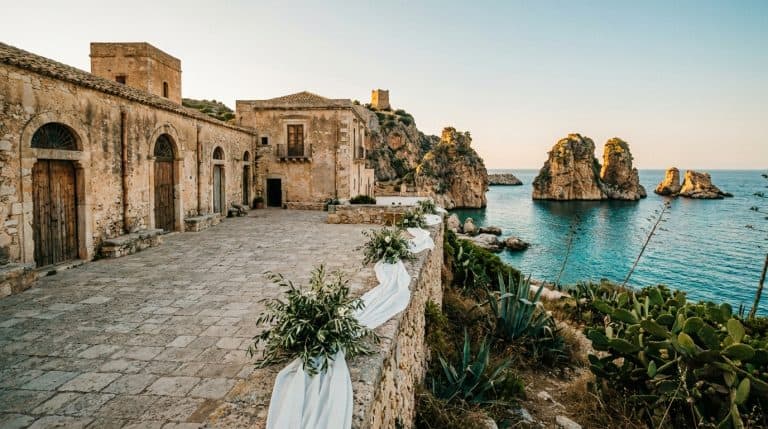 Tips
Tips
Getting married at the Tonnara di Scopello - History and Charm of a Unique Location
Tonnara di Scopello: a wedding venue between history, sea, and stone Choosing to get married at the Tonnara di Scopello means […]
Read more