
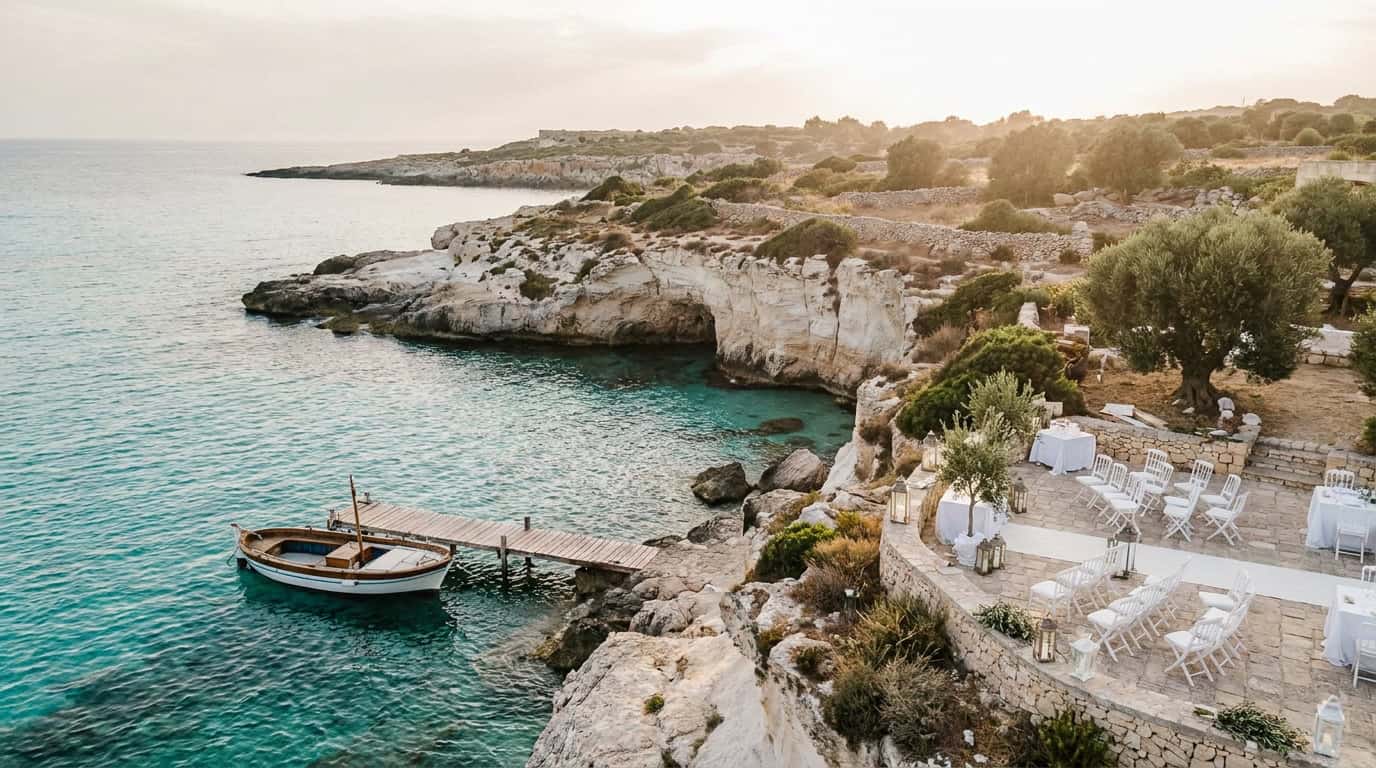
Favignana and Egadi: how to manage transfers and accommodations for a wedding weekend
Wedding weekend in Favignana: why this format works
Organising a wedding weekend Favignana (or, more generally, in the Egadi) means turning the wedding into a complete experience: not only the ceremony and the reception, but also the arrival, shared time, small welcome rituals and the “slow” moments that on an island naturally become memorable. It’s an ideal format for those who want a wedding destination in Sicily, with an intimate and curated feel, where logistics are not a detail but the thread that holds everything together.
Goal and style: intimate, destination, curated
Favignana and the Egadi lend themselves to different styles: from minimal chic to a warmer Mediterranean vibe, up to an elegant and discreet setup. In any case, the rule is the same: perceived quality comes from smoothness. If guests arrive without stress, understand where to go and when, and find a coherent welcome, the whole weekend “levels up” without the need for excess.
For those considering the island as the main setting, some general context about the area can be useful: In-depth: Favignana (Wikipedia).
What to expect in terms of timing and logistics
A wedding weekend on the islands requires a change of mindset compared to the mainland. Travel is dictated by timetables and connections; availability of accommodation and services can be more limited in certain periods; and the guest logistics islands must be planned in advance, because even small variations (a late arrival, an extra bag, a change in weather) can affect the organization.
The good news is that, with clear planning, it’s possible to create a very streamlined experience: staggered arrivals, coordinated transfers, simple reference points and communication that anticipates questions before they arise.
Step-by-step planning for Egadi transfers and accommodation
Planning a weekend in the Egadi works best when you proceed in blocks: first you define the “anchors” (dates, venue, number of guests), then you build the arrival and stay flows around them. This approach reduces unforeseen issues and makes it easier to manage the Egadi transfers in a harmonious way.
Realistic timeline: from 12 to 2 months before
Below is a practical timeline (adaptable to the time of year and the number of guests). The goal is not to fill the agenda, but to secure the decisions that impact logistics.
- 12–10 months before: defining dates and the length of the weekend; choosing the reference area (Favignana as a base, or a combination with other islands); first estimate of the number of guests and their profile (families, groups of friends, international guests).
- 10–8 months before: selecting venues for the main moments (ceremony, reception, possible welcome); first draft of an “arrival plan” with recommended time windows; preliminary hold on an indicative number of rooms/solutions across different price ranges.
- 8–6 months before: defining the flows: who arrives when, by what means and where they should be directed; setting up a communication system (wedding website or digital guide); coordination with suppliers who depend on schedules (music, photo/video, setups).
- 6–4 months before: confirming accommodation, map of meeting points, any shuttles or arrival assistance; draft of the weekend program with realistic times and tolerance margins.
- 4–2 months before: finalizing the “guest journey”: pre-departure messages, luggage instructions, dress code, practical tips; defining the reference contacts (one person or a team) for on-site support.
Essential supplier checklist (with island focus)
Beyond the classic wedding suppliers, on an island some “connecting” roles and services become crucial. An essential checklist can include:
- Wedding planner/coordination: overall direction, time management, interface with venue and guests.
- Transport: support for internal travel and coordination of meeting points.
- Accommodations: a person or point of contact to help distribute guests coherently (families close to services, friends in more dynamic areas, etc.).
- Catering and beverage: logistical assessment (access, loading/unloading times, storage). If an operational detail is not certain, check the product sheet or in the service data sheet.
- Setups and flowers: delivery planning and setup/teardown timelines.
- Photos and videos: defining travel and light timings, avoiding unnecessary back-and-forth between one location and another.
Guest management and transfers: the “group” method
For the guest logistics islands, the most effective method is to think in clusters of guests. Instead of managing individual people one by one (which becomes unmanageable), you create groups with similar needs and build dedicated instructions.
- Group A: guests arriving the day before (ideal for welcome and low-key activities).
- Group B: guests arriving on the day of the event (need very quick instructions and priority at check-in).
- Group C: families with children or people with mobility needs (require simpler routes and more generous timing).
- Group D: international guests (need clear communications, often bilingual, and a reliable point of contact).
This approach reduces repetitive questions and makes it easier to communicate times, meeting points, and alternatives.
Budget and priorities for a Favignana wedding weekend
On a weekend in the Egadi, the budget is not just “how much to spend”, but how to distribute energy between aesthetics, comfort, and smoothness. Guests’ perception depends a lot on what they experience from one moment to the next: arrivals, waiting, transfers, welcome. For this reason, priorities need to be set with a different logic than a city wedding.
Main items to consider (without surprises)
Without going into figures, the areas that typically weigh most in a destination weekend in Sicily include:
- Location and related services (spaces, usage times, operational management).
- Food & beverage (with attention to timing and logistics).
- Setups (flowers, lighting, table setting, scenic details).
- Coordination and staff (essential when guests are spread across multiple accommodations).
- Transport and guest assistance (the heart of Egadi transfers, especially if the program includes multiple moments).
Where to invest to maximize the scenic effect (without complicating)
If the goal is an elegant and memorable result, it’s often worth investing in what creates visual consistency and in what removes friction. Some choices that improve the experience without weighing down the direction:
- A clear concept (palette, materials, floral style) replicated in a few strategic points.
- Lights and atmosphere to accompany the transition from sunset to evening, avoiding sharp “breaks”.
- Discreet and useful signage (even just digital) to help guests find their way.
- A well-managed welcome moment: when the welcome is well taken care of, guests immediately get into the weekend mood.
Typical mistakes that drive up costs (and stress)
- Too dense program: more travel means more room for delays and more complexity.
- Accommodations too scattered: if guests are scattered without logic, every transfer becomes a mini-operation.
- “Tight” schedules: on islands you always need a buffer; the time saved on paper is often paid for in anxiety.
- Fragmented communication: different messages on different channels create confusion and last-minute requests.
Plan B and risk management for venues and transfers to the Egadi Islands
A wedding weekend on an island is wonderful precisely because it’s authentic, but it also requires clear-headed risk management. The secret is not to “control everything”, but rather to anticipate credible alternatives and communicate them in a reassuring way.
Weather: alternative solutions that don’t feel like fallbacks
Plan B works when it’s conceived as a second set design, not as an emergency solution. Some useful principles:
- Define a complete alternative (spaces, flows, timing) for the key moments.
- Protect the guest experience: sheltered routes, reduced waiting times, clear directions.
- Set a “decision deadline”: a time by which to confirm the set-up, so the staff can work with peace of mind.
Permissions and restrictions of the location: what to ask immediately
Every venue has rules and operational limits (hours, access, music, loading/unloading, usable areas). To avoid surprises, it’s helpful to gather this information well in advance and align it with suppliers. When a detail isn’t explicitly stated, check the product sheet or in the venue/service documentation.
In particular, for island logistics, clarify right away:
- Access for staff and setups.
- Support spaces (backstage, storage, staff area).
- Assembly/disassembly times compatible with transfers and with the schedule.
Contracts and deposits: how to protect the weekend (without rigidity)
In a destination wedding, contractual clarity is part of peace of mind. Without going into specific legal aspects, it is useful to ensure that every agreement clearly states:
- what is included and what is extra;
- timelines delivery and on-site presence;
- modification conditions in case of schedule changes;
- alternative plan agreed upon for weather or unforeseen logistical issues.
Guest experience: hospitality, transportation, and clear communication
A wedding weekend in the Egadi truly works when guests feel they are being guided naturally. There’s no need to “control” every minute: it’s enough to have clear reference points, a pleasant rhythm, and discreet support. This is where the difference is made between a nice weekend and a weekend everyone will talk about.
Welcome moment, activities and hospitality: the weekend takes shape
The welcome is the first chapter of the story. It can be simple and refined, as long as it is consistent with the style of the event and easy to experience. Some setup ideas (without turning them into obligations):
- Soft welcome with a clear meeting point and a wide time window.
- Optional activities for those who arrive earlier (sea moments, walks, free time guided by suggestions).
- In-room hospitality with practical information: schedule, useful contacts, etiquette and getting-around tips.
The key word is “optional”: guests love having options, not obligations. The weekend schedule must breathe.
Transport, shuttles, parking: how to avoid bottlenecks
In Egadi transfers, the most common mistake is to think only about the “journey” and not the entire route: meeting point, waiting, boarding/disembarking, orientation upon arrival. To make everything smoother:
- Define simple pick-up points and easy to recognize.
- Provide arrival windows instead of a single rigid schedule.
- Assign a point of contact for guests (even just at certain key moments) to reduce calls and messages.
- Reduce unnecessary travel: if you can, group more moments in nearby areas or along linear routes.
If evening travel is planned, the priority is perceived safety: clear directions, realistic timings, and a plan that doesn’t force anyone to “guess” how to get back.
Clear directions and wedding website: the invisible direction
Well-crafted communication is the most elegant form of assistance. A wedding website (or a digital guide) can include everything needed without becoming an endless document. The important thing is that it is easy to consult and updated in a single place.
Content that truly helps:
- Program with times and addresses (and a small stated buffer).
- How to get there and how to get around once on the island.
- Dress code designed for context and climate.
- Useful contacts (guest point of contact, coordination, organizational emergencies).
- Logistics FAQ (luggage, check-in, transfers, possible weather alternatives).
When communication is clear, even an unexpected issue becomes manageable: guests know where to look and who to message, without creating a chain reaction of confusion.
If you’re starting to define the project and want a complete view of the organizational journey, this guide may be useful: How to organise a wedding.
Frequently asked questions about the logistics of a wedding weekend in Favignana
Below you’ll find concise answers to the questions that most often come up when planning a wedding weekend in the Egadi, with a focus on accommodations, travel, and guest management.
Do you want a wedding weekend in the Egadi without organizational stress? If you want a project cared for in every detail, with discreet direction and solid management of accommodations and transfers, explore the services and in-depth resources dedicated to planning: the ChiaraB Events team can help you turn complexity into a smooth and memorable experience.
FAQ
What is the easiest way to manage guest logistics between islands during a wedding weekend in Favignana?
A “group-based” approach works well: divide guests by arrival windows and needs (those arriving the day before, the same day, families, international guests) and prepare dedicated instructions with a single point of reference for updates and contacts.
How do you avoid delays and confusion in Egadi transfers?
Focus on easily recognizable meeting points, arrival windows (not a single rigid time), a guest point of contact at key moments, and a schedule with realistic buffers. Reducing travel between locations helps more than any “perfect fit”.
Is it better to concentrate guests in a single area or distribute the accommodations?
In general, a thoughtful distribution is preferable: families and guests with specific needs near services and meeting points; groups of friends in more dynamic areas. However, avoid excessive dispersion, because it complicates transfers and communication.
What should a wedding website include for a wedding weekend in Favignana?
Schedule with times and addresses, directions on how to get there and get around, dress code appropriate to the context, useful contacts, and answers to practical questions (check-in, luggage, evening travel, alternatives in case of weather). The important thing is that updates are in one place.
How do you set up a credible Plan B for a wedding in the Egadi Islands?
Plan B must be a complete alternative setup, not a fallback: spaces, flows, and timings already defined, a decision deadline shared with suppliers, and clear communications to guests. If an operational detail is not explicitly stated, check the product sheet or the venue/service documentation.
From the blog
 Sicily
Etna Wedding among vineyards: how to manage climate, dresses and plan B
Why a wedding on Etna among the vineyards really works (if you plan it well) A wedding on Etna among the vineyards does not […]
Read more Sicily
Wedding in Taormina: how to choose between sea view terraces, villas, and 5-star hotels
Why the “destination wedding” in Taormina really works A wedding in Taormina is not just an aesthetic choice: it is a […]
Read more Planning
Method, priorities and criteria for turning the initial idea into a concrete wedding project
At first everything seems simple: a date to imagine, a style you like, some saved images, the desire to bring together the […]
Read more