
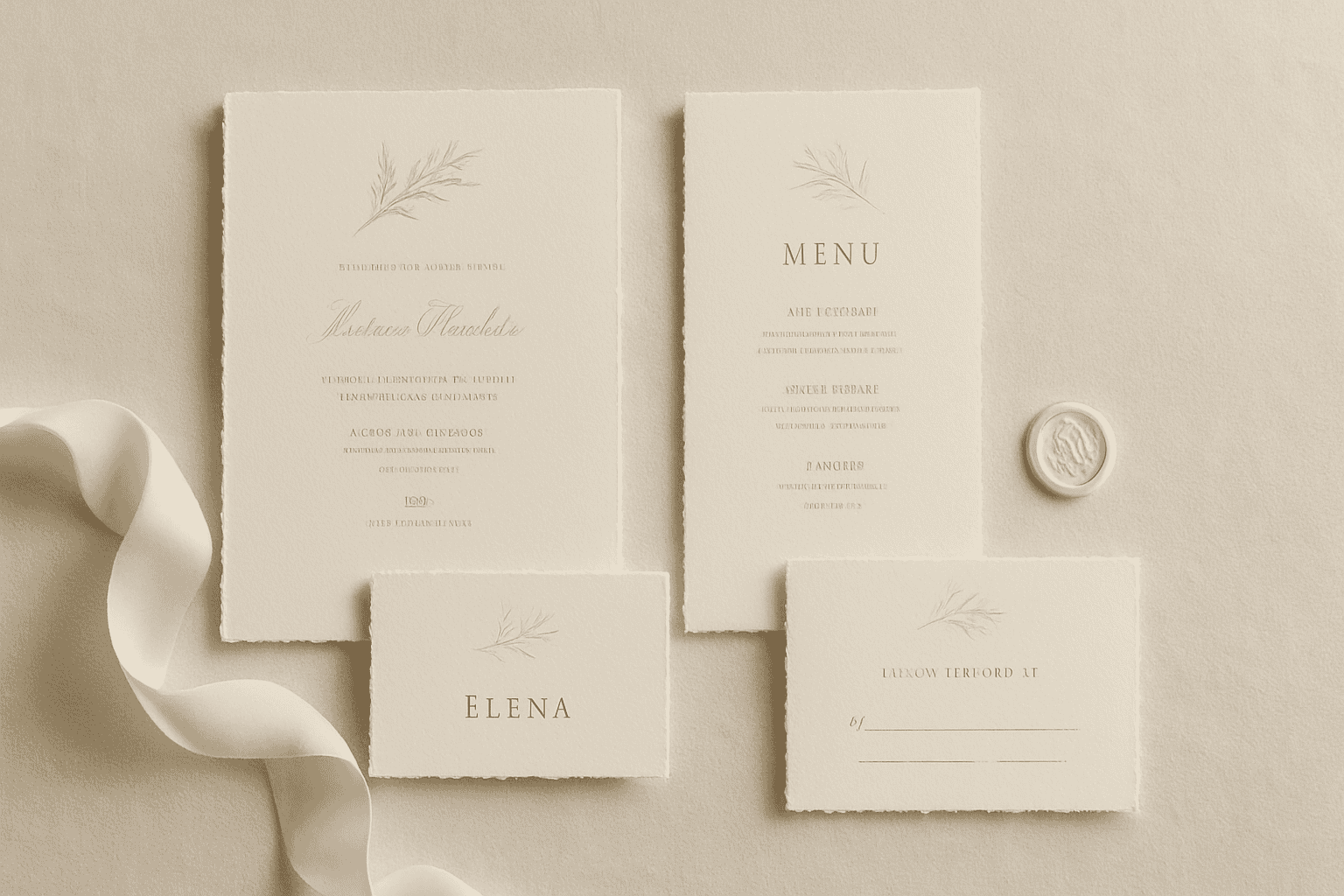
Luxury stationery: invitations, menus, place cards and graphic consistency
Luxury wedding stationery: why graphic consistency changes everything
La luxury wedding stationery it’s not just a simple “set of papers”: it’s the first emotional touchpoint with your event and, often, the element that makes a style immediately recognizable. When elegant invitations, menus, place cards and coordinated details speak the same visual language, the experience feels more curated, more intentional, more memorable.
The point isn’t to “add” elements, but to build a system: a coherent palette, readable and distinctive typography, materials that dialogue with the venue, and a tone of voice aligned with the type of wedding (luxury, intimate, contemporary, classic, or destination).
Goal and style: luxury, intimate, or destination
Before choosing cards and finishes, clarify the goal: what feeling do you want to create? A luxury wedding tends to favor clean compositions, tactile details, and an essential graphic hierarchy; a intimate wedding can focus on warmth and personalization; an event abroad often requires a wedding stationery more informative stationery, with clear directions and travel-suitable materials.
If you are organizing a celebration out of town or in another country, it can be helpful to contextualize what is meant by destination wedding: Insight: Destination wedding (Wikipedia).
Timing and logistics: what to really expect
The “invisible” part of stationery is logistics: revisions, color proofs, coordination with printing and packaging, shipping and delivery to the venue. In a well-managed project, timelines are planned with a buffer, especially if you’re including calligraphy, seals, ribbons, or special processes (check the product sheet to see if a detail requires extra time).
Step-by-step planning of wedding stationery
Effective wedding stationery comes from a realistic timeline. There’s no need to rush: you need to decide well, once, and then apply the same language across all materials.
Realistic timeline (from 12 to 2 months)
- 12–10 months: defining mood, palette, fonts and overall style; first ideas for invitations and tone of voice.
- 9–7 months: graphic draft of the invitations; choosing envelopes, any informational inserts, setting up the coordinated suite.
- 6–4 months: text review (names, addresses, times), checking consistency with the venue and ceremony; print approval.
- 3–2 months: defining “day-of” materials (menus, place cards, seating chart, welcome cards) and adjustments based on the guest list.
If the event includes multiple moments (welcome dinner, ceremony, brunch), graphic consistency should be conceived as a “collection”: same identity, different variations.
Essential supplier checklist
To avoid inconsistencies, it helps to understand who decides what and when. Depending on the project, the following may be involved:
- Designer (or graphic studio) for identity and layout;
- Typography for printing and finishes;
- Wedding planner for coordination with décor and timing;
- Florist and decor for harmony between the floral palette and paper goods;
- Location for delivery and set-up logistics.
A step that’s often underestimated: sharing a mini “brand kit” (palette, fonts, layout rules) with whoever produces visual elements for the event, to avoid styles that “clash”.
Guest management and transfers: when graphics become a service
Stationery is not just aesthetic: it is also orientation. If guests need to move between the ceremony and reception, or if you are planning shuttles, parking, and meeting points, include clear, easy-to-read information. In the case of multi-day events, consider a summary card with the schedule and useful contacts.
Budget and priorities in luxury wedding stationery
The budget should not be a list of “things to buy”, but a hierarchy of impact. In luxury stationery, the wow effect comes from the whole: materials, printing, wording, packaging, and consistency with the rest of the design.
Main items to consider
- Graphic design (identity and variations);
- Printing and finishes (check the product sheet for availability and results);
- Packaging (envelopes, closures, inserts);
- Day-of elements (menus, place cards, signs, seating chart);
- Shipping and deliveries, if needed.
Where to invest to maximize the scenic effect
If you have to make choices, focus on what guests touch e see repeatedly:
- Elegant invitations with impeccable typographic hierarchy (legibility first and foremost);
- A menus well laid out, consistent with the place setting and centerpieces;
- Place cards that integrate into the table without “disturbing” the composition;
- A recurring “signature” element (monogram, graphic motif, border, pattern).
Luxury, often, is subtraction: white space, perfect alignments, few details but intentional.
Mistakes that increase costs (and stress)
- Draft texts: last-minute changes generate revisions and reprints.
- Inconsistent formats: every exception requires adjustments and proofs.
- Aesthetic choices not suited to logistics: delicate materials for complex shipments, or media that are hard to read in evening light.
- Lack of a “master” file: without graphic rules, every piece looks like it’s from a different event.
Plan B and risk management: when wedding stationery needs to be flexible
A well-thought-out wedding stationery project includes variables and alternatives. It’s not pessimism: it’s attention to detail. Graphic consistency is maintained even when schedules, spaces, or flows change.
Weather and alternative solutions
If the ceremony or aperitif is outdoors, plan for some graphics to be repositioned or replaced. For example, welcome signs and directional signage should work both in a garden and on an indoor floor. Readability matters too: adequate contrast and text sizes designed to be seen from a distance.
Venue constraints
Every venue has practical rules: where you can post signage, access times for setup, delicate surfaces. Before finalizing materials and formats, coordinate with whoever manages the space and with the team installing the setup. If a detail depends on a specific technique, check the product sheet or with the supplier.
Contracts, deposits, and operational responsibilities
Without getting into legal aspects, it’s useful for roles and responsibilities to be clear: who delivers to the venue, who handles the set-up of menus and place cards, who manages any last-minute corrections. A simple list of deliveries and contacts avoids misunderstandings and protects the final quality of the project.
Guest experience: invitations, menus, and place cards as an elegant guide
Stationery is a narrative thread: it starts with the invitation and continues until the last moment of the event. When it’s designed well, guests don’t “notice” the effort: they feel guided.
Welcome moment, activities and hospitality
If you’re planning a welcome moment, a card with a brief program, map, or suggestions can become a gesture of hospitality. The tone should remain consistent with the invitations: if the invitation is formal, the directions should maintain the same elegance; if the style is modern, you can use more essential and direct language.
Transport, shuttles and parking: clarity above all
For getting around, the graphics must be functional: information in order, key points highlighted, useful contacts. Better clean communication than an overly decorative layout. In the case of multiple locations, consider a small “timeline” of the day, so guests immediately understand where to be and when.
Clear directions and wedding website
A wedding website (if you use it) can complement the stationery: same visual identity, same colors, same monogram. Here too, consistency means trust. For a complete view of the organization and to coordinate all aspects of the event, it can be useful to start from a general guide such as How to organise a wedding, so as to align design, logistics, and timing.
Practical questions for choosing elegant invitations and coordinating the set
Before finalizing your wedding stationery, ask yourselves a few operational questions: they will help you maintain real graphic consistency, not just “at a glance”.
- What is the identifying element? (monogram, pattern, palette, typography)
- Which information is essential? (times, addresses, dress code, RSVP)
- How will the day be experienced? (spaces, light, flows, movements)
- What should remain as a keepsake? (invitation, menu, place cards, personalized cards)
When these answers are clear, aesthetic choices also become simpler: every detail has a reason, and the whole naturally feels “luxurious”.
Do you want stationery consistent with your wedding design? Explore resources and inspiration in the section dedicated to wedding planning on ChiaraB Events: you’ll find useful ideas to align invitations, mise en place, and event graphics into a single vision.
FAQ
What is the difference between wedding stationery and simple invitations?
Wedding stationery includes all the graphic materials for the wedding (invitations, menus, place cards, signs, and informational materials), designed as a coherent system. Invitations are only the first piece of a complete visual identity.
How to get elegant holdings without weighing down the style?
Aim for a clear typographic hierarchy, white space, essential text, and a single recurring distinctive element (for example a monogram or pattern). The feeling of elegance often comes from cleanliness and consistency, rather than from an accumulation of decorations.
When is it best to define the menu and place cards in relation to the invitations?
Invitations should be set first because they define identity and tone. Menus and place cards are finalized closer to the date, when the number of guests, table setting, and the day's flow are clear, while still maintaining the same graphic style.
What must not be missing in a luxury wedding stationery for an event with guests who are traveling?
Clear and readable information: concise schedule, addresses, directions on transfers and useful contacts. In these cases the wedding stationery must be beautiful but also functional, so guests feel guided.
How to avoid last-minute mistakes in wedding stationery?
Confirm final texts (names, times, addresses), establish a “master” file with graphic rules and share it with the involved suppliers. Also allow a time buffer for revisions and deliveries, especially if special processing is planned (check the product sheet if necessary).