

How to Manage Your Budget with the Support of a Wedding Planner
Wedding budget: why a wedding planner makes the difference
Managing the wedding budget does not mean “cutting” at random, but deciding clearly how to distribute resources between what really matters to you and what can be scaled back without regrets. This is where the support of a wedding planner becomes a concrete ally: not only to coordinate vendors and timing, but to prevent impulsive spending, avoid duplicates and maintain consistency between desires, priorities and operational choices.
A professional used to planning events knows how to read the budget like a map: they identify critical points, anticipate the most frequent extras and help you turn an idea (perhaps very emotional) into a sustainable plan. If you are starting to find your way, you can explore the planning approach on Text and understand how a tailor-made journey is built.
Defining priorities: the first real “tool” for controlling expenses
Even before talking about numbers, the wedding planner guides you through an often underestimated phase: clarifying priorities. Without this foundation, the budget becomes a sum of disconnected choices and the risk is investing a lot in minor details, only to then have to give up what you really wanted.
An effective method is to think in terms of the wedding’s “pillars.” In practice: what are the elements that, if successful, will make the day exactly as you imagine it?
- Atmosphere and style: elegant, natural, minimal, romantic, contemporary.
- Guest experience: welcome, comfort, pace, memorable moments.
- Memories: photo/video, symbolic details, ceremony.
- Logistics: ease of travel, plan B, time management.
The wedding planner translates these priorities into practical choices: what makes sense to enhance and what can be simplified without “emptying” the idea. If you are interested in understanding how to define a coherent style (and therefore more controllable also in terms of spending), you may find it useful Text.
How to set a realistic wedding budget with a wedding planner
A realistic budget is not just a total: it is a allocation plan that takes into account the complexity of the event and your decision-making habits. The wedding planner helps you build a clear structure, with items and sub-items, so as to avoid the “everything all at once” effect that makes it hard to understand where you’re headed.
Generally, the work starts with three steps:
- Needs gathering: approximate number of guests, desired type of venue, time of year, level of formality.
- Estimate of macro-areas: the main categories the choices will focus on.
- Definition of margins: a “buffer” area for unforeseen events and normal fluctuations.
The advantage of working with a wedding planner is that each item is linked to a decision: not “decorations” in the abstract, but which decorative elements, with what visual impact, at which strategic moments of the day. This approach reduces redundant purchases and makes it easier to say “no” to what isn’t needed.
Expense items and smart choices: where budget is lost (or saved)
Many couples discover too late that the budget doesn’t “break” because of a single decision, but because of a series of uncoordinated micro-choices. The wedding planner works precisely on this: linking the items to one another, so that each choice supports the others.
Consistency between style and setup
When the style is defined precisely, it becomes easier to select what you really need. A coherent plan avoids the accumulation of “cute” elements that are off-theme, which often end up not enhancing the overall result. The wedding planner can propose solutions with strong aesthetic impact but more essential, focusing on a few well-designed focal points.
Guest experience: comfort before abundance
A practical rule: guests remember how they felt. Investing in comfort and flow (timing, welcome, space management) is often more effective than multiplying decorative details. The wedding planner helps you understand where an “extra” service truly improves the experience and where, instead, it’s just a cost that leaves no trace.
Personalizations: selecting the ones that tell your story
Personalizations can be beautiful, but not all have the same value. A wedding planner guides you to choose a few signature elements (consistent with your story and style), avoiding spreading yourself too thin across too many micro-details. The result is more elegant and, often, more sustainable.
Negotiation strategies and stress-free supplier management
The budget is also protected during the comparison phase with suppliers. It’s not about “haggling over the price,” but about clarifying goals, inclusions, and alternatives before confirming. A wedding planner knows how to ask the right questions and read proposals carefully, so as to avoid misunderstandings and extra costs due to misaligned expectations.
Some useful levers a professional can manage with you:
- Detailed brief: the clearer it is, the fewer revisions and later additions there are.
- Equivalent options: evaluate alternatives with a similar result, but better suited to your plan.
- Contractual priorities: understand what is truly non-negotiable and what can be flexible.
- Decision timeline: avoid rushed choices that lead to second thoughts.
If you want to learn more about how coordination with suppliers works during the organization, you can consult Text.
The “buffer” for unforeseen events: how to plan for it without anxiety
Unexpected issues are not a sign that you’re doing something wrong: they’re part of any event. The difference is whether you face them with a “tight” budget or with a plan that includes margins. The wedding planner helps you set up a buffer and, above all, to decide in advance when when to use it and what for.
Typical examples of situations that may require a margin (without going into specific details):
- logistical adjustments related to weather or spaces;
- needs that emerge along the way (timing, flow, guest management);
- targeted upgrades to improve the overall experience.
A good practice is to define a simple rule with the wedding planner: the buffer is used only if the intervention solves a real problem o clearly increases the quality of the day. Everything else can wait.
Timeline and deadlines: the planning that avoids last-minute expenses
Many extras come from rushing: decisions made late, urgent deliveries, “emergency” solutions. The wedding planner sets up a timeline that spreads decisions over time, leaving room to compare proposals and evaluate alternatives without pressure.
In a well-built timeline, each phase has a goal:
- Initial phase: defining style, priorities, the scope of the event.
- Central phase: selecting key vendors and a coherent creative project.
- Final phase: details, confirmations, logistics, plan B and coordination.
This approach reduces impulsive choices and allows you to stay in control even when enthusiasm (or anxiety) pushes you to add “one more thing” at the last minute.
Budget and style: how to maintain consistency without giving up the “wow” effect
An impactful wedding doesn’t depend on the quantity of elements, but on direction. The wedding planner thinks like a creative director: she establishes a common thread and applies it in a targeted way. That way, even with more essential choices, the overall result feels polished and memorable.
Some techniques that help achieve a scenic result without scattering efforts:
- One focal point per moment: ceremony, entrance, cake cutting, photo area.
- Consistent palette and materials: repeating a few well-chosen elements creates harmony.
- Lighting and atmosphere: often it’s what “ties” everything together and enhances the space.
- Targeted details: better a few quality details, placed where they matter.
If you are considering creative support beyond logistics, you can explore Text to understand how a style project is built.
Control checklist: how to monitor the budget during planning
A budget works only if it is monitored. The wedding planner helps you set up a simple system, easy to update and understandable even when you have little time. The goal is not to control every micro-expense rigidly, but to maintain visibility over the decisions that really shift the balance.
Here is a practical checklist you can use as a reference (adapting it to your case):
- Every new idea has a motivation? Does it improve the experience or is it just an “extra”?
- Every item has a decision-maker (you, the wedding planner, both)?
- Every confirmation is consistent with the style and priorities?
- Every change replaces something or is it added on?
- Every week is there a moment to review (even briefly) the plan?
When monitoring is constant, corrections are small and painless. When you put it off, corrections become drastic and stressful.
Useful links to organize the wedding with more peace of mind
To explore some aspects related to budget management and organization, you can also consult these contents:
When to involve the wedding planner to protect the budget
The best time is when you still have room to choose calmly. Involving the wedding planner early allows you to set a strategy and reduce typical mistakes of the initial phase: non-comparable quotes, inconsistent style choices, undefined priorities. That said, even if you are already halfway through, a professional can help you restore order, identify waste and realign the project.
If you recognize yourself in one of these situations, the support can be particularly useful:
- you have lots of ideas but not a single direction;
- you are receiving very different proposals and you don’t know how to compare them;
- you fear going over budget because details keep being added;
- you want a polished result without having to manage everything personally.
CTA: If you want a clear method to manage the budget without giving up style, discover the ChiaraB Events selection and let yourself be guided toward solutions consistent with your project: the team can help you choose what you really need, at the right time.
FAQ
Does a wedding planner really help you avoid going over the wedding budget?
Yes, because it sets priorities and a consistent spending plan, monitors decisions over time, and reduces extras due to late or uncoordinated choices. The goal is not to eliminate costs, but to manage them methodically.
How do you set spending priorities in a concrete way?
We start from what is non-negotiable for you (atmosphere, guest experience, memories, logistics) and translate it into operational choices: what to enhance and what to simplify. A wedding planner facilitates this transition, avoiding redundant purchases.
What does it mean to create a “buffer” for unexpected events?
It is a margin planned in the budget to manage changes or needs that arise during the organization. With the wedding planner, you decide in advance when to use it and for which situations, so as not to affect the priorities.
When is it best to involve a wedding planner for the budget?
Ideally at the beginning, because style, priorities, and the budget structure are defined right away. If you are already further along, it can still be useful to reorganize the items, compare proposals, and realign the project.
How can you compare suppliers without getting confused by different proposals?
A clear brief and consistent comparison criteria are needed (inclusions, alternatives, flexibility, timeline management). The wedding planner helps ask targeted questions and verify what is included: if a detail is not certain, check the product sheet or the supplier's proposal.
From the blog
 Tips
Tips
Wedding Ideas: Trends and Tips for a Perfect Wedding
Organizing a wedding today means choosing among endless possibilities without losing sight of what really matters: telling your […]
Read more Tips
Tips
Getting married on Lake Garda: the perfect wedding between water and mountains
Between luminous shores, stone villages, and mountain profiles that change color with the sun, getting married on Lake Garda […]
Read more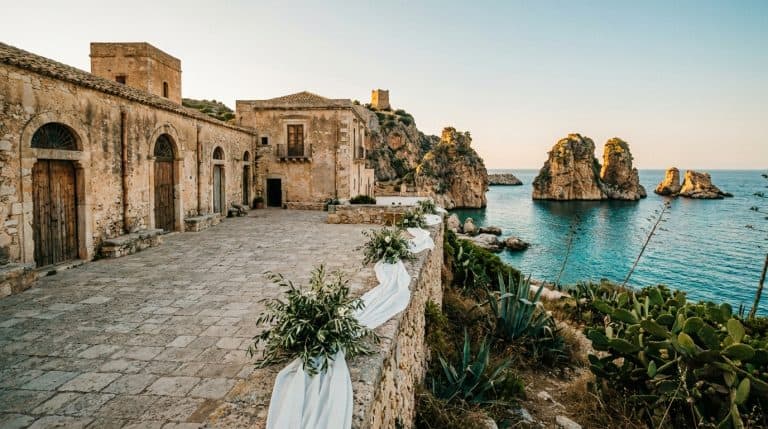 Tips
Tips
Getting married at the Tonnara di Scopello - History and Charm of a Unique Location
Tonnara di Scopello: a wedding venue between history, sea, and stone Choosing to get married at the Tonnara di Scopello means […]
Read more