




Photo permits in Rome: what to ask for and how to avoid problems at iconic locations
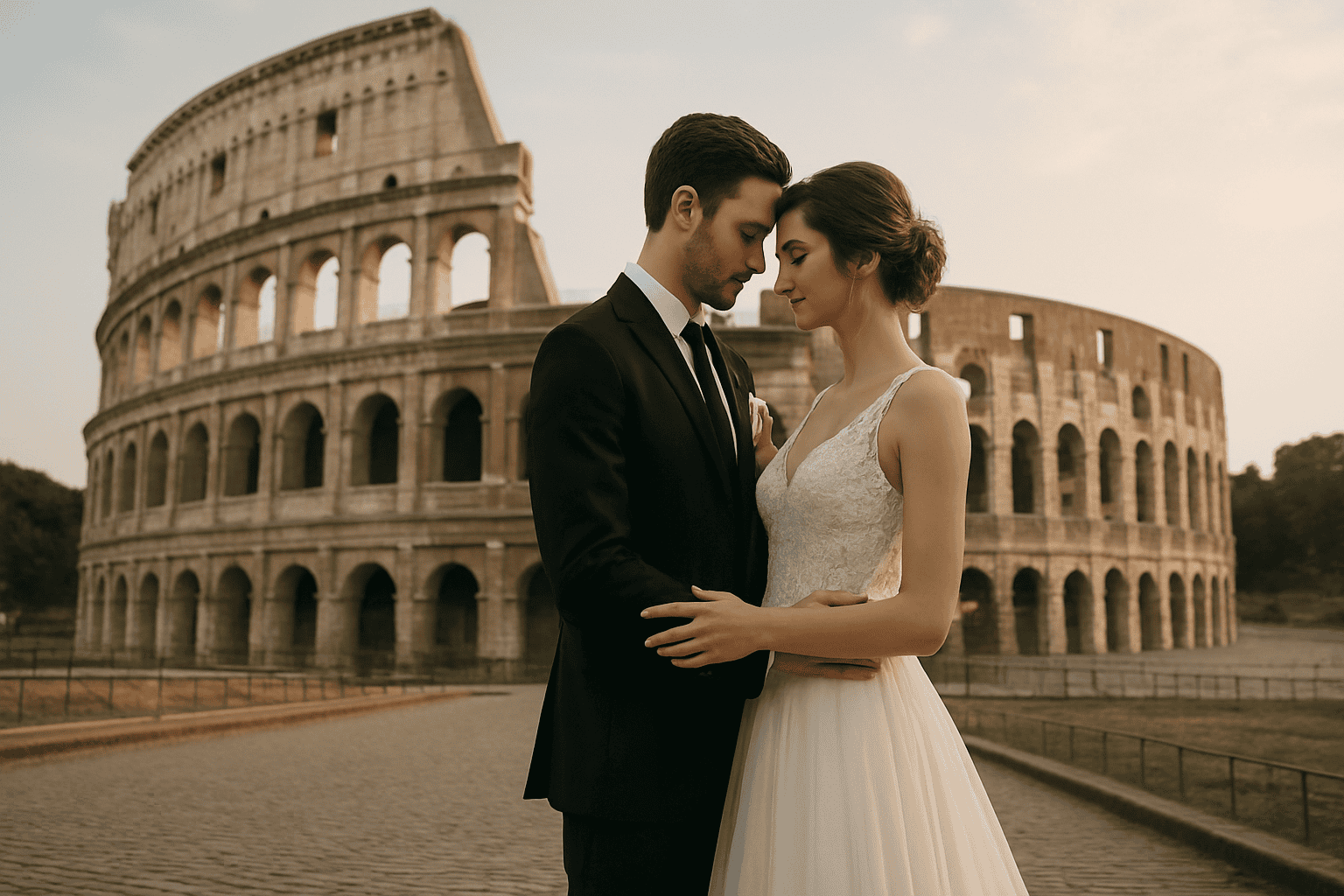
Wedding photo permits Rome and Rome shooting: why planning ahead saves your day
Rome is a natural set: alleys, squares, staircases, historic gardens, panoramic terraces. Precisely for this reason, when talking about shooting Rome (whether it is a couple service, a pre-wedding or an editorial) or wedding photo permits Rome, the difference between a smooth experience and a day full of setbacks almost always lies in preparation.
Many iconic places are highly frequented public areas, others are spaces managed by entities or private structures, others still have specific rules on access, hours, equipment use, and flow management. The photo rules Rome they are not “the same for everyone”: they change depending on the context, the type of shooting, and the impact the shoot may have on passersby and the protection of the place. Furthermore, it is essential to inquire about the specific conditions required to obtain the necessary permits, especially in historic places or those with high tourist traffic. For those seeking suggestive settings, the best photo locations in Val d’Orcia offer breathtaking landscapes and a unique atmosphere, but even here rules apply to protect their beauty. Therefore, it is always advisable to plan ahead and respect local regulations to ensure a peaceful and smooth visit. Additionally, if you are looking for inspiration for unique shots, there are many options to choose from, such as the best photographic spots along the lake, where nature and the landscape create a magical atmosphere. Always remember to respect the surrounding environment, avoiding damage to flora and fauna during photo sessions. Finally, sharing your experiences and discoveries with other photographers can enrich your creative background and lead to even more extraordinary shots.
Objective and style: luxury, intimate, destination (stress-free)
Whether you are building a story luxury, an intimate wedding or a destination wedding, the keyword is consistency: choosing locations and times that enhance the style, but are also compatible with permits, access, and logistics. A “cinematic” service with multiple people, outfit changes, and significant equipment often requires a different level of organization compared to a light and discreet mini shoot.
A professional approach helps you to:
- avoid interruptions or sudden requests to move;
- reduce downtime between stops;
- protect the guests' experience (and your peace of mind);
- obtain cleaner images, with less crowd and more control.
What to expect in terms of timing and logistics
Rome is not “just” beautiful: it is alive. Between traffic, events, construction sites, celebrations, and tourist flows, a perfect stop on paper can become complex in the field. That’s why, when planning a shoot, it is useful to consider:
- times (dawn, early morning, golden hour) and days of the week;
- accessibility (ZTL, pedestrian areas, distance from parking);
- real-time movement between locations (not the “from map” one);
- backup plan if an area is too crowded or unavailable.
If the photo service is part of the wedding day, the logistics must integrate with the ceremony, reception, and makeup/hair times: the goal is not to “do as many places as possible,” but to achieve the best result with the least friction.
Step-by-step planning for Rome shooting: what to ask and when to move
To avoid surprises, planning should start with a simple question: what type of shooting is it? A discreet couple’s service is different from a set with crew, lights, tripods, and outfit changes. The greater the impact, the more likely permissions are needed or specific rules apply.
Realistic timeline (from 12 to 2 months): how to organize
Every project has different timings, but a “safe” timeline helps avoid running late:
- 12–9 months before: define style, mood, season, and macro-areas (historic center, parks, neighborhoods, terraces). If the wedding is destination, also consider a site inspection or a plan for alternative locations.
- 8–6 months before: select the “must” locations and check if they are public, private, or managed by authorities. At this stage, practical information is gathered: access, recommended time slots, any restrictions.
- 5–3 months before: align photographer/videomaker and wedding planner (if present) on itinerary, timings, and movements. If constraints arise, adapt the route.
- 2 months before: confirm the final schedule and prepare a credible plan B (not “improvised”). If formal requests are necessary, now is the time to finalize them.
Practical note: if you are building a complex project, it can be useful to manage the organizational part together with a professional. If you need a complete guide on timings and priorities, you can find useful insights here: How to organise a wedding.
Essential supplier checklist (and what they need to know)
For a smooth service, everyone must share the same information. An essential checklist includes:
- photographer and/or videomaker: style, planned equipment, number of people on set, need for tripod/lighting, shooting times;
- planner or coordinator: management of times, movements, contacts of locations, alternatives;
- makeup and hair: pace of the day, touch-ups, look changes if planned;
- transportation: car with driver, pick-up point, possible stops, plan for ZTL/pedestrian areas;
- location/facilities (if private): internal rules, access, allowed areas, any restrictions on music, drones, flash.
The point is not to “complicate life”, but to avoid a decision made by one supplier impacting the others (for example: a location change that disrupts the ceremony schedule or reduces time for guests).
Guest and transfer management: how not to keep them waiting
If the shooting takes place between the ceremony and the reception, guest management is part of the direction. Some elegant solutions:
- plan a welcome moment or an early aperitif at the reception;
- organize clear transfers with schedules and meeting points;
- reduce the number of photo stops and focus on a “strong” location consistent with the style.
When guests are calm and guided, the couple also experiences the shooting more lightly: and this shows in the images.
Photo rules in Rome at iconic places: what to check before shooting
“Can I take photos here?” is a question that often has an answer in Rome: it depends. It depends on what you are doing, how you are doing it, and who manages the space. To guide yourself, think in categories.
Public spaces, tourist areas, and crowded contexts
In many public areas, photos can be taken, but there may be practical limitations or behavior requests: do not block passages, do not occupy sensitive points for long, do not create gatherings. If the shooting involves a “structured” set, it is more likely that constraints or authorization requirements will arise.
Useful questions to ask yourself (and the team):
- How many people will be present besides the couple?
- Is the use of tripods, lights, stands or scenic elements
- expected? Does the shooting require stopping passersby
- or delimiting spaces? Are there video shoots
with movements that may cause obstruction?
The more answers are “yes,” the more it is advisable to check in advance the access conditions and any procedures.
Villas, gardens, museums, hotels, and private locations When the space is private or managed, the rules are often clearer but also stricter: limited access, allowed areas, precise schedules, policies on equipment and filming. In these cases, the golden rule is to ask in writing
what is allowed and what is not, to avoid misunderstandings on the day of the shooting.
- Before confirming a location, check: if external shootings
- are allowed (even if you are not a guest); if
- reservations or dedicated access are needed; or support areas;
- if filming is allowed during certain time slots.
Drones and aerial filming: extra caution
Aerial filming is a separate chapter and requires a higher level of attention: not only for operational reasons, but because in a complex city like Rome there may be restrictions and sensitive areas. If you are considering this option, the safest choice is to rely on a professional and check in advance feasibility and conditions with those managing the space or area.
How to request wedding photo permits in Rome (without wasting time)
When a request is needed, the quality of the information you send makes a difference. An effective message is clear, complete, and measured. Include:
- desired date and time slot (with alternative);
- exact location and involved areas;
- type of shooting (wedding, engagement, editorial);
- number of people present;
- main equipment (without unnecessary technicalities);
- special needs (wardrobe change, support point, car access).
If you are unsure about a detail (for example, the final equipment), state it transparently and update as soon as possible. This avoids vague responses or requests for additional information that prolong the process.
Budget and priorities: where to invest for a truly spectacular Rome shoot
When it comes to images in Rome, the temptation is to add stops, locations, and “special moments.” In reality, often the best result comes from making targeted choices: few elements, very well curated. Without going into numbers or prices, let's consider the priorities that really affect the final effect.
Main items to consider (without surprises)
The areas that most often influence organizational complexity are:
- transport and timing: transfers, waiting times, access to the center;
- location and access: any procedures, bookings or internal rules;
- styling: clothes, accessories, bouquet, possible look change;
- team: number of professionals involved and coordination;
- weather plan: consistent alternatives (not “fallback”).
The practical rule: if a choice increases complexity, the aesthetic or emotional value of the shot must also increase. Otherwise, it’s just extra effort.
Where to invest to maximize the scenic effect
Rome offers a lot even with essential solutions. To truly enhance it:
- choose smart timings: soft light and less crowd change everything;
- prefer a compact route (same area) instead of crossing the city;
- take care of details that appear in photos: bouquet, palette, accessories, grooming;
- define a storytelling: not just “poses”, but real and coherent moments.
Mistakes that increase complexity (and ruin the rhythm)
- Too many moves in a short time: the couple arrives tired and the team rushes.
- Locations chosen only for “fame”: if they are unmanageable that day, they don’t work.
- Lack of alternatives: just one closed road can cost an hour.
- Fragmented communication: everyone has a different version of the timeline.
Plan B and risk management: weather, permits, and location constraints in Rome
The difference between a “beautiful” project and a “professional” project is often the Plan B. In Rome, an unexpected event is not an exception: it is a real possibility. Being prepared does not mean being pessimistic, it means being free to enjoy the day.
Weather and alternative solutions (without losing style)
An effective Plan B is not “let’s go wherever it happens.” It is a list of options consistent with the style: arcades, courtyards, bright interiors, hotels with elegant spaces, locations with covered areas. If you are building an intimate and refined story, even rain can become a narrative element, provided there is a suitable context.
Before the date, agree with the team:
- who decides the plan change (and when);
- which alternative locations are actually feasible;
- how to manage any guests or transfers if the shooting is postponed.
Permits and location constraints: what to put in black and white
When a location has specific rules, it is useful to have written confirmations on key points, for example:
- access and stay times;
- areas allowed for photos and videos;
- any limitations on equipment or setups;
- procedures in case of delays or program changes.
It is not a matter of distrust: it is clarity. And clarity reduces friction on the day of the event.
Contracts and deposits: aligning expectations and responsibilities
Without going into legal aspects or specific details, one principle is always valid: make sure that the conditions agreed with suppliers and locations are consistent with the timeline and the constraints of the place. If a detail is not certain (for example, an internal policy that may change), check the product sheet or in the documentation/agreements provided by the facility before basing the entire plan on it.
In particular, it is useful to clarify:
- what happens in case of date change or rain;
- who manages any last-minute requests;
- which services are included and which require confirmation.
Guest experience in Rome: how to integrate shooting and day without interruptions
A wedding in Rome (or an event with guests arriving from outside) is also a travel experience. If the shooting takes too much time or creates waiting, the energy of the event can drop. The solution is to design the shooting as part of the narrative, not as a “technical break”.
Welcome moment, activities and hospitality
If guests stay in the city for several days, you can turn the organization into a gesture of hospitality:
- an informal welcome moment (before or after the ceremony);
- directions on neighborhoods to explore on foot and real travel times;
- a mini itinerary for those arriving early or leaving late.
For those who want to contextualize the city also in the event story, you can share a general reference link such as In-depth: Rome (Wikipedia) along with your personalized directions.
Transport, shuttles, parking: reducing uncertainty
Rome rewards those who simplify. If you plan movements, it works better:
- a single meeting point that is easy to find;
- schedules communicated in advance and confirmed the day before;
- clear directions on access and pedestrian areas;
- a contact person (planner or coordinator) to manage any delays.
This is even more important if the shooting is downtown and the reception outside: the transition must be linear, not a “leap into the void”.
Clear directions and wedding website: fewer questions, more presence
An elegant way to avoid dozens of messages is to centralize information: schedules, addresses, dress code, useful contacts, transport suggestions. Even a simple page (or a PDF) can make a difference. If the ceremony is in the Town Hall or involves specific steps, it can be useful to inquire in advance: Civil wedding: requirements and timing.
When guests know what to expect, you can focus on what matters: living the day and enjoying every moment, including the shooting.
Useful links and final tips to avoid problems during a shooting in Rome
Before closing your schedule, let's recap the points that really reduce the risk of hiccups during shooting Rome and photo shoots in iconic locations:
- Define the impact of the shooting: number of people, equipment, space occupation times.
- Choose strategic times: less crowd, more control, better light quality.
- Check the rules of the place before building the itinerary (public/private/managed).
- Prepare real alternatives for weather and crowding, consistent with the style.
- Communicate a single timeline to all suppliers and those managing guests/transportation.
Rome can be generous to those who listen to it: rhythms, distances, light, and flows. With smart planning, even the most iconic places become a natural set, without tension and without compromising the result.
Do you want to build an elegant project without surprises? If you are organizing your event in Rome or Lazio and want complete direction (location, timing, logistics, and coordination), explore the dedicated section How to organise a wedding: you will find an approach designed to transform ideas and inspirations into a concrete, coherent, and enjoyable plan.
FAQ
When are permits required to take wedding photos in Rome?
It depends on the location and the impact of the shooting. In general, the more people involved, equipment, and space occupation increase, the more important it is to check in advance if the location requires permits or dedicated procedures.
Are the photo rules in Rome the same at all iconic places?
No. Rules may vary between public spaces, areas managed by organizations, and private locations (hotels, villas, gardens). Before defining the itinerary, it is advisable to check access, hours, and specific restrictions of the chosen place.
What should I write when requesting permission for a photoshoot in Rome?
Enter date and time slot (with alternative), exact location, type of shooting, number of people, main equipment, and special needs (wardrobe change, support point, car access). A clear message reduces requests for additional information and response times.
What is the most common mistake during a Rome photoshoot on the wedding day?
Underestimating time and travel. Rome is subject to traffic, tourist flows, and pedestrian areas: a route that is too long can cause delays and stress. It is better to focus on a few well-chosen stops and strategic times.
How can I manage the guests while the couple is taking photos?
Plan a welcome moment or an aperitif, clearly communicate transfers and schedules, and appoint a contact person (planner or coordinator) for practical management. This way guests won't be left waiting and the energy of the event remains high.
What to do if it rains or a place is too crowded for photos?
A plan B consistent with the style is needed: covered or indoor alternatives, or a second feasible location in the same area. Agree beforehand on who decides the plan change and when, to avoid improvisations.
