
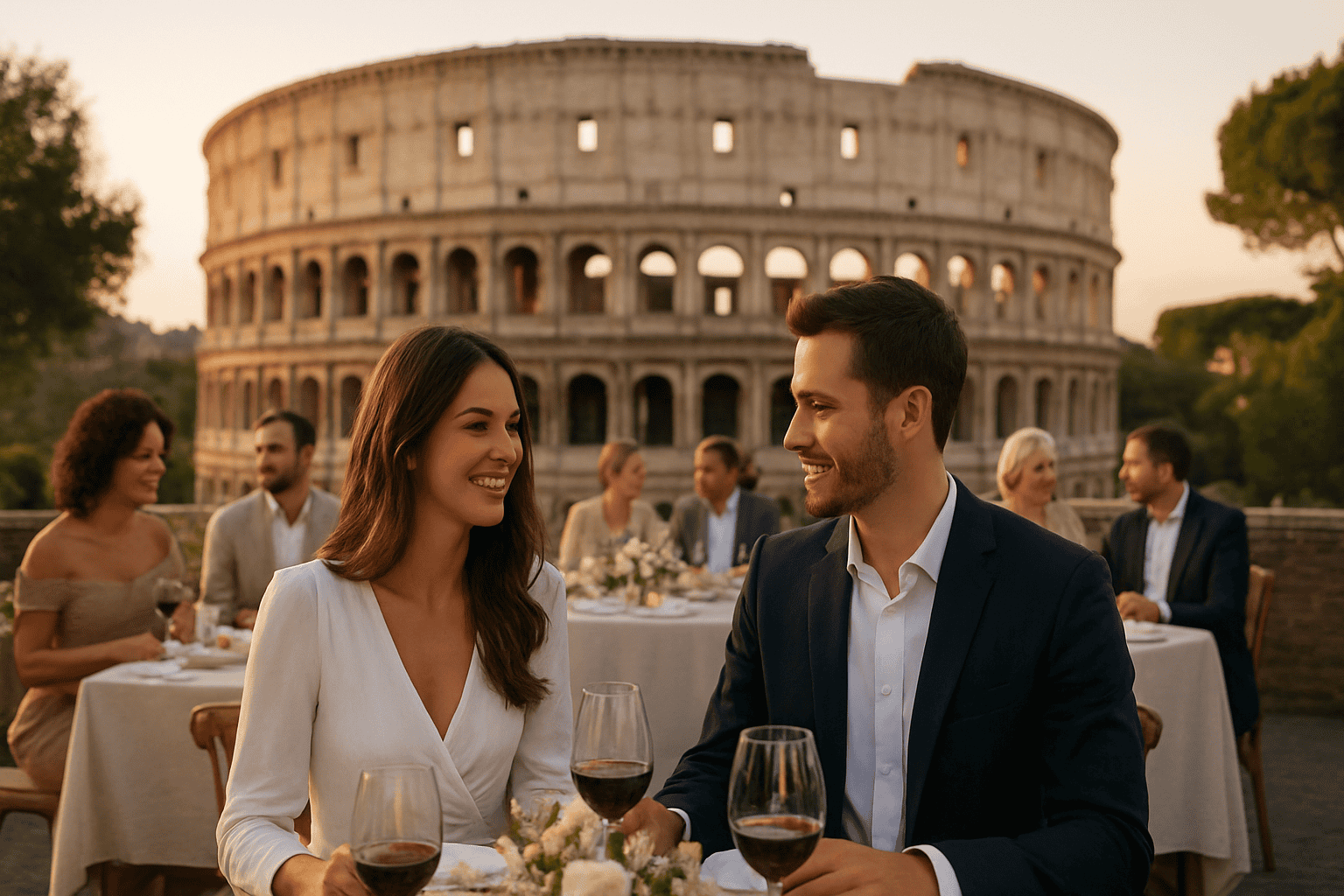
Pre-wedding events in Rome: premium experiences for international guests
Pre-wedding events in Rome: why choose premium experiences for international guests
When a wedding is a true destination experience, the pre-wedding is not an “extra”: it is the moment when guests begin to feel part of the story. A Rome, this means turning the wait into a carefully curated journey, with a consistent aesthetic language and discreet direction. The pre-wedding experiences Rome most successful ones have a clear goal: to welcome, guide, and create connections among people who often arrive from different countries and don’t know each other.
In an international setting, the added value lies in the ability to make everything simple: smooth transfers, clear communications, respected timings, and an atmosphere that reflects the tone of the main event (luxury, intimate, contemporary, classic). Rome offers iconic settings and neighborhoods with very different personalities: choosing “where” and “how” is not just a matter of taste, but of the overall experience.
Goal and style: luxury, intimate, destination
A premium format works when every element is intentional. In practice:
- Seamless welcome: guests immediately understand where to go, what to expect, and how to move around.
- Consistent atmosphere: music, lighting, mise en place, timing, and dress code speak the same language.
- An authentic but curated “Rome” experience: not a generic postcard, but a selection of moments that enhance the city without stress.
The result is a pre-wedding that doesn’t compete with the wedding day, but prepares it: it creates familiarity among guests, eases logistical anxiety, and makes the main event smoother.
Timing and logistics: what to really expect
For international guests, timings are often compressed: staggered arrivals, jet lag, check-in, and transfers. A well-designed pre-wedding includes realistic windows and safety margins, especially if the experience involves moving around the city. In general, it’s best to work with:
- Flexible start times (not too early) to accommodate those arriving the same day.
- Measured durations: better a short but impeccable experience than a long and tiring program.
- Simple meeting points: recognizable places, with clear directions and support staff.
If you want a broader reference framework for designing the entire event, it can be helpful to start with the guide How to organise a wedding, so you can align pre-wedding and wedding day under a single direction.
Step-by-step planning of pre-wedding events in Rome
Planning is what makes an experience “premium”: not only the location or the menu, but the feeling that everything flows naturally. For this reason, the rule is one: design the flow first (arrivals, welcome, timing, return) and then build the aesthetics.
Realistic timeline: from 12 to 2 months before
Every wedding has different dynamics, but an effective timeline for pre-wedding events in Rome can follow this structure:
- 12–9 months: defining the concept, choosing areas/zones, first selection of locations and format (e.g., welcome dinner, welcome cocktail, daytime experience).
- 8–6 months: booking key vendors (catering, entertainment, transportation), draft transfer logistics, defining the guest communication plan.
- 5–3 months: operational details (final timing, welcome staff, signage, any translations), layout and flow confirmation.
- 2 months: finalizing guest management (arrivals, hotels, shuttles), route rehearsal, plan B, final vendor briefing.
If some details depend on the venue (spaces, access, schedules), it is always advisable check the product sheet or in the documentation provided by the partner.
Essential vendor checklist for an international pre-wedding
A pre-wedding event for international guests requires a lean but complete team. Generally, essential vendors include:
- Location with spaces suitable for a smooth welcome (entrances, lounge areas, rain plan).
- Catering and beverage consistent with the tone of the event (elegant aperitif, seated dinner, cocktail dinner).
- Transport: shuttles, car with driver, pick-up coordination.
- Direction and coordination: a single point of contact to manage timing, staff, and vendors.
- Music and atmosphere: live set, DJ set, or discreet sound design.
- Photo/video (if desired): to capture the energy of the arrival and the first interactions.
For guests who speak different languages, it is useful to provide bilingual materials (or multilingual) and staff able to handle communications naturally.
Guest management and transfers: the difference between “nice” and “impeccable”
The critical point of pre-wedding events in Rome is almost always the same: how guests move. A wonderful city can become complex if key steps are not anticipated. To reduce friction:
- Group the hotels (or define collection hubs) to optimize pick-ups.
- Communicate in advance times and meeting points, including maps and visual references.
- Provide a welcome team at the venue and, if necessary, at departure points.
- Manage the return with the same care as the outbound: it’s a delicate moment, especially at the end of the evening.
Budget and priorities for welcome dinner and pre-wedding in Rome
Talking about budget, in a premium context, means talking about priorities. There’s no need to “include everything”: you need to invest where the guest perceives value. A welcome dinner Rome successful one is one in which every choice supports the experience: comfort, beauty, pacing, quality of the welcome.
Main items to consider
Without going into figures, the areas that typically have the biggest impact are:
- Venue and setups: spaces, furnishings, lighting, scenic elements.
- Food & beverage: quality, service, management of any dietary preferences.
- Transport: shuttles and operational coordination.
- Entertainment: music, performances, sound.
- Staff and direction: coordination, welcoming, guest management.
Where to invest to maximize the scenic effect (without excess)
To achieve an elegant “wow” impact, it often works to focus on a few high-yield elements:
- Lighting: it creates atmosphere, enhances the architecture, and makes photos more beautiful.
- Smart layout: lounge and conversation first, then dinner, closing with a convivial moment.
- A welcome gesture: a well-curated welcome moment (not necessarily complex) that makes guests feel expected.
Rome is full of already powerful settings: often the most sophisticated choice is to leave room for the city, avoiding overload and focusing on quality details.
Mistakes that increase costs (and stress guests)
- Overly long programs: more hours = more complexity, more staff, more room for the unexpected.
- Venues far from each other: repeated transfers increase time and the risk of delays.
- Late communications: if guests don’t have clear information, last-minute requests and corrective interventions increase.
- No plan B: emergency solutions, when improvised, are almost always more expensive and less elegant.
Plan B and risk management for pre-wedding events in Rome
A premium event isn’t the “perfect” one: it’s the one that stays perfect even when something changes. In Rome, the most common risks involve weather, access, timing, and the venue’s operational constraints. The solution is to design credible alternatives, not fallbacks.
Weather: alternative solutions that don’t look like alternatives
If the experience includes outdoor spaces, build a plan B that keeps the same tone. A few tips:
- Indoor spaces with the same aesthetic quality (characterful rooms, covered terraces, porticoes).
- Modular setups that can be repositioned quickly.
- Flexible timing: a small schedule shift can save the atmosphere.
If the venue offers specific options (covers, alternative rooms, routes), check the product sheet or in the service contract.
Venue permits and constraints: what to clarify in advance
Rome has very different settings: historic palaces, terraces, gardens, contemporary spaces. Each place may have specific rules on access, hours, music, loading/unloading, setups. To avoid surprises, clarify in advance:
- Entry and exit times for staff and suppliers.
- Technical limitations (electrical capacity, water points, constraints on fixings).
- Noise management and music hours.
- Accessibility for guests and vehicles.
For an overview of the city and its historical-cultural context, also useful for building a narrative consistent with international guests, you can consult In-depth: Rome (Wikipedia).
Contracts and deposits: setting up a smooth direction
In a premium pre-wedding, peace of mind comes from clarity. It’s helpful for every supplier to have:
- Defined scope: what is included and what is not.
- Timing and responsibilities: who does what and when.
- Change policy: managing guest changes, weather, schedules.
If some aspects are subject to specific conditions, always refer to the official documentation and check the product sheet of the chosen service.
Guest experience in Rome: welcome moment, activities, and hospitality
The heart of the pre-wedding is the guest. It’s not enough to offer a program: you need to build a feeling of care. In this, Rome is an extraordinary ally because it allows you to alternate iconic moments and more secluded corners. The best guest activities Rome they are the ones that respect the energy, time, and expectations of those arriving from afar.
Welcome moment and welcome dinner in Rome: how to make them memorable
The “welcome” is an emotional passage: it is the first point of contact between guests, the couple, and the city. Some setup ideas (without going into specific product names or pre-packaged formats):
- Welcome with hostess and welcome drink in a lounge area, to encourage spontaneous conversations.
- Opening moment brief and heartfelt (a toast, a few words), to set a rhythm without weighing things down.
- Dinner with a dynamic flow: alternating seated and standing moments can help people who don’t know each other mingle.
A welcome dinner Rome premium doesn’t necessarily have to be formal: it has to be intentional. Elegance can also be relaxed, as long as everything is harmonious and well coordinated.
Activities for guests in Rome: curated experiences between culture and lifestyle
When it comes to pre-wedding experiences Rome, the temptation is to fill the calendar. In reality, for international guests a selection of short, high-level, and easily accessible activities works better. Here are some types that fit well into a wedding weekend:
- Gastronomic experiences with a focus on conviviality and the local area, designed for groups who want to socialize.
- “Light” cultural moments: itineraries that prioritize beauty and storytelling, without turning into marathons.
- Lifestyle experiences: shopping assistance, craftsmanship, ateliers, and details that tell Rome’s story in a contemporary way.
- Relaxation and wellness: perfect for those arriving with jet lag or who want to recharge before the wedding day.
The guiding criterion is always the same: reduce complexity. One excellent activity, with well-managed transfers and clear communications, is worth more than three “nice” but tiring activities.
Transport, shuttles and parking: how to avoid friction
Rome requires careful direction of movements, especially during peak hours or in central areas. To improve the experience:
- Shuttles with time windows: more closely spaced departures reduce anxiety and delays.
- Unified pick-up points: a few clear points, well communicated.
- Solutions for those arriving independently: directions for drop-off and nearby parking options, if available.
If the location has restrictions on vehicle access or parking areas, it is essential to confirm in advance and check the product sheet of the service or in the venue’s official information.
Clear directions and a wedding website: the golden rule for international guests
Impeccable communication is part of hospitality. For international guests, it’s advisable to centralize information in a single place (for example a wedding website or a well-structured digital document) including:
- Brief schedule with schedules and dress code.
- Maps and addresses copyable, with notes on the correct entrances.
- Useful contacts (coordination, transportation, logistical emergencies).
- Operational FAQs on weather, transfers, recommended arrival times.
A detail often underestimated: include visual references (photo of the entrance, screenshot of the meeting point) drastically reduces last-minute messages and improves the perceived experience.
A pre-wedding consistent with the destination: Rome today, Lazio and alternatives for traveling guests
If some guests are staying for more days, it can be useful to think about a gentle extension of the experience, keeping Rome as the heart of the story and opening up to ideas in Lazio. The important thing is not to turn the pre-wedding into a demanding tour: the goal remains to arrive at the wedding day with energy and lightness.
In some cases, couples with an international profile also consider different destinations for other moments of the journey (for example a subsequent event or an anniversary). If you are exploring iconic alternatives in Italy, this resource may be useful to you: Wedding on Lake Como: guide. The idea is not to “change scenery”, but to understand how to build a destination experience with the same care, in different contexts.
Organizing pre-wedding events in Rome without stress: coordination and style under a single direction
For international guests, quality is measured in invisible details: a realistic timeline, a welcome that anticipates questions, logistics that go unnoticed because they work. If you want a pre-wedding that combines aesthetics and organization, the best approach is to work with a single direction that brings together concept, vendors, and guest management.
Do you want to design bespoke pre-wedding experiences in Rome and aligned with your wedding day? Rely on ChiaraB Events to transform welcome moments, welcome dinner, and guest activities into a coherent, elegant, and easy-to-enjoy journey.
FAQ
How long does a pre-wedding event in Rome typically last for international guests?
It depends on the format (welcome cocktail, dinner, daytime experience), but generally a measured duration works that leaves time for check-in, rest, and socializing. The key is to build a realistic schedule with buffers for staggered arrivals and transfers.
What is the difference between a welcome dinner and a welcome party?
The welcome dinner is often a more structured dinner (seated or with defined service), while the welcome party tends to be more dynamic and informal, with more room for conversation and movement. Both can be premium if the concept, direction, and hospitality are consistent.
Which guest activities in Rome are most suitable before the wedding?
Ideal activities are short and well-curated: convivial food and wine experiences, cultural moments that aren’t too demanding, lifestyle and relaxation. The goal is to experience Rome without tiring the guests and without complicating the logistics.
How to manage transfers and meeting points in a complex city like Rome?
It is advisable to define a few clear pick-up points, communicate maps and visual references, provide closely spaced departure windows, and have a welcoming team. It is also important to take care of the return trip, which is often more delicate at the end of the evening.
Do you always need a plan B for a pre-wedding event in Rome?
Yes, especially if outdoor spaces are planned. An effective plan B must not feel like a fallback: it should be designed with the same aesthetic and with credible indoor alternatives. For specific venue constraints, check the product sheet or the official documentation.
How to communicate effectively with international guests before the pre-wedding?
It is useful to centralize information on a wedding website or in a digital document: brief schedule, copyable addresses, maps, dress code, useful contacts, and operational notes. Bilingual materials and visual cues reduce last-minute requests.
From the blog
 Rome
Rome
Luxury elopement in Rome: shooting itinerary between historic center and rooftop
Luxury elopement in Rome between historic center and rooftop: goal, style, and rhythm of the day A luxury elopement in Rome […]
Read more Rome
Rome
Castelli Romani: villas and historic residences for an elegant wedding near Rome
Villas in the Castelli Romani for weddings: why this format really works Choosing the Castelli Romani for an elegant wedding means […]
Read more Rome
Rome
Photo permits in Rome: what to ask for and how to avoid problems at iconic locations
Wedding photo permits in Rome: why to get informed before shooting Rome is a natural stage: squares, fountains, staircases, historic parks, glimpses […]
Read more