
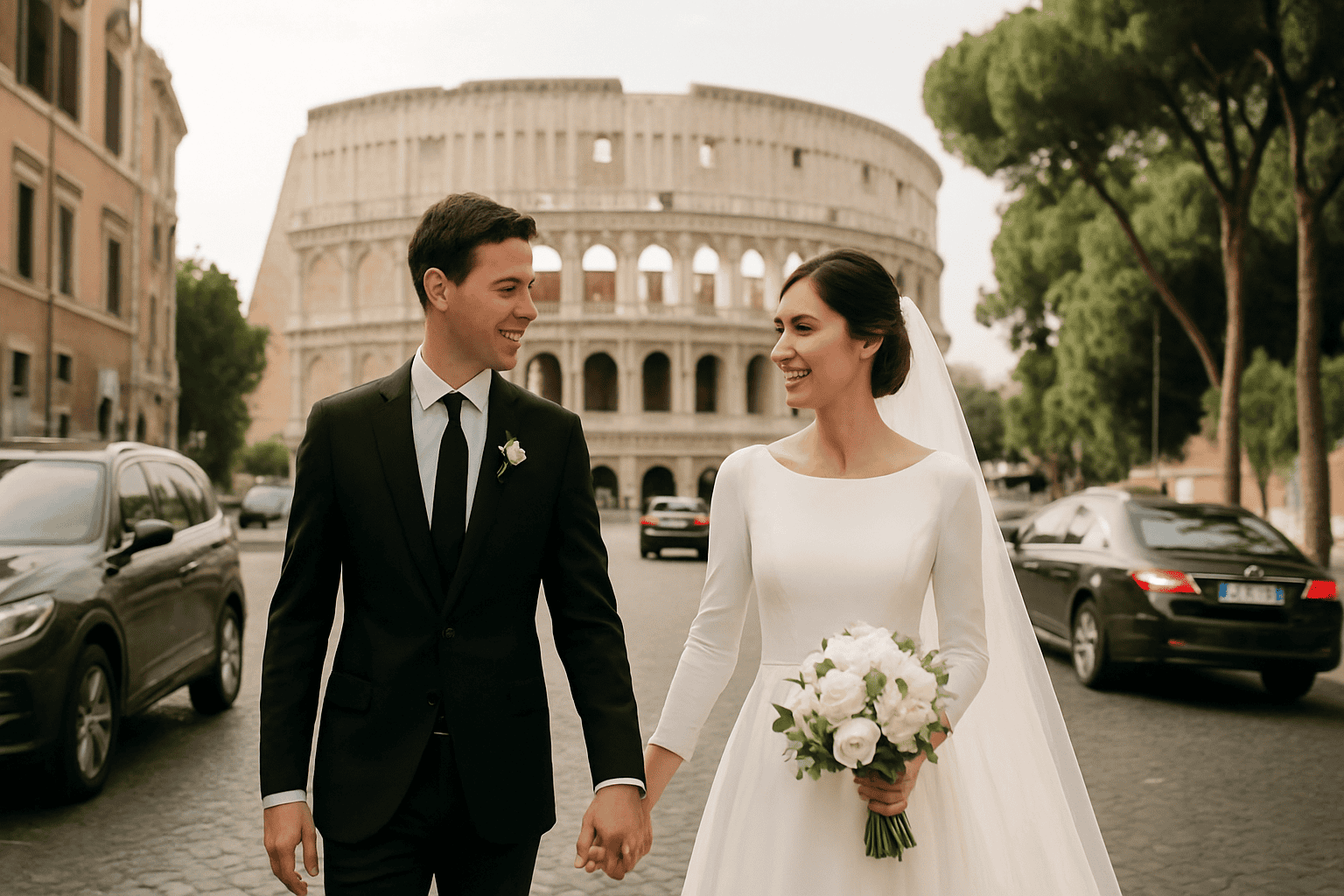
Wedding in Rome: ZTL management, transfers, and realistic times for photos and ceremony
Wedding in Rome: why logistics (and the ZTL) determine the success of the day
Rome it is a city that offers natural scenery, splendid light, and an immediately recognizable atmosphere: for this reason the wedding Rome is among the most desired, both by local couples and by those who choose a destination wedding. But precisely because Rome is alive, complex, and often unpredictable, the difference between a smooth day and a “jerky” day lies in the time planning and in the management of travel.
When it comes to Rome wedding logistics ZTL, it doesn’t just mean “figuring out where cars can enter”: it means designing a realistic route between getting ready, ceremony, photos and reception, taking into account traffic, access points, loading/unloading areas, parking, the most critical times and guest comfort. In other words: logistics are not a technical detail, they are part of the experience.
In this article you’ll find a practical and professional approach to building a credible (and enjoyable) day, with useful tips even if you’re working with a wedding planner or with vendors already selected. If you want an overview of the city, you can also consult In-depth: Rome (Wikipedia).
Rome Wedding: style, expectations and realistic timing between ceremony and photos
Every wedding has an identity: underwear, luxury, destination, traditional or contemporary. In Rome, however, whatever style you choose must contend with a simple truth: distances aren’t measured in kilometers, but in real minutes. And this is where many timelines that are “beautiful on paper” start to creak.
Goal and style: what changes in logistics
Style directly influences time management:
- Luxury and scenic: it often involves more setting changes (getting ready in a hotel, ceremony in the center, photos in multiple spots, reception in a villa). More changes = more risk, if transfers aren’t planned.
- Intimate and cozy: it can work very well with a “everything in one area” or “everything at the venue” approach, reducing travel and increasing the quality of time with guests.
- Destination wedding: it requires extra attention to orientation, punctuality and communication (language, maps, meeting points, luggage handling, jet lag).
What to really expect in terms of timing and travel
Rome doesn’t forgive timelines that are too tight. A realistic plan considers:
- buffer time between one moment and the next (even just to breathe, adjust the dress, do a touch-up, greet someone);
- boarding/alighting times from vehicles (especially with elderly guests or families with children);
- clear meeting points (a wrong entrance or a group split in two creates cascading delays);
- ZTL management and access for cars, vans, any technical vehicles and suppliers.
The most useful rule is this: fewer transfers, more quality. If you want more photo spots, it’s possible, but it must be built as a coherent route and not as an improvised “tour”.
Step-by-step planning: timeline, suppliers and guest transfers Rome
Effective planning isn’t an endless list of things to do: it’s a sequence of decisions in the right order. Here you’ll find an outline that works both for couples organizing on their own and for those who delegate part of the work.
Realistic timeline: from 12 to 2 months (without anxiety, with method)
12–9 months before
- Define the concept (style, priorities, atmosphere) and the scope: historic center, panoramic areas, Roman countryside, Castelli, etc.
- Lock in the choices that impact logistics: ceremony/reception venue and approximate times.
- Set a first draft of the journey (getting ready → ceremony → photos → reception), even if not final.
8–6 months before
- Select the key suppliers (photo/video, catering if needed, music, setups).
- Start designing the guest journey: where guests stay, how they arrive, how they move around.
- Evaluate the strategy for the guest transfers Rome: single shuttle, multiple runs, partnered taxis, meeting points.
5–3 months before
- Refine the timeline with the suppliers: arrival times, setups, soundcheck, deliveries.
- Definisci i loading/unloading points per sposi e ospiti (dove si scende davvero, non dove “sarebbe comodo”).
- Prepara una comunicazione chiara per gli invitati (anche multilingua se serve).
2 months–last weeks
- Conferma gli orari finali e inserisci margins tra i momenti più delicati (uscita cerimonia, trasferimento, ingresso ricevimento).
- Condividi un documento unico con tutti: contatti, indirizzi, accessi, timing, note per ZTL e parcheggi.
- Fai un check finale dei percorsi: se un dettaglio non è certo, check the product sheet o nella documentazione della location/servizio scelto.
Checklist fornitori essenziali (con focus sulla logistica)
Oltre ai fornitori “classici”, a Roma conviene dare priorità a chi impatta direttamente i tempi:
- Photos and videos: devono conoscere la timeline e i punti di ripresa; la loro mobilità influenza gli spostamenti.
- Transport: driver, navette, van; fondamentale coordinare orari, ritrovi e alternative.
- Location manager o referente: per accessi, ingressi secondari, aree di attesa, piano meteo.
- Coordination (wedding planner o wedding coordinator): utile soprattutto quando la giornata include più luoghi.
Gestione ospiti e trasferimenti: come evitare il “tutti in ritardo”
Il punto critico non è lo spostamento degli sposi (che si può “proteggere” con un’auto dedicata), ma lo spostamento del gruppo. Per i guest transfers Rome funzionano bene alcune scelte operative:
- Un punto di raccolta unico (hotel principale o piazzale comodo) con orario chiaro e margine.
- Simple communication: un messaggio con “dove, quando, come riconoscere il mezzo” riduce le chiamate last minute.
- Piano per ritardatari: taxi/ride alternative o seconda corsa, se coerente con la giornata.
- Guest distribution: if many are staying in different areas, consider multiple pick-ups or a central point reachable on foot.
In the city, the typical mistake is thinking that everyone moves “like a couple”: guests have different schedules, different needs, and different fatigue thresholds. Logistics serves to protect them.
Wedding logistics Rome ZTL: access, loading/unloading and smart routes
The ZTL and limited-traffic areas can become an obstacle only when they are discovered late. In the planning phase, instead, they can be managed with simple choices: correct arrival points, suitable vehicles, consistent schedules and a communication plan which avoids improvisation.
How to set routes without complicating the day
- Reduce location changes: one less transfer is often worth more than one more photo.
- Avoid “crossing” the city center at the most delicate moments (ceremony arrival, reception entrance).
- Plan a drop-off point convenient and safe: where to get out without blocking traffic and without making guests walk too much.
- Select nearby photo spots close to each other or along the same route, so the session stays enjoyable and doesn’t turn into continuous transferring.
Practical tip: “operational map” for vendors and guests
One of the most effective solutions is to prepare a mini operational map (also in digital format) with:
- exact addresses and correct entrances (not just the name of the venue);
- meeting points and times;
- notes on access and areas where not to stop;
- contact of a reference person (not the couple).
This document reduces misunderstandings and phone calls during the most emotional moments.
Realistic timing for photos, ceremony, and reception in Rome
Rome invites you to “do it all”: photos in multiple locations, iconic stops, sunset views. The secret is turning the desire into a sustainable plan, without draining energy from the ceremony and the party.
Photos: how to get variety without losing the day
To have different images without stress:
- Decide the priority first: do you want an intimate moment as a couple or more photos with guests and family?
- Agree on clear time windows with the photo/video team: when you shoot, where, with whom.
- Consider a “first look” if consistent with the style: it can lighten the post-ceremony and make the rest flow more smoothly.
- Don’t underestimate the micro-times: moving around, adjusting the dress, touch-ups, waiting.
An elegant approach is to choose one strong moment for couple photos (for example before the ceremony or during a short break), and then let the story continue naturally.
Ceremony: punctuality without rigidity
The ceremony is the heart: everything else must protect it. To avoid delays:
- set a guest arrival time more “comfortable” time than the actual start;
- define who welcomes and directs (hostess, witnesses, coordination);
- provide a entrance plan for the bride/groom that doesn’t depend on unexpected traffic issues.
Reception: entrance, cocktail hour, and smooth transitions
The reception works when transitions are invisible: guests understand what’s happening without having to ask. It helps a lot:
- a route with shelters welcome moment clear (water, directions, a point of reference);
- shared timing with music and catering;
- spaces designed to avoid “bottlenecks” (narrow entrances, lines at the cloakroom, etc.).
Priorities and smart choices: how to invest without waste (without talking about prices)
When organizing a wedding in Rome, the feeling of “having to add” is strong: the city offers so many options. In reality, the most successful days are those in which the priorities are few and clear, and every choice supports the experience.
Items that truly impact the outcome (and peace of mind)
- Location: not only beauty, but accessibility, waiting areas, weather plan, flow management.
- Photo/video: in Rome, the light and scenery are a heritage, but you need a team that knows how to work with realistic timing.
- Transport: they are often the “glue” between perfect moments and cascading delays.
- Coordination: someone who keeps schedules, people, and vendors together while you live the day.
Where to invest to maximize the scenic effect (without complicating)
For an elegant scenic effect, it’s worth focusing on:
- a memorable main setup (ceremony or dinner) instead of many micro-setups;
- lighting and atmosphere consistent with the venue;
- a palette and a concept that dialogue with Rome, without “covering it up”.
The city is already a backdrop: the goal is to enhance it, not compete with it.
Mistakes that increase complexity (and stress)
- Too many moves in a few hours.
- Overly optimistic timings between ceremony and reception, without any buffer.
- Guests left “on their own” in difficult areas: if everyone has to figure out on their own how to get there, delays are inevitable.
- Lack of a point person: if everyone calls the couple, the day gets broken up.
Plan B and risk management in Rome: weather, location constraints, and contracts
A well-designed wedding isn’t one without unexpected events: it’s one that absorbs them without ruining the experience. In Rome, the most common risks aren’t “dramatic”, but practical: weather changes, delays, non-linear access, setup times longer than expected.
Weather: credible alternatives (not “makeshift solutions”)
Plan B must be:
- already beautiful (not a bare secondary room);
- communicable (guests must understand where to go without confusion);
- compatible with catering, music and photos.
If the venue offers multiple options, ask to see the alternative spaces and understand how the flows change. If a detail isn’t certain, check the product sheet or in the venue proposal.
Permissions and constraints of the location: what to clarify immediately
Without going into specific regulatory aspects, it’s useful to clarify with the venue:
- access times for suppliers and technical vehicles;
- loading/unloading areas and internal routes;
- spaces for waiting and transitions (cocktail, room change, cake cutting);
- operational restrictions that impact music, lights, setups.
Contracts and deposits: protecting the timeline as well as the services
A well-structured contract isn’t just “what’s included”, but also how and when the service takes place. From a logistics perspective, it’s useful for these to be clear:
- arrival times and end of service;
- setup/breakdown times;
- responsibility for delays and schedule changes;
- communication methods in case of changes.
Guest experience in Rome: welcome, mobility and clear communication
A wedding in Rome can also be a small trip. Taking care of the guest experience means making them feel guided, welcomed and at ease, especially if they don’t know the city.
Welcome moment, activities and hospitality (without overloading)
For a destination wedding or for guests arriving from out of town, it works well:
- a welcome moment simple (at the hotel or at the venue) with practical information;
- light activities (a few, selected) that don’t compete with the wedding day;
- useful information about travel, timing, dress code, and contacts.
Transportation, shuttles, parking: how to make them actually work
Mobility is a central part of the wedding Rome. To make it smooth:
- choose easy meeting points that are easy to find and reach;
- specify a departure time and an “arrive by” (two different pieces of information, both useful);
- provide an alternative for those traveling independently;
- if there are guests with specific needs, plan ahead (accessibility, longer timings, assistance).
Clear directions and wedding website: fewer messages, more peace of mind
A wedding website (or a well-made digital document) drastically reduces last-minute questions. It should include:
- addresses and maps;
- schedules and dress code;
- how to get between locations;
- point of contact for the day.
If you want a broader guide to the overall process, you can find useful resources and in-depth information here: How to organise a wedding.
Practical questions that always come up when planning a wedding in Rome
When you get into the details, the same questions often come up: how much time do you really need to get around? How do you avoid delays? How do you handle the ZTL without stress? In the FAQs below you’ll find concise, practical answers, designed to help you build a smoother, more enjoyable day.
Do you want full direction, with realistic timings and transfers without surprises? If you’re planning a wedding in Rome and want professional management of the day (from the Rome wedding logistics ZTL to coordinating vendors and welcoming guests), explore ChiaraB Events’ services and insights in the section dedicated to planning: the goal is to turn complexity and travel into an elegant, seamless, and memorable experience.
FAQ
How to manage wedding logistics in Rome's ZTL without stress for guests and suppliers?
Start from the actual arrival points (drop-off) and not just from the addresses, then build a route with few location changes and buffers between key moments. Share an “operational map” with correct entrances, times, contacts, and notes on the points where not to stop. If information about access points is not certain, verify it in the product sheet or in the documentation of the location/transport service.
What is the most common mistake in guest transfers in Rome?
Leaving guests completely on their own without a meeting point and without simple instructions. In a complex city, this creates cascading delays and many calls to the newlyweds. Better to plan a single meeting point, a clear departure time, and an alternative for those who arrive late.
How to make the timing between the ceremony, photos, and reception in Rome realistic?
Insert buffer time between each phase, limit movements, and choose consistent photo spots that are close to each other. Agree in advance with the photo/video team on precise time windows (when and where) and define who coordinates guests during transitions. A “softer” timeline often produces a more elegant and less stressful result.
Is it better to take couple photos before or after the ceremony at a wedding in Rome?
It depends on the style and the day. Before can lighten the post-ceremony and reduce pressure on transfers; after keeps the tradition but requires a well-protected time window and minimal travel. The best choice is the one that preserves the ceremony and the presence of the newlyweds with the guests.
What should a good Plan B for a wedding in Rome include?
An alternative space that is already beautiful and consistent with the style, clear routes for guests, and compatibility with catering, music, and photos. Plan B shouldn't feel like a makeshift solution: it should be conceived as a complete second direction, ready to start without confusion.
How can you effectively communicate travel arrangements and schedules to guests?
Use a single channel (wedding website or digital document) with addresses, maps, times, dress code, how to get around, and a point of contact other than the couple. Keep messages short, repeating only the essential information: where to meet, at what time, and how to recognize the vehicle.
From the blog
 Rome
Rome
Luxury elopement in Rome: shooting itinerary between historic center and rooftop
Luxury elopement in Rome between historic center and rooftop: goal, style, and rhythm of the day A luxury elopement in Rome […]
Read more Rome
Rome
Castelli Romani: villas and historic residences for an elegant wedding near Rome
Villas in the Castelli Romani for weddings: why this format really works Choosing the Castelli Romani for an elegant wedding means […]
Read more Rome
Rome
Photo permits in Rome: what to ask for and how to avoid problems at iconic locations
Wedding photo permits in Rome: why to get informed before shooting Rome is a natural stage: squares, fountains, staircases, historic parks, glimpses […]
Read more