
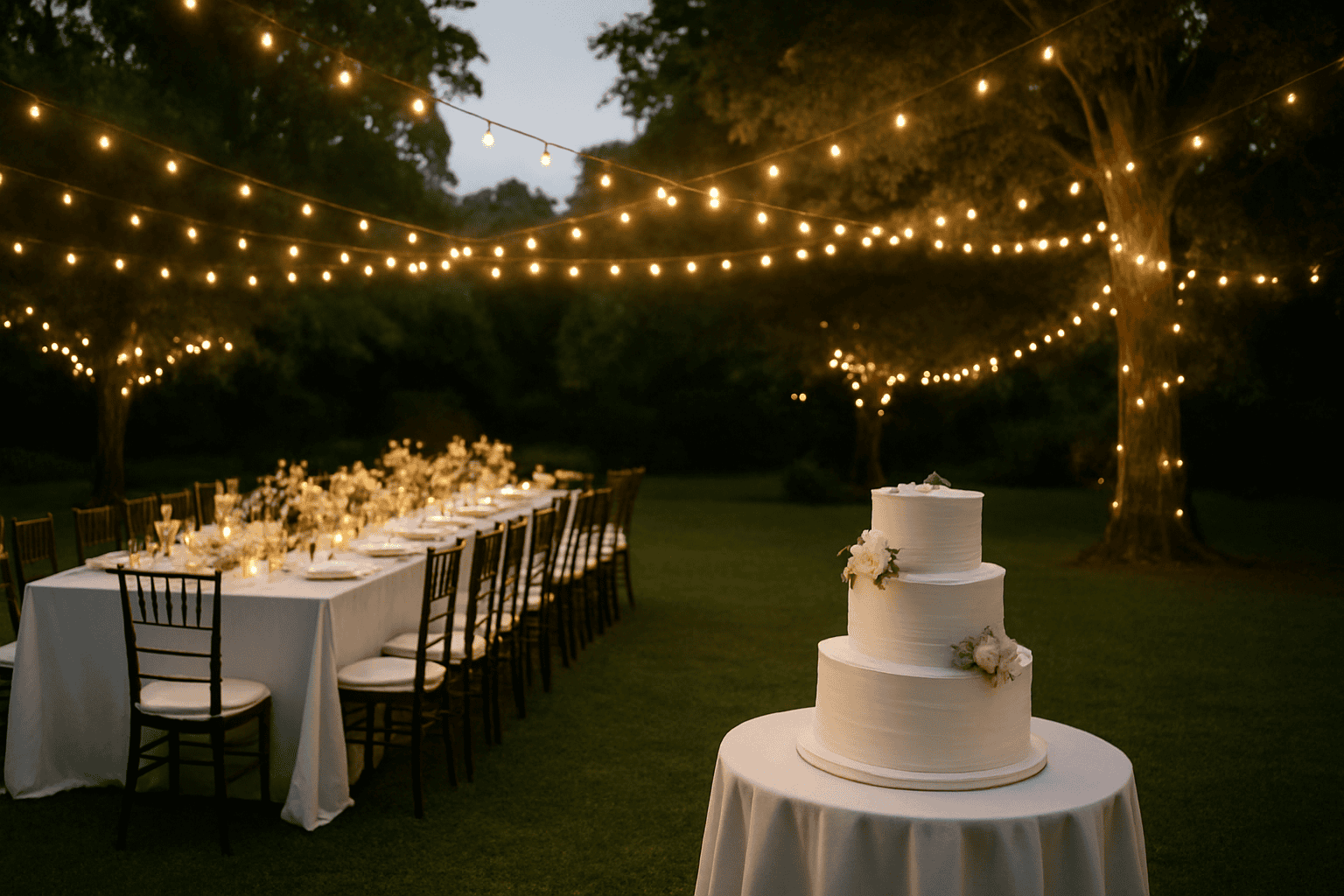
Scenic lighting: how to design lights for dinner, cake cutting, and party
Wedding lighting design: why light really changes the reception
At the reception, light isn’t only there to “see”: it builds atmosphere, guides the eye, and sets the pace for key moments. A wedding theatrical lighting well-designed one can turn an already beautiful venue into a memorable experience, because it defines volumes, enhances details, and creates that sense of an “event” that photos and videos capture powerfully.
When it comes to lighting design wedding, the goal isn’t to fill the space with effects, but to tell a story consistent with the chosen style: romantic and soft, contemporary and graphic, intimate and warm, or more theatrical and dynamic for the party. The difference is felt especially in three moments: dinner, cake cutting e after party, which require different intensities, temperatures, and “accents”.
Goal and style: luxury, intimate, destination
Before choosing types of lights and placements, clarify the style you want to achieve. Some typical directions:
- Contemporary Luxury: clean lines, targeted accents on architecture, a controlled lighting palette, great attention to symmetry.
- Intimate and convivial: warm light, closely spaced light points, an “islands” atmosphere that invites people to stay and chat.
- Destination: enhancement of the landscape, integration with local elements (courtyards, gardens, terraces), soft transitions between outdoors and indoors. If you’re planning a wedding far from home, you may find this link useful: Insight: Destination wedding (Wikipedia).
The practical rule is one: the light must seem “born” in the venue, not placed on top of it. For this reason, the design always starts with a site visit (or with floor plans and updated photos) and a discussion with catering, the floral designer, and music.
What to expect in terms of timing and logistics
The scenic part takes time: setups, tests, alignment with the other installations. Even without going into technical details, it’s useful to know that:
- the lighting is designed in advance and checked on site (better if in a time slot similar to that of the event);
- often two lighting “souls” are needed: one for dinner (softer) and one for the party (more dynamic);
- logistics change a lot between indoors and outdoors: for the outdoor wedding lights solutions consistent with the spaces, access, and constraints of the venue must be planned.
The best result is achieved when light is conceived as part of the reception project, not as a last-minute add-on.
Step-by-step planning for dinner lights, cake cutting and party
Effective planning follows a clear sequence: defining the concept, mapping the spaces, scenic priorities, timing, and only then choosing the solutions. Below you’ll find a practical method, designed to avoid second thoughts and lighting “gaps” during the most photographed moments.
Realistic timeline (from 12 to 2 months)
- 12–9 months before: definition of the mood and style of the reception; initial indications on times (sunset, dinner, party) and spaces (outdoor or indoor dinner, cake area, dance area).
- 8–6 months before: site inspection or collection of materials (floor plans, updated photos); draft lighting project with “focus points” (couple’s table, guest tables, pathway, cake, band/DJ).
- 5–4 months before: alignment with catering and floral; definition of any scene changes (for example moving from dinner to party in another area).
- 3 months before: final review of the project; confirmation of setup and rehearsal timings; definition of the outdoor plan B.
- 2 months before: check of the “invisible” but crucial details: pathways, signage, dark spots, transitions between areas, visual comfort.
If the venue is complex or on multiple levels, making choices early avoids improvised solutions that risk breaking the harmony of the setup.
Essential vendor checklist (for a cohesive wedding lighting design)
The lighting design wedding works when all vendors speak the same language. During coordination, make sure there is alignment between:
- Wedding planner / coordinator: manages timing and experience priorities.
- Location: indicates constraints, usable areas, access points and internal rules.
- Catering: defines table layout, service routes, dinner and cake timing.
- Floral and staging: flowers and structures change volumes and shadows, so they influence the light.
- Photos and videos: it’s useful to share the style (warm, natural, more contrasty) to avoid surprises in post-production.
- Music/DJ: the party requires different dynamics compared to dinner.
In practice: first you design the experience, then you light it. Not the other way around.
Guest management and transfers: light as a guide
At the reception, light is also orientation. A well-lit path reduces confusion, delays and “dead zones”. That’s why it’s worth planning for:
- welcome light points upon arrival (entrance, welcome drink);
- lighting transitions between areas (aperitif → dinner → cake → party);
- visual signals to indicate services and passageways without intruding on the aesthetics (for example with warmer or more intense light in specific spots).
This aspect is particularly important for outdoor wedding lights, where the perception of space changes a lot after sunset.
Budget and priorities: where to invest to maximize the scenic effect
Talking about budget doesn’t mean talking about numbers: it means choosing priorities. At the reception, some areas “deliver” more than others because they are central to the experience and to the photos. The best strategy is to distribute light the way you would stage a direction: with a protagonist, supporting roles, and a coherent background.
Main items to consider (without getting lost in the details)
To plan realistically, consider these macro-areas:
- Design and direction: concept, lighting map, consistency between moments.
- Ambient lighting: create a pleasant lighting base for dinner and pathways.
- Scenic accents: enhance architecture, trees, walls, details.
- Special moments: cake cutting, first dance, speeches.
- Party: dynamics and atmosphere, without “crushing” the wedding’s elegant mood.
If you are considering specific solutions, check the product sheet the lighting output and the recommended use for indoor/outdoor: it’s a detail that affects the final coherence.
Where to invest to maximize wedding scenic lighting
If you have to choose, focus your design energy on three areas:
- Dinner area: it’s the longest moment. Well-calibrated light makes the atmosphere immediately feel “curated” and comfortable.
- Cake cutting: it’s a set. Here the light must be intentional, clean, without unpleasant shadows on the face.
- Dancefloor: it’s the change of pace. It needs a different scene, but harmonious with the rest.
A very effective directing trick is to create a progression: warm, soft welcome, enveloping dinner, cake with a theatrical focus, more energetic party. This way each moment feels “new”, while remaining coherent.
Mistakes that increase costs (and reduce the effect)
- Deciding late: when layouts and schedules are already set, light becomes a compromise.
- Ignoring shadows: flowers, structures and trees can create dark areas on tables or on the cake set.
- Too much uniformity: lighting everything the same way flattens the scene; better hierarchies and accents.
- Disconnected party: a dancefloor that’s too aggressive compared to the dinner can “break” the overall elegance.
- Neglecting pathways: if guests don’t understand where to go, the experience loses flow.
Plan B for outdoor wedding lighting and risk management at the venue
When the reception is outdoors, the light is wonderful but more exposed to the unexpected. A plan B is not a fallback: it’s a second direction ready to go, consistent with the style, that avoids stress and rushed decisions.
Weather and alternative solutions without losing the scenography
For the outdoor wedding lights, plan a credible alternative from the start. Some useful approaches:
- Double set: a main outdoor scene and an indoor “mirror” one for cake or party, already designed harmoniously.
- Quick transitions: if you change area, the light must accompany the move and not make an abrupt “cut” noticeable.
- Priority to key moments: if the weather forces choices, save the cake and first dance first, then the rest.
The most important thing is that plan B is photogenic as much as plan A: otherwise the event changes tone right at the most anticipated moment.
Permissions and constraints of the location: what to ask before
Every venue has rules and limits. Without getting into regulatory aspects, it’s useful to clarify in advance:
- where scenic elements can be placed and where not;
- which areas must remain clear for safety and service;
- times and access procedures for setup and rehearsals;
- any restrictions on fixings, supports, or cable runs (if planned).
This information directly affects how to build a wedding theatrical lighting elegant and “clean”.
Contracts and deposits: protecting the event direction
From an organizational point of view, lighting is a service that depends on timing and coordination. To avoid misunderstandings, it helps if the following are clear:
- what is included (design, setup, assistance during the event, any scene changes);
- timelines access and teardown;
- liability in case of layout changes or moves between areas;
- terms in case of a plan B or an internal location change.
If something isn’t spelled out, ask for it to be clarified beforehand: lighting is direction and it works when it doesn’t have to chase last-minute decisions.
Guest experience: how to use light for welcome, comfort, and rhythm
A successful reception feels “easy”: guests understand where to go, move naturally, and experience every moment without friction. Light can make everything more intuitive, as well as more beautiful.
Welcome moment, activities, and hospitality: creating atmosphere without confusion
First impressions matter. On arrival, welcoming light immediately conveys care and warmth. Some direction ideas (without getting into product solutions):
- recognizable entrance with a light point that “invites” and makes the arrival photo-friendly;
- welcome drink area with soft, even light, to encourage conversation and first shots;
- special corners (guestbook, cigar bar, photo area) highlighted with discreet accents, so they don’t get lost in the dark.
In a lighting design wedding when well thought out, the guest doesn’t notice the “trick”: they only feel that the atmosphere is right.
Transport, shuttles, parking: safety and orientation with outdoor wedding lights
When the venue has distant parking, paths, or level changes, lighting isn’t just scenery: it’s comfort. For the outdoor wedding lights it’s worth planning for:
- readable pathways between parking and entrance, without glare;
- waiting points for shuttles or taxis with enough light to find your way;
- passage areas between different spaces (courtyard → hall, garden → terrace) with lighting continuity.
The result is a smoother event, with fewer interruptions and more relaxed guests.
Clear directions and wedding website: consistency between information and set design
Light works even better when it’s supported by clear communication: schedule, map, dress code, guidance on shoes for grass or any area changes. If you’re building the overall direction of the day, it can help to start from a complete guide like How to organise a wedding, so you can integrate light, timing, and logistics into a single project.
In particular, if you’re planning multiple “scenes” (aperitif in one spot, dinner in another, cake elsewhere), sharing this information with guests in advance reduces chaotic movement and lets you enhance each area with the right lighting atmosphere.
Designing the three key moments: dinner, cake cutting, and after party
To achieve a truly scenic effect, it’s worth thinking of the reception as three acts. Each act has different lighting, but the overall palette remains consistent. Below you’ll find a practical guide to avoid the most common mistakes and get clean images.
Lights for dinner: warmth, flattering faces, and “alive” tables
During dinner, the priority is comfort: guests need to see each other well, the food should look inviting, and the atmosphere must remain elegant. In terms of direction:
- avoid overly harsh contrasts that create shadows on the face;
- create a uniform base and then add accents on scenic elements (trees, walls, architectural details);
- think about depth: don’t light only the tables, but also the background, to give photos three-dimensionality.
If dinner is outdoors, the light must also “contain” the space: without a luminous frame, the garden can become a black void beyond the tables.
Cake cutting: a scenic set with a clean focus
The cake cutting is one of the most anticipated and most photographed moments. Here the light has to do one specific thing: bring the attention to the two of you and on the cake, without distractions. It works well when:
- the cake area is visually separated from the rest (even just with a change in intensity or direction of the light);
- the background is well curated: a wall, a tree, a panoramic view enhanced by subtle accents;
- the guests’ path to the cake is clear, so the moment begins without waiting or confusion.
If you plan cold sparks, light fountains, or other scenic elements, make sure the main light remains readable: the effect must complement, not cover.
After party: energy, dynamism, and consistency with the style
The party is a change of language: from conversation to dancing. Here the light can become more rhythmic, but without losing elegance. A good balance is achieved when:
- the dancefloor is clearly identified (even in large spaces);
- there are decompression zones (lounge, bar, outdoor area) with softer light;
- the scene does not “invade” the dinner if the spaces are close: each area must maintain its function.
In a lighting design wedding If it’s well curated, the party is also photographable: there’s no need to turn everything into a club, just give a visual rhythm consistent with the event.
Questions to ask the lighting supplier before confirming the project
To choose with peace of mind and get a result up to standard, here are some useful questions to ask (or to clarify with whoever coordinates):
- Which areas of the reception will be lit and with what priority?
- Is a scene change planned between dinner, cake, and party?
- How is plan B handled if dinner or the cake move indoors?
- Will there be a rehearsal or an on-site check at a time similar to the event?
- Who coordinates with catering, music and floral setups during setup and the event itself?
These questions help you understand whether the proposal is truly a project for wedding theatrical lighting or just a set of lights not integrated into the direction of the reception.
A reception that “lights up” at the right moment: direction makes the difference
Light is one of the most powerful tools for transforming the venue and making every phase of the reception recognizable, emotional and coherent. If you want to build a complete project — from the timeline to logistics, all the way to the lighting scenography for dinner, cake cutting and party — rely on expert direction: on ChiaraB Events you’ll find inspiration and a method for organizing a wedding with a guest experience cared for in every detail.
[w4y_bf_related_posts post_id=”34943″]
FAQ
What is the difference between wedding scenic lighting and simple technical lighting?
Technical lighting ensures visibility; wedding scenic lighting adds direction: it creates atmosphere, visual hierarchies, and enhances the venue and key moments (dinner, cake, party) in a way that is consistent with the style.
How to manage outdoor wedding lighting when it gets dark?
It is worth planning a luminous base for tables and pathways, plus more accents on backgrounds and volumes (trees, walls, architecture). A gradual transition between sunset and night is also useful, so the scene remains natural and comfortable.
For the cake cutting, is it better to stay close to the dinner or create a dedicated area?
It depends on the location and the guest flow. A dedicated area often makes the moment more “set-like” and orderly, but it only works if the route is clear and the background is well taken care of. In any case, the lighting must draw attention to the couple and the cake without unpleasant shadows.
How to prevent the party from ruining the elegance of the reception?
Separating the scenes: a recognizable and more dynamic dancefloor, but with a coherent palette; lounge and bar areas with soft light; be careful not to encroach on the dinner area if the spaces are close. Good wedding lighting design keeps the energy without losing style.
When should you start planning the wedding lighting design?
Ideally together with the reception concept and the definition of the spaces. In practice, it is useful to start several months in advance to coordinate layout, flowers, catering and music, and to build a credible plan B if outdoor areas are planned.
What should you ask the venue to avoid surprises with the lighting?
Ask about constraints on usable spaces, access for setup and testing, areas that must remain clear for service and passageways, and rules on any fixings or supports. This information directly affects the feasibility of the lighting set design.
From the blog
 Reception
 Elegant open bar: quantity, signature cocktails, and how to avoid waste
Elegant open bar: goals, style, and time management A well-designed open bar is not “just” a beverage service: […]
Read more