




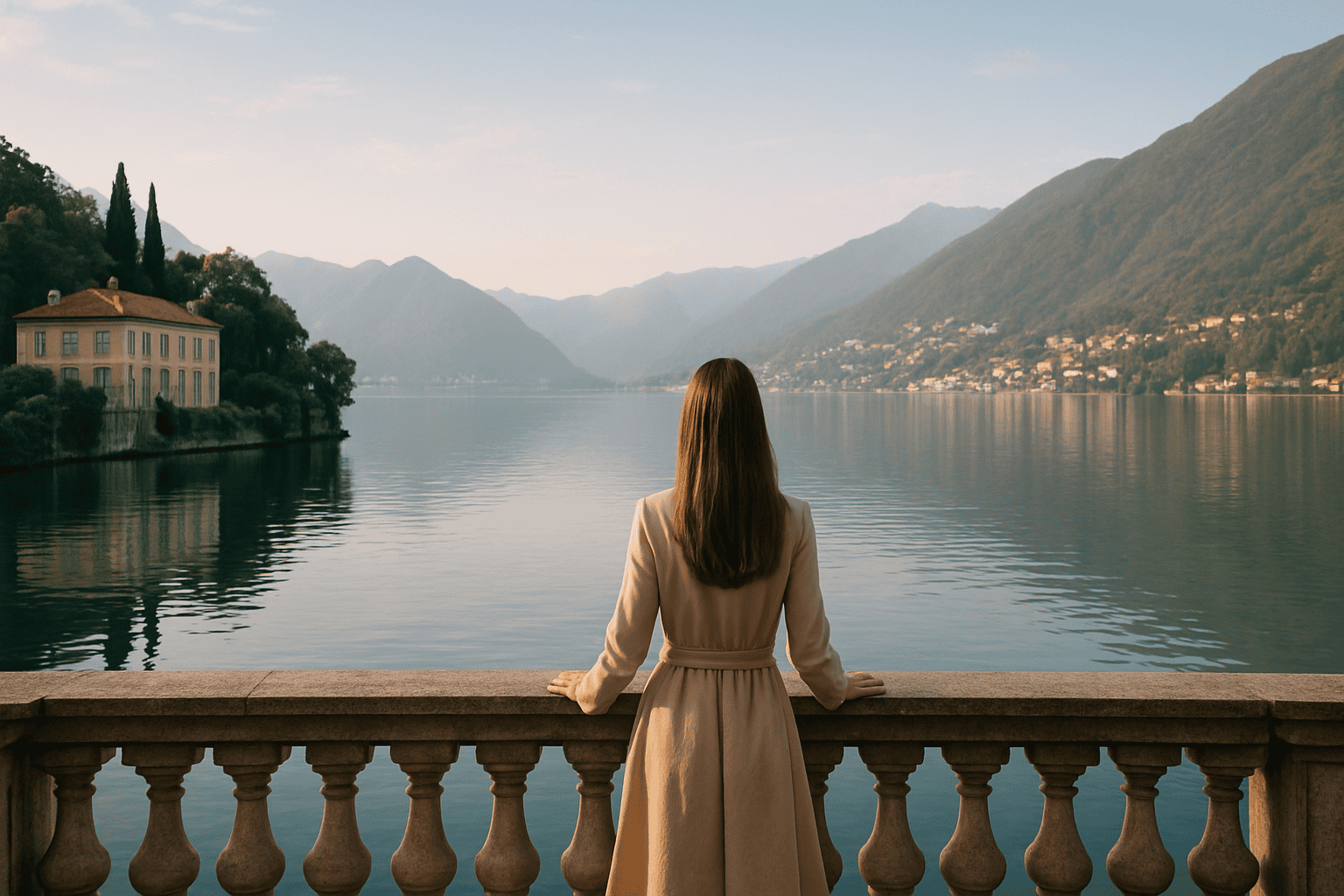
Creating editorial photos Lake Como means working in an iconic but also complex setting: rapidly changing light between mountains and water, significant tourist flows, often regulated access, and private locations with specific policies. If the goal is a “magazine” style shoot (refined, narrative, with curated aesthetics and scene details), three elements make the difference: times, spot e photo permits.
In this guide you will find practical tips to plan an editorial shoot on Lake Como: when to shoot, where to find the most effective shots, how to move between villas, gardens, piers, and villages, and what checks to make before arriving on site. For an overview of the territory and its geography, you can also consult Insight: Lake Como (Wikipedia).
Editorial photos on Lake Como: why this format works
Goal and style: luxury, intimate, destination
The editorial shoot is not “just” a photo shoot: it is a visual narrative that enhances atmosphere, architecture, landscape, and styling. On Lake Como this approach works because the territory offers:
- Natural settings (water, mountains, terraced gardens) that also hold up well with a minimal aesthetic.
- Recognizable architectures (historic villas, small harbors, staircases, loggias) perfect for an editorial style.
- Destination vibe: even an intimate shoot can appear international if you take care of details, palette, and the rhythm of the shots.
Whether you are building a portfolio, a service for a brand, or an inspirational story, the goal is the same: to create images that seem “inevitable,” as if that place was made for that story. To get there, planning is needed.
What to expect in terms of timing and logistics
Lake Como is beautiful, but not always straightforward. Expect:
- Slower movements than expected (narrow roads, traffic, limited parking).
- Regulated access in many areas (villas, gardens, private piers, event areas).
- Variable lighting conditions: sharp shadows in the morning on some shores, strong backlight in the afternoon, reflections on the water.
In practice: a “lean” but realistic plan is often more productive than an endless list of spots. Better to have a few carefully chosen locations, with buffer times and ready alternatives.
Step-by-step planning for shooting and photo permits on Lake Como
Realistic timeline (from 12 to 2 months)
When it comes to shooting villa Como and prestigious locations, planning is an integral part of the outcome. A useful timeline, to be adapted to the project, can be:
- 12–8 months before: concept definition (mood, palette, styling), choice of macro-area (Como shore, Lecco shore, central lake), first list of spots and alternatives.
- 8–6 months before: contacts with private locations, availability check, access rules and image policies; draft call sheet.
- 6–4 months before: team confirmation (photo, video if planned, styling, make-up/hair), site inspection or digital scouting with maps and light schedules.
- 4–2 months before: finalization of logistics (transfers, parking, possible boat), weather plan, releases and required documentation.
If you are working on a project related to an event or a wedding, it can be useful to integrate the vision with a broader guide like Wedding on Lake Como: guide, because many dynamics (timing, access, flows) are the same even for an editorial shoot.
Essential supplier checklist
For a credible editorial, it’s not enough to just “arrive and shoot.” Here is an essential checklist, to be adjusted based on the ambition of the project:
- Photographer with experience in natural light and managing crowded locations.
- Styling (wardrobe and props) consistent with the architecture and the season.
- Hair & make-up with quick retouching skills (wind, humidity, sun).
- Assistant(s) for equipment management, outfit changes and timing.
- Planner/producer (even light) for call sheet, contacts, permits and logistics.
A practical reference to avoid missing pieces, especially if the shoot is connected to an event, is a checklist structured like Organizing a wedding: checklist: many items (timeline, contacts, plan B) are transferable 1:1 to the shooting world.
Guest and transfer management (even for small sets)
Even if the team is small, Lake Como “amplifies” every micro-delay. For this reason, it’s advisable to set a production logic:
- Single meeting point close to reliable parking.
- Staggered times for those who need to prepare (hair/make-up first, styling after).
- Reduced transfersTwo well-chosen spots often perform better than five “bite and run” spots.
- Buffer between one scene and another for traffic, outfit changes, and unforeseen events.
If the project involves formal moments (symbolic ceremony, vow exchange, “wedding inspired” set), it can be useful to also know the organizational framework of a ritual: Civil wedding: requirements and timing helps to understand the difference between editorial aesthetics and the constraints of a real day.
Best times and priorities: how to maximize the scenic effect
Best times for an editorial look (without chasing the light)
The best times depend on the shore, the orientation of the spot, and the desired effect. In general, for editorial photos Lake Como three windows work:
- Early morning: clean atmosphere, fewer people, soft reflections. Ideal for piers, lakesides, and villages before they fill up.
- Late morning / noon: harder and more contrasted light. It can be perfect if you are looking for a graphic editorial with sharp shadows, architecture, and lines.
- Golden hour and blue hour: romantic mood, softer skin, “alive” water. Great for intimate scenes, silhouettes, details, and portraits.
Practical note: if you work near water, always consider reflections e backlight. Sometimes just moving the set a few meters can turn a “difficult” shot into a cover.
Where to invest to maximize yield (without complicating production)
When you want an editorial result, it’s worth investing energy in what is really seen in the photo:
- Spot choice: better a place with few but strong elements (stairs, arch, pier, garden) than a “full” and confusing one.
- Consistent styling: colors and textures that interact with stone, iron, green, and water.
- Timing: arriving 20 minutes early often matters more than adding an additional location.
- Set management: order, simplicity, rhythm. Editorial is also subtraction.
If the project includes a villa or a historic garden, the “scenic” is already there: the key is not to overload. A bouquet or a well-chosen prop can be enough to give direction to the image.
Mistakes that worsen the result (and complicate timing)
- Too many spots in one day: Lake Como does not forgive tight travel schedules.
- No plan for the crowd: some spots are always busy; a strategy for framing and timing is needed.
- Ignoring permits: arriving and “hoping” can turn the shoot into a race against time.
- Not accounting for wind/humidity: hair, light clothes, and props must be managed with kits and assistance.
Spots and locations: villas, villages, piers, and gardens for shoots on Lake Como
Villas and gardens: the immediate “editorial” effect
Villas (private or visitable) are often the strongest choice for a shooting villa Como because they offer a variety of sets within a few meters: staircases, terraces, balustrades, greenhouses, pergolas, lake views. Before including them in the plan, always check:
- Access and photo/video rules (policy for editorial, brand, commercial use).
- Available hours and windows to avoid overlaps with visits or events.
- Allowed areas (some zones may be excluded).
- Equipment limits (tripods, lights, stands, etc.): if uncertain, check the product sheet or in the location's information sheet.
Creative advice: in a villa, alternate wide shots (context) with details (hands, fabrics, architectural elements). It’s the mix that gives editorial “breath.”
Villages and lakesides: authenticity, but direction is needed
The villages on Lake Como work when you want a more spontaneous and narrative style: alleys, doors, small squares, stairs leading down to the lake. Here the challenge is managing foot traffic. Useful strategies:
- Shoot early to have cleaner backgrounds.
- Use smart focal lengths and angles to isolate the subject and reduce “modern” elements.
- Create micro-scenes (walking, pause, gesture) instead of posing too much: the editorial should not seem rigid.
Piers, boats, and perspectives from the lake
The pier is one of the most requested sets because it immediately gives depth and minimalism: lines that lead the eye, water as a background, natural movement. If you plan shots from a boat or with a boat:
- Consider safety (shoes, long clothes, protected equipment).
- Plan for the wind: it affects hair, veils, clothes, and stability.
- Evaluate the light: on the water it changes quickly; having a plan of essential poses helps.
For some shots it may be necessary to coordinate with managers or local operators; if it is not clear what is allowed, check with the provider before the date.
Photo permits on Lake Como and location restrictions: what to really check
When permits are needed and when access is enough
The theme photo permits it is central: on Lake Como you can find yourself in very different contexts (public space, accommodation facility, private villa, visitable garden, managed pier). In general, what you need to clarify first is:
- Who is the owner/manager of the area where you want to shoot.
- What is the use of the images (editorial, portfolio, brand, adv): the same location can treat them differently.
- How many people and what equipment you will bring: this can also change the conditions.
If you are working on a project that could be published or sponsored, it is even more important to have written answers. Do not assume that “editorial” automatically means “free”: every location has its own policy.
Frequent requests from locations (and how to prepare)
Many locations ask for similar information. Preparing a concise document saves you time and positions you as a professional team. Include:
- Date and time slot requests (with alternatives).
- Number of people present on set.
- Equipment description (without unnecessary technicalities).
- Concept and purpose of the shooting.
- Operational needs (outfit changes, support area, car access).
If the location requires forms or releases, filling them out in advance prevents the shoot from starting “on a difficult note”.
Privacy, third parties and images in shared spaces
In public or tourist places it is easy for people to appear in the background. To maintain a clean editorial aesthetic:
- Frame selectively and use architectural elements as backdrops.
- Wait for micro-windows of free passage: often 30 seconds is enough.
- Prefer less crowded times and weekdays when possible.
If the project requires “controlled” images (empty backgrounds, exclusive set), the most reliable way remains a reserved location or a dedicated time slot.
Plan B and risk management: weather, access, and contracts
Weather and alternative solutions without losing consistency
The weather on the lake can change quickly. An effective Plan B is not just “let’s shoot indoors,” but a list of alternatives consistent with the mood:
- Porticoes, loggias, greenhouses: maintain natural light and architectural context.
- Bright interiors with large windows: perfect for details, portraits, and still life.
- Narrative scenes (reading, toasting, preparation): the editorial also lives through moments.
If you plan an outdoor set with delicate clothes or sensitive props, organize a “weather window” and a shooting sequence that secures the essential images first.
Permissions and location constraints: what can block a shoot
The most common unforeseen events are not creative but logistical. Some examples:
- Access denied to docks or gardens because they are reserved or under maintenance.
- Overlapping events that change flows and availability.
- Equipment limitations (tripods, lights, drones): don’t assume, ask.
There is only one solution: written confirmations, updated call sheet, and alternatives already prepared. If an operational detail is uncertain, check the product sheet or in the location information sheet before finalizing the timeline.
Agreements, deposits and conditions: how to avoid misunderstandings
Without going into specific aspects, it is good practice to always clarify:
- Access times and tolerances (entry/exit).
- Included areas and excluded areas.
- Image usage rules and credits, if requested.
- Postponement conditions in case of weather or force majeure.
Clearing everything up beforehand makes the shooting smoother and protects the team's work.
Guest and team experience: hospitality, transport and clear directions
Welcome moment and energy management on set
A successful editorial also depends on the energy of the people involved. A small “welcome moment” (even informal) helps to set the pace and focus:
- Quick brief on objectives, mood and shot sequence.
- Essential kit (water, wipes, makeup touch-up, pins, fashion tape).
- Support space tidy for changes and props.
When everyone knows what happens next, the set becomes lighter and the images more natural.
Transport, shuttles, parking: the invisible part that saves the day
Logistics on Lake Como is often the real “director” of the result. Some choices that reduce stress:
- Planned parking (not improvised) and equipment drop-off point.
- One less car when possible: a single vehicle or coordinated transfers simplify.
- Realistic travel times, especially between shores and lake center.
If you plan multiple sets in a day, build the timeline in “circles”: first what is nearby, then what requires travel, and finally a simple closing (portraits, details) that holds up even if you are late.
Clear directions and wedding website (also for shooting)
You don't need a complex site, but a single page or document with all the information reduces messages and confusion. Include:
- Timings with meeting points and contacts.
- Map and parking instructions.
- Dress code for team and talent (if planned) and weather notes.
- Set sequence and approximate times.
This approach, typical of event organization, is also perfect for an editorial shoot: less operational friction, more space for creativity.
Practical tips for a coherent editorial result (even with little time)
Build a mini shooting schedule
To avoid coming home with beautiful but “disconnected” images, create a simple narrative schedule:
- Establishing: 2–3 shots that tell where you are (villa, garden, lake).
- Portrait: 3–5 clean shots, without too many variables.
- Details: hands, fabrics, accessories, architectural elements.
- Moment: a micro-action (walking, glance, gesture) to bring the editorial to life.
Reduce “noisy” elements
Lake Como can be visually rich: boats, signs, tourists, random colors. If you want a luxury and clean look:
- Choose continuous backgrounds (clear walls, hedges, water) when possible.
- Work by palette: few colors repeated among outfits, props, and flowers.
- Check the lines: horizon, railings, stairs. The editorial lives on geometry.
Photo permits: organize communication professionally
If you need to request access or authorizations, send a clear and brief email with essential attachments. A professional tone and a well-structured request increase the chances of getting quick responses, especially in high season. If in doubt about policies and image use, explicitly ask what is allowed: it is the simplest way to avoid misunderstandings.
Useful links for those planning a project on Lake Como
- Wedding on Lake Como: guide to help you navigate locations, logistics, and style.
- Organizing a wedding: checklist to set a solid timeline and not forget key steps.
- Civil wedding: requirements and timing if the shooting is intertwined with a ceremony or “wedding inspired” content.
Do you want to turn an idea into a truly coherent editorial on Lake Como? Chiara B Events supports projects and destination weddings with careful direction on aesthetics, timing, and locations: discover inspirations and approach in the section dedicated to Wedding on Lake Como: guide and contact us to build a tailored plan. Lake Como offers breathtaking scenery that can turn every wedding into an unforgettable event. We are here to ensure that every detail is carefully planned, also considering alternative plans in case of rain. Let yourself be inspired by our proposals and make your dream of a wedding on the lake a reality.
FAQ
What are the best times for editorial photos on Lake Como?
They generally work early in the morning (less crowd and softer light) and during the golden/blue hour (romantic mood and luminous water). The ideal choice depends on the orientation of the spot and the desired effect: it is advisable to do scouting and plan a window with a buffer.
Is it always necessary to request photo permits to shoot on Lake Como?
Not always, but often yes: it depends if you are in public space, in managed areas or on private property (villas, gardens, piers). Before taking pictures, check who manages the area and what rules apply based on image use, number of people, and equipment.
How to choose the best spots without wasting time on travel?
Select 1–2 nearby macro-areas and build a narrative outline (context, portraits, details, moment). On Lake Como, movements can be slow: a few strong and well-planned spots are more effective than a long list.
What do villas usually ask for a villa Como shooting?
They often require date and time slot, number of people, description of the equipment, purpose and use of the images, as well as the areas where you intend to shoot. Each location has different policies: it is advisable to obtain written confirmations before the day.
What is a good plan B if it rains during the shooting on Lake Como?
An effective plan B includes alternatives consistent with the style: porches, loggias, greenhouses, bright interiors with large windows, and narrative scenes (preparation, details, gestures). It is also advisable to reorganize the shot sequence to save the essential images first.
