
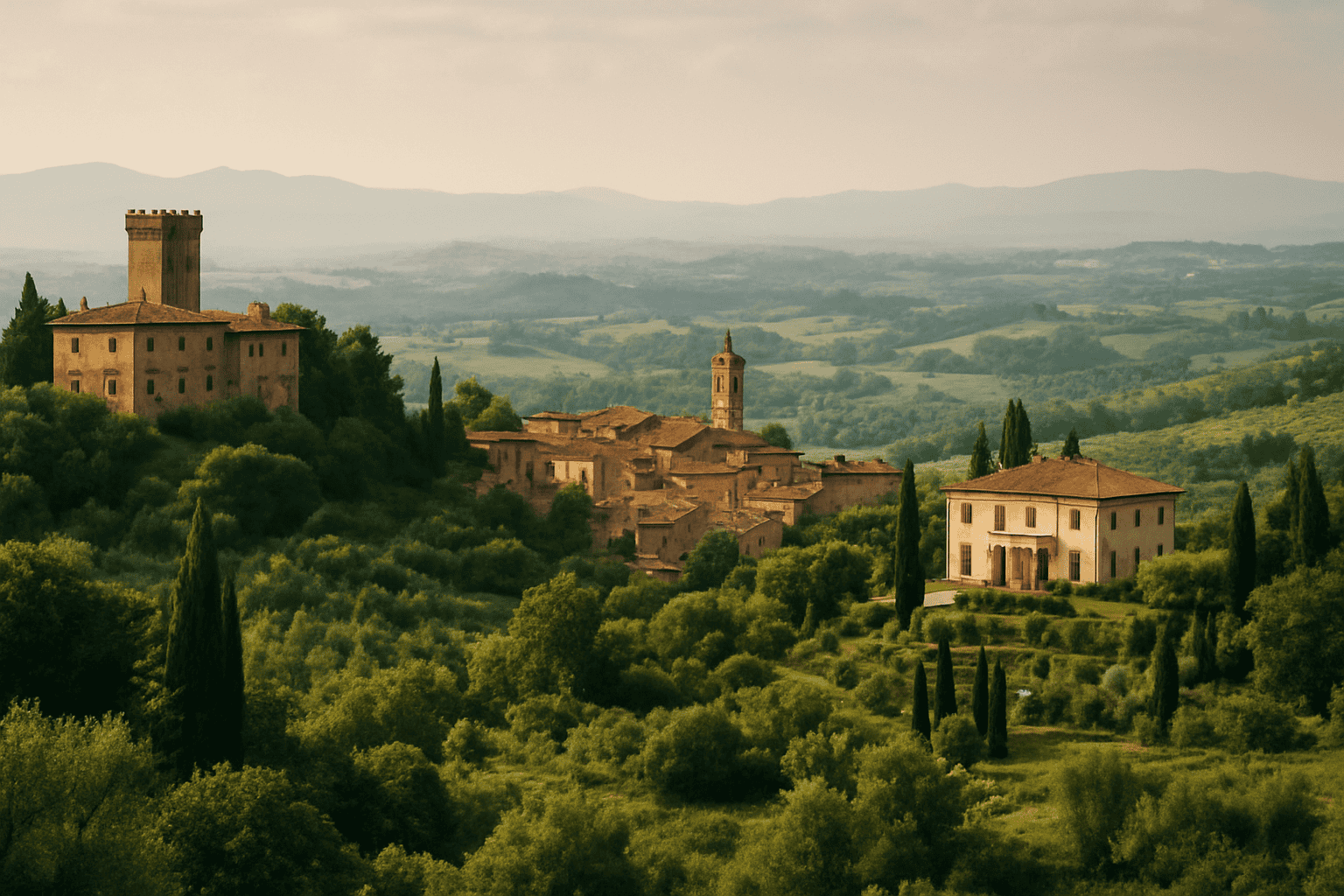
Castle vs village vs villa in Tuscany: practical differences for budget and logistics
Castle, hamlet or villa in Tuscany: how to choose based on style and logistics
Choosing between castle, village e villa it's not just an aesthetic issue: in Tuscany every type of location carries very concrete implications on budget, travel, guest management and setup times. If you’re considering a Tuscany wedding location for a destination, intimate or luxury event, the goal isn’t to find “the most beautiful” one, but the one that makes the experience smooth from arrival to brunch the next day.
In this guide you’ll find castle village villa Tuscany differences explained in a practical way: what really changes on the ground, which questions to ask during a site visit and where indirect costs are hidden (without getting into prices or figures). For a broader overview of the area, you can consult In-depth: Tuscany (Wikipedia).
Castle vs village vs villa in Tuscany: practical differences for budget and logistics
When it comes to Tuscany wedding budget, people often think only about the “visible” items (catering, flowers, music). In reality, the type of venue also influences what you don’t see: build times, access, space constraints, the need for shuttles, management of the plan B. Here is a concrete look at the three options.
Castle in Tuscany: high visual impact, more technical logistics
A castle is the ideal choice if you’re looking for great visual impact and a “cinematic” narrative: courtyards, walls, historic halls, panoramic views. The flip side is that logistics tend to be more complex.
- Access and loading: check whether there are ramps, stairs, narrow passages or access limits for technical vehicles. During the site visit, ask how far catering and suppliers can get.
- Distributed spaces: often the ceremony, aperitif, dinner and party are in different areas (courtyard, garden, indoor hall). This is beautiful, but it requires precise direction and realistic timing.
- Constraints on setups: in historic settings there may be restrictions on fixings, candles, use of certain rooms or hours. If a detail isn’t certain, check the product sheet or in the location’s regulations.
For those who want a luxury event with a strong identity, a castle works very well, provided planning is meticulous and guest management is designed as a journey.
Hamlet in Tuscany: immersive experience and “all in one”
The village is often the most complete solution for a destination wedding: it is not just a location, but a micro-world. It can include small squares, alleys, multiple buildings, panoramic areas, and sometimes widespread reception spaces.
- Sociable vibe: perfect for a wedding weekend, welcome dinner and informal moments that make guests feel “on vacation”.
- Internal logistics: some hamlets require short walks between different areas; carefully assess accessibility for guests with specific needs.
- Noise and schedule management: if the hamlet is close to residential areas or has shared spaces, there may be limits. Always ask how the party is managed and which areas are authorized.
In terms of Tuscany wedding location, the village is often the more “experiential” choice: the wedding becomes a story spread across multiple moments and places, with a natural rhythm.
Villa in Tuscany: elegance, control of spaces and flexibility
The villa is synonymous with Italian elegance: geometric gardens, lemon houses, bright halls, terraces. From an operational point of view, it is often the most “manageable” type because the spaces are designed to host events and flows.
- Clear paths: entrance, ceremony, aperitif, dinner and party can be planned with linear and intuitive transitions.
- More easily integrated Plan B: many villas have indoor spaces suitable for an elegant dinner without distorting the style (always check capacities and available areas).
- Faster setups: access and technical areas are often simpler than in a castle, with a positive impact on timing and coordination.
If you want a refined and coherent result, with less “adventurous” logistics, the villa is an extremely solid choice, especially for those who want to optimize the Tuscany wedding budget avoiding indirect extras.
Goal and style: luxury, intimate or destination (and what really changes)
Before you fall in love with a view or a courtyard, define the style of your wedding in three words. It’s not a creative exercise: it’s an operational compass.
- Luxury: it requires aesthetic consistency, perceived quality and impeccable service. Often a castle and a villa work very well, but even an exclusive village can be perfect if managed as a “scattered resort”.
- Intimate: it favors intimate spaces, atmosphere and slow timing. A villa with a garden or a village with a small square can create a sense of home and authenticity.
- Destination: the priority is the guest experience: transfers, welcome, clear information, side activities. The village is often a natural fit, but villa and castle can also work if there is a hospitality strategy.
On a practical level, expect the type of location to influence the setup times, number of suppliers involved e complexity of transfers. This is where the differences become decisive.
Step-by-step planning for a wedding location in Tuscany
Tuscany is in high demand and availability of the best locations may be limited. An orderly plan reduces stress and prevents rushed choices. Here you’ll find a reasoned (not rigid) path that you can adapt to your case.
Realistic timeline: from idea to details (from 12 to 2 months)
- 12–10 months: defining style, approximate number of guests, location shortlist (castle/village/villa) and site visits. Confirm the location and lock in key suppliers.
- 9–7 months: creative project (palette, mood, materials), catering selection and logistical setup (transport, accommodation, event flows).
- 6–4 months: defining the run of show, music/entertainment, photography, floral design and lighting. Guest communication begins (save the date and travel info).
- 3–2 months: finalizing layout, timing, plan B, operational confirmations with the venue and suppliers. Collecting guest preferences (intolerances, arrivals, needs).
If you’re building a wedding weekend, keep in mind that direction doesn’t concern only “the big day”: welcome, activities and farewell moments require the same care.
Essential supplier checklist (based on the type of venue)
Beyond the classic suppliers, some roles become more important depending on the venue:
- Transport and shuttles: almost always crucial for panoramic castles or villages with limited access.
- Lighting designer: essential if the venue has large outdoor spaces or if you want to enhance architecture and gardens.
- Technical production: audio, microphones, any structures for coverings or platforms (to be assessed with the venue).
- On-site coordination: indispensable when spaces are spread out and suppliers are numerous.
For an operational guide that helps you not miss steps, you can consult Organizing a wedding: checklist.
Guest management and transfers: the point that changes everything
Many weddings in Tuscany become memorable (or complicated) for one reason: how guests move around. When choosing a venue, ask yourself:
- Where will guests sleep: on-site, nearby, in multiple hotels?
- How will they get there: by car, private transfers, shuttles? Is there convenient parking?
- How intuitive is navigation: signage, meeting points, clear schedules?
A village can reduce travel because it “contains” the experience; a castle may require more precise direction; a villa often offers an effective compromise. This is where an important part of the Tuscany wedding budget in terms of indirect costs and management.
Tuscany wedding budget: priorities, main items and costly mistakes
Talking about budget without numbers is possible if we do it by priorities. The idea is simple: define what must be “wow” and what must simply be impeccable and functional. The choice between castle, village and villa influences both.
Main expense items (no surprises)
The macro-areas that most often determine the budget balance are:
- Location and spaces: exclusivity, usable areas, access times for setup/teardown.
- Catering and service: perceived quality, time management, kitchen and back-of-house logistics.
- Design and setups: flowers, furnishings, mise en place, stationery, lighting.
- Music and production: entertainment, audio, any technical requirements.
- Hospitality and transport: shuttles, welcome, arrival/departure management.
In a castle, for example, the visual impact is already strong but may require more production; in a villa you can invest in refined details and achieve a very coherent result; in a borgo you could spread the budget across multiple moments (welcome, wedding day, brunch) to create a complete experience.
Where to invest to maximize the visual impact (smartly)
To achieve a “high-end” result without waste, focus on a few elements that truly change perception:
- Lighting: transforms outdoor spaces and enhances historic architecture without weighing it down.
- Table setting and materials: dinner is the most photographed moment after the ceremony; coherence and quality make the difference.
- Targeted floral design: better a few iconic focal points (ceremony, entrance, head table) than decorations everywhere.
- Guest experience: welcome, smooth timing, comfort. It’s a “luxury” people remember.
The guiding question is: “What is the scene I want everyone to remember?”. Everything else must support it.
Mistakes that increase costs (even without realizing it)
- Underestimating setup times: if the venue has complex access, suppliers may need more hours or more staff.
- Unfunctional layout: unnecessary movement between areas increases staff, signage, and coordination.
- Improvised Plan B: rethinking everything at the last minute leads to extras and aesthetic compromises.
- Non-centralized transportation: leaving guests “free” can create delays, inconveniences, and a less premium experience.
These mistakes don’t depend only on the venue, but the type chosen can amplify them. That’s why the castle village villa Tuscany differences should also be read in terms of operational risk.
Plan B in Tuscany and risk management: weather, constraints, and contracts
In Tuscany, outdoor settings are wonderful, but a well-designed event doesn’t “hope” for good weather: it integrates it as option A and builds an option B of the same caliber.
Weather and alternative solutions without losing style
A good Plan B is not an empty room where you “move everything”: it’s a parallel plan, already thought through and coherent. During the site visit, check:
- Indoor spaces that are truly usable: not just “available”, but suitable for atmosphere and flows.
- Covered transitions: how do guests and staff move in case of rain?
- Lighting and acoustics: some historic spaces require dedicated solutions.
Castles and villages can have magnificent halls but with constraints; villas often offer spaces that are more “ready” for an elegant Plan B. In any case, check the product sheet or in the venue’s regulations which areas are included and under what conditions.
Venue permits and constraints: what to ask without technicalities
Without getting into regulations, there are practical aspects that are useful to clarify right away:
- Hours and party management: until what time are music and entertainment possible? In which areas?
- Use of flames and candles: often regulated in historic settings.
- Supplier access: time slots, loading/unloading areas, technical parking.
- Staff spaces: dressing rooms, staff area, back-of-house for catering.
These answers directly affect logistics and the Tuscany wedding budget indirectly.
Contracts and deposits: how to protect the project
The venue and suppliers’ contract is an integral part of the direction. Some points to clarify (with the support of professionals, if necessary):
- Conditions for using the spaces: which areas are included and which are optional.
- Policies on changes and moves: what happens if the plan changes due to weather or timing.
- Operational responsibilities: who manages security, access, any potential damage.
It’s not a “cold” topic: it’s what allows creativity and beauty to exist without unmanageable surprises.
Guest experience at a wedding venue in Tuscany: welcome, comfort and pace
A wedding in Tuscany is remembered for how it made you feel. The guest experience is the thread that ties all the moments together, especially in a destination wedding.
Welcome moment, activities and hospitality: luxury is care
Whether you choose a castle, a hamlet or a villa, think of hospitality as a sequence:
- Easy arrival: clear directions, welcome point, realistic timings.
- Welcome moment: a welcome gesture consistent with the style (even minimal, but well cared for).
- Weekend rhythm: light and optional activities, without turning the wedding into a marathon.
The hamlet naturally facilitates this “vacation” dimension; the villa makes it elegant and orderly; the castle makes it memorable and scenic, provided the timings are well planned.
Transportation, shuttles, and parking: the invisible direction
Transport logistics are often what distinguishes a beautiful event from an impeccable event. A few tips:
- Shuttles with clear schedules: reduce delays and make the experience safer and more relaxed.
- Intuitive pick-up points: avoid places that are hard to find or too far from the hotels.
- Parking and access: ask where cars and technical vehicles can park, and how to handle any arrival peaks.
In a hilltop castle or in a hamlet with narrow streets, these aspects become central. In a villa, they are often more straightforward, but still need to be planned.
Clear directions and wedding website: fewer questions, more magic
Well-crafted communication is part of the luxury experience: guests shouldn’t have to “guess.” Consider a wedding website or a centralized information system with:
- How to get there and where to park/meet up
- Dress code and practical tips (shoes, terrain, schedules)
- Program of the weekend with maps and useful contacts
This reduces last-minute messages and helps keep the timing, especially when the venue is complex (hamlet or castle).
Questions to ask during the site visit: castle, hamlet or villa (practical checklist)
To choose your Tuscany wedding location, bring with you a list of questions that cover logistics, spaces and flows. Here’s an essential checklist:
- Available spaces: which areas are included and which are optional? Can they be used in case of variable weather?
- Plan B: where do the ceremony, aperitif, dinner and party take place if it rains? Is it a truly beautiful alternative?
- Technical access: where do suppliers load/unload? Are there time limits or narrow passages?
- Acoustics and music: which areas are allowed for entertainment and until when?
- Hospitality: rooms on-site or nearby? How are check-in and check-out handled during a wedding weekend?
- Transport: parking, shuttles, meeting points. What does the venue recommend based on the area?
Answering these questions helps you turn inspiration into a feasible project that’s consistent with your Tuscany wedding budget.
A simpler choice: start with exclusive villas and estates in Tuscany
If you want a wedding curated in every detail, with a balance between aesthetics and operational management, it can be helpful to start with a selection of venues already geared toward high-end events. Take a look at the collection Luxury weddings in Tuscany: it’s a great starting point to understand which spaces best suit your style and your logistics.
CTA: If you want to turn the choice between castle, hamlet and villa into a smooth project (without operational surprises), ChiaraB Events can guide you from selecting the venue to the full direction of the wedding weekend in Tuscany, with a bespoke approach and a coherent vision from the idea to the staging.
FAQ
What is the main difference between a castle, a village, and a villa for a wedding in Tuscany?
The main difference is operational: the castle offers great visual impact but often requires more technical logistics; the village creates an immersive “all-in-one” experience; the villa tends to guarantee greater control of the spaces and a more easily integrated plan B. For specific details on areas and conditions, check the location’s product sheet.
Which type of wedding venue in Tuscany is best suited for a destination wedding?
In general, the village is very suitable because it facilitates a wedding weekend with widespread accommodation and informal moments. The villa and the castle can also work very well if guest management (transfers, meeting points, communication) is planned precisely.
How does the choice between a castle, a village, and a villa affect the wedding budget in Tuscany without talking about prices?
It mainly affects indirect costs: setup and assembly times, access complexity, need for shuttles, technical production, and management of plan B. A more complex venue may require more coordination and additional solutions.
What questions should I ask during the site visit to avoid logistical surprises?
Ask which spaces are included and usable, how plan B works, where suppliers access for loading/unloading, what the rules are on music and party areas, and how parking and shuttles are managed. If a point is not clear, check the product sheet or the venue regulations.
How do you manage a good plan B in Tuscany without ruining the style of the event?
A good plan B should be designed as a complete alternative, not as a fallback: coherent indoor spaces, covered transitions, an already thought-out layout, and adequate lighting. In castles and villages, check for any constraints on the rooms; in villas, check which rooms are actually available.
Is it always necessary to provide shuttles for a wedding in Tuscany?
Not always, but it is often advisable: in panoramic castles or villages with narrow access points, shuttles improve punctuality and comfort. They can also be useful at a villa if guests are staying in multiple accommodations. The choice depends on distances, parking, and flows: check with the venue.
From the blog
 Tuscany
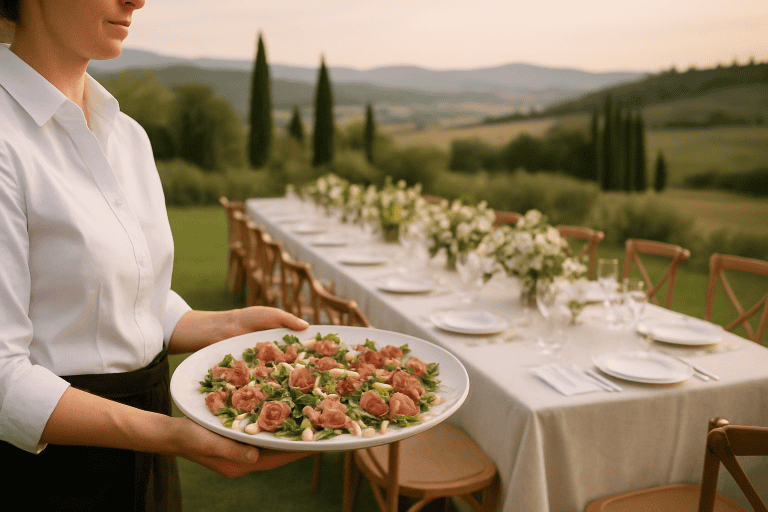
How to choose catering in Tuscany: tasting, seasonality, and allergies
Choosing catering in Tuscany for a wedding: what really matters (besides the menu) When you start choosing catering […]
Read more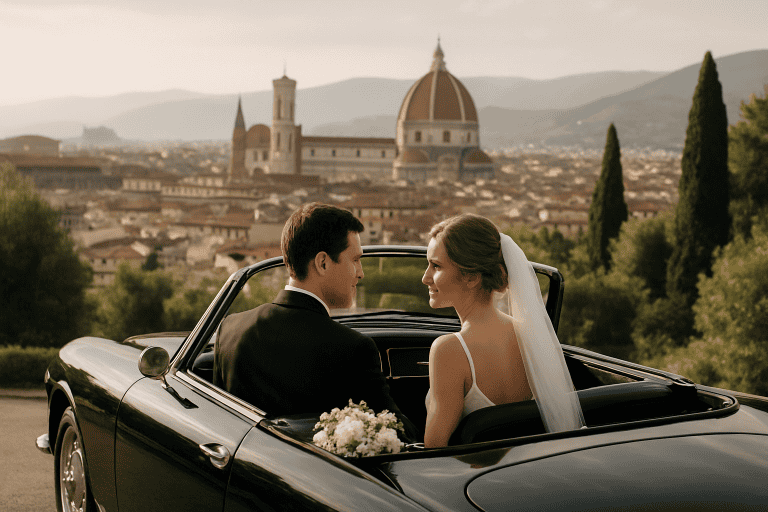 Tuscany
Florence: civil ceremony in the city and reception in the villa (timeline and transportation)
Organizing a civil ceremony in Florence with a reception in a villa is one of the most requested formats in Tuscany: it combines the […]
Read more Tuscany
Wedding weekend in Tuscany: welcome dinner, pool party, and farewell brunch
Wedding weekend Tuscany: why choose welcome dinner, pool party, and wedding brunch A wedding weekend in Tuscany is not “just” a […]
Read more