
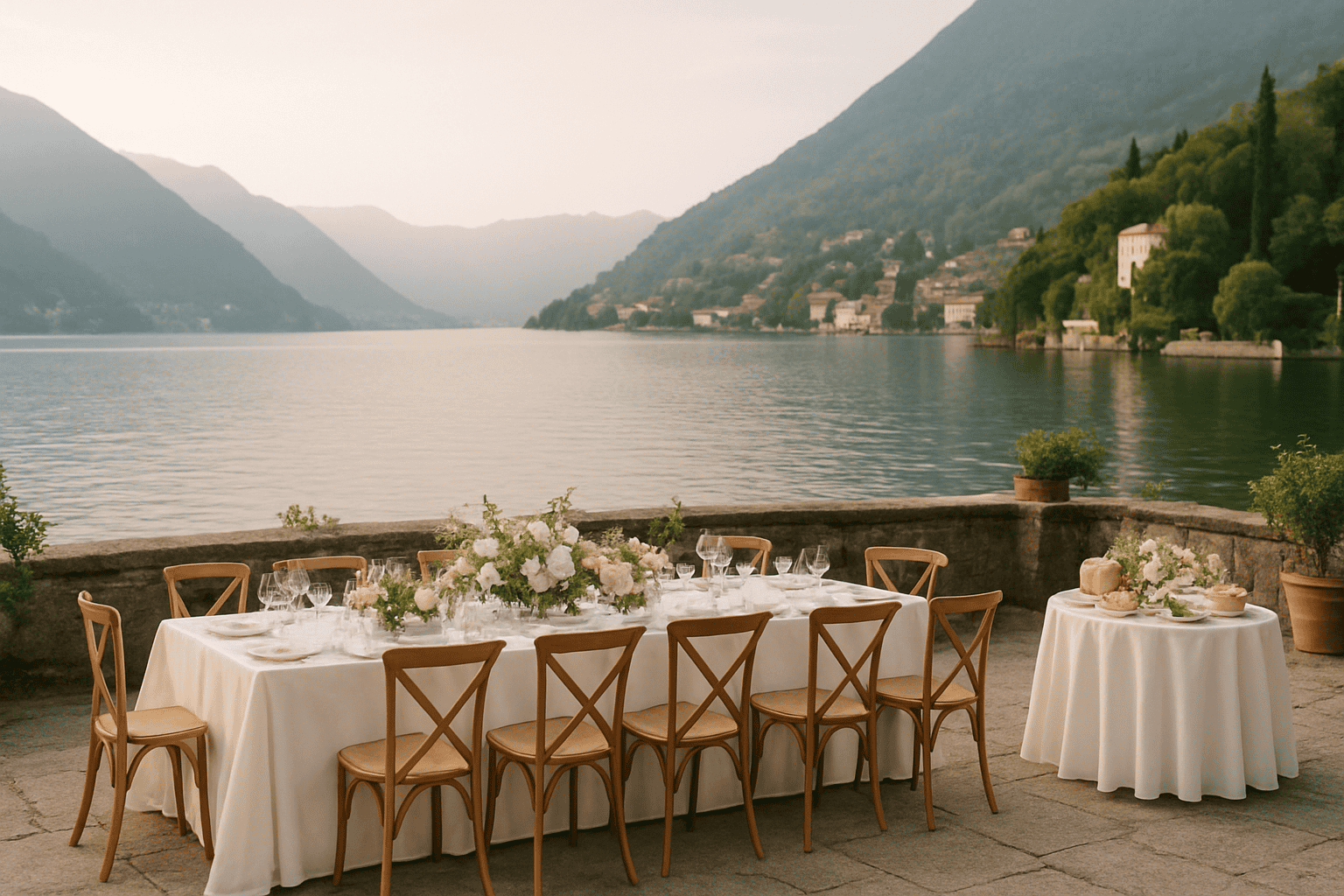
How to manage a wedding weekend on Lake Como: welcome dinner and brunch
Lake Como wedding weekend: why a welcome dinner and farewell brunch are the right choice
A wedding weekend lake como well designed is not “a longer wedding”: it is a complete experience, designed to accompany guests in a coherent story, from arrival to farewell. On Lake Como this format works particularly well because the territory naturally invites to slow down, to experience landscapes and atmospheres with relaxed timing, and to enhance the meeting between people who often come from different cities or countries.
The heart of the weekend generally revolves around two key moments: the welcome dinner (which welcomes and makes everyone feel at ease) and the farewell brunch (which closes on a light note and allows you to truly say goodbye, without rushing). In between there is the wedding day, but the weekend’s energy comes precisely from continuity: guests don’t just “attend”, they participate.
Goal and style: destination, intimate, curated
The strength of a weekend on Lake Como lies in the possibility of defining a clear, recognizable style in every detail, without weighing it down. Whether you imagine a essential luxury, a classic elegance or a more intimate and contemporary atmosphere, the goal remains the same: to create a smooth journey, with different but harmonious moments.
- Welcome dinner: warm, convivial, often more informal than the main reception, perfect for breaking the ice.
- Wedding day: the emotional and scenic peak, with more structured timing.
- Farewell brunch: relaxed, bright, ideal to close with gratitude and simplicity.
Timing and logistics: what to really expect
Lake Como is fascinating also because “it’s not a city”: travel, access to venues, parking, and lake transport require careful direction. In a wedding weekend, logistics are not a detail: they are part of the experience. Planning well means guests perceive a sense of ease, even when there is complex organization behind it.
If you are gathering broader information about the area and strategic choices, this resource may be useful to you: Wedding on Lake Como: guide. For a general overview of the place, you can also find Insight: Lake Como (Wikipedia).
Step-by-step planning for a welcome dinner and farewell brunch on Lake Como
The key is to build a realistic timeline, with decisions made in the right order. A wedding weekend can’t be improvised: more moments mean more interlocks. Below you’ll find a practical path, designed to avoid last-minute rushes and to maintain consistency between welcome dinner, the wedding day and farewell brunch.
Realistic timeline (from 12 to 2 months before)
12–10 months before
- Define the format: two or three days? Only welcome dinner + wedding day + brunch, or also extra activities.
- Secure venues and accommodations: on Lake Como availability can vary, especially in the most in-demand periods.
- Set the travel map: where guests sleep, where the main moments take place, how they connect to each other.
9–6 months before
- Select catering and beverages for the different moments: the welcome dinner can have a different feel from the reception, the brunch requires a softer pace.
- Define the creative concept: palette, flowers, table setting, lights. The goal is continuity, not repetition.
- Start building communication to guests: save the date, initial information on airports/stations, stay suggestions.
5–3 months before
- Confirm entertainment and music for each moment: what works for a welcome dinner is not always suitable for a brunch.
- Design signage and informational materials (including digital): maps, schedules, dress code.
- Define menus and timing: pay attention to dietary needs and the management of intolerances.
2 months before
- Finalize logistics: shuttles, boats, pick-up points, coordination with hotels and concierge.
- Confirm the setup: lighting plan, any coverings, table layout and lounge areas.
- Collect final RSVPs and assign transfer groups.
Essential supplier checklist (without overlaps)
Over a weekend, some vendors work across multiple days. To avoid confusion, clarify from the start who covers what and with which team. Depending on the plan, you might consider:
- Planner/coordinator: a single director to keep timing, vendors, and guests aligned.
- Location management: points of contact for access, schedules, spaces, backup plans.
- Catering: differentiate offering and service between the welcome dinner, wedding day, and brunch.
- Setups and flowers: aesthetic consistency, but with mood variations (softer at brunch, more theatrical at the reception).
- Audio/lights: essential for creating atmosphere and managing any area changes.
- Transport: shuttles, taxis, private transfers and, if planned, lake connections.
- Photo/video: consider full or selective coverage (some prefer to tell only the main moments).
Guest and transfer management: the rule is “simple for them”
Guests remember how they felt. If they arrive in a wonderful place but don’t know where to go, what time to leave, how to get back, the experience loses its flow. For a wedding weekend on Lake Como, guest management is based on three pillars:
- Advance information: send schedules and meeting points well in advance.
- Smart redundancy: the same info in multiple formats (email, wedding website, message the day before).
- On-the-ground support: a person or a team to direct, accompany, solve issues.
If you need a broader organizational outline to bring order to decisions and priorities, this resource can help you: Organizing a wedding: checklist.
Budget and priorities: how to distribute energy and impact between the welcome dinner, wedding day, and brunch
Over a weekend, the risk isn’t just “spending more”, but diluting the impact. The best strategy is to define which moments should be more scenic and which more essential, always maintaining a level of care consistent with Lake Como and with the expectations of a destination wedding.
Main items to consider
Without getting into figures (which vary greatly depending on season, venue, and number of guests), the areas that have the biggest impact are:
- Location and spaces: possible different areas for dinner, party, brunch; access logistics.
- Food & beverage: three moments with three different rhythms; attention to quantities and service.
- Transport: on Lake Como they can be decisive for comfort and punctuality.
- Setups: flowers, lighting, mise en place, furnishings; more events require modular planning.
- Music and entertainment: calibrated to the mood (convivial at the welcome dinner, celebratory at the wedding, soft at the brunch).
- Coordination: more days mean more call sheets, more checks, more on-site coverage.
Where to invest to maximize the scenic effect (without overloading)
Lake Como already offers a natural backdrop. The most effective investment is often not “adding,” but to frame:
- Lights: they transform a terrace or a garden, make the welcome dinner memorable and the party warmer.
- Focal point: a signature area (an imperial table, an aperitif corner, a discreet backdrop) creates identity without overwhelming.
- Guest comfort: well-designed lounges, clear pathways, smooth transitions between moments.
- Timing: a realistic program is an “invisible investment” that improves everything.
Mistakes that increase costs (and stress) during the wedding weekend
- Multiplying venues without solid logistics: every move requires time, staff, and coordination.
- Replicating the same level of setup across all moments: better to differentiate intelligently.
- Overly ambitious timing: if guests chase impossible schedules, delays and the need for “last-minute solutions” increase.
- Late communication: information given at the last minute generates individual requests and confusion.
Plan B and risk management on Lake Como: weather, venue constraints, and agreements
A wedding weekend is a small ecosystem: if one element fails, it can affect multiple moments. That’s why Plan B shouldn’t be thought of as a compromise, but as an alternative version that is already beautiful and coherent, especially for the welcome dinner and brunch, which are often envisioned outdoors.
Weather: credible alternatives for welcome dinner and brunch
The weather on the lake can change quickly. The most effective solution is to design two scenarios from the start:
- Scenario A (outdoor): layout, lighting, service flows, music.
- Scenario B (indoor or covered): equivalent spaces in terms of capacity and atmosphere, with a dedicated lighting plan.
To prevent scenario B from feeling like a “fallback”, focus on elements that work in both cases: palette, modular centerpieces, elegant signage, adaptable beverage corners.
Venue constraints: schedules, access, noise, spaces
Each venue on Lake Como has specific characteristics. Before defining the weekend program, check with the venue:
- Usage hours the spaces and possible transitions between areas.
- Access and loading/unloading for catering and setups.
- Indoor spaces actually usable in case of uncertain weather.
- Music management and volume levels: to avoid last-minute changes close to the event.
If a detail is not certain, check the product sheet or in the documentation provided by the venue/vendor: it’s the simplest way to avoid interpretations.
Agreements, deposits, and operational clarity
With multiple days, the line items and the vendors involved increase. It’s useful for every agreement to clearly include:
- What is included for each moment (welcome dinner, wedding day, brunch).
- Setup and teardown times and on-site coverage responsibilities.
- Change conditions in case of weather or schedule changes.
Central coordination helps keep everyone aligned, especially when guests move between hotels, villas, piers and restaurants.
Guest experience during a Lake Como wedding weekend: welcome, activities, transportation and communication
The difference between a “nice” weekend and a truly memorable one lies in guest care. On Lake Como, where many arrive for the first time, hospitality must be intuitive and warm. The goal is to let them experience the area without turning the program into a marathon.
Welcome moment: how to set up arrival and the welcome dinner
The arrival moment is delicate: some arrive early, some late, some need to rest. A good welcome reduces anxiety and makes the welcome dinner more attended. Some organizational ideas (adaptable to your style):
- Welcome message with essential information (times, dress code, expected weather, useful contacts).
- Corner hospitality in hotel or at the venue: water, herbal teas, small local touches.
- Soft timing: a longer aperitivo and dinner with a convivial pace, so those who arrive late don’t feel “out of sync”.
The welcome dinner works best when it’s designed as a bridge: it introduces people, sets the mood for the wedding, but leaves room for spontaneity.
Activities and free time: offer options without obligations
On a destination weekend, not everyone wants to do everything. The secret is to offer clear choices and non-binding: a couple of well-curated proposals (a walk, a moment by the lake, a light visit) and the rest free time. This way guests feel guided but not “channelled”.
If you include activities, always consider:
- Realistic duration and buffers for return and outfit changes.
- Meeting points easy to find.
- Alternatives for those who prefer to rest or have different needs.
Transport, shuttles, parking: how to avoid confusion
Lake Como requires precise transport coordination, especially if guests are staying in multiple properties. To make everything run smoothly:
- Reduce the pick-up points: better a few clear points than many points that are “convenient” only on paper.
- Communicate times as windows: for example, a departure interval, with a latest recommended time.
- Provide a contact person for each main route: guests need to know whom to ask.
- Manage the returns: after the party, guests’ peace of mind depends on the return as much as on the event.
If you plan travel by lake, consider that perceived punctuality improves when guests have simple directions (pier, time, group name) and a staff presence to welcome them.
Clear directions and wedding website: communication is part of the design
A well-made wedding website isn’t just “informational”: it’s an extension of the weekend’s style. It must be readable and up to date, with essential, well-organized content. For a Lake Como wedding weekend, the most useful sections are:
- How to get there: recommended airports/stations and suggested transfers.
- Where to sleep: recommended areas and practical notes.
- Program: schedule, dress code, meeting points, contacts.
- Guest FAQ: weather, recommended shoes, any travel, what to bring.
The clearer the information, the more guests experience the welcome dinner and farewell brunch with ease, without having to constantly ask for details.
Organizing a wedding weekend on Lake Como with professional direction
A successful weekend is recognized by the natural way it flows: guests move around without stress, the moments have a harmonious rhythm, and every choice seems inevitable, as if it had always been that way. If you want to plan a wedding weekend lake como with welcome dinner e farewell brunch consistent in style and impeccable in logistics, you can rely on expert direction that knows how to enhance the venue, timing, and details. Discover the approach and inspiration dedicated to the Wedding on Lake Como: guide and contact ChiaraB Events to create a tailor-made weekend, elegant and truly enjoyable.
FAQ
How long should a wedding weekend on Lake Como last to work well?
It usually works when it includes at least two moments beyond the wedding day: a welcome dinner upon arrival and a farewell brunch the next day. The ideal duration depends on guests’ arrival times and the distances between the hotel and the venue: the goal is to avoid rushing and leave time to enjoy the lake.
Should the welcome dinner be as formal as the wedding reception?
Not necessarily. It’s often more convivial and relaxed, designed to bring guests together and create an atmosphere. It can be elegant but with a gentler pace, so those arriving from afar can settle in without pressure.
What’s the difference between a farewell brunch and a simple lunch the next day?
The farewell brunch is designed as the final moment of the story: flexible hours, a lighter style, space to chat and truly say goodbye. A traditional lunch can be more rigid; brunch, instead, encourages spontaneity and a natural close to the weekend.
How to manage guests' transportation on Lake Como without confusion?
Reduce the number of pick-up points, communicate times and locations repeatedly (email, wedding website, reminder message), and provide on-site support. If lake transfers are planned, it is useful to organize clear groups and simple directions for the pier and times.
What should we plan as a Plan B in case of bad weather for the welcome dinner and brunch?
An alternative version is needed that is already thought out and coherent: suitable indoor or covered spaces, a defined layout, a lighting plan, and service flows. The idea is that scenario B should be as beautiful as the outdoor one, not an improvised emergency solution.
Is it better to use a single location for the whole weekend or multiple locations?
It depends on the style and logistics. A single location simplifies transfers and timing; multiple locations can enrich the experience but require very precise transport coordination. The best choice is the one that keeps the experience simple for guests.
From the blog
 Lake Como
Floral arrangements on Lake Como: elegant palettes and seasonality
Floral arrangements Lake Como: why elegant palettes and seasonality really matter When talking about floral arrangements Lake of […]
Read more Lake Como
Historic villa vs luxury hotel on Lake Como: which choice is really worth it?
Historic villa vs luxury hotel on Lake Como: how to really choose the right venue Choosing between historic villa […]
Read more Lake Como
Transport and parking on Lake Como: shuttles, taxi boats, and realistic timing
Transport and parking on Lake Como: what to really expect (times, style, logistics) When talking about weddings on the Lake […]
Read more