
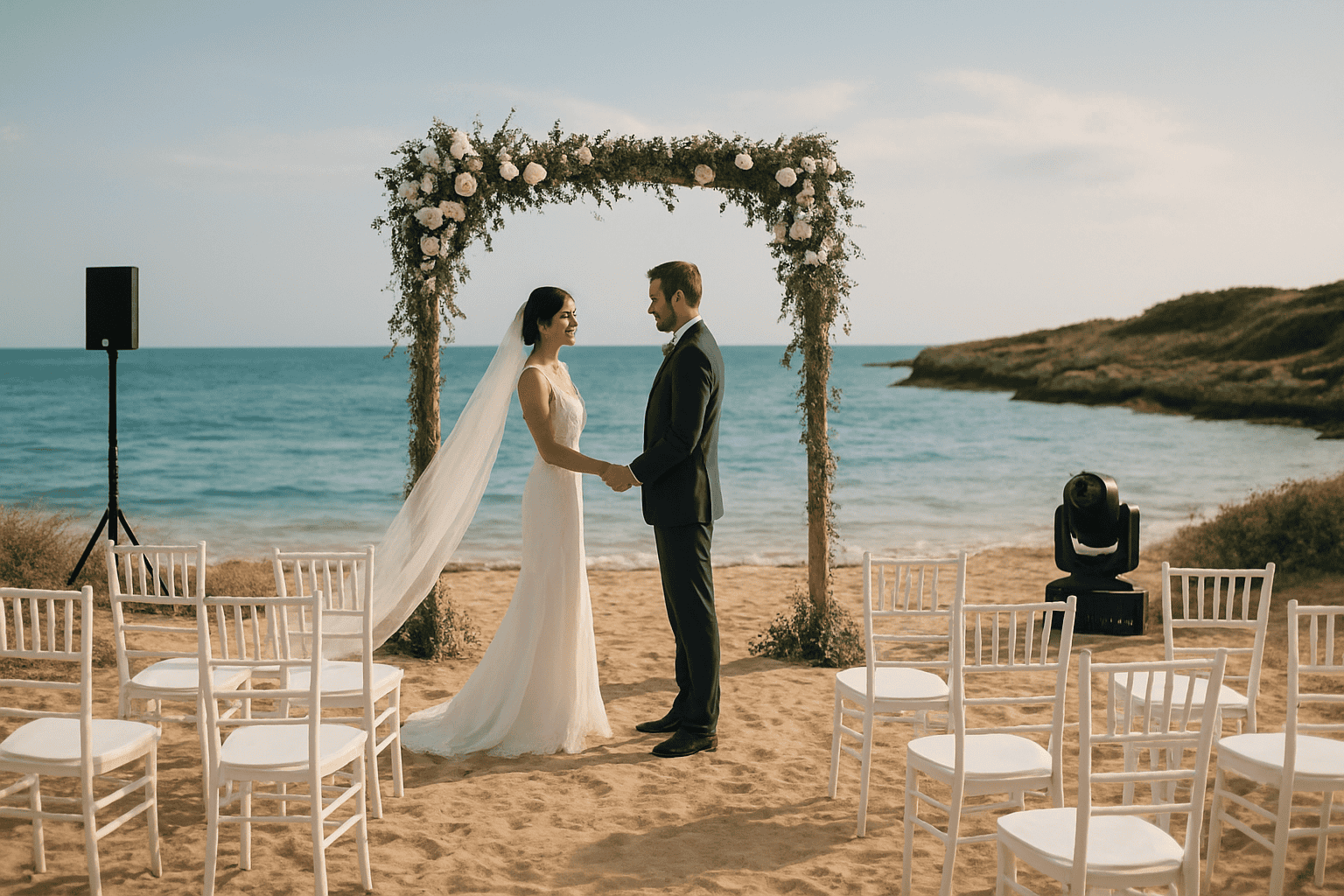
Seaside wedding in Puglia: wind, lights, and audio for a perfect ceremony
Seaside wedding in Puglia: why wind, lights, and audio make the difference
A seaside wedding in Puglia has an immediate charm: open horizons, natural light that changes minute by minute, Mediterranean scents and that feeling of a “destination” that turns the day into an experience. But precisely what makes it special (wind, salt air, glare, sand, fast sunsets) can become the critical point if it isn’t managed methodically.
In a beach ceremony Puglia, technical direction is not a detail: it’s what allows everyone to hear the vows, see the key moments and experience the atmosphere without distractions. The good news is that, with clear planning and a few precautions, the “wow” effect comes naturally, without forcing it.
Goal and style: luxury, intimate or destination (without losing control)
Whether you imagine an essential ceremony with few guests or one destination wedding with guests coming from out of town, the style must remain consistent with the location. By the sea, everything that is light, airy and highly legible: clean lines, palettes that dialogue with the landscape, scenic elements that don’t “fight” the wind.
- Luxury: meticulous attention to detail, lighting designed to enhance volumes and pathways, audio that’s invisible but present.
- Intimate: few elements, but chosen well; the priority is sound quality and emotional closeness.
- Destination: extra attention to logistics, timing and communication to guests (especially about transfers and dress code).
What to expect: timing, logistics and “sea variables”
The sea sets a different rhythm: the light at sunset speeds up decisions, the wind changes direction, humidity can affect materials and comfort. That’s why the key word is prevention: planning alternatives and testing on site (when possible) reduces surprises.
If you’re considering a ceremony directly on the sand or on a platform, it can be useful to start with an overview dedicated to permits and inspiration: Beach wedding: permits and ideas.
Step-by-step planning for a beach ceremony in Puglia
A beach ceremony Puglia a successful one is built with a realistic timeline. There’s no need to complicate: you need to put priorities in order and lock in early what is hardest to source (venue, coordination, technical suppliers, any transfers).
Realistic timeline: from 12 to 2 months (with a margin for the weather)
- 12–10 months: choose area/period, site visit (if possible), define style and number of guests. First draft of plan A and plan B.
- 9–7 months: book key suppliers (coordination, catering, photo/video, music/DJ or live, audio-lighting service). Define the ceremony run-of-show.
- 6–4 months: study the layout (seating, aisle, ceremony spot, any shade), choose materials suitable for outdoors, define guest communication.
- 3 months: timing rehearsal (ceremony duration, entrances, readings), briefing on wedding wind management and miking, transport plan.
- 2 months: operational confirmations, “seasonal” weather check, define details (signage, welcome, comfort kit), final call with all suppliers.
Checklist of essential suppliers (with a focus on audio and lighting)
By the sea, some roles become more important than elsewhere because they have to work in a “live” environment. Here’s an essential checklist:
- Wedding planner/coordinator: stage management, timing, handling unforeseen events, supplier coordination.
- Audio and lighting service: microphones suitable for wind, speaker placement to avoid feedback and sound dispersion, lighting for the day-to-evening transition.
- Setup: stable elements, materials that withstand humidity and salt air, anti-wind solutions for fabrics and arrangements.
- Music: choosing a setup consistent with the context; attention to volume and moments (ceremony ≠ party).
- Photo/Video: planning shots in relation to sun and wind, timing for golden hour.
To avoid missing important steps in the overall preparation, a structured list is useful: Organizing a wedding: checklist.
Guest management and transfers: the “behind the scenes” that saves the atmosphere
A seaside wedding is often also a small trip. Logistics must be invisible, yet present: clear schedules, meeting points, alternatives in case of traffic or limited parking. If guests arrive from multiple locations, plan a simple system to reduce stress and delays (shuttles, guided car pooling, shared directions).
Budget and priorities for a sea-view wedding in Puglia
Talking about budget doesn’t mean talking only about numbers: it means deciding where to put energy to achieve the desired scenic effect, especially in a natural setting that is already powerful. In a sea-view wedding in Puglia, often just a few targeted interventions are enough to elevate everything.
Main items: what really affects the experience
- Location e logistica: access, distances, any transfers, setup/teardown times.
- Setup: seating, ceremony spot, any light structures, flowers and materials suitable for outdoors.
- Audio and lighting: miking, even sound distribution, lighting for the ceremony and subsequent moments.
- Food & beverage: managing heat/humidity, service times compatible with sunset.
- Photo/Video: coverage of key moments and making the most of natural light.
Where to invest to maximize the scenic effect (without overloading)
The sea is already the scenery. The most “intelligent” investment is often what you don’t see but you feel:
- Clean, stable audio: if guests can’t hear, the heart of the ceremony is lost. The wedding wind management here is decisive: microphones, placement, and rehearsals matter more than any decoration.
- Lighting for the transition to dusk: when the light fades, everything must remain legible and warm. Small, well-distributed points of light enhance faces, pathways, and details.
- Discreet comfort: water available, fans or shawls if the evening cools down, guidance on suitable footwear. These are thoughtful touches that make people speak well of the event.
Mistakes that increase costs (and how to avoid them)
- Postponing technical choices: audio and lighting require a site visit and planning; deciding late leads to “emergency” solutions.
- Ignoring the wind: arches that are too light, fluttering fabrics not controlled, unstable arrangements. Better fewer elements, but stable.
- Overly tight timing: if the ceremony starts late, you lose the best light window and end up chasing everything else.
- Untested layout: distances and orientation relative to the sun can create discomfort (glare) or less effective photos.
Plan B and risk management: weather, wind, and alternatives in Puglia
The point is not “if” a plan B is needed, but how much it is integrated into the project. A good plan B must not feel like a fallback: it must maintain style, rhythm, and the quality of the experience.
Weather and alternative solutions: how to stay true to the concept
For a ceremony by the sea, the most common variables are strong wind, humidity, and sudden changes. The most effective alternatives are those already consistent with the aesthetic:
- Covered or semi-covered space near the sea: it keeps the “sea view” feeling without exposing guests.
- Ceremony brought forward or postponed (if compatible with the day): useful when the best weather window is different from what was initially imagined.
- Modular layout: seats and ceremony spot that can be repositioned without overturning the setup.
The choice depends on the location and the configuration of the spaces: it’s best to check it during a site visit and, when evaluating specific technical solutions, check the product sheet compatibility with outdoor use.
Permits and constraints of the location: clarify first so you don’t have to change later
Every setting has operating rules and practical limits: supplier access, schedules, power points, usable areas, sound volume management. Even without getting into regulatory aspects, it’s essential to gather all the information in advance and translate it into concrete choices (timing, layout, run of show).
If you want a starting point specific to the “beach” context, you’ll find useful ideas and considerations in the guide Beach wedding: permits and ideas.
Contracts and deposits: aligning expectations and responsibilities
With multiple suppliers involved, clarity prevents misunderstandings. It’s helpful for every agreement to clearly describe: what is included, setup times, responsibilities in case of changes, and how a setup change due to weather is handled. The goal is not to complicate things, but to protect the quality of the event and reduce last-minute decisions close to the date.
Guest experience in a seaside ceremony: comfort, sound and light
Guests’ memories come from very concrete details: knowing where to go, feeling welcomed, not being excessively hot, being able to follow the ceremony without effort. In Puglia, with bright days and variable breezes, the experience is built with a “gentle” direction.
Welcome moment, activities and hospitality: start the day off right
Before the ceremony, create a small welcoming ritual: it helps guests get into the mood and reduces the feeling of waiting. Some simple and very effective ideas:
- Welcome point with clear directions (where to sit, when it starts, where to find facilities).
- Water and refreshments: especially if the wait is in the sun.
- Suggested dress code: comfortable shoes, colors that work in photos, possibly a shawl for the evening.
If the wedding is a destination, you can add light micro-activities (without overfilling): a welcome moment the day before or a relaxed brunch. The important thing is not to drain energy from the central moment.
Transport, shuttles and parking: reduce friction and delays
In many coastal areas, parking can be the real “unexpected issue”. That’s why it’s worth planning the arrival flow as part of the event:
- Meeting points simple and communicated in advance.
- Staggered times to avoid congestion at the entrance.
- Directions for the walking route if the last stretch is on sand or dirt road.
Clear directions and wedding website: fewer questions, more presence
Essential but complete communication avoids dozens of last-minute messages. A wedding website (or a shared information page) can include:
- times and addresses;
- map of the arrival point and the ceremony location;
- tips on outfits and footwear;
- notes on wind and hair/accessories (no alarmism, just practicality);
- reference contact for logistical emergencies.
Wind, lighting and audio: a practical guide to managing wedding wind by the sea
Wind is the invisible director of every event on the seashore. It can be pleasant, but it can also compromise audibility, the stability of setups, and comfort. Proper wedding wind management starts from three areas: orientation, materials, and technical direction.
Orientation: how to position the ceremony and seating for audibility and photos
When you decide where to “face,” you also decide how it will sound and look. In general, it’s worth considering:
- Wind direction: position officiants and microphones to reduce rustling and turbulence.
- Sun: avoid guests having the sun in their eyes during the vows.
- Reverberation: hard surfaces or open spaces can disperse the voice; audio coverage should be designed to cover evenly.
Audio: make everything audible without a “megaphone effect”
On the beach, audio needs to be present but natural. Some useful measures:
- Proper miking for the officiant and the couple, with wind protection when предусмотрено.
- Distributed coverage to avoid volumes that are too high nearby and too low farther away.
- Sound checks with real readings (not just “one-two-test”) to verify clarity and dynamics.
If you’re considering specific solutions for microphones or speakers, check the product sheet outdoor performance and compatibility with windy conditions.
Lighting: from the ceremony to the after-party without losing the atmosphere
Natural light in Puglia is an ally, but it changes quickly. Lighting should accompany, not overpower. A layered strategy works well:
- Functional light for entrances, pathways, and focal points (readings, signatures, ring exchange).
- Ambient lighting to keep the setting warm when the sun goes down.
- Subtle light points to enhance details without making the sea feel “theatrical.”
Wind-proof setups: stability first and foremost
By the sea, the rule is simple: fewer fluttering elements, more structure. Some choices that help:
- more compact fabrics or controlled draping;
- arrangements designed to withstand sudden breezes;
- signage that is stable and readable even in intense light;
- hair accessories and veils assessed based on the wind (and the type of hairstyle).
Puglia as a backdrop: choose the right area and make the most of the light
Puglia offers very different coastlines: cliffs, coves, long sandy beaches, livelier seaside towns, and intimate corners. The choice of area affects wind, accessibility, and the type of light. If you want a general overview of the region, you can consult In-depth: Puglia (Wikipedia).
In practice, the question to ask is: what experience do we want guests to have? More “resort and comfort” or more “nature and authenticity”? Both work, as long as the logistics are consistent and the ceremony time is chosen with the light and heat in mind.
Useful links for organizing a seaside ceremony
Do you want to plan a truly smooth, elegant, and stress-free sea-view ceremony? ChiaraB Events helps you coordinate aesthetics and technical aspects (wind, lighting, audio, guest logistics) to turn your idea of Puglia into an experience curated in every detail. Discover the section dedicated to beach weddings and start building your project with a clear vision.
FAQ
What is the first thing to define for a sea-view wedding in Puglia?
The priority is to set the ceremony location and time based on light and logistics, and to immediately set up a Plan B consistent with the style. From there, layouts, audio/lighting, and guest flows are built.
How does wedding wind management work during a beach ceremony in Puglia?
Work on the orientation of the ritual point with respect to the wind, suitable outdoor microphone setup, distributed audio coverage, and stable setups (controlled fabrics and well-anchored elements). When you evaluate specific technical solutions, check the product sheet for compatibility with outdoor use.
What must not be missing for the audio of a beach ceremony?
Microphones for the officiant and the couple, windshields when required, speakers positioned for uniform coverage, and a real test with readings. The goal is clarity without excessive volume.
How do you manage the transition from sunset to evening at a seaside wedding?
With a layered lighting design: functional lighting for pathways and key moments, and atmospheric light points to maintain warmth and readability when natural light fades.
What are the most common mistakes in a beach ceremony in Puglia?
Underestimating wind and timing, postponing technical choices (audio/lights), not planning a modular layout, and communicating too little to guests about access, footwear, and movements.
From the blog
 Apulia
Guest experience in Puglia: tours, tastings, and activities for foreign guests
When organizing a destination wedding, the ceremony is only part of the story. For guests arriving from abroad, […]
Read more Apulia
How to choose the best period in Puglia: heat, tourism, and availability
How to choose the best period for a wedding in Puglia: heat, tourism, and availability Choosing the right date in Puglia does not only mean […]
Read more Apulia
Wedding in Puglia: luxury farmhouse or historic residence? how to decide
Wedding in Puglia: why choose between a luxury masseria and a historic residence Organizing a wedding in Puglia means choosing an atmosphere first […]
Read more