
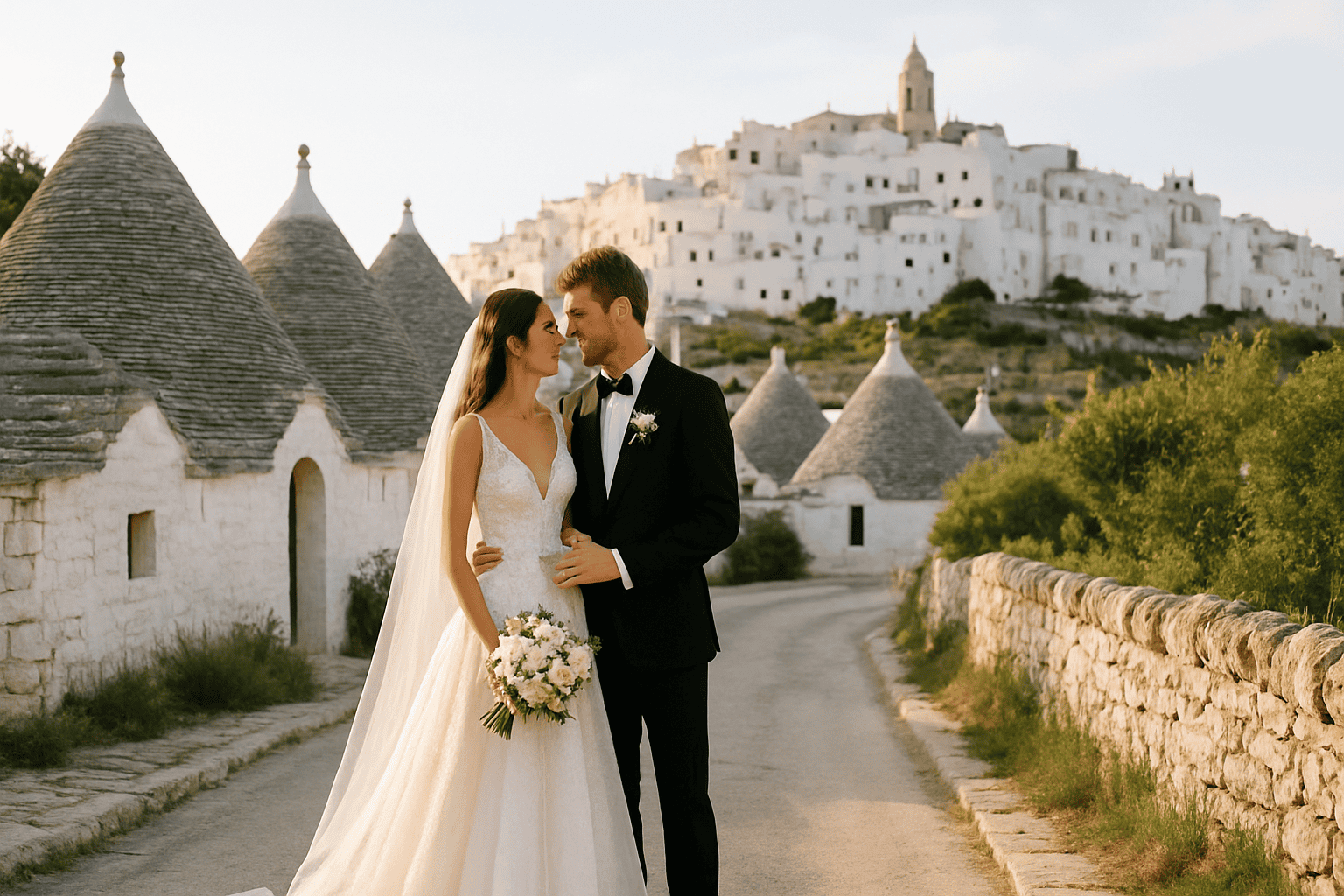
Valle d’Itria: wedding weekend among white villages and farmhouses (logistics included)
Wedding weekend in Valle d’Itria: why choose this format among white villages and masserie
A wedding weekend in Valle d’Itria it’s not “just” a wedding: it’s a spread-out experience, made of staggered arrivals, moments of conviviality and settings that change hour by hour. Here Puglia tells its story with masserie nestled among the olive trees, scenic roads, light stone and historic centers that in the evening become a natural set. If you’re imagining an event intimate but refined, with a destination imprint and a more relaxed pace than a single day, this format is often the most elegant answer.
Valle d’Itria is particularly suitable because it allows you to build a journey: welcome in a masseria, ceremony in an iconic setting, dinner under the lights, and a final, more informal moment. Moreover, it’s an area that lends itself well to different combinations: a alberobello wedding can coexist with a countryside dinner, just as a ostuni wedding can become the pretext for an after party in a nearby masseria.
For those who want an overview of the area, here is a useful reference: In-depth: Puglia (Wikipedia).
Goal and style: luxury, intimate, destination (without rigidity)
When we talk about a “wedding weekend”, the style is not necessarily formal: the goal is to create a coherent story in multiple chapters. In Valle d’Itria, an aesthetic that enhances natural materials, bright palettes, artisanal details and discreet direction works particularly well.
- Luxury: it doesn’t mean ostentation, but comfort, well-managed timing, perceived quality and scenic environments.
- Intimate: even with many guests, the atmosphere can remain intimate if the logistics are smooth and the spaces are well “paced”.
- Destination: guests don’t just attend a ceremony, they experience a journey with you.
What to expect in terms of timing and logistics
Logistics are the real difference between a memorable weekend and a tiring weekend. In Valle d’Itria the distances aren’t huge, but timings can vary due to back roads, historic centers with limited access, parking and evening transfers. The point isn’t “doing a lot”, but doing it well, leaving room for the unexpected and for the naturally pleasant slowness of the place.
In practice, a well-designed wedding weekend includes:
- 1 main hub (masseria or accommodation) where to concentrate welcome and key moments;
- 1 or 2 satellite locations (village, terrace, event space) to create variety without splitting the group;
- guided transfers (shuttles or cars with drivers) especially in the evening;
- clear communication for guests: schedules, meeting points, dress code, maps.
Step-by-step planning for a wedding weekend in Valle d’Itria
Ideal planning starts with a simple question: what kind of experience do you want to create? From there you build a realistic timeline, avoiding the most common mistake: choosing “the photos” first and only afterwards the flows. In a context like this, directing movements is part of the design.
If you want a structured method to set the foundations (from vision to run sheet), this guide may be useful: How to organise a wedding.
Realistic timeline (from 12 to 2 months)
Every couple has different timing, but for a weekend in Puglia it’s best to move ahead of time, especially if you want a specific masseria or a very in-demand period. Here’s a practical outline to customize:
- 12–10 months before: define the concept (style, number of guests, duration), choose the area (Valle d’Itria with a focus on Alberobello/Ostuni or countryside), secure the main venue and a second venue if planned.
- 10–8 months before: select catering/banqueting, photographer/video, music (live/DJ), officiant (if planned), coordinate transfers (shuttles/drivers) and initial hotel/guesthouse options for guests.
- 8–6 months before: design décor and lighting, define the guest journey (arrivals, check-in, welcome), draft a wedding website or information document, save the date and first confirmations.
- 6–4 months before: tastings, music run sheet, define menu and beverages, targeted site visits (also via video call if you’re not on site), weather plan B with the venue.
- 4–2 months before: finalize the detailed timeline, assign shuttles, collect dietary requirements, confirm vendors and the guest communication plan (maps, schedules, dress code).
- Last weeks: alignment call, print essential materials (if planned), confirm final numbers, rehearsal and briefing with the team.
Important note: if you’re building a alberobello wedding with moments in the village, consider that the experience is wonderful but requires greater care with access, meeting points and group management, especially in the evening.
Essential supplier checklist (without overlaps)
In a wedding weekend the vendor list can grow quickly. The key is to distinguish between “essentials” and “nice to have”, and above all avoid duplicates (two people managing the same task). An essential checklist can include:
- Location manager (or internal point person) + event coordination (wedding planner or coordinator): complementary roles, not interchangeable.
- Catering/banqueting with experience in events at a masseria and managing outdoor spaces.
- Photo/Video with a sensitivity for natural light and evening scenes (luminarie, candles, courtyards).
- Music (ceremony, aperitif, party) with a single coherent audio direction.
- Floral arrangements and styling (tables, ceremony, hospitality corners).
- Lights (essential in courtyards and gardens) for atmosphere and functionality.
- Transport: shuttles, drivers, parking management and loading/unloading points.
If the idea is a ostuni wedding with moments in the historic center, add to the checklist someone who knows the local flows well: no need to complicate, you need anticipate.
Guest management and transfers: the invisible architecture of the weekend
The Itria Valley works when guests don’t have to “figure out on their own” what to do. The invisible architecture is made of simple directions, realistic timings, and choices that reduce last-minute decisions.
To organize transfers smoothly:
- choose a meeting point clear (hub) and keep it consistent;
- plan arrival windows (not just one time) for check-in and welcome;
- reduce location changes on the same day, especially on the wedding day;
- communicate return trips with times and alternatives (first run, middle run, last run).
Budget and priorities for a wedding weekend between masserie and villages of the Itria Valley
Talking about budget, without numbers, means talking about priorities. A wedding weekend has more moments and therefore more “touchpoints” to take care of: welcome, ceremony, reception, after party, day after. The risk is spreading resources everywhere and getting a uniform but not very impactful result.
Main items to consider (so you’re not caught off guard)
The items that have the biggest impact, in general, are those tied to the venue and the direction of the experience:
- Location (spaces, exclusivity, indoor/outdoor areas, internal logistics);
- Catering/banqueting (service, timing, beverage management);
- Transport (evening shuttles, drivers, coordination);
- Setups and flowers (ceremony + tables + welcome areas);
- Lights and audio (often underestimated, but decisive);
- Photo/Video (coverage over multiple days if desired);
- Hospitality (welcome kit, concierge, handling guest requests).
Where to invest to maximize the scenic effect (without excess)
In the Itria Valley the scenic effect is already “in the place”. The smartest investment is the one that lights up the location and guides the gaze. Some choices with high perceived impact:
- lighting designed for courtyards, gardens and tables: it creates atmosphere and also improves photos and videos;
- an iconic focal point (ceremony or imperial table or lounge area) designed as the main scene;
- elegant signage and coordinated (even minimal) to make guests feel “guided”;
- music with progression: over a weekend, the sound narrative matters, not just the party.
If you are considering a alberobello wedding, consider that the village’s scenery is extremely powerful: often it’s better to focus on a few targeted elements and on directing the timing (sunset, evening lights) rather than overloading the setup.
Mistakes that increase costs (and lower the experience)
- too many locations in a short time: they increase transport, coordination and stress;
- timeline too tight: every delay is amplified and requires “quick fixes”;
- lack of a plan B: leads to last-minute choices that are less consistent with the style;
- incomplete guest communication: generates improvised taxis, late arrivals, disorientation;
- duplication of roles: more suppliers doesn’t mean more quality if there isn’t a single direction.
Plan B and risk management in Puglia: weather, constraints and agreements with the location
The beauty of Puglia is often outdoors: courtyards, gardens, terraces, olive trees. Precisely for this reason, risk management must be tackled with clarity, without anxiety but with method. A well-built plan B doesn’t “ruin” the event: it makes it more solid and, paradoxically, more relaxing.
Weather and alternative solutions: credible indoor, not improvised
A real plan B is not just any room “if it rains”. It’s an alternative that maintains aesthetic consistency and quality of the experience. When you evaluate a masseria or a location, ask yourself:
- is the indoor space large enough and is it pleasant during the day too?
- can you recreate a simple guest flow (arrival, ceremony, aperitif, dinner) without traffic jams?
- are the acoustics and lighting manageable without disrupting the atmosphere?
If the venue offers specific solutions, check the product sheet or in the venue’s fact sheet which spaces are included and under what conditions.
Permissions and constraints of the location: what to clarify beforehand
Every context has operating rules: hours, music, access, loading/unloading, use of certain areas. There is no need to go into technicalities, but it is essential to clarify in advance the constraints that impact the weekend management, especially if you plan moments in the village for a ostuni wedding or a photo stop in very busy areas.
Useful questions to ask the venue:
- which areas are available for each moment (ceremony, aperitif, dinner, party)?
- are there limitations on music and hours?
- how does access work for technical vehicles and suppliers?
- what are the alternative plans in case of unstable weather?
Agreements, deposits and responsibilities: clarity first, peace of mind after
In a wedding weekend the suppliers involved are several and the fit is delicate. It’s useful for every agreement to be clear about: what is included, setup/teardown times, operational responsibilities and change conditions. It’s not a matter of distrust: it’s a form of protection for everyone and makes it easier to work well.
If a detail isn’t spelled out (for example the management of a specific area or access hours), ask for it to be clarified in writing or check the product sheet of the service/supplier.
Guest experience in the Itria Valley: welcome, activities and hospitality (without stress)
A wedding weekend works when guests feel welcomed and oriented. In the Itria Valley hospitality is a natural value, but it needs to be turned into a journey: small gestures, the right timing, essential information. The goal is to let people experience Puglia authentically, without turning the weekend into a marathon.
Welcome moment, activities, and rhythm of the weekend
The welcome is the first “chapter” and often determines the mood of the whole weekend. It works well when it’s simple, well cared for and not too long. Some structure ideas (to be adapted to the couple’s style):
- Arrivals and check-in with a wide time window and a point of reference always present.
- Welcome drink at a masseria or in a shaded area, with soft music and a brief greeting moment.
- Informal dinner or conviviality at long tables: perfect for helping guests get to know each other.
For the following day, many couples include a more relaxed closing moment (brunch or farewell). Alternatively, you can propose a small optional activity: the important thing is that it doesn’t become “mandatory” and that it remains compatible with departures and returns.
Transport, shuttles, parking: how to avoid confusion
Transport logistics are one of the most delicate points, especially when moving between a masseria and a borgo. Some practical tips:
- Evening shuttles: recommended when a party is planned or you’re returning late. It reduces stress and makes the experience safer and more enjoyable.
- Clear pick-up points: an address isn’t enough; you need a recognizable meeting point that’s clearly communicated.
- Parking: if the venue has dedicated areas, explain in advance how to use them; if it doesn’t, plan a consistent alternative.
- Driver for the couple: useful for keeping timings smooth between getting ready, the ceremony, and the photo shoot.
In case of travel to historic centers (typical in a ostuni wedding), access management can change depending on the period and context: it’s better to design a simple plan and reduce unnecessary steps.
Clear directions and wedding website: the difference between “nice” and “professional”
Communication is part of hospitality. A wedding website (or a well-made digital document) helps guests feel confident and keep to the schedule without pressure. Useful contents:
- weekend schedule with realistic times and an approximate duration for each moment;
- how to get there and where to park / where to catch the shuttle;
- dress code with practical tips (shoes, terrain, outdoor evening);
- contacts of a point person (not the couple) for logistical questions;
- Guest FAQ (intolerances, children, returns, useful items).
This is particularly important if you’re building a wedding weekend valle d itria with guests arriving from out of the region or from abroad: fewer last-minute messages means more time to truly enjoy the weekend.
Do you want to turn the Itria Valley into your wedding story, without losing control of the logistics? If you want full direction (timeline, vendors, guest flows, Plan B, and a cohesive style), explore the section How to organise a wedding and discover a professional approach to designing a wedding weekend in Puglia with elegance and peace of mind.
FAQ
How many days are needed for a wedding weekend in the Itria Valley?
Usually, the most seamless format includes arrival and welcome, the wedding day, and a closing moment (brunch or farewells). The ideal duration depends on travel, number of guests, and the chosen venues.
Is it better to choose a masseria as a base or move between multiple locations?
In the Itria Valley, having a “hub” structure (masseria or resort) and at most one or two satellite locations works very well. It reduces transfers and makes the experience more relaxing for everyone.
How to manage transportation for an Alberobello wedding?
It is advisable to define clear meeting points, allow for wider time windows, and, if there are evening moments, organize shuttles or drivers. The management of flows is essential to avoid delays and group dispersion.
Is an Ostuni wedding in the historic center compatible with a weekend in a masseria?
Yes, it’s often a winning combination: a masseria as a base for hospitality and reception, and the historic center for an iconic moment (shooting or event). It’s important to plan access, timing, and returns carefully.
What should a good weather plan B in Puglia include?
An effective Plan B includes credible indoor spaces consistent with the style, an alternative guest flow already planned (ceremony/aperitif/dinner), and clear operational instructions. If the venue offers specific solutions, check the product sheet or the facility sheet.
How can you communicate the schedule to guests without creating confusion?
A wedding website or a digital document with the schedule, maps, shuttle points, dress code, and a point of contact (not the couple) reduces last-minute messages and helps keep to the timing naturally.
From the blog
 Apulia
Guest experience in Puglia: tours, tastings, and activities for foreign guests
When organizing a destination wedding, the ceremony is only part of the story. For guests arriving from abroad, […]
Read more Apulia
How to choose the best period in Puglia: heat, tourism, and availability
How to choose the best period for a wedding in Puglia: heat, tourism, and availability Choosing the right date in Puglia does not only mean […]
Read more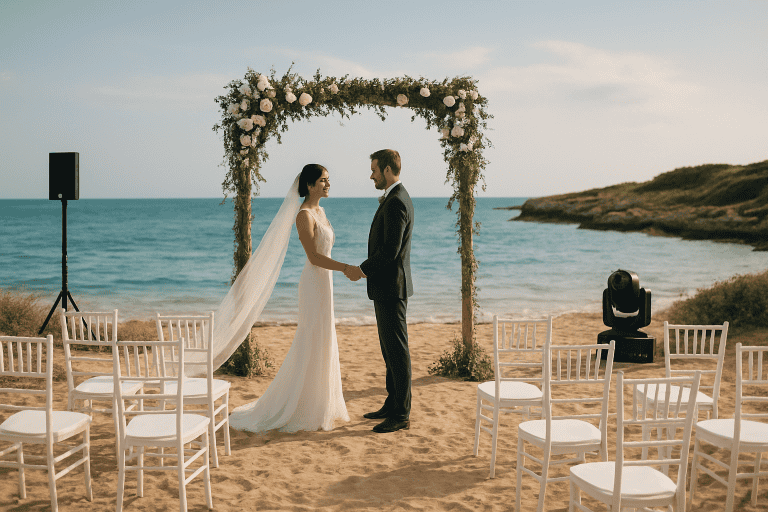 Apulia
Seaside wedding in Puglia: wind, lights, and audio for a perfect ceremony
Seaside wedding in Puglia: why wind, lighting, and audio make a difference A seaside wedding in Puglia has […]
Read more