
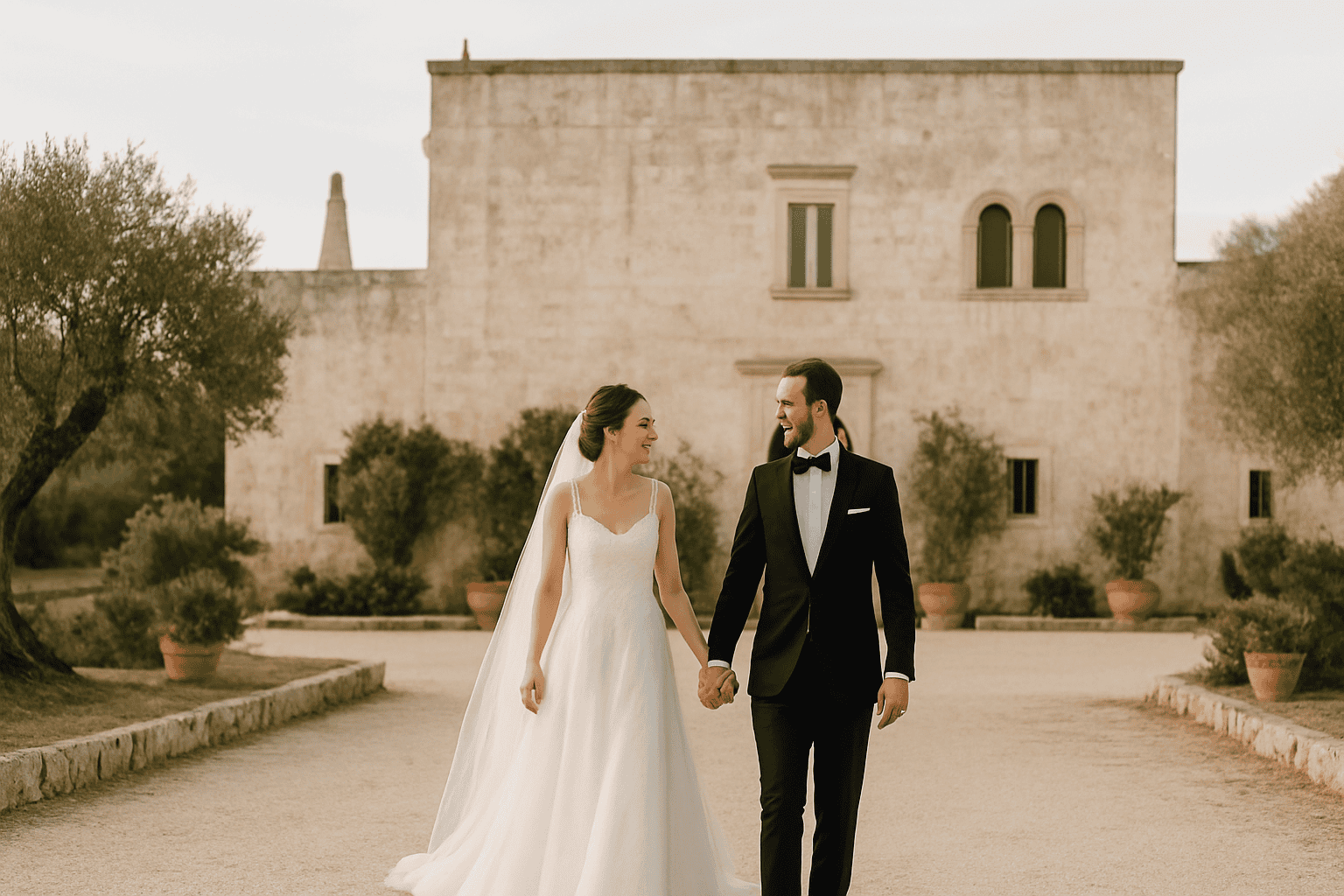
Wedding in Puglia: luxury farmhouse or historic residence? how to decide
Wedding in Puglia: why choosing between a luxury masseria and a historic residence
Organising a wedding Puglia means choosing an atmosphere even before choosing a date. The region offers very different settings: centuries-old olive groves, light stone, inner courtyards, panoramic terraces, Mediterranean gardens and historic centers with timeless charm. In this context, the most frequent question is practical: better a luxury masseria wedding Puglia or one historic residence Puglia?
There is no universal answer. There is, however, a method to decide clearly, bringing together style, logistics, guest comfort and the “impact” of the experience. In this guide you’ll find practical and commercially useful criteria to help you orient yourself, avoiding impulsive choices and aiming for a result consistent with the kind of wedding you want to experience (and have others experience).
If you want an overview of the region and its areas, you can start from this In-depth: Puglia (Wikipedia) and then come back here to turn inspiration into operational decisions.
How to understand if a luxury masseria in Puglia is the right choice
A luxury masseria wedding Puglia is often the ideal answer when you want an immersive, “all-in-one” experience: large spaces, scenic outdoor areas, the possibility of on-site accommodation and an aesthetic that combines authenticity and contemporary comfort.
Goal and style: luxury, intimate, destination
High-end masserias work very well for destination-style weddings destination, where guests come from outside the region (or from abroad) and the wedding becomes a weekend. The visual impact is immediate: you arrive in an iconic place, often surrounded by countryside, and the event “breathes” from the very first moment.
- Natural luxury: stone, arches, courtyards, olive trees, warm light; elegance is often already in the venue.
- Intimacy without giving up the scenery: even with few guests, the spaces allow for photo sets and different moments (ceremony, aperitif, dinner, party).
- Continuous experience: if the property offers rooms, you can build a story over multiple days (welcome, wedding day, brunch).
What to expect in terms of timing and logistics
A masseria tends to simplify logistics because it concentrates many activities in one place. However, not all masserias are the same: some are more “resort,” others more authentic and with spaces to manage carefully. If a detail isn’t certain, check the product sheet or in the venue’s proposal (for example: availability of covered areas, schedules, accessibility).
In practical terms, a masseria is often ideal if:
- you want to reduce travel between ceremony, reception and party;
- you want an integrated accommodation plan (or at least one that can be coordinated);
- you’re aiming for a contemporary Mediterranean aesthetic, with high comfort.
When a historic residence in Puglia truly enhances your wedding
A historic residence Puglia is the right choice when you’re looking for a wedding with a strong cultural imprint and a more “architectural” elegance: halls, staircases, frescoes (when present), formal gardens or noble courtyards. It’s a setting that speaks of history and often lends itself to more ceremonial direction.
The type of atmosphere: ceremony, ritual, grand entrance
If you imagine a scenic arrival, an aperitif in the garden with live music and a more formal dinner, the historic residence can amplify the feeling of a “unique” event. Photography changes too: lines, perspectives, period details and a more classic or editorial mood.
- Timeless elegance: perfect for those who love a refined aesthetic and less “country-chic”.
- Symbolic value: the history of the place becomes part of the wedding story.
- Indoor visual impact: useful if you want indoor spaces with strong character (especially for certain seasons).
Logistics: what to evaluate before falling in love
Historic residences may require more careful management of access, routes, loading/unloading, and setups. It’s not a limitation: it’s an element to plan for. Before choosing, clarify with the venue aspects such as technical areas, spaces for catering, and the possibility of creating a smooth flow between the moments of the event. If a piece of information isn’t made explicit, check the product sheet or ask for written confirmation.
Wedding Puglia: step-by-step planning between venue, suppliers, and guests
Whether you choose a masseria or a historic residence, a wedding Puglia successful one is born from orderly planning. Puglia is in high demand: the difference between a “nice” wedding and a truly memorable wedding often lies in the quality of the direction, the timing, and guest management.
Realistic timeline (from 12 to 2 months)
- 12–10 months before: defining style, rough budget, venue selection (luxury masseria or historic residence), site visit and date hold.
- 9–7 months before: choosing the main suppliers (catering, photo/video, music), design concept and first ideas for the mise en place.
- 6–4 months before: defining the day’s schedule, guest logistics, possible wedding website, draft of setups and lighting.
- 3 months before: operational confirmations, menu and tastings if planned, transfer plan, ceremony details.
- 2 months before: finalizing timing, seating, guest communications, weather plan B, final revisions.
If you’re setting up the project from scratch and want a complete guide, you’ll find a useful path here: How to organise a wedding.
Checklist of essential suppliers (without overloading the project)
The temptation, especially in such a scenic region, is to add “everything”. In reality, it’s better to start with the pillars and then add coherent extras.
- Location: spaces, flows, plan B, schedules, technical logistics.
- Catering: service style, time management, coordination with setups.
- Photo/Video: important to enhance light and architecture (masseria vs historic residence changes a lot).
- Music/Entertainment: define the moments (welcome, aperitif, after dinner) and the tone.
- Floral design and lighting: in Puglia, light is a narrative element; the evening requires a dedicated plan.
Guest and transfer management
One of the most underestimated points in weddings in Puglia is managing transportation. Even when the venue is “central,” guests may arrive from different airports or stay in different areas. Deciding between a masseria and a historic residence affects this aspect:
- Farmhouse: it often allows for a more concentrated experience and, if there is accommodation, reduces shuttles and “critical” schedules.
- Historic residence: it may be closer to urban centers or villages, but requires attention to parking and access.
The practical rule: if you want a relaxed wedding, plan transportation as part of hospitality, not as a last-minute detail.
Budget and priorities: where to invest to maximize the scenic impact in Puglia
You don’t need to talk about figures to talk well about budget. You need to talk about priorities. In Puglia, the venue is already a great “set,” but the difference is made by the details that make the experience smooth and coherent.
Main items to consider (realistically)
- Location and spaces: exclusivity, available areas, any nights on site, included services (check the product sheet).
- Catering and beverage: reception style and quality perceived by guests.
- Setups: flowers, table setting, furnishings, decorative details consistent with a masseria or a historic residence.
- Lights and audio: essential to enhance courtyards, gardens, and facades.
- Logistics: transfers, welcome, on-site coordination.
Where to invest to achieve an elegant “wow effect”
In a luxury masseria wedding Puglia, often the wow effect comes from direction that makes use of the spaces: an aperitif in a panoramic spot, a dinner in the courtyard with warm lights, a cake cutting in an iconic corner. In a historic residence Puglia, the wow effect can be a scenic entrance, a setup that dialogues with the architecture, or a route through rooms and garden conceived as a story.
In both cases, the best “invisible” investments are:
- lighting design (because it transforms the venue after sunset);
- timing (because it avoids dead time and keeps energy up);
- coordination (because it makes everything feel natural, with no perceived stress).
Mistakes that increase costs (and how to avoid them)
- Choosing a venue without a plan B: if you then have to “scramble for cover,” the solution becomes more complex.
- Too many set changes: beautiful on paper, but they require time, staff, and duplicated setups.
- Guest logistics not designed: shuttles added at the last minute, confusing routes, poorly staggered arrivals.
- Inconsistent design: when style and location don’t speak the same language, you end up fixing it with add-ons.
Plan B and risk management: weather, location constraints, and agreements
A wedding in Puglia is often imagined outdoors, but risk management is what truly makes the experience “luxury”: guests must not notice anything, even if something changes.
Weather and credible alternative solutions
Plan B isn’t a phrase, it’s an alternative setup designed with the same care as Plan A. Whether you’re in a masseria or a historic residence, ask:
- which indoor spaces are actually usable for the ceremony/aperitif/dinner;
- whether there are covered areas already integrated into the venue’s aesthetic;
- how the guest flow changes in case of a change.
If the venue offers specific solutions, check the product sheet or in the contract which options are actually available.
Permissions and constraints of the location: what to clarify immediately
Every property has rules and constraints: hours, music, use of certain areas, technical access, setup limits. It’s not a problem: it’s a framework. The important thing is to know it before defining the concept, so the project is born already compatible.
Agreements, deposits and conditions: how to protect the project
To avoid misunderstandings, it helps to put every key choice in writing: included spaces, setup/teardown times, weather management, any exclusivity and operational responsibilities. Without getting into technical or legal aspects, the rule is simple: what affects the experience must be clarified beforehand.
Guest experience: hospitality, transportation, and clear communication
A wedding Puglia it is remembered for its beauty, but also for how you feel inside that beauty. Hospitality is what turns an event into an experience: welcome, pacing, information, comfort.
Welcome moment, activities, and care for the welcome
If many guests are coming from out of town, planning a welcome moment (even informal) helps create connection. In a masseria, this can be natural: a lounge area, a courtyard, a sunset aperitif. In a historic residence, it can become a more “living-room” moment, with an elegant, intimate tone.
Some ideas that work well, without weighing down the schedule:
- welcome drink with relaxed pacing and background music;
- small touchpoints comfort touches (water, directions, shaded areas when needed);
- light activities for those staying multiple days, coordinated with the wedding day schedule.
Transport, shuttles, parking: the order you don’t see
When guests don’t have to ask “where do I go?” or “how do I get back?”, the event levels up. Evaluate in advance:
- clear, easily reachable pick-up points;
- realistic travel times between accommodations and the venue;
- managing returns after the party, to avoid anxiety and early departures.
If the venue has parking or dedicated areas, check the product sheet the capacity and access methods.
Clear directions and wedding website: fewer questions, more experience
Clear communication reduces stress and unexpected issues. A wedding website (or a well-made digital document) can include: map, dress code, schedule, useful contacts, accommodation suggestions, and transfer information. There’s no need to be complex: you need to be clear.
How to decide: guiding questions to choose between a luxury masseria and a historic residence in Puglia
If you’re undecided, try answering these questions. The answers will naturally lead you in one direction.
- Do you want an immersive weekend with guests staying on-site? A luxury masseria tends to make this experience easier.
- Are you more moved by historic architecture and formal elegance? A historic residence can be perfect.
- Do you prefer large, natural outdoor spaces or interiors with strong character? This is often where the decisive difference lies.
- How important is it to reduce travel? If you want to simplify, choose a property that concentrates the main moments.
- What tone do you want to give the evening party? Some venues lend themselves better to courtyard parties, others to halls and gardens with a more classic direction.
In summary: a luxury masseria wedding Puglia is often the more “experiential” and immersive choice; a historic residence Puglia excels when you’re looking for architectural refinement and a more ceremonial narrative. Both can be extraordinary, if the choice is consistent with your goals and with the real logistics.
A tailor-made plan for your wedding in Puglia
If you want to turn inspirations and moodboards into a concrete plan—venue selection, day-of direction, vendor coordination, and attention to the guest experience—you can rely on professional support. Discover the method and dedicated services in the section How to organise a wedding: the goal is to build a wedding in Puglia that is coherent, elegant, and stress-free, making the most of either a masseria or a historic residence based on what truly matters to you.
FAQ
Is a luxury masseria or a historic residence better for a wedding in Puglia?
It depends on the experience you want to create: the luxury masseria is ideal for an immersive and “all-in-one” wedding, often with large outdoor spaces and a contemporary Mediterranean mood. The historic residence enhances a more architectural and ceremonial elegance, with characterful interiors and a strong cultural impact.
What logistical aspects should I check before booking the venue?
Check the flow between the ceremony, aperitif, dinner, and party; accessibility and parking; technical areas for suppliers; the venue’s hours and rules; and above all a credible weather Plan B. If a detail isn’t clear, check the product sheet or ask the venue for written confirmation.
How do you build a realistic timeline for a wedding in Puglia?
Generally, you start 12–10 months in advance with style, budget, and venue; 9–7 months in advance with the main vendors; 6–4 months in advance with the schedule and guest logistics; 3 months in advance with operational confirmations; and in the last 2 months with final timing, communications, and a plan B.
Where is it worth investing to achieve a great visual impact without overdoing it?
Focus on a well-thought-out lighting design, smooth timing, and careful coordination. These elements enhance both masserie and historic residences and improve the perceived quality of the event, avoiding downtime and improvised solutions.
How to improve the guest experience at a destination wedding in Puglia?
Provide a welcome moment, clear information (also via a wedding website), organized transfers, and safe returns after the party. Reducing uncertainties and unnecessary travel increases comfort and makes the experience more relaxed and memorable.
From the blog
 Apulia
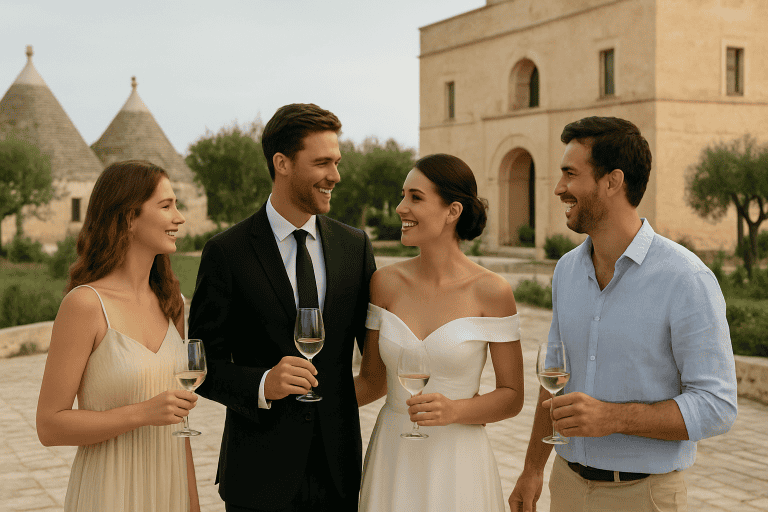
Guest experience in Puglia: tours, tastings, and activities for foreign guests
When organizing a destination wedding, the ceremony is only part of the story. For guests arriving from abroad, […]
Read more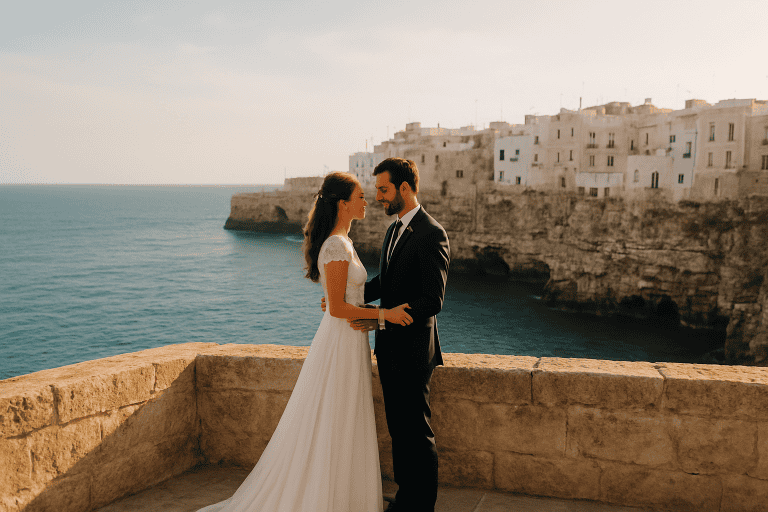 Apulia
How to choose the best period in Puglia: heat, tourism, and availability
How to choose the best period for a wedding in Puglia: heat, tourism, and availability Choosing the right date in Puglia does not only mean […]
Read more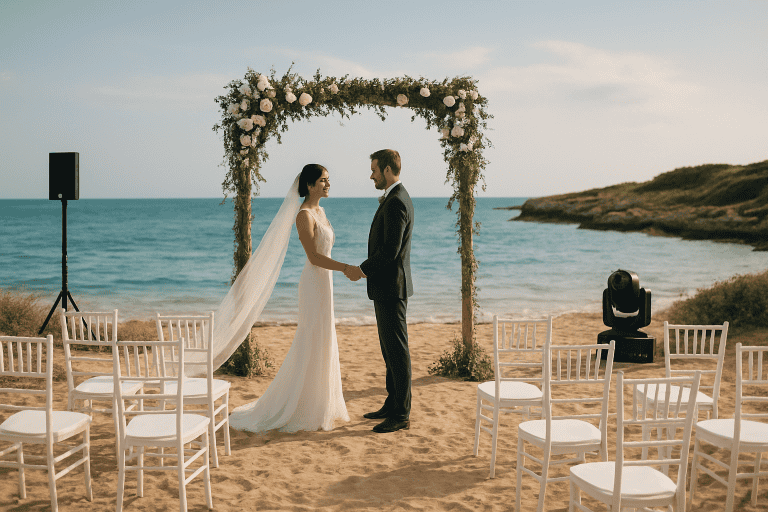 Apulia
Seaside wedding in Puglia: wind, lights, and audio for a perfect ceremony
Seaside wedding in Puglia: why wind, lighting, and audio make a difference A seaside wedding in Puglia has […]
Read more