
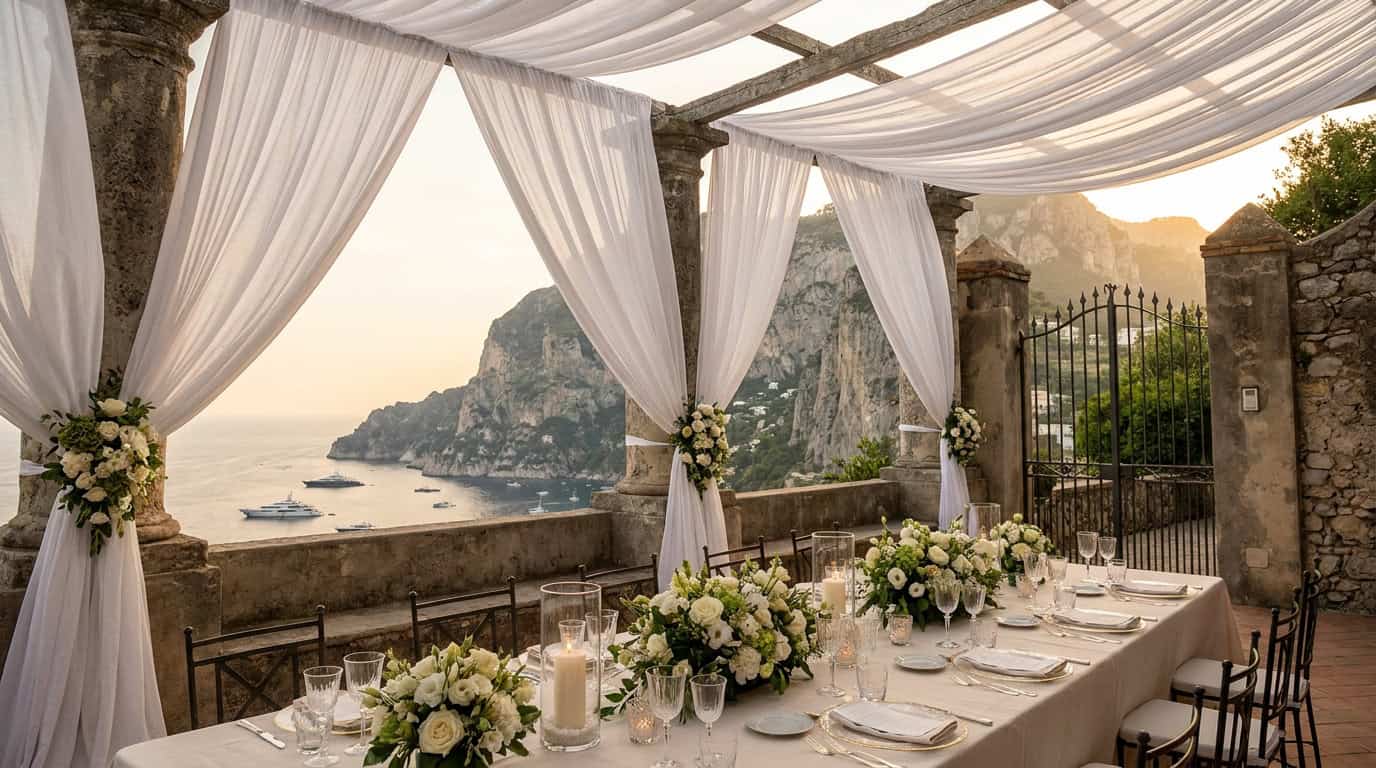
Wedding in Capri with total privacy: how to choose a villa or hotel and manage access
Capri wedding privacy: what it really means and why it changes everything
Capri it is an iconic destination: vertical landscapes, Mediterranean light, high-level services and a natural vocation for hospitality. Precisely for this reason, when the goal is a private event, the Capri wedding privacy it is not a “plus” but a design criterion. It means being able to live every moment without outside interference, controlling who comes in and who goes out, protecting guests’ discretion, and maintaining aesthetic and narrative consistency from arrival to cake cutting.
In a setting like Capri, privacy doesn’t depend only on a “beautiful” venue, but on a combination of factors: space layout, access points, visibility from nearby areas, supplier logistics, transfer management, and communication to guests. The event can be luxury, intimate, destination: in all cases, privacy is built with clear operational choices and meticulous coordination.
If you’re starting to navigate between venues and scenarios on the island, you can start with Wedding in Capri: guide, useful for getting an overall view and understanding how to set up the journey.
A wedding in Capri with total privacy: choosing between a villa and a luxury hotel
The first decision that truly impacts confidentiality is the type of venue: private villa o hotels. Both can work, but with different approaches. The key is to choose based on the level of control you want, the number of guests, and the type of experience you want to create.
Capri wedding villa: when privacy is part of the atmosphere
A Capri wedding villa is often the most natural choice for those who want an intimate, scenic, and “protected” event. The feeling is that of a private home turned into a stage: guests enter a world of its own and the day unfolds with a more personal rhythm.
- Pros: greater control of access, the ability to customize routes and setups, exclusive atmosphere.
- Points to watch: supplier logistics (loading/unloading), technical spaces, noise and time limits (check the product sheet/contract), alternative weather plans.
The villa is ideal if you want direction “on a closed set”: staggered arrivals, separate areas for staff and guests, corners for photos and video without an outside audience.
Luxury hotel Capri: high privacy with integrated services
A luxury hotel Capri can offer a level of comfort and continuity that is hard to replicate: rooms, dining, event spaces, in-house staff, and often well-tested flow management. For privacy, the spaces make the difference: a reserved terrace, a dedicated area, separate entrances, or the possibility of reserving certain zones.
- Pros: coordinated services, simplified guest management, alternative plans often more immediate.
- Points to watch: the presence of other hotel guests, shared passageways, the need to clearly define the perimeter and reserved access.
Basically: the hotel can be perfect for a destination wedding with multiple moments (welcome, symbolic ceremony, party), provided that you negotiate and plan precisely areas, times, and routes.
Guiding questions to decide without second thoughts
- How important is it that no outsiders see the ceremony or the reception?
- Do you want guests to stay “inside the experience” for several days (hotel) or do you prefer a focused, cinematic event (villa)?
- Do you need separate spaces for backstage (makeup/hair, outfit changes, photo/video direction)?
- What kind of arrival do you envision: discreet, staggered, or a show-stopping entrance?
Step-by-step planning for a private event in Capri
A wedding in Capri requires planning that brings together beauty and operations. When privacy is a priority, the timeline isn’t only about “staying on schedule”: it’s about reducing unforeseen issues and unwanted contacts. Here is a realistic outline (adaptable based on the season and the venue’s availability).
Realistic timeline (from 12 to 2 months) with a focus on access and discretion
- 12–10 months: define style, number of guests, choice between villa and hotel; first draft of the “privacy perimeter” (reserved areas, sensitive points, no-photo moments).
- 9–7 months: site inspection (or virtual inspection), study of routes (guests/suppliers), definition of spaces for backstage and direction; selection of key suppliers.
- 6–4 months: logistics plan: arrivals, transfers, loading/unloading times; definition of access rules (name lists, passes, security).
- 3 months: event run-of-show with privacy “windows” (e.g., intimate moment before the ceremony, shooting without an audience); guest communication plan.
- 2 months: finalization of layout, supplier briefing, definition of contacts and responsible persons; test of the weather plan and alternatives (check in the venue’s product sheet/contract).
Checklist of essential suppliers (with one criterion: fewer interferences, more flow)
It’s not just a matter of “who to hire”, but of how to make them work without creating traffic, waiting times, or movement through guest areas.
- Planner/coordinator: overall direction and access control during critical moments.
- Location manager or internal point of contact: essential to align routes and schedules.
- Catering/banqueting: backstage management, service timing, technical areas.
- Photo/video: definition of “safe” zones and reserved moments; any requests for discretion.
- Set-ups and flowers: installations with time windows and dedicated routes.
- Security/hostesses: access control, welcoming, list management.
For a broader operational outline (useful even if you’re comparing multiple destinations), you can complement your planning with Organizing a wedding: checklist.
Guest management and transfers: privacy is won or lost during travel
Many “privacy leaks” happen outside the venue: simultaneous arrivals, waiting in visible spots, unclear directions. To avoid this, work on three levers:
- Staggered arrivals: entry windows for groups, to reduce crowding.
- Discreet meeting points: meeting locations that aren’t too exposed (to be defined based on the actual routes).
- Shuttle coordination: schedules and routes communicated precisely, with a point person to handle any delays.
Managing access and the privacy perimeter: a practical strategy for villas and hotels
Privacy isn’t an abstract concept: it’s a list of decisions. The goal is to create a “perimeter” that protects key moments without turning the event into something rigid. The secret is to give guests the sense of a smooth experience, while behind the scenes everything is controlled.
Single entrance, separate entrances, and “buffer zones”
- Single entrance for guests: reduces mistakes and simplifies welcoming.
- Separate entrance for suppliers: avoids run-ins with outfits, the ceremony, photo sets.
- Buffer zones: small transition spaces (even just a corridor, a side garden, a terrace) where you can manage waiting without exposure.
Name lists, passes and “gentle” communication
For private events, access management works when it is clear but not intrusive. Some practical solutions:
- Named guest list shared with reception and security.
- Discreet passes (minimal wristbands, cards, or simple name confirmation) depending on the style of the event.
- Pre-event messages that explain where to go and what to expect, avoiding overly detailed public directions.
Protect the most sensitive moments (without ruining the atmosphere)
There are moments that deserve a higher level of privacy: getting ready, first look, ceremony, speeches, after party. The best management is often “invisible”:
- Time windows where some areas remain closed or monitored.
- Alternative routes for staff and vendors during key moments.
- Briefing for photo/video on angles that avoid outside areas or passers-by.
Priorities and smart choices: invest where it increases the scenic impact (without losing privacy)
When it comes to priorities, the most common mistake is to focus everything on aesthetics and leave privacy “to chance”. In reality, in Capri the wow effect and privacy can support each other: a well-designed route is more scenic and also more protected.
Main items to consider (from a commercial and operational perspective)
- Venue and private spaces: dedicated areas, possible exclusivity, management of the spaces.
- Logistics and transfers: coordination of arrivals, shuttles, timing.
- Set-ups: elements that create visual wings and guide flows.
- Welcome and access control: hostesses, security, discreet signage.
- Event production: direction, supplier coordination, run of show.
Where to invest to maximize set design and privacy
- Smart layout: define a guest route that “reveals” the spaces gradually, avoiding exposed points.
- Natural screens: greenery, decorative elements and furnishings that screen without weighing things down.
- Lighting: lighting that enhances and, at the same time, reduces the perception of outdoor areas.
- Timing: schedules that limit overlaps with other flows (to be checked with the venue and suppliers).
Mistakes that increase complexity (and risk exposing the event)
- Too many location changes without a transfer plan: every move is a vulnerable point.
- Directions sent in a confusing way: guests asking around for information, arriving early or stopping in visible areas.
- Setups happening at the same time as guest arrivals: crossings, noise, loss of magic.
- Lack of an access point person: even the most exclusive venue becomes permeable.
Plan B and risk management in Capri: weather, alternatives and agreements
Privacy is also protected in alternative plans. A sudden change of spaces can create confusion, crowds and uncontrolled passages. For this reason, Plan B must be designed with the same care as Plan A.
Weather: alternatives consistent with the style (and with privacy)
It’s not enough to “have an indoor option”: you need an alternative that maintains atmosphere and control. Consider:
- Covered spaces that do not force guests to pass through common or exposed areas.
- Dry paths and protected between ceremony and reception.
- Flexible timing to move certain moments without creating long waits.
Details such as capacities, use of certain rooms or terraces, and operating conditions must be confirmed: check the product sheet/contract of the venue.
Venue constraints: what to clarify right away
To avoid surprises, it’s useful to clarify in advance (and put it in writing) aspects such as:
- Setup/takedown times and technical access.
- Available areas for backstage and storage.
- Rules on music and entertainment (check the product sheet/contract).
- Management of external staff: entrances, badges, routes.
Agreements with suppliers: operational clauses that help privacy
Without going into specific legal aspects, there are practical elements that are worth aligning:
- Arrival times staggered and confirmed.
- Single points of contact for each team, to reduce fragmented communications.
- Briefing on discretion and behavior in guest areas.
Guest experience in Capri: hospitality, transport, and stress-free communication
Confidentiality must never become “distance.” A private wedding works when guests feel guided and pampered, without having to ask for information or improvise. In Capri, where the destination experience is part of the value, hospitality is a pillar.
Welcome moment and activities: creating a rhythm that protects privacy
A well-thought-out welcome reduces random movements and makes everything feel more natural. Some ideas (to be adapted to style and season):
- Hotel reception or in a private spot with clear directions for the event day.
- Moments in small groups to avoid large simultaneous flows.
- Light schedule that leaves room for the destination but with precise references on where and when.
Transport, shuttles and meeting points: less waiting, more elegance
For a private event, logistics must be almost “silent”. It works when:
- Pick-up points are easy to find and not too exposed.
- Times are communicated in advance and with a realistic buffer.
- There is a dedicated contact for guests, to avoid scattered phone calls.
Clear directions and wedding website: privacy also in communication
Well-designed communication is a form of protection. Instead of sharing sensitive details publicly, you can use controlled channels (digital invitations, reserved area, direct messages). In particular:
- Addresses and maps only to those who are invited, with practical instructions.
- Dress code and timing explained clearly to avoid early arrivals.
- Photo/social guidelines if you want discretion (with a gentle tone consistent with the style).
Capri as a setting: context, identity and coherent choices
Capri is not just a backdrop: it is a visual and cultural language. Knowing the context helps you make more coherent choices, especially if you want an elegant and private event. For a general overview of the island, you can consult Further reading: Capri (Wikipedia).
From a privacy perspective, the point is not to “hide”, but to choose spaces and times that allow you to experience Capri intensely, without feeling watched or interrupted. This is where the difference between a beautiful event and a truly memorable event becomes evident.
FAQ
How to get total privacy for a wedding in Capri?
A complete project is needed: choice of the location with spaces that can actually be reserved, definition of a perimeter (guest/backstage areas), access management with named lists, and a transfer plan that avoids waiting in exposed points. Operational details must be confirmed with the location: check the product sheet/contract.
Is it better to have a villa or a luxury hotel in Capri for a private wedding?
The villa often offers more control and a “closed-set” atmosphere, ideal for intimate events. A luxury hotel can guarantee integrated services and continuity over multiple days, but it requires clearly defining dedicated areas and separate routes to avoid interference with other guests.
How do you manage guest access without making the event rigid?
With discreet reception and simple rules: a single entrance for guests, separate routes for suppliers, name lists and clear pre-event communications. The goal is to make guests perceive smoothness, while keeping control behind the scenes.
What are the most delicate moments for privacy during a wedding in Capri?
Preparation, first look, ceremony, speeches and after party. To protect them, time slots with monitored areas, alternative routes for staff and photo/video briefings on angles and areas to avoid work.
What should be included in Plan B to avoid losing privacy in case of variable weather?
An alternative that maintains control and atmosphere: truly usable covered spaces, protected routes between the moments of the event, and a flexible schedule to reduce waiting times and crowding. Check in the product/contract sheet which areas are available and under what conditions.
How to communicate directions and logistics to guests without exposing sensitive information?
Use controlled channels (digital invitations, members-only area, direct messages) and share addresses and maps only with invitees. Specify timing and meeting points clearly to avoid early arrivals or requests for information in public places.
From the blog
 Capri
Capri
Welcome bag for guests in Capri: what to include and how to personalize it
Welcome bag Capri: why it really improves the guest experience A well-thought-out welcome bag Capri is not just a “gift”: […]
Read more Capri
Capri
Elopement in Capri: intimate ceremony, shooting, and private dinner (complete plan)
Elopement in Capri: an intimate wedding between ceremony, shooting, and private dinner An elopement in Capri is not “a wedding […]
Read more Capri
Capri
Plan B weather in Capri: elegant indoor solutions without ruining the style
Weather Plan B in Capri: why an indoor alternative is part of the style Capri is not just a destination: it is an image […]
Read more