
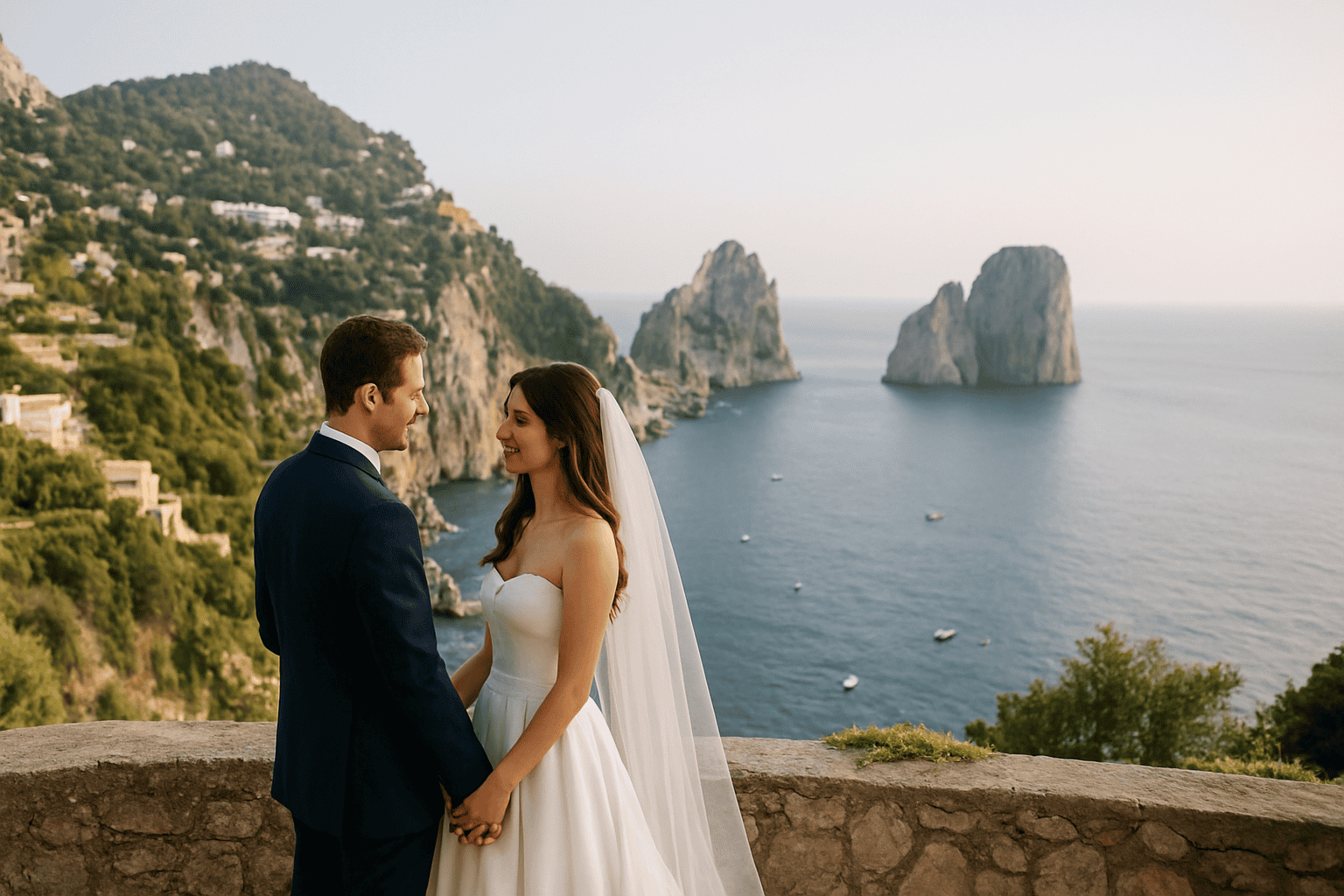
How the period affects costs and availability in Capri: high season vs shoulder season
Capri peak season vs shoulder season: what really changes in terms of costs and availability
When it comes to destination wedding with Capri, the chosen period is not a detail: it is a strategic lever that influences availability of venues and suppliers, the pace of logistics and the overall perception of the experience. In other words, the wedding costs Capri period does not depend only on “how much” you want to do, but also on “when” you want to do it.
Capri has a very pronounced seasonality: in the months of Capri high season the island experiences its peak in visitors, with an immediate impact on bookings, response times and the possibility of customization. The shoulder season (the periods immediately before and after the peak) often offers a different balance: the same iconic atmosphere, but with more flexible dynamics, especially if your goal is an destination wedding budget optimized without giving up style.
For an overview of the island and its main areas, you can consult Further reading: Capri (Wikipedia).
Capri peak season: advantages, limits and impact on the destination wedding budget
In peak season, Capri is at the height of its energy: long days, intense light, a lively atmosphere, instantly recognizable photographic settings. For many couples it is the “natural” choice, especially if they want a wedding that feels like a luxury vacation shared with guests.
That said, peak season brings some practical consequences that directly affect costs e availability:
- Full calendars: sought-after venues and top suppliers are booked well in advance; last-minute alternatives are more limited.
- Denser logistics: transfers, embarkations, timing between ceremony and reception require wider margins and stricter direction.
- Less flexibility: in periods of maximum demand, changes and customizations can be harder to fit in.
If your goal is a destination wedding budget under control, peak season is not “wrong”, but it must be managed with clear priorities: choose what really matters (view, privacy, quality of service, guest experience) and build the project around that.
Shoulder season in Capri: more breathing room, the same magic (if planned well)
The shoulder season is often the choice of those who want an elegant, well-curated wedding, but with a more “smart” approach: less crowding, easier coordination of suppliers and, in many cases, greater availability of dates and solutions.
It doesn’t mean giving up the Capri effect, but change the pace:
- More intimate experience: the island can feel more livable, with spaces and time perceived as more exclusive.
- Greater operational flexibility: more chances to find favorable fits between the ceremony, the shoot, and hospitality moments.
- Wider choices: some venues and creative teams may have more room for customization and details.
Attention though: “shoulder” doesn’t automatically mean simple. Capri remains a destination with island logistics and access rules that can vary. If a detail depends on specific conditions (times, access, space availability), check the product sheet or in the documentation of the venue/service you are evaluating.
Capri wedding costs by period: how the calendar influences expense items
Talking about wedding costs Capri period means thinking in terms of dynamics, not figures. The period affects three levels: demand, complexity e Lake Como is synonymous with discreet luxury and natural beauty. Neoclassical villas overlook turquoise waters, terraced gardens slope down to the shore. It is the destination chosen by celebrities and couples from all over the world.. And these three factors are reflected in many items of the project.
Demand: when everyone wants Capri, everything moves faster
In high season demand is high and availability decreases. This can translate into:
- more lead time required to secure venues and suppliers;
- fewer equivalent alternatives if an option isn’t available;
- more attention to planning, because moving a date or a time can have a domino effect.
Complexity: more crowds, more coordination
With the island fuller, the variables increase: transfer times, managing arrivals, synchronization between boats, luggage, check-in. Even when everything is perfectly organized, it takes more direction to maintain fluidity e comfort.
Time: your timeline shortens or lengthens
The chosen period also influences how you build the timeline. In high season it’s often best to plan further in advance and with quick decision-making steps. In the shoulder season you might have more leeway, but it shouldn’t be taken for granted: some “bridge” dates or highly sought-after weekends can fill up anyway.
Step-by-step planning: from the vision to the date (without missing opportunities)
To manage Capri well, the key word is sequence. It’s not just about choosing suppliers, but doing so in the right order, because different periods change priorities.
Realistic timeline: from 12 to 2 months (and what changes between high season and shoulder season)
- 12–9 months before: defining the vision (style, number of guests, mood), choosing the time window and pre-selecting the location. In Capri high season this step is crucial to avoid losing the best dates.
- 9–6 months before: securing the location and key suppliers (catering/banqueting if planned, photography, video, floral design, music). In shoulder season you may find more options, but the most in-demand teams are still booked well in advance.
- 6–4 months before: defining guest logistics (arrivals, departures, transfers), drafting a schedule and choosing spaces for any extra moments (welcome, day-after).
- 3–2 months before: finalizing details, confirmations, rehearsals, final timing, guest communications and weather plan.
If you want a clear operational structure, you can start from Organizing a wedding: checklist and adapt it to the specifics of an island destination.
Checklist of essential suppliers (different priorities depending on the period)
A wedding in Capri is a directing project. Some suppliers become “essential” not only for style, but for logistical success:
- Location and space plan: in high season availability is the first constraint; in shoulder season the versatility of the spaces matters a lot.
- Transport and coordination: managing arrivals/departures, transfers, timing between different points on the island.
- Creative team: photo/video and floral design must work with real light, wind, spaces and timing.
- Music and entertainment: in crowded periods it’s worth planning set-up and assembly/disassembly times precisely.
The point isn’t “having everything”, but having what you need to maintain aesthetic consistency e serenity on the day of the event.
Guest management and transfers: the element that changes more than the budget
The period has a huge impact on guest management. In high season, guests may organize the trip as a vacation: this is an advantage, but it increases the spread of schedules and preferences. In shoulder season, they often move in a more “compact” way, and it can be easier to guide the group with clear directions.
In both cases, it’s useful to:
- define a reference point (hotel/area) for communications and meet-ups;
- create a timeline with real (not optimistic) buffers;
- provide dedicated coordination for key transfers.
Budget destination wedding: how to choose priorities to maximize the Capri effect
A destination wedding budget effective isn’t what “cuts,” but what allocated intelligently. Capri is a natural backdrop: the secret is to make every choice enhance the context, instead of fighting it.
Main cost items (and why the season makes them fluctuate)
Without getting into prices, the items most affected by the season are:
- Location: availability, days of the week, and time windows can change the accessibility of options.
- Hospitality and logistics: overnight stays, transfers, luggage handling, and timing are more “sensitive” in high season.
- Setups: wind, temperatures, and light influence materials, technical solutions, and floral choices.
- Team and production: in periods of high demand, securing the best professionals requires quicker decisions.
Where to invest to maximize the scenic impact (without chasing excess)
Capri rewards attention to detail and coherence. In terms of results, these often work very well:
- choosing a viewpoint (a terrace, a lookout, a garden) that becomes the event’s “signature”;
- lighting and atmosphere to transform spaces as evening falls;
- a floral design conceived for the place, that dialogues with the island’s architecture and colors;
- a realistic photo timeline, built around the light of the chosen period.
In high season, investing in direction and flow management can be what makes the event feel “effortless.” In shoulder season, investing in the versatility of spaces (indoor/outdoor) can be the key to peace of mind.
Mistakes that increase costs (more frequent in high season)
- Deciding late: postponing holds and confirmations can reduce options and force less efficient solutions.
- Scheduling too many moves: changing more locations on the same day increases complexity and the risk of delays.
- Underestimating timing: in Capri, time “stretches” naturally; you need some buffer to enjoy the experience.
- Not planning a weather contingency: even a small change can impact setups and logistics.
Plan B and risk management: weather, location constraints, and agreements
The difference between a beautiful wedding and an impeccable wedding often lies in risk management. The chosen period affects the likelihood of having to activate alternatives and how easy it is to do so.
Weather and alternative solutions: not just “rain yes/no”
Weather in Capri isn’t only about precipitation: wind, humidity, and temperature variations affect comfort and setups. A good Plan B:
- must not feel like a fallback, but a coherent second setting;
- should be designed together with the venue, verifying actual spaces and capacities;
- requires an alternative timeline already prepared, with clear responsibilities on who decides and when.
If a solution depends on specific venue provisions (covers, indoor spaces, sheltered areas), check the product sheet or in the official documentation before considering it “guaranteed”.
Permissions and constraints of the location: what to ask before signing
Every venue has operating rules: hours, access, technical limits, music management, loading/unloading. It’s not a “cold” topic: it’s what determines whether your project is feasible with peace of mind.
Useful questions (to adapt to the case):
- What are the setup and breakdown windows?
- Which areas can be used exclusively and which are shared?
- What are the options in case of adverse weather?
- Are there technical constraints for lighting, audio, flowers, or scenic elements?
Contracts and deposits: how to protect the project (especially in the most in-demand periods)
In high season, pressure on dates can lead to quick decisions. It’s important that every confirmation is accompanied by clear conditions: what is included, what is extra, what the payment timelines are, what happens in case of changes. The goal is not to rigidify the project, but to make it predictable.
Guest experience in Capri: hospitality, transportation, and communication (depending on the period)
Capri is a destination guests remember for years. But the experience isn’t created only by a view: it’s built through micro-details that, overall, make everyone feel guided and welcomed.
Welcome moment, activities, and hospitality: how it changes between high season and shoulder season
In high season, many guests will already have a full agenda: sea, beach clubs, boat tours, shopping. A well-thought-out welcome moment can become the group’s point of connection without “stealing” time.
In shoulder season, guests are often more available to enjoy shared activities: slower experiences, cultural itineraries, gastronomic moments. The important thing is that everything is consistent with the wedding’s style: luxury does not necessarily mean “formal”, but well-groomed.
Transport, shuttles, parking: the invisible side that makes the difference
Logistics in Capri are an integral part of the event design. In high season, timelines can be tighter and the availability of solutions may require more advance planning. In the shoulder season, there may be more breathing room, but coordination remains essential:
- guests’ arrival and departure times;
- simple and intuitive meeting points;
- return plans after the reception (without leaving anyone “stranded”).
A practical tip: minimize the choices guests have to make on their own. The more guided the experience is, the more it is perceived as premium.
Clear directions and a wedding website: the elegant solution to complexity
When the wedding involves travel, communication is part of the service. A wedding website (or a well-designed digital document) helps to:
- share the schedule and dress code without misunderstandings;
- explain how to get around and where to meet;
- reduce repetitive messages and stress in the days leading up to it.
In high season, this tool becomes almost indispensable for maintaining order. In the shoulder season, it makes the experience smoother and “easier” for everyone.
If you’re evaluating scenarios, style, and organizational approach, you’ll find a complete overview in the Wedding in Capri: guide, useful for helping you navigate choices, timing, and logistics.
Frequently asked questions about timing, availability, and planning in Capri
Below you’ll find some quick answers to the most common questions when comparing Capri high season and the shoulder season, with a focus on planning and destination wedding budget.
Do you want to understand which period truly enhances your idea of a wedding in Capri? Tell us the style you envision, the kind of experience you want for your guests, and your priorities: ChiaraB Events can help you turn seasonality into an advantage, building a cohesive, seamless, and meticulously curated project in every detail.
FAQ
How much does the time of year affect the costs of a wedding in Capri?
It mainly affects availability and complexity: in high season, dates and vendors fill up sooner and logistics may require more coordination; in shoulder season there is often more flexibility. For a realistic estimate, it’s best to define priorities first (location, guest experience, style) and then build the budget accordingly.
Is Capri in high season always the best choice for photos and atmosphere?
Not necessarily. Peak season offers intense light and lively energy, but also more crowds and tighter timing. Shoulder season can provide a more intimate atmosphere and smoother logistics, while still keeping iconic scenery if the timeline is planned around the light and conditions of the period.
When do you need to book the venue and suppliers for a wedding in Capri?
It depends on the period and the level of demand for the venue and team. In high season it’s wise to move earlier so you don’t miss the best dates; in shoulder season there may be more leeway, but the most in-demand professionals still get booked early. The correct order is: date window, venue, then key suppliers and guest logistics.
How do you handle a weather plan B in Capri without ruining the style?
Plan B works when it is designed as a coherent second setup, not as a fallback. It must be defined with the venue by checking alternative spaces and timing, and coordinated with setups and suppliers. If some options depend on specific equipment, check the product sheet or the venue documentation.
What is the most common mistake that increases the destination wedding budget in Capri?
Underestimating logistics and leaving too many decisions to the last minute. In Capri, travel and real timings have a big impact on the experience: clear coordination, few location changes on the same day, and effective communication to guests help avoid complications and indirect costs.
How to improve the guest experience based on the selected period?
In high season it’s useful to guide guests with very clear instructions (meeting points, timing, returns) to avoid people getting scattered. In shoulder season you can focus on slower, more thoughtful shared moments. In both cases, a wedding website or a digital document with the schedule and practical info reduces stress and makes the experience feel more premium.
From the blog
 Capri
Capri
Wedding in Capri with total privacy: how to choose a villa or hotel and manage access
Wedding privacy in Capri: what it really means and why it changes everything Capri is an iconic destination: vertical landscapes, Mediterranean light, services […]
Read more Capri
Capri
Welcome bag for guests in Capri: what to include and how to personalize it
Welcome bag Capri: why it really improves the guest experience A well-thought-out welcome bag Capri is not just a “gift”: […]
Read more Capri
Capri
Elopement in Capri: intimate ceremony, shooting, and private dinner (complete plan)
Elopement in Capri: an intimate wedding between ceremony, shooting, and private dinner An elopement in Capri is not “a wedding […]
Read more