




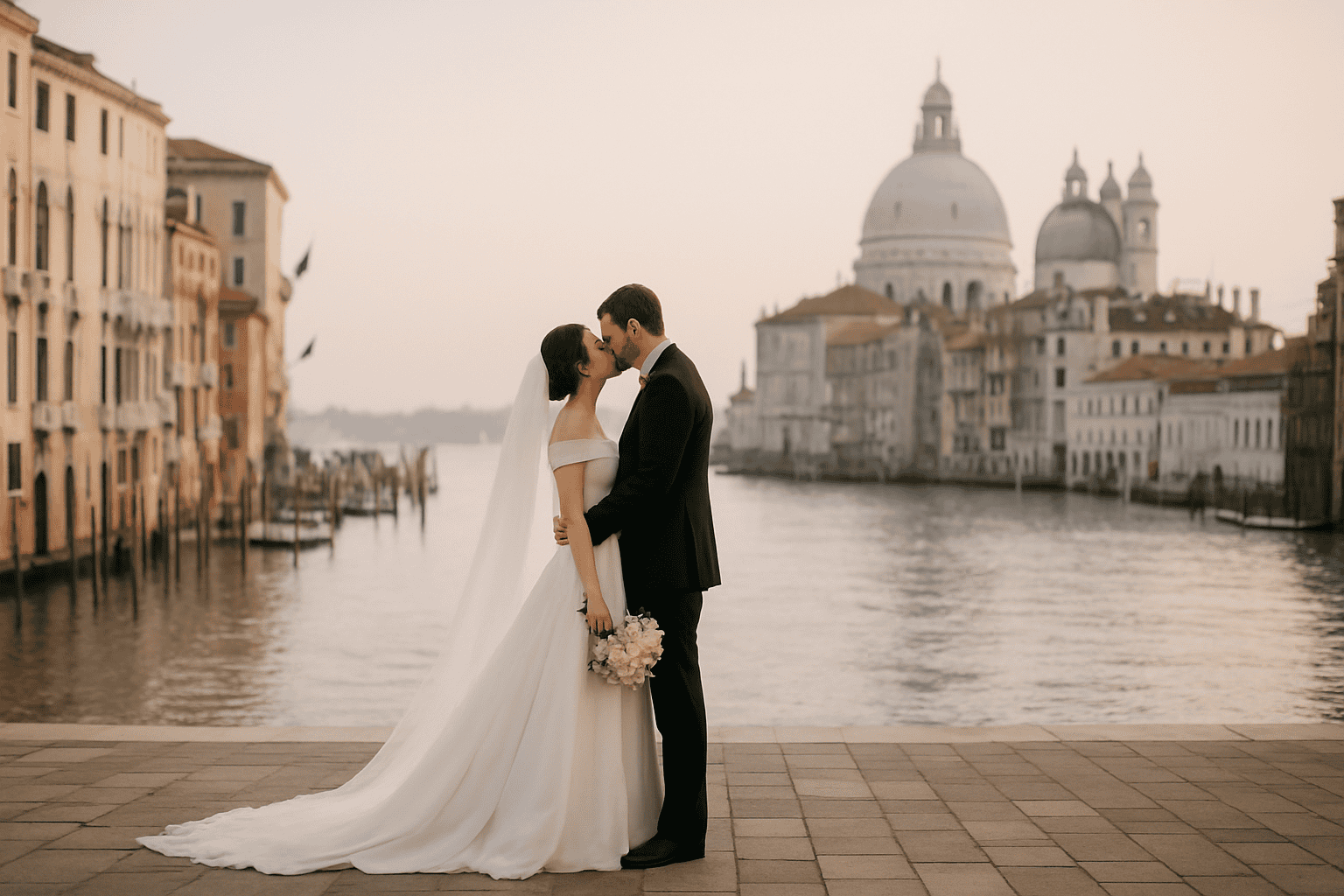
Wedding photos Venice without crowds: why focus on times and itineraries
Venice is a natural stage: narrow alleys, bridges, reflections on the water, palaces that change color with the light. Precisely for this reason, however, it is also one of the most photographed destinations in the world. If your goal is wedding photos Venice without crowds, the difference is not made “only” by the photographer: it is mainly made by the direction of the experience.
This article guides you practically on times, itineraries e photo permits Venice, with an approach designed for those who want an elegant, intimate, and smooth shooting, without stress and without chasing “impossible” views at the wrong times. If you are considering a larger event, you can also start from the Wedding in Venice: guide to orient yourself among locations, style, and logistics.
Goal and style: luxury, intimate, destination
One shooting Venice well designed is not a checklist of spots to “tick off”. It is a narrative: arrival, waiting, meeting, walk, boat, details, glances. In a luxury context (even when the budget is limited), the feeling you want to achieve is calm: few moves, right timing, favorable light, and a path that “flows” without interruptions.
For this reason, the format works when:
- you choose a strategic time (dawn, very early morning or evening slot);
- you build a compact itinerary (few points, but iconic);
- you plan for alternatives weather and crowding;
- you clarify in advance any permits required for specific areas or particular accesses.
What to expect in terms of timing and logistics
Venice requires a different type of logistics compared to other cities: walking, bridges, “variable” times related to water and tourist flows. In a wedding photoshoot, this translates into a simple rule: less is more. Better 3–4 well-chosen micro-scenarios, rather than trying to cross half the city.
If you want a quick reference to understand the structure of a day (or a weekend) and coordinate suppliers and moments, an operational outline like Organizing a wedding: checklist, adapted to the Venetian specificity, can also be useful.
Step-by-step planning for a stress-free Venice shooting
To achieve natural shots without crowds, planning is what allows you to live the city instead of chasing it. Below you will find a sequence of steps that works both for those getting married in Venice and for those organizing a pre/post wedding photo shoot. Good planning also includes details such as guest management for the wedding on a boat, ensuring that everyone feels comfortable while exploring the wonders of Venice. Consider the timing of the photo shoot to make the most of natural light and less crowded locations. Finally, don’t forget to clearly communicate expectations to guests so that everyone can enjoy this unique experience without stress.
Realistic timeline: from 12 to 2 months before
- 12–9 months: define the style (classic, editorial, cinematic, minimal), the period, and the basic idea of the itinerary (San Marco area? Dorsoduro? Cannaregio?). If the ceremony is civil, it is advisable to immediately align times and movements with the administrative part: Civil wedding: requirements and timing.
- 8–6 months: choose photographer and, if planned, videomaker. Agree on a lighting/schedule plan and a first draft of the route with alternatives.
- 5–3 months: check access and conditions of the locations (some private spaces or facilities may require authorizations or internal rules). If you have doubts about a detail, check the product sheet or in the official communication of the facility/service.
- 2 months: finalize timeline, starting and ending points, means (on foot, water taxi, gondola if consistent with the style). Prepare a weather plan B and an “anti-crowd” plan.
Essential supplier checklist (for photos without crowds)
To achieve wedding photos Venice without crowds dozens of figures are not needed, but the right ones, coordinated, are.
- Photographer: it is essential that they know the city and can “read” the light between alleys and canals.
- Make-up & hair: in a humid and windy city, endurance makes the difference. Plan a quick touch-up before going out.
- Transport: if you include water and boat, allow waiting times and a comfortable boarding point.
- Planner/coordinator (if present): useful for managing times, meetings, any access, and to prevent the shooting from becoming a race.
Guest management and transfers (when the shooting is on the wedding day)
If the shooting takes place on the same day as the ceremony, the question is: where are the guests while you shoot? The most elegant solution is to turn the wait into an experience: a welcome drink, a short tour, a moment of hospitality. This way the shooting remains intimate, and guests do not perceive “dead time”.
Best times for wedding photos in Venice without crowds
Timings are your number one ally. Venice changes its face several times a day: not only because of the light but also because of the rhythm of people. In general, for a shooting Venice cleaner and more controllable look, these time slots are often the most effective.
Dawn and early morning: the most authentic Venice
This is the most powerful option if you want empty alleys and a suspended atmosphere. Dawn offers you:
- free spaces even in iconic areas;
- soft light and delicate reflections on the water;
- a cinematic mood, perfect for editorial shots.
Drawback: requires discipline with timing (makeup and preparation earlier) and well-practiced logistics.
Late afternoon and evening: atmosphere, but with strategy
The evening slot can work very well for a more romantic story, especially in less central areas or on “micro-stop” routes. The key point is to avoid relying on a single spot: better a sequence of quick and close views, so if you find a crowded spot you skip it without losing the rhythm.
Noon: when to avoid it (and when it can work)
In many situations, noon is the most challenging time slot: harsh light, sharp shadows, and crowds. However, it can work if:
- you are in shaded areas (arcades, narrow alleys, interiors with natural light);
- you have a very targeted itinerary and quick timing;
- you aim for a more “street” and dynamic aesthetic.
Recommended itineraries for an elegant and uncrowded Venice shoot
An effective itinerary is not the “most famous” one, but the one that allows you to get visual variety within a few minutes of walking. Here you find modular ideas: they are not rigid routes, but mental maps to build your own.
Itinerary 1: classic atmospheres with smart detours (San Marco area)
San Marco is iconic but can become unmanageable. The trick is to use the area as the “opening” or “closing” of the shoot, at the right times, and then immediately move to quieter side alleys.
- Start: glimpse with important architectures in the very early morning.
- Transition: side alleys, less frequented little bridges, details of doors and Istrian stone.
- Finale: a short stretch on the water (if planned) to change perspective.
Itinerary 2: Dorsoduro and Zattere for light and breath
If you are looking for a more airy Venice, Dorsoduro is often an excellent choice: long walks, glimpses of the water, elegant but less crowded atmosphere. It is ideal for those who want natural shots, with movement and little “pressure” on them.
- Slow walk with photographic pauses every few minutes.
- Alternation between open backgrounds and more intimate alleys.
- Possibility to include a couple moment (a coffee, a toast) without feeling watched.
Itinerary 3: Cannaregio and Ghetto for an authentic mood
For those who love a truer and less “postcard” aesthetic, Cannaregio offers long canals, quiet corners and an everyday Venice. It also works well in late morning, because many areas remain livable.
Practical advice: choose 2–3 strong points and a linear route. Avoid “zigzagging”: in Venice zigzag means bridges, and bridges mean time and effort (with formal clothes and shoes, even more).
Itinerary 4: islands (Murano/Burano/Torcello) for a different story
The islands completely change rhythm and color palette. They are perfect if you want an “extra” chapter of your photographic story. Be careful though: they require longer times and precise planning of transfers. If the goal is without crowds, the choice of timing is even more decisive.
For a general context on the city and its urban structure, you can consult Further reading: Venice (Wikipedia).
Venice photo permits: what to check before the shooting
The theme photo permits Venice is often underestimated, because people tend to think that “a camera is enough”. In reality, the need for permits can depend on various factors: the chosen area, the use of particular equipment, access to private spaces or the request for exclusivity.
To avoid surprises, set a simple method: always check with those who manage the space (hotel, building, museum, terrace, private pier) and agree in writing what is allowed.
Public spaces vs private spaces: operational differences
- Public spaces: often the “light” shooting is easier, but it remains essential to maintain a low profile, without obstructing passages and without expecting empty areas during peak hours.
- Private spaces: here the rules can vary greatly. Some facilities allow photos only in certain areas or time slots, others require internal authorizations.
Equipment and set: when everything can change
The more the shooting resembles a set (lights, tripods, frequent outfit changes, large crew), the more likely additional checks are needed. Even without entering specific regulatory aspects, the good practice is:
- keep the crew lean;
- choose equipment light and mobile;
- prefer routes where you can stop without creating obstruction.
How to manage permits without slowing down creativity
A common mistake is to talk about permits too late, when the itinerary and times are already fixed. Instead, integrate the topic from the start:
- first choose 2 itineraries (A and B);
- then identify points that might require authorizations;
- finally confirm the rules with the managers and adapt the timeline.
Result: the shooting remains smooth and you don’t waste time improvising on site.
Budget and priorities: where to invest to maximize the scenic effect
When talking about budget, the goal is not to “do more,” but to do it better. Venice is already scenic: often it is enough to invest in choices that make the story coherent and uninterrupted.
Main factors affecting the photographic experience
- Photography and video: knowledge of the city, light management, ability to move in crowded spaces.
- Transport: when you include water, the quality of the experience changes (timing, comfort, perceived privacy).
- Styling: clothes, accessories, and bouquet must harmonize with the Venetian palette (stone, water, desaturated or pastel colors depending on the area).
- Support location: a comfortable base point reduces stress and makes it easier to change pace (and shoes).
Where to invest for a “wow” effect without complications
If you want to maximize the scenic effect without increasing complexity, focus on:
- perfect timing (dawn/early morning or evening);
- short itinerary with high visual impact;
- a single distinctive element (for example, a boat ride or a panoramic spot), instead of many extras.
Mistakes that increase costs (and stress)
- Trying to include too many distant areas in the same shoot.
- Scheduling iconic shots during peak hours, forcing long waits.
- Not having a plan B and having to “resort” to it at the last minute.
- Underestimating the need to check access and photo permits Venice in specific spaces.
Plan B and risk management: weather, crowds, and unforeseen events
The secret to a smooth shoot is having alternatives ready. In Venice, unforeseen events are not “exceptions”: they are part of the game. The difference lies in how you absorb them without losing style.
Weather: alternative solutions that remain photogenic
Rain or overcast skies do not mean ruined photos. On the contrary: Venice in the rain can become extremely cinematic. Prepare:
- a route with shelters (arcades, narrow alleys, scenic entrances); an indoor spot with natural light (hotel or palace, if allowed);
- accessories consistent with the styling (elegant umbrella, neutral cape).
- Crowding: micro-strategies that really work
Leave early
- : even 30–45 minutes can change everything.Move linearly
- : fewer backtracks, fewer encounters with tourist flows.Reduce stops
- at “famous” spots and increase shots in side alleys. Use water
- as a “corridor”: when possible, a short boat ride moves you quickly and changes the scenery. Contracts, deposits and confirmations: what to put in black and white
Without going into specific legal aspects, it is useful that agreements with suppliers and locations clarify:
service hours and duration;
- any conditions in case of bad weather;
- access and behavior rules at the location;
- who manages checks related to any permits.
- When a detail depends on a specific service or facility,
or in official communication. check the product sheet Guest experience: how to make the shooting a pleasant moment for everyone
If the shooting takes place during the wedding day, the guest experience is part of the overall success. The goal is to avoid the photo session being perceived as a long and disorganized “break.”
A simple idea: while the couple shoots, guests experience a curated moment. It can be a welcome drink, a brief guided experience, or a reception corner. The result is twofold: you have time and privacy, they have a pleasant memory.
Welcome moment, activities and hospitality
Un’idea semplice: mentre la coppia scatta, gli ospiti vivono un momento curato. Può essere un welcome drink, una breve esperienza guidata o un corner di accoglienza. Il risultato è doppio: voi avete tempo e privacy, loro hanno un ricordo piacevole.
Transportation, shuttles, and meeting points (without confusion)
Venice requires clear directions: where to meet, how to get around, how much time is needed. To avoid chain delays:
- define a single meeting point easy to recognize;
- if you plan water transfers, communicate times and methods in advance;
- reduce vehicle changes, when possible.
Clear directions and wedding website: the key to not repeating yourself 20 times
A wedding website (or even a simple shared document) can contain: map, schedules, dress code, useful contacts, and logistical notes. It doesn't need to be complex: it needs to be clear. So you don't have to answer the same questions while in the middle of the day.
One last tip for wedding photos in Venice without crowds
The most effective way to get clean and refined images is to treat the shooting as a tailored experience: right timings, compact itinerary, advance checks on access and permits, and a ready plan B. If you want full support in planning your wedding and directing the day (including photographic routes and logistics), check the section dedicated to Wedding in Venice: guide and contact Chiara B Events to create a truly impeccable Venetian experience.
FAQ
What is the best time for wedding photos in Venice without crowds?
Generally, dawn and early morning are the most effective times to find less crowded calli and bridges and soft light. Evening can also work, but it is advisable to choose compact and flexible routes to avoid the busiest spots.
Which areas to choose for a quieter Venice photoshoot?
It depends on the style: Dorsoduro and Zattere are often suitable for an airy and romantic mood; Cannaregio offers authentic and less “postcard-like” views. San Marco can only work with strategic timings and detours into side alleys.
Are photo permits required in Venice to shoot during the wedding?
It may depend on the type of space and the shooting setup. In private areas (hotels, palaces, terraces, piers) it is common to have internal rules or authorizations. To avoid unforeseen issues, always check with the location manager and agree in advance on what is allowed.
What changes if the shooting includes lights, tripods, or a larger crew?
The more the shooting resembles a set, the more checks may be required (access, location rules, space management). To maintain fluidity and discretion, a lean team and light equipment often work better.
How to handle the weather in a wedding photoshoot in Venice?
Prepare a plan B with sheltered routes (arcades and narrow alleys) and, if possible, an indoor spot with natural light. Rain can become a scenic element: the important thing is to have alternatives already ready and consistent with the style.
How to prevent guests from waiting while you take photos?
Turn the wait into a well-managed moment: welcome drink, brief activity, or hospitality in a comfortable area. Communicate schedules and meeting points clearly (also via wedding website) to reduce confusion and delays.
