

Reception in a Venetian palace: how it works between access, catering, and constraints
Reception in a Venetian palace: why it’s a choice that requires method
A venetian palace reception has an immediate charm: frescoed salons, scenic staircases, canal views, and that feeling of “elsewhere” that makes Venice a unique destination. Precisely for this reason, however, it is not a format to improvise. It works when the aesthetic idea (and the level of service you desire) is supported by concrete planning: access, schedules, loading/unloading, catering, music, lighting, transfers, and property constraints.
If you are considering a Venice wedding in a palace, imagine the event as a journey: guests’ arrival, welcome, moments of conviviality, dinner, any party and return. Each phase must “fit together” with the rules of the Venice venues choice and with the city logistics, which are often different from those of any other Italian city.
Goal and style: luxury, intimate, destination
The Venetian palace lends itself to multiple interpretations, but generally excels in three directions:
- Discreet luxury: meticulous details, impeccable service, setups that dialogue with the architecture without overpowering it.
- Intimate and refined: smaller numbers, attention to hospitality, unhurried timing to enjoy the spaces.
- Destination wedding: a complete experience for guests coming from out of town, with transfers and “extra” moments integrated.
Choosing the style guides everything: from the type of catering (more formal or more convivial) to the management of spaces (one large hall or multiple rooms), all the way to transfers. In a palace, the scenery is already there: the goal is to enhance it with coherent choices, without forcing it.
What to expect in terms of timing and logistics
The main difference compared to a “traditional” venue is logistics. In Venice, often:
- access is via water and/or on foot;
- setup times must respect windows agreed with the property;
- catering may require a support kitchen or specific technical management (check the supplier’s product/service sheet);
- some areas may have usage limits (for example due to the delicacy of floors, furnishings or artworks).
In practice: the result is extraordinary, but you need a clear operational plan. If you want a complete overview of how to set up your choices, you can start from Wedding in Venice: guide, useful to help you navigate scenarios and priorities.
Step-by-step planning for a wedding in a Venetian palace
When the setting is a palace, planning isn’t just “booking suppliers”: it’s building a realistic sequence, with buffers and alternatives. Below is a practical outline (to be adapted to your case and the location’s conditions).
A realistic timeline: from 12 to 2 months before
12–10 months: defining the concept and securing the location. At this stage it’s useful to clarify right away:
- which spaces can be used and at what times;
- how access and unloading take place (by water, internal courtyard, secondary entrance);
- whether there are limits on music, lighting, open flames, fixings and materials (check with the property).
9–7 months: selecting catering and technical production. Here you decide the event’s structure: aperitif, dinner, any after-dinner. Catering, in particular, should also be chosen based on its ability to work in historic settings and with complex logistics.
6–4 months: definition of setups, flowers, lights and furnishings. In a Venetian palace, the golden rule is to engage in dialogue with the space: choose palettes and materials that enhance stuccoes, fabrics, floors and proportions.
3–2 months: guest plan and transfers. It’s time to make “simple” what isn’t simple: arrivals, routes, meeting points, schedules. In parallel, run sheets and timing are finalized with all suppliers.
Essential supplier checklist (without forgetting logistics)
At a palace reception, some suppliers become as strategic as flowers and music. An essential checklist includes:
- Catering with experience in historic venues and management of technical spaces;
- Audio/lighting service able to enhance frescoes and volumes without intruding;
- Water transport (taxis, motorboats, any shuttles) coordinated on schedules and boarding points;
- Setups and floral design with “non-invasive” solutions (no unauthorized fixings, protections for delicate surfaces);
- Coordination in the control room on the day of the event to manage access, timing and unforeseen issues.
If you prefer a broader operational list, with checks and micro-tasks to tick off, it can help you Organizing a wedding: checklist, to be adapted to Venetian specifics.
Guest management and transfers: the “behind the scenes” that makes the difference
In the Venice wedding, the guest experience often depends on how you move them around. A palace may have a scenic water entrance, but guests need to know:
- where to arrive and at what time;
- whether there is a recommended meeting point;
- how to reach the entrance if arriving on foot;
- who to contact if they get lost or if plans change.
A detail that seems small (a clear map, a single point of contact, a meeting time) can transform the perception of the entire event. And when the perception is smooth, the palace “breathes” better too: fewer delays, less waiting, more time to experience the moments.
Budget and priorities for a reception in a Venetian palace
Talking about budget without numbers means talking about priorities. In a palace, some items weigh more than others because they are directly linked to feasibility: logistics, service, compatible setups, guest management. The guiding question is: where to invest to achieve an authentic scenic effect without complicating operations?
Main items to consider (realistically)
- Venue and use of spaces: hall, any outdoor areas, access times and staffing.
- Catering and beverage: catering offer, waiting staff, equipment and technical management.
- Set-ups and furnishings: tables, seating, place settings, decorative elements consistent with the space.
- Lights and audio: essential to enhance ceilings, frescoes, the depth of the halls.
- Transport: coordination of arrivals/departures, any water shuttles, flow management.
- Direction and coordination: the difference between “nice” and “nice and stress-free”.
Every palace is different: some have more flexible spaces, others require more bespoke solutions. That’s why it’s useful to ask right away what is included and what needs to be added (check the supplier’s product/service sheet or the venue proposal).
Where to invest to maximize the scenic effect
In a historic setting, the visual impact often comes from targeted choices, not from excess. Three areas that tend to pay off a lot:
- Lighting design: well-designed lighting can make the hall warmer, deeper, more “cinematic”, while respecting constraints.
- Thoughtful floral design: arrangements that frame key points (entrance, main table, photo areas) without saturating every surface.
- Hospitality: welcome and comfort (timing, directions, small touches) raise the perception of luxury more than many decorative elements.
If the goal is an authentic Venetian atmosphere, it’s often best to let the palace be the star: the project becomes a work of “accents” rather than superstructures.
Mistakes that increase costs and complexity
- Ignoring access: designing set-ups without having clarified how materials and staff will arrive.
- Too dense schedule: too many moments in too little time increase delays and stress, especially with transfers.
- Incompatible setups: solutions that require fixings or supports that aren’t allowed, forcing last-minute changes.
- Underestimating audio/lighting: in tall, decorated spaces, the result changes a lot; without a plan you risk a flat outcome.
- Insufficient guest communication: if guests don’t know where to go, the “cost” translates into wasted time and disorder.
Plan B and risk management amid venue constraints and unforeseen events
A reception in a Venetian palace requires a mature approach to risk: not to expect the worst, but to ensure a smooth experience even when something changes. Plan B isn’t a fallback: it’s part of the project.
Weather: credible alternatives without losing atmosphere
If you’re planning outdoor moments (courtyard, terrace, pier, arrival by water with welcome), ask from the start what the indoor alternative is and how the space is transformed. A good Plan B:
- maintains the event sequence as much as possible;
- does not require drastic last-minute changes;
- includes “buffer” areas for welcoming and waiting.
In some cases, the best solution is to design the event already indoors and use the outdoors as a bonus, so the atmosphere remains consistent in every scenario.
Permits and location constraints: what to clarify before signing
Every venue has specific rules. Before confirming, it’s useful to clarify (and put in writing) aspects such as:
- access times for setup and teardown;
- limits on music and entertainment (volume, hours, positioning);
- restrictions on candles, smoke, special effects and materials;
- areas not usable or usable only with supervision;
- loading/unloading procedures and permitted routes.
If a detail isn’t explicitly stated, ask for formal confirmation either check in the product/service sheet from the venue or from the supplier involved. Initial clarity avoids costly revisions and “rush” decisions.
Contracts and deposits: protecting the project (without unnecessary rigidity)
In a complex event, contracts are there to protect everyone: the couple, the venue, and suppliers. Some points to handle carefully:
- what is included and what is extra (spaces, time, staff, equipment);
- modification conditions (hours, number of guests, layout);
- liability for damages and rules for protecting the premises;
- payment plan and withdrawal conditions, if applicable.
It’s not a “cold” topic: it’s what makes a smooth experience possible. If you have professional coordination, this part becomes easier because every item is assessed in terms of operational feasibility.
Guest experience in Venice: welcome, transport, and clear information
A Venice venues can be wonderful, but if the guest arrives confused or late, the magic breaks. The experience should be designed like a guided journey: little information, crystal clear, repeated at the right moments.
Welcome moment, activities and hospitality
The reception in the palazzo can begin with a welcome moment that “anchors” guests: a welcome drink, a small welcome note, a reference point with dedicated staff. If you have guests staying for several days, you can add light activities consistent with the event’s style, without turning the wedding into a frantic tour.
Venice naturally invites discovery. For those who want to put the destination in context (even before arrival), you can share an informational link such as Further reading: Venice (Wikipedia), useful for a general overview of the city.
Transport, shuttles, parking: how to make them “invisible”
The key word is coordination. Some practical choices that help:
- a single meeting point for groups of guests (when possible);
- time windows for staggered arrivals, avoiding queues and crowding;
- guidance on what to wear (comfortable shoes for walking stretches, possibly a rain cape) in an elegant, non-alarmist way;
- on-site assistance with a point person to handle changes and unexpected issues.
If some guests arrive by car, it’s important to explain clearly where to leave the vehicle and how to continue. Here too: few instructions, very practical, and a single contact for questions.
Clear directions and wedding website: fewer messages, more precision
A Venetian palazzo is often reached with a combination of water transport and walking routes: relying only on an address may not be enough. A wedding website (or a dedicated information page) can include:
- map with the recommended arrival point and walking route;
- times meeting and departure points for any shuttles;
- dress code and comfort notes;
- contacts coordination contact for emergencies;
- Guest FAQ (short: “How do I get there?”, “What happens if it rains?”, “What time does it end?”).
The result is a more elegant event because it’s easier to experience. And when guests are relaxed, the key moments (entrances, toasts, cake cutting) flow naturally.
Organizing a reception in a Venetian palace without stress: the method matters
A palace in Venice is not just a backdrop: it is an organism with rules, timelines, and fragilities. If you want a project that combines aesthetics, logistics, and hospitality, the best approach is to work with a direction that can coordinate access, catering, setups, and transfers in a way that is consistent with the venue.
If you are starting to define your Venice wedding and you want to turn the idea into a concrete plan, visit the dedicated section and find out how we can build a tailor-made reception together: Wedding in Venice: guide.
[w4y_bf_related_posts post_id=”34863″]
FAQ
How are access arrangements to a Venetian palace managed for setups and catering?
Usually, routes and time windows for loading/unloading (by water or service entrances) are defined in advance, and suppliers are coordinated with a single control room. Ask the venue for rules and permitted access points and check the supplier's product/service sheet for any technical requirements.
Is a reception in a Venetian palace also suitable for an intimate wedding?
Yes: it is often one of the most effective solutions for intimate and refined events, because historic spaces naturally enhance the atmosphere. The key is to choose settings proportionate to the number of guests and build a schedule with relaxed timing.
What should you ask the venue in Venice right away before confirming?
Ask which spaces can be used, access hours for setup/teardown, any limits on music and lighting, restrictions on materials or fixings, and how guest entry works (by water/on foot). If a detail is not explicitly stated, request written confirmation or check the product sheet.
What is the most credible Plan B in case of uncertain weather in Venice?
The best Plan B is the one that keeps the same event sequence with an already designed indoor layout, using any outdoor spaces as a bonus. This way, no drastic last-minute changes are needed and the atmosphere remains consistent.
How to make the guest experience simple during a wedding in Venice?
Centralize information (map, schedules, meeting points, contacts) on a wedding website or in a single clear message. Appoint a point of contact for guests and, if necessary, coordinated transfers with time windows to avoid waiting and confusion.
From the blog
 Venice
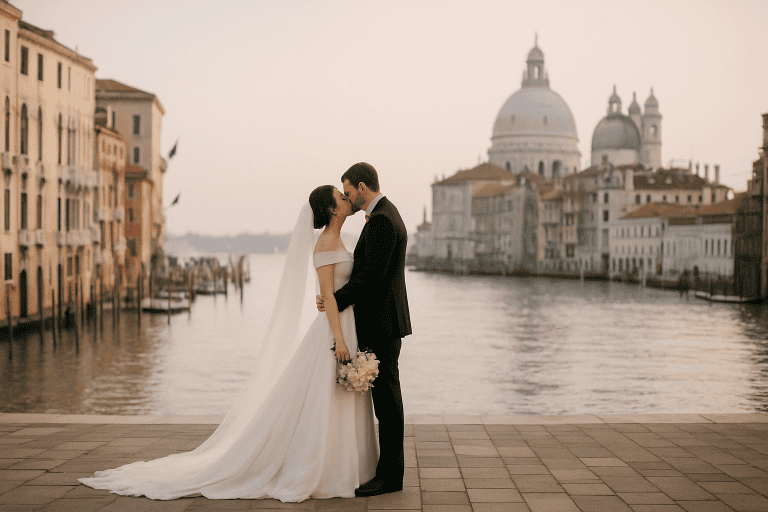
 Wedding photos in Venice without crowds: schedules, itineraries and permits
Wedding photos in Venice without crowds: why focus on times and itineraries Venice is a natural setting: narrow alleys, bridges, reflections […]
Read more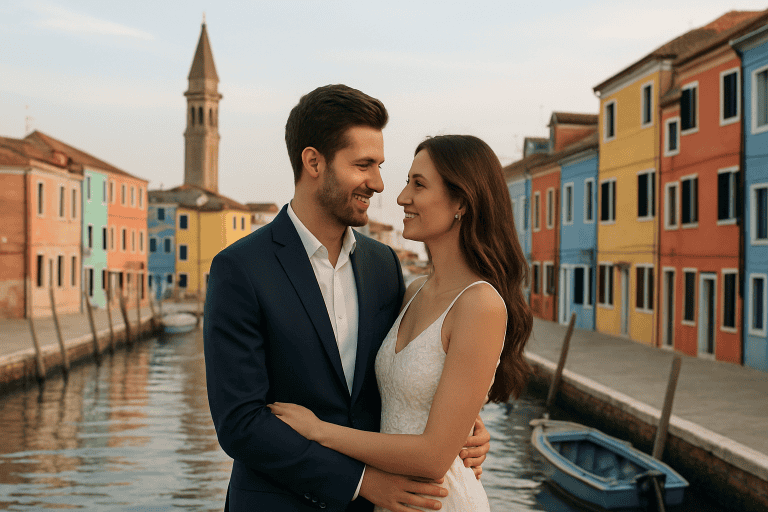 Venice
 Murano and Burano for the pre-wedding: ideas for welcome tour and aperitif
Murano and Burano for the pre-wedding: why choose a welcome tour among islands and aperitif A pre-wedding in the lagoon does not […]
Read more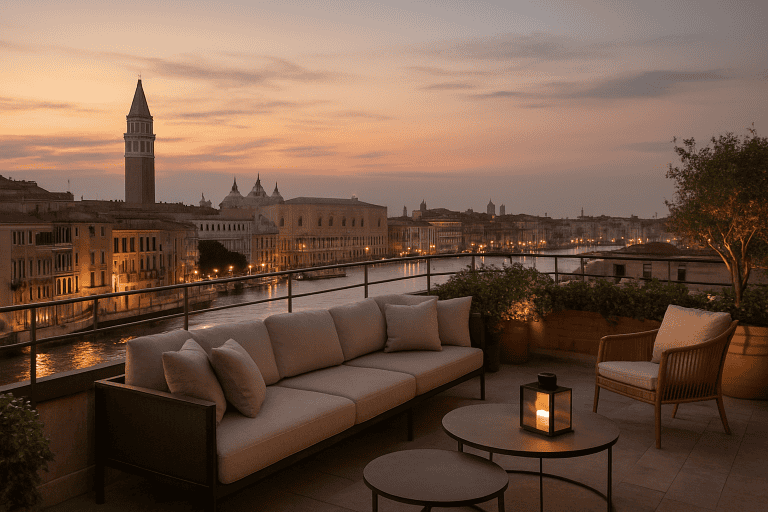 Venice
 After party in Venice: rooftop, lounge, and solutions to continue the celebration
After party in Venice: why choose rooftop and lounge after the reception When the reception ends, in Venice often not […]
Read more