
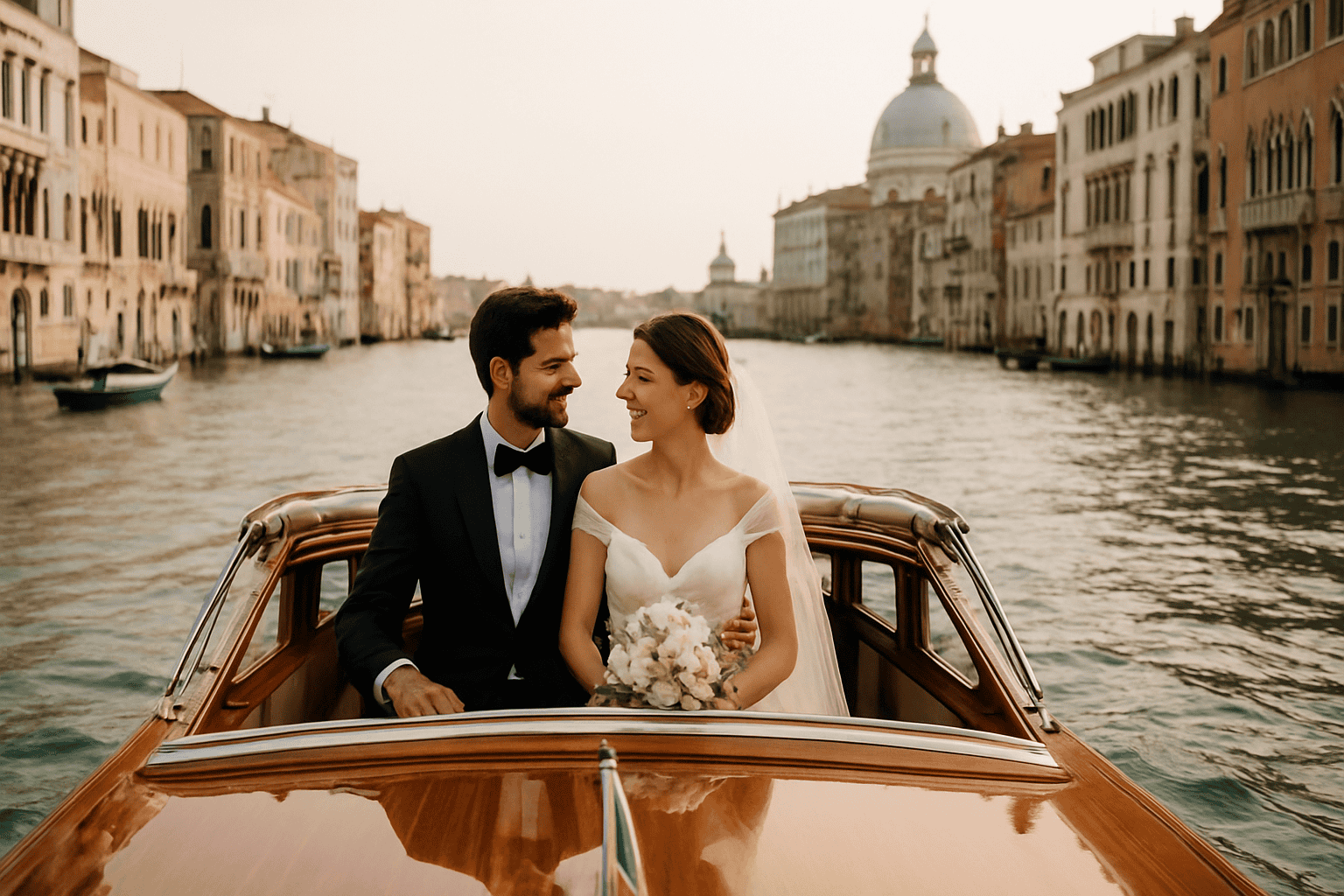
Wedding in Venice with arrival by boat: guest management and perfect timing
Wedding boat arrival in Venice: why it really works (and what it involves)
Choose a boat arrival wedding Venice it’s not just a scenic detail: it’s a format that defines the rhythm, atmosphere, and perception of the event. In Venice, water isn’t “background”; it’s the main road. This changes everything, especially when the goal is to create a coherent, elegant, and seamless experience for the couple and guests.
It works particularly well in three cases:
- Destination wedding with guests who want to experience the city authentically, without the stress of “traditional” travel.
- Intimate weddings, where every moment can be curated like a scene, with no dead time.
- Luxury style, because arriving by water immediately conveys exclusivity and attention to detail.
That said, Venice’s beauty requires precise direction: timing, boarding, meeting points, luggage, access to the venue. This is where the less visible but decisive part comes into play: the wedding logistics. If the logistics are solid, the boat arrival becomes a memorable moment; if it’s improvised, it risks turning into waiting, confusion, and cascading delays.
Goal and style: from postcard to direction
The point isn’t “making a grand entrance,” but building a sequence that makes sense: welcome, transfer, arrival, ceremony start. In Venice, even a short distance can require coordination, because it depends on docks, access points, tourist flows, and the location of the hotel or departure point.
If you’re considering different options and want a broader picture of how to set up the event in the city, you may find this resource useful: Wedding in Venice: guide.
What to expect in terms of timing and logistics
A successful boat arrival requires thinking in “blocks” rather than individual minutes. In practice:
- Buffer time: safety buffers between one moment and the next (especially between transfer and ceremony).
- Group management: guests divided by time slots or by boats, with a point person for each group.
- Clear meeting points: a “readable” address, a simple description, and an operational contact.
The ideal result is that guests perceive only the magic: the city flowing by, the arrival at the dock, the welcome. Everything else must be invisible.
Step-by-step planning for Venice transport and perfect timing
When it comes to Venice transport for a wedding, the key word is “sequence”. It’s not enough to book a transfer: you need to design the entire flow of the day and the surrounding days (arrivals, rehearsals, wedding day, possible brunch).
Realistic timeline: from 12 to 2 months before
12–9 months before: define the structure of the event (ceremony and reception, same venue or two different places) and the geography of the guests (where they are staying, how they arrive). This is the right time to understand whether the venue has convenient water access and which landing points are most functional.
8–6 months before: build a draft wedding-day timeline with “block” times. At this stage you also decide whether the boat arrival will be only for the couple or also for the guests (or for a selected part, for example family and witnesses).
5–3 months before: go into operational detail: meeting points, communications to guests, any transfers in multiple legs (hotel → pier → venue). Here the wedding logistics becomes a proper document, shareable with vendors and staff.
2 months before: confirm the final timeline, adding safety buffers. It’s also the time to prepare an alternative plan in case of unfavorable weather or last-minute logistical changes.
Essential supplier checklist (without overlaps)
To avoid “everyone handling a piece” without a single overall vision, the checklist must clarify roles and responsibilities. Generally you need:
- Event coordination: a director who keeps times, vendors, and guests aligned.
- Water transfers: management of boarding, routes, and schedules.
- Location: point person for access, pier, internal logistics, and setup timing.
- Photos and videos: alignment on the real timing of the boat arrival (so as not to “steal” minutes from the ceremony).
- Music/welcome: if the arrival is part of the storytelling, the welcome must be synchronized (even just with a welcome drink and a brief accompaniment moment).
A practical tip: define a single decision point for day-of changes. That way, if you need to move a boarding time earlier or later, you don’t trigger ten disconnected phone calls.
Guest management and transfers: how to avoid waiting and dispersion
Guest management in Venice works when it is simple for those attending and precise for those coordinating. Some choices drastically reduce the risk of delays:
- Meet at a single point (or a few points), avoiding making people “hunt for” unintuitive piers.
- Time slots by groups: guests don’t all have to arrive in the same minute.
- A point person on site with the guest list and clear directions (even just to direct those who arrive late).
- Redundant communications: important information should be repeated consistently (digital invitation, wedding website, reminder message).
If you are building the overall project and want a complete operational roadmap, you can integrate this resource into your planning: Organizing a wedding: checklist.
Budget and priorities for a wedding in Venice with arrival by water
Talking about budget in a Venetian wedding doesn’t just mean “how much to spend”, but where to set priorities to achieve a harmonious result. Arriving by boat is a high-impact element: to enhance it, it needs to be consistent with the rest of the day.
Main items to consider (realistically)
Without going into figures, the areas that generally have the biggest impact are:
- Transfers and coordination: not only the main route, but also any transfers between different moments.
- Venue and access: internal logistics (dock, routes, waiting areas) may require organizational choices.
- Setup and welcome: if the arrival is a “staged moment”, the welcome must live up to it.
- Photo/video: to tell the story of the arrival without stressing the timeline.
Where to invest to maximize the scenic effect (without excess)
To make the arrival truly memorable, it’s often worth investing in:
- Perfect timing: the scenic effect comes from punctuality and smooth flow, more than from an excess of elements.
- Welcome at the dock: a well-cared-for moment (even minimal) avoids the feeling of a “technical disembarkation”.
- Communication to guests: clear directions reduce anxiety and delays, improving the overall experience.
The real luxury, in Venice, is making what isn’t simple look simple.
Mistakes that increase costs (and how to avoid them)
- Too tight timeline: when there’s no buffer, every micro-delay creates urgent solutions and stress.
- Too many departure points: if guests leave from different places without coordination, dispersion and complexity increase.
- Uncommunicated “surprise” arrival: if guests don’t know where to go or what to expect, waiting and constant calls ensue.
- Underestimating luggage logistics: if there are hotel changes or check-in/out close to the event, a dedicated plan is needed.
Plan B and risk management for wedding logistics in Venice
The most professional part of a project is what you prepare “just in case”. In Venice, a Plan B is not pessimism: it is care. The wedding logistics must provide credible and communicable alternatives without creating panic.
Weather: alternative solutions without disrupting the experience
If the weather changes, the goal is to maintain a sense of continuity. Some useful strategies:
- Reorganize the schedule keeping the same moments (welcome, ceremony, toast), but with a more sheltered sequence.
- Provide covered waiting points near the arrival point, to prevent guests from being exposed.
- Communicate quickly and unambiguously any changes, with a single official channel (wedding website or broadcast message).
If the venue offers alternative spaces or different routes, check the product sheet or in the information provided by the venue, how internal movements are handled in case of rain.
Permissions and constraints of the location: what to clarify immediately
Without going into regulatory aspects, it is important to clarify with the venue (and with whoever manages the transfers) some practical points:
- Access times for setups and suppliers.
- Pier rules: docking times, management of multiple boats, any operational limitations.
- Guest routes: where they enter, where they wait, how they move between ceremony and reception.
This information directly impacts timing: if a pier does not allow prolonged stops, the arrival must be designed as a continuous flow, not as a “static” moment.
Contracts and deposits: how to protect the timeline
The best protection is clarity: who does what, when, and what happens if schedules change. During the agreement phase, it is useful to make sure the following are defined:
- Time slots and operational tolerances for transfers.
- Coordination manager on the day of the event.
- Change procedures in case of weather or delays.
There is no need to weigh down the experience with technicalities: it is enough that the direction has concrete tools to decide quickly.
Guest experience: welcome, Venice transport and stress-free communication
A wedding in Venice can be unforgettable even for those who don’t know the city, as long as the guest feels guided. Perceived quality comes from simple details: clear directions, reasonable timing, consistent hospitality.
Welcome moment, activities and hospitality
If many guests are coming from out of town, the “welcome” isn’t an extra: it’s a way to put everyone in the right frame of mind. Ideas that work well:
- Welcome moment at the hotel or at an easy-to-reach spot, with essential information about the day.
- Suggested mini-itineraries (simple and realistic), especially for those who have only a few free hours.
- Operational contact for questions about getting around and schedules, so the couple don’t become a “switchboard”.
For those who want an overall context about the city and its unique layout—also useful for explaining to guests why getting around is different compared to other destinations—you can share this link: Further reading: Venice (Wikipedia).
Transport, shuttles, parking: how to make life easier for guests
The “how do I get there?” topic is often the first source of anxiety. That’s why it’s best to separate two levels:
- Arrival in the city: train, car, taxi, private transfers. Here the goal is to provide clear, unambiguous instructions.
- Getting around during the event: this is where Venice transport</strong by water and walking routes come in, with simple meeting points.
If some guests arrive by car, it’s helpful to indicate precisely where to stop and how to continue, avoiding overly technical directions. If the venue or hotel offer dedicated services, check the product sheet which options are actually available.
Clear directions and a wedding website: the difference between chaos and smoothness
A wedding website (or a well-made digital document) becomes the “map” of the experience. To be truly useful, it must include:
- Block schedules (not a minute-by-minute timeline for guests).
- Meeting points with a simple description and a visual reference.
- Dress code and practical notes (comfortable shoes for walking stretches, travel times, what to do in case of rain).
- Contact: a point person and a single channel for updates.
When information is clear, guests move with confidence and arriving by boat becomes a moment of pleasure, not an orienteering test.
Organizing a boat arrival in Venice: details that make the difference
The success of a arrival by boat wedding Venice is played out in micro-details that, added together, create a sense of naturalness. Here are the ones that most often determine the difference between “nice” and “perfect”.
Arrival sequence: who arrives, when, and where they position themselves
Decide in advance whether the boat arrival is:
- Only the couple, with guests already present at the venue.
- All guests, as part of the shared experience.
- Mixed: guests in multiple waves and the couple in a dedicated moment.
Each option changes the direction: music, welcome, photos, start of the ceremony. The goal is to avoid overlaps (for example, guests disembarking while the couple is about to arrive, creating confusion on the dock).
Photo and video: how to get iconic images without stealing time
Arrival images are among the most desired, but they must be integrated into the timeline. A solution that is often effective is to plan for:
- Dedicated time right after disembarking, brief but protected.
- A defined shooting point, so the team doesn’t have to improvise.
- A clear route toward the ceremony, without crossing guest flows.
This way you get the cinematic effect without pushing the whole day back.
Real-time coordination: the secret of wedding logistics
Logistics isn’t just “planning”, it’s also live management. On the wedding day you need someone who:
- Confirms the times and keep in touch with the transfers.
- Manage the guests at the meeting points, with a kind but firm tone.
- Protect the couple from phone calls and operational decisions.
When this role is covered, the couple can experience the arrival by boat as an emotional moment and not as a “logistics check”.
Contact ChiaraB Events for a detail-oriented wedding in Venice
If you want a wedding in Venice with an arrival by boat that is truly smooth, elegant and stress-free for guests, ChiaraB Events can help you plan timing, transfers and welcoming with full coordination. Discover the approach and inspirations in the section dedicated to weddings in Venice and let’s turn logistics into a memorable experience.
FAQ
How much time should be planned for arriving by boat to a wedding in Venice?
It depends on the starting point, access to the pier, and guest flows. In general, it is best to think in blocks (transfer, disembarkation, welcome) and include safety buffers between arrival and the ceremony to avoid cascading delays.
Is it better to have the guests arrive by boat too, or only the newlyweds?
Both solutions work. Only the newlyweds: maximum visual impact and simpler management. Also guests: an immersive experience for everyone but it requires coordination for groups, clear meeting points, and an on-site operations contact.
How do you manage transportation in Venice for guests who are not familiar with the city?
Clear, repeated communication is needed: easy meeting points, time slots, instructions on how to get to the city, and an operational contact. A wedding website or a digital document with a map and directions reduces anxiety and confusion.
What should be included in a Plan B for weather or unforeseen events during arrival by water?
An effective Plan B includes alternative times and routes, sheltered waiting points, an arrival sequence that avoids overlaps, and a single channel to communicate changes to guests quickly and consistently.
What details should be clarified with the venue and suppliers to avoid problems at the dock?
It is useful to define access and schedules, docking procedures and mooring times, guest routes between the pier and the event spaces, as well as who makes operational decisions on the wedding day. If the venue has specific options, check the product sheet or the information provided by the location.
How to get beautiful photos of the arrival by boat without slowing down the day?
By planning a short protected moment immediately after disembarkation, agreeing in advance on the pickup point and the route to the ceremony. This way the photo/video team works with realistic timing without taking away space from the main moments.
From the blog
 Venice
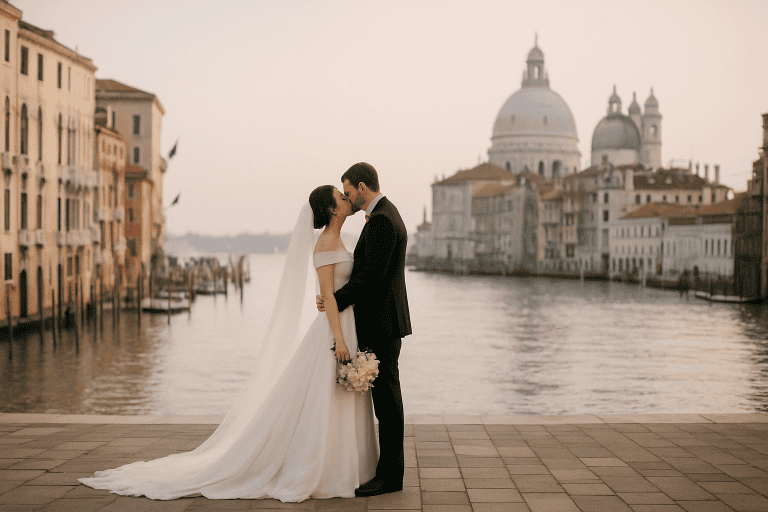
Wedding photos in Venice without crowds: schedules, itineraries and permits
Wedding photos in Venice without crowds: why focus on times and itineraries Venice is a natural setting: narrow alleys, bridges, reflections […]
Read more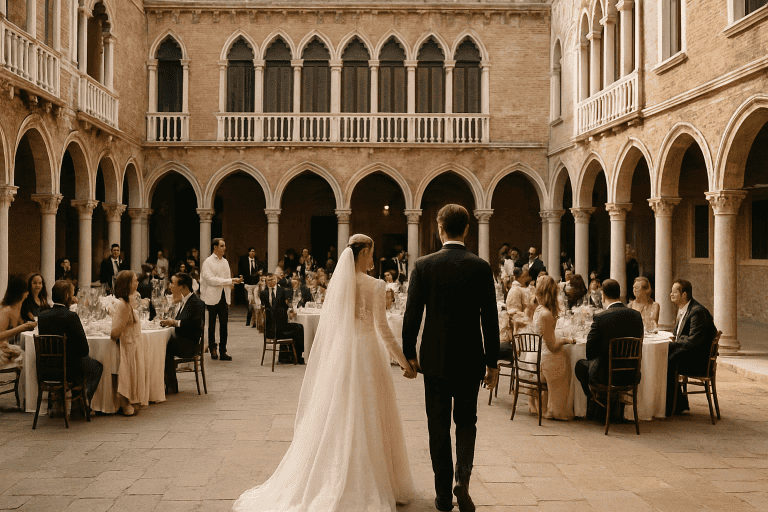 Venice
Reception in a Venetian palace: how it works between access, catering, and constraints
Venetian palace reception: why it is a choice that requires method A Venetian palace reception has an immediate charm: frescoed halls, […]
Read more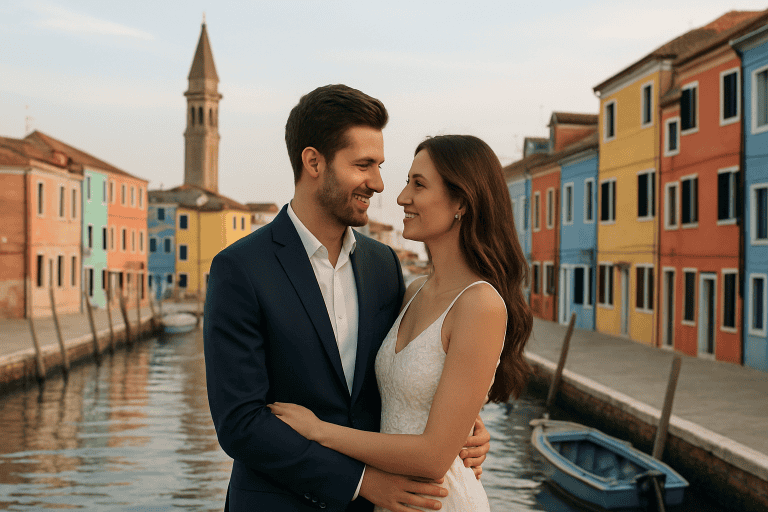 Venice
Murano and Burano for the pre-wedding: ideas for welcome tour and aperitif
Murano and Burano for the pre-wedding: why choose a welcome tour among islands and aperitif A pre-wedding in the lagoon does not […]
Read more