




Castle vs village vs villa in Tuscany: practical differences for budget and logistics
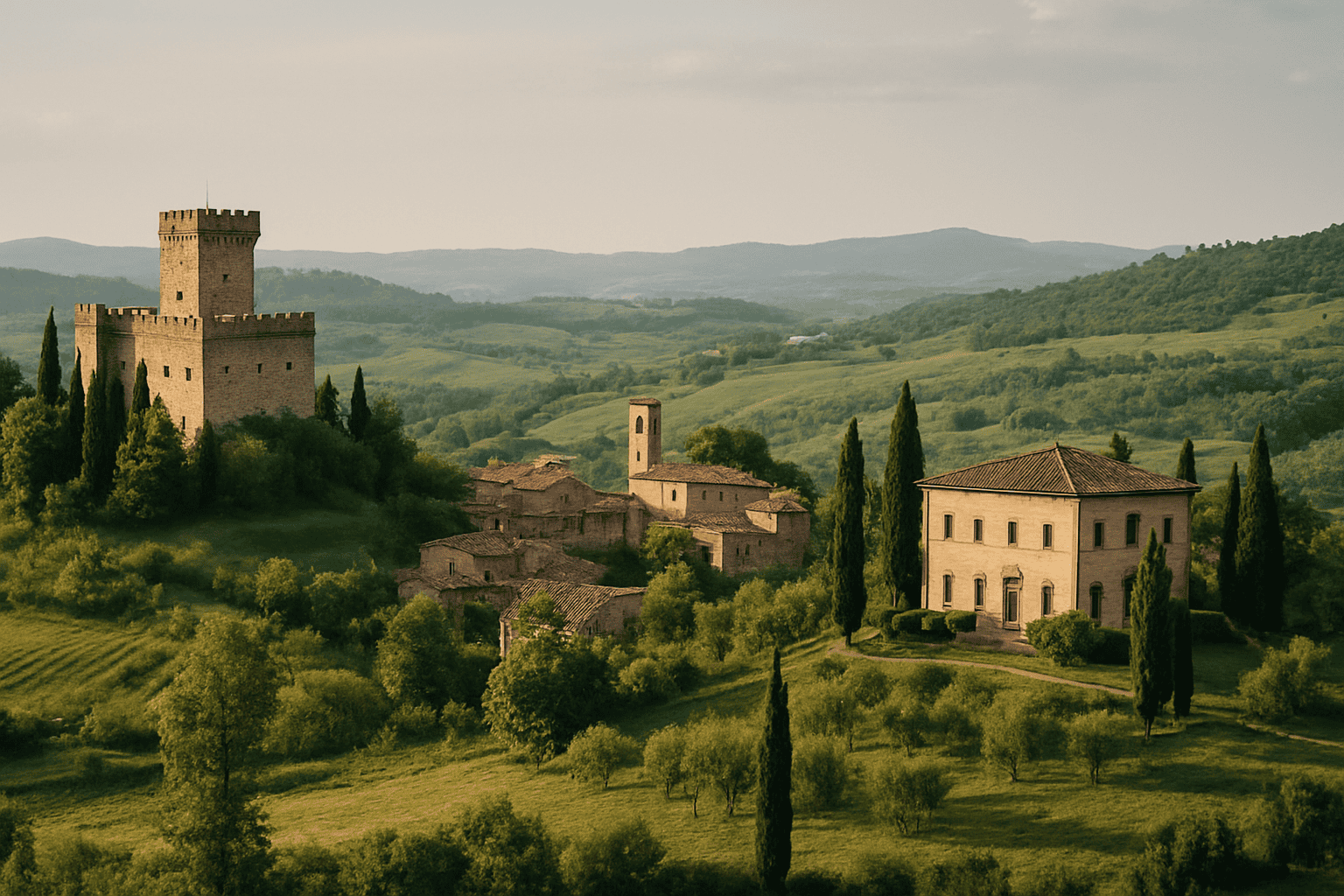
Castle, village or villa: practical differences in Tuscany (budget and logistics)
Choosing between castle, village o villa is not just a matter of aesthetics: in Tuscany the type of location directly affects daily flows, movements, plan B and, above all, how to set the Tuscany wedding budget without surprises. If you are considering a Tuscany wedding location for an intimate, luxury or destination event, this guide helps you understand the differences with an operational approach.
When it comes to castle village villa Tuscany differences, the right question is not “which is more beautiful?”, but: which is more suitable for my number of guests, the pace I want and the level of complexity I can (or want to) manage? In Tuscany, the morphology of the territory, distances and accessibility also matter a lot: for a general overview of the region, you can consult In-depth: Tuscany (Wikipedia).
Castle vs village vs villa in Tuscany: how style, timing and logistics change
Goal and style: luxury, intimate, destination
Each type conveys a different imagery and, consequently, brings different expectations (also from the guests).
- Castle: scenic atmosphere, often more formal and “iconic”. Ideal if you want an immediate impact effect (arrival, photos, ceremony). It may require more coordination due to space and route constraints.
- Village: immersive and “micro-destination” experience. Perfect for wedding weekends and for those who want to experience multiple moments spread out (welcome, ceremony, party, brunch) without having to change location.
- Villa: private elegance and flexibility. Often suitable for a refined event, with linear transitions between areas (garden, terrace, indoor rooms) and a more “domestic” hospitality management.
If your goal is a high-profile experience with tailored care, it can be useful to explore the selection dedicated to Luxury weddings in Tuscany, to guide you through styles and contexts without wasting time on inconsistent options.
What to expect in terms of timing and logistics
Logistics is not a detail: it determines the timeline, the number of people involved in coordination and the guests' peace of mind.
- Castle: often has “historic” accesses and paths (stairs, courtyards, passages). This can make setup, flow management, and accessibility more complex. Check the product sheet for usable spaces and service areas.
- Village: the logic is “spread out.” It is wonderful for the experience but requires careful direction: check-in, luggage, signage, meeting points, internal shuttles if necessary.
- Villa: tends to offer a more linear layout. If it has a good indoor/outdoor alternation, it can simplify plan B and transitions between ceremony, aperitif, and dinner.
In practice: if you want a smooth day with quick scene changes, the villa often helps; if you want a “chaptered” story over several days, the village is natural; if you aim for grandeur, the castle is unmatched but must be managed more carefully.
Step-by-step planning for a wedding venue in Tuscany (stress-free)
Realistic timeline: from concept to the event week
Effective planning depends not only on the months available but on decisions in the correct order. Here is a practical sequence that works for castle, village, and villa (with adaptations):
- Format definition: single wedding day or weekend? Symbolic or religious ceremony? Number of guests and style (intimate, luxury, destination).
- Location selection: besides photos, ask for floor plans, capacities for different moments, and indoor alternatives. Check the product sheet for any restrictions on times or spaces.
- Key supplier block: catering/banqueting, photo/video, music, floral design, lighting. The type of venue greatly influences the choice (for example, in a village you might want to create “islands” of entertainment).
- Hospitality plan: rooms on-site or external hotels? Transfers? Welcome moment? Here the difference between village and other options becomes decisive.
- Day direction: schedules, flows, gathering points, signage, timing of ceremony and dinner, sunset management (if relevant for photos and atmosphere).
- Event week: final inspection, layout confirmation, plan B, emergency contacts, light/audio test, staff briefing.
To avoid missing important steps, an operational guide like Organizing a wedding: checklist, can help you keep track of details and priorities.
Essential supplier checklist (adapted for castle, village, villa)
Some roles are always central, but the venue changes the “weight” of each.
- Wedding planner / coordination: in a village it is often fundamental for widespread management; in a castle it helps prevent bottlenecks in passages; in a villa it guarantees aesthetic coherence and timing.
- Catering/banqueting: evaluates logistics of kitchens, access, and service times. In historic castles, technical spaces can be more restrictive: check in the product sheet.
- Setups and floral: in a villa you can work on elegance and proportions; in a village on micro-scenographies; in a castle on focal points that interact with the architecture.
- Lights and audio: they are often the key to transforming courtyards, gardens, and small squares. In a village, the lights also “guide” the paths.
- Transport: shuttles, parking, arrival management. In Tuscany, scenic roads can be narrow: plan ahead and check accessibility in the product sheet.
Guest management and transfers: the difference between a smooth event and a broken day
Here the really important aspects emerge. castle village villa Tuscany differencesIf guests have to move multiple times, the risk is losing energy and punctuality.
- Castle: it is often a “destination” in itself, but it can be isolated. Plan clear pick-up points and a welcome system upon arrival.
- Village: if it offers rooms, it is a huge advantage. If hospitality is partial, a mixed strategy is needed (on-site + nearby hotels) with well-timed shuttles.
- Villa: excellent for a compact flow. If there are few rooms, you can create a hotel “hub” and use the villa as the heart of the event.
A detail often underestimated: the moment of return.A well-designed transport plan avoids early departures and keeps the party alive.
Wedding budget Tuscany: how priorities change between castle, village, and villa
Main items that impact the most (without talking about figures)
The Tuscany wedding budget it’s not just “how much you spend,” but where you invest to achieve the desired effect. The main items that tend to weigh more, depending on the location, are:
- Location and spaces: exclusivity, number of usable areas, indoor alternatives, usage times. Check what is included in the product sheet.
- Hospitality: central for villages, variable for villas and castles.
- Transport: the more the location is a “destination” and less serviced, the more it becomes a strategic item.
- Setups, lights, audio: in castles and villages they can be decisive to enhance architectures and widespread spaces.
- Staff and coordination: grows with the complexity of the flows and with the number of moments over multiple days.
Where to invest to maximize the scenic effect (without waste)
A common mistake is to distribute the budget “sprinkled”. Better to choose a few high-impact points, consistent with the location.
- In a castle: enhances the arrival, the ceremony, and an iconic area (courtyard, terrace, main hall). Working well on lighting and mise en place can be more effective than adding too many decorative elements.
- In a village: creates an experiential path. Small repeated scenographies (elegant signage, light points, corners) make the whole set refined and “cinematic”.
- In a villa: focuses on proportions, palette, and details. A villa supports a minimal-chic aesthetic very well, as long as every element is of quality and well positioned.
In all cases, the consistency between concept e real spaces is what makes an event perceived as “high level”.
Mistakes that increase costs (and how to avoid them)
- Underestimating transfers: even a few kilometers, if badly managed, become lost hours and extra services.
- Not defining a final layout: changing your mind late about ceremony/dinner/party impacts setups, lighting, and staffing.
- Ignoring service areas: access for catering, loading/unloading points, technical spaces. Check in the product sheet.
- Not providing credible indoor alternatives: an improvised plan B may require last-minute rentals and interventions.
- Format too ambitious for the location: for example, wanting to “spread” too many moments in a castle with complex routes, or creating a night party in an unsuitable context. Better to design in harmony with the place.
Plan B and risk management in Tuscany: weather, constraints, and contracts
Weather and alternative solutions: how to choose a plan B that doesn’t seem like a fallback
In Tuscany, outdoor is often part of the dream, but peace of mind comes only when plan B is aesthetically up to standard of the plan A.
- Castle: excellent if it has scenic indoor rooms. However, pay attention to capacities and routes between spaces. Check in the product sheet which rooms are actually usable.
- Village: can offer multiple alternative spaces (rooms, porticoes), but requires precise coordination to reposition moments and guests.
- Villa: often the most flexible if it has large interiors and a good connection with the garden (French doors, loggias, verandas).
An effective plan B includes: a pre-designed layout, updated timing, communication to guests, and a lighting solution that maintains the atmosphere.
Permits and location constraints: what to clarify before signing
Each venue has different rules. Without going into regulatory aspects or unverifiable details, there are practical points to always clarify (and check in the product sheet):
- Hours and music management (volumes, allowed areas, possible party relocations).
- Usable spaces: do not assume that “the whole castle” or “the entire village” is included.
- Access and logistics: loading/unloading, staff routes, parking, any vehicle restrictions.
- Indoor solutions: which spaces are available in case of bad weather and under what conditions.
Contracts and deposits: how to protect the vision of the event
The more complex the location, the more clarity is needed. In general, it is useful that the contract and attachments precisely describe:
- Included spaces and time slots of use.
- Conditions of plan B (which areas, when the switch is decided, who does what).
- Rules for external suppliers and technical access.
- Change policies (number of guests, layout changes, extra time). Check in the product sheet or in the documentation provided by the venue.
The golden rule: everything that is “fundamental” for your event must be written down, not just promised verbally.
Guest experience: hospitality, transportation and communication (the real difference between castle, village and villa)
Welcome moment, activities and hospitality: how to enhance a wedding weekend
Tuscany naturally invites you to turn the wedding into an experience. Here the village often plays an advantage, but castles and villas can also offer a complete story if well designed.
- In a village: create a light itinerary (welcome drink, small corners, widespread moments). The guest must feel “guided” without perceiving rigidity.
- In a villa: focus on a curated and private welcome (lounge spaces, moments of relaxation, a well-orchestrated final brunch).
- In a castle: use the scenery for memorable moments (aperitif in the courtyard, cake cutting in an iconic spot), keeping the logistics of movements clear.
A transversal tip: define a “promise” for the guest (relaxation, party, discovery, elegance) and make sure every moment confirms it.
Transportation, shuttles, parking: how to avoid delays and confusion
Transportation management is an integral part of the Tuscany wedding location, not an accessory service. It works when designed as an experience:
- Simple meeting points and communicated in advance.
- Clear time windows for arrivals and returns (without forcing guests to “guess”).
- Reception staff to direct parking and check-in, especially in villages and castles.
- Solution for guests with different needs (families, elderly people, those arriving independently). Check the accessibility of the spaces in the product sheet.
Clear directions and wedding website: the invisible logistics that improves everything
When guests have clear information, the event flows smoothly. A wedding website (or a well-made digital information) can include:
- Maps and directions for arrival and parking.
- Program with schedules and dress code (if provided).
- Details on transfers and pick-up points.
- Useful contacts (coordination, transportation, hospitality).
This is particularly important in a village (where spaces are distributed) and in a castle (where routes may not be intuitive).
How to choose between castle, village, and villa in Tuscany: a quick guide based on real priorities
If you want an operational summary, think in terms of priorities:
- Do you want an immediate and spectacular “wow effect”? The castle is often the most iconic choice, with careful logistical direction.
- Do you want an immersive wedding weekend, with guests sharing multiple moments together? The village is naturally suited, especially if it offers on-site hospitality.
- Do you want private elegance, linear flows, and a refined event without excessive complexity? The villa tends to offer an ideal balance.
In any case, the castle village villa Tuscany differences become really clear only when you cross: number of guests, style, plan B, accessibility, and transport plan. If one detail is decisive (for example indoor spaces, allowed areas, or technical accesses), check the product sheet of the location or request a written confirmation.
Do you want a selection consistent with a high-profile event in Tuscany? Discover the proposals and inspiration of the collection dedicated to Luxury weddings in Tuscany: it is a great starting point to turn the choice of location into a complete, elegant, and well-managed project.
FAQ
What is the main difference between a castle, village, and villa in Tuscany for a wedding?
The main difference is the logic of space usage: the castle focuses on scenery and often more constrained routes, the village offers a “diffused” experience ideal for a wedding weekend, the villa tends to ensure more linear flows and simpler management between indoor and outdoor.
Which type is best suited as a wedding location in Tuscany for a wedding weekend?
Generally, the village is the most suitable because it allows you to distribute welcome, ceremony, party, and brunch in a single setting, especially if it includes hospitality. Check the product sheet for the availability of rooms and spaces for the different moments.
How does the choice between castle, village, and villa affect the Tuscany wedding budget?
It affects priorities: in a castle, directing, logistics, and scenic enhancement (targeted lighting/decorations) often weigh heavily; in a village, hospitality and flow management become central; in a villa, the investment tends to focus on aesthetic quality, comfort, and a credible plan B.
What should I check to avoid logistical surprises in a castle or a village?
Always check accesses and routes (stairs, passages, loading/unloading), areas actually usable, indoor alternatives, and operating rules (hours, permitted spaces). If uncertain, check the product sheet or request written confirmation.
What is the best way to manage transportation and shuttles in Tuscany?
Design transportation as part of the experience: clear meeting points, time windows communicated in advance, welcoming staff, and a return plan that avoids early departures. Check the product sheet for any accessibility or parking restrictions.
How to build a weather backup plan that doesn't seem like a fallback?
Choose a location with an indoor space that is truly suitable and design in advance a complete alternative layout (ceremony, aperitif, dinner, party), with updated timing and a coherent lighting solution. Check in the product sheet which indoor spaces are available and under what conditions.
