




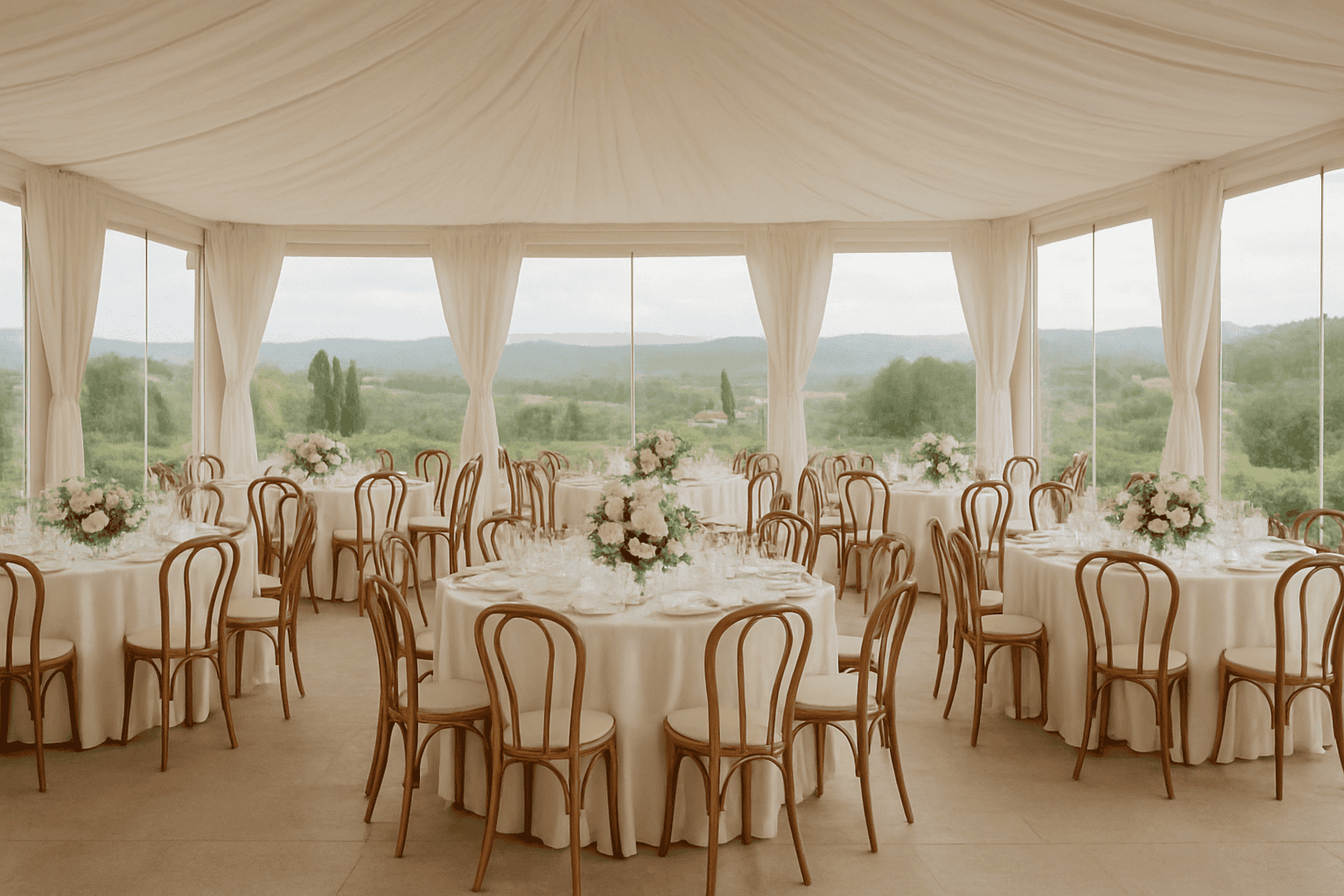
In Tuscany, the weather can change with surprising rapidity: a clear sky in the morning, sudden rain in the afternoon, an evening breeze that lowers the temperature right during dinner. For a wedding, this variability should not turn into anxiety. A weather plan B in Tuscany well designed is a style choice: it protects the guests' experience, preserves the aesthetics of the setup, and allows the schedule to be maintained without last-minute rushes. A good plan B not only ensures a peaceful wedding but also allows exploring the beauty of indoor spaces, creating an intimate and welcoming atmosphere. Covered spaces can offer fascinating settings, turning necessity into an opportunity. Moreover, guests will have the chance to discover indoor alternatives on vacation, making the entire experience memorable even in case of bad weather.
The good news is that today there are refined alternatives consistent with a high-level wedding: from the wedding tensile structure with clean design to the indoor locations in Tuscany capable of offering atmosphere, comfort, and natural scenography even in case of rain. The goal is not to “settle,” but to build two equally desirable plans, so that whatever the day, the wedding remains exactly as you imagined it.
If you are organizing a destination wedding, a broader context in the territory can also be useful: In-depth: Tuscany (Wikipedia).
Weather Plan B Tuscany wedding: how to make it elegant (not a fallback)
An effective Plan B works when it is thought together with Plan A, not after. In practice, this means designing layouts, lighting, flows, and styling so that the possible change of scenario is natural and does not penalize the “wow” effect. This approach is particularly important for luxury, intimate, or destination weddings, where the aesthetic expectation is high and the time available to correct the course is often limited.
Goal and style: luxury, intimate, destination
A high-end wedding is recognized not only by details but by the continuity of the experience. Plan B must have the same identity as the main project: palette, materials, stationery typography, floral mood, and luminous atmosphere must “hold” in both options.
Some elements that help maintain coherence:
- Palette and textures designed for natural light and artificial light (candles, warm spots, reflections).
- Focal point replicable: an arch, a floral installation, a backdrop for the ceremony or cake cutting.
- Table scenography designed to work both under a tensile structure and in an indoor room.
For some events, a wedding tensile structure can even become the main plan: elegant, bright, photogenic, and capable of “embracing” the landscape without giving up protection.
Timing and logistics: what to really expect
The difference between a fluid plan change and a chaotic one lies in logistics. Even when everything has been planned, operations require technical times: setups, seat rearrangements, audio repositioning, light adjustments, cloakroom management, and dry paths for guests.
During the planning phase, it is useful to foresee:
- Two complete layouts (A and B) with measurements and flows, including entrance, ceremony area, cocktail, dinner, party.
- A “control point” to coordinate suppliers and staff, with shared contacts and timing.
- A communication plan to inform guests and suppliers without creating confusion.
If the venue offers multiple environments, the most elegant solution is often to create a path that works in both cases: for example, cocktail in a sheltered area, dinner in a marquee or indoor room, party in a space already equipped with lights and audio.
Step-by-step planning for a wedding in Tuscany with plan B
Clear planning reduces stress and unforeseen events. Below you will find a practical structure that integrates the weather plan B from the start, so you don’t have to “reinvent” everything close to the date.
Realistic timeline (from 12 to 2 months)
- 12–10 months: choice of venue and definition of the concept. Immediately check which indoor spaces are actually usable and how (capacity, routes, acoustics, light points). If the venue offers technical solutions, check the product sheet or in the provided informational material.
- 9–7 months: definition of key suppliers (catering, photo/video, floral design, music). Share the dual scenario to avoid surprises regarding logistics and set-up.
- 6–4 months: detailed design of layout A/B, lighting study and audio plan. At this stage, decide whether the wedding tensile structure is a discreet “insurer” or a central scenic element.
- 3 months: operational inspection with main suppliers. Map covered routes, support points, technical areas, backstage.
- 2 months: finalization of the wedding website/guest info, definition of transfers and communications. Preparation of the weather “decision moment” (when and how to decide the switch to plan B).
Essential suppliers checklist (with focus on plan B)
Besides the classic suppliers, plan B requires attention to roles and responsibilities. A useful checklist includes:
- Location manager: availability and priority of indoor spaces, access times, service areas.
- Catering: service flows indoor/outdoor, beverage management, possible repositioning of stations.
- Setup and floral: modular elements, transportable compositions, materials that withstand humidity and temperature changes.
- Audio/lights: alternative lighting plan, cable management and route safety, soundcheck in a closed environment.
- Photo/video: indoor shooting set, light points, “clean” corners consistent with the style.
- TransportShuttles and adaptable timing, sheltered drop-off points.
To not miss anything during transitions, a complete operational checklist can help: Organizing a wedding: checklist.
Guest and transfer management: the detail that saves the day
In case of rain, the guest mainly remembers two things: if they were welcomed well and if they understood where to go. For this reason, logistics is not a “technical” issue: it is part of hospitality.
Some choices that improve the experience:
- Clear arrival points with welcoming staff and immediate directions.
- Dry paths (carpets, covered walkways, secondary entrances if more convenient).
- Shuttle timing with margins: better a comfortable wait than a rushed arrival.
Budget and priorities: where to invest for a truly spectacular weather plan B
Plan B should not “double” costs, but requires smart priorities. The idea is to invest in elements that work in both versions of the event and maintain high visual impact even without sun.
Main items to consider
Without going into figures, the areas that have the most impact when designing an elegant plan B are:
- Structures and coverings (if planned): aesthetic definition, assembly times, finishes and transparencies.
- Lighting design: essential to create atmosphere indoors or under cover.
- Floral arrangement: scenographies that do not depend on the weather to “work”.
- Logistics and staff: coordination, welcoming, flow management.
Where to invest to maximize the scenic effect
If the goal is a refined result, there are three levers that make the difference:
- LightIn Tuscany, even a gray day can become cinematic with warm and coherent lighting direction.
- Materials: fabrics, glass, metals and textures that reflect and enhance the indoor environment.
- Perspectives: a layout that guides the gaze (entrance, imperial or round tables, dance area) makes the space “important” even if more intimate.
A indoor locations in Tuscany With rooms of authentic character (stone, beams, large windows) it can become an advantage: it is not just an alternative, but a scenography already ready.
Mistakes that increase costs (and how to avoid them)
- Deciding lateWaiting until the last moment often implies extra operational efforts and less harmonious solutions.
- Do not design layout B: improvising means wasting time and having to “adapt” elements not designed for indoor use.
- Underestimating audio and lighting: indoors, acoustics and perception change; without a dedicated plan, the effect can be flat.
- Confused communication: disoriented guests and unaligned suppliers generate delays and stress.
Plan B and risk management: weather, location, and contracts
A weather plan B Tuscany wedding Well done is not just a list of alternatives: it is a risk management strategy. It means anticipating what can change and deciding in advance who does what, when, and with what priorities.
Weather and alternative solutions: tensile structures and indoor
The most solid options, in Tuscany, usually fall into two categories:
- Wedding tensile structure: ideal when you want to maintain the connection with the landscape, while protecting dinner and/or party. It can be minimal and transparent, or more “architectural” depending on the concept. For details on materials and configurations, check the product sheet or in the supplier's proposal.
- Indoor location Tuscany: perfect when you want a ready-made solution, with comfort and easier flow management. It works very well for symbolic ceremonies, elegant dinners, and parties with lighting control.
A often winning strategy is the hybrid: prepare a covered area for the most sensitive moments (dinner, cake, party) and keep outdoor spaces for photos, welcome, and small moments “between clearings”.
Permissions and constraints of the location: what to ask before
Every estate or villa has rules and operational limits. Without going into regulatory aspects, it is useful to clarify in advance:
- Which indoor spaces are actually available on the day of the event and at what times.
- Where technical areas can be located (catering, backstage, audio/light control).
- Which outdoor areas are most suitable for coverage without compromising aesthetics.
- Access and routes for suppliers and guests in case of rain.
When the location is of great value, the key is to make technology and beauty interact: a well-positioned cover and an indoor space enhanced with lighting and styling can be more elegant than an unprotected “all outside” setup.
Contracts and deposits: clarity above all
Serenity is also built on transparent agreements. During the contracting phase, it is useful for the team to define:
- Plan change conditions: who makes the decision and within what timeframe.
- Included services in case of plan B (rescheduling, overtime, additional staff).
- Operational responsibilities: who coordinates the transition and who updates the guests.
If a point is not explicitly stated, ask for a written addition: it avoids misunderstandings and protects the quality of the event.
Guest experience in Tuscany: comfort, hospitality, and communication
A successful wedding is not only beautiful to see: it is easy to live. When the weather is uncertain, attention to the guest becomes the real luxury. The difference is perceived in seemingly small details: a sheltered entrance, a well-managed welcome drink, clear directions, flexible timing.
Welcome moment, activities, and hospitality even in the rain
If the weather does not cooperate, the goal is to avoid “dead time.” A well-designed welcome can turn waiting into a memorable moment. Some elegant ideas:
- Indoor welcome area with soft music, cloakroom, and a first toast.
- Experiential corners discreet (guided tasting, small gastronomic islands) that do not require large outdoor spaces.
- Photo moment at an architectural point of the location, with curated lighting and a clean background.
In a indoor locations in Tuscany well chosen, even the rain becomes part of the atmosphere: windows, inner courtyards, and loggias can offer poetic shots and a more intimate rhythm. Even on a rainy day, the beauty of the Tuscan landscape manages to inspire, creating a unique and evocative atmosphere. With the right lighting and decorations, every corner can transform into a dream place, reflecting the magic of the moment. This is where careful planning becomes essential, and a ‘plan b for indoor events’ proves crucial to ensure every detail shines, regardless of weather conditions. In this context, it is essential to have a ‘plan b for events in Capri‘ that can safeguard the magic of the day, maintaining the festive mood and desired elegance. The choice of alternative locations and creative setups thus becomes essential to guarantee an unforgettable, vibrant, and scenic experience, capable of adapting to any unforeseen event. With the right approach, even an indoor event can become an enchanting and memorable experience for all guests.
Transport, shuttles, parking: reduce friction and delays
In case of unstable weather, travel times and access difficulties increase. For this reason, it is advisable to plan transfers and arrivals with an “anti-stress” approach:
- Staggered times to avoid congestion upon arrival.
- Covered drop-off points or close to the main entrance.
- Signage and staff to guide guests without hesitation.
If international guests are present, clarity is even more important: bilingual signs, simple maps, and useful contacts reduce last-minute requests.
Clear directions and wedding website: the invisible direction
When there is a plan B, communication must be ready but discreet. The guest should not perceive “weather panic,” but feel accompanied. A wedding website (or a coordinated message) can include:
- Recommended dress code with an elegant note on shoes and outerwear.
- How to get there with map, parking, and shuttle contacts.
- Weather information handled tactfully: “In case of rain, the event will take place in indoor/covered spaces, without any changes to the program.”
The result is a perception of control: even if the sky changes, the experience remains smooth.
Useful links to choose villas, estates, and suitable spaces in Tuscany
If you are in the selection phase and want an inspirational context with solutions consistent with a high aesthetic and impeccable organization, it may be useful to explore an overview dedicated to Luxury weddings in Tuscany. Evaluating indoor spaces, covered areas, and guest routes from the start will help you build an equally scenic plan A and plan B.
CTA: If you want a tailor-made project that integrates an elegant weather plan B from the start (tensile structures, indoor rooms, lighting control, and guest flows), rely on Chiara B Events: from the creative idea to logistics, we transform every variable into a coherent and memorable experience in Tuscany.
FAQ
When is it advisable to activate the weather plan B for a wedding in Tuscany?
It is advisable to establish a shared “decision moment” in advance with the location and suppliers (for example, the day before or the morning of the event), based on updated forecasts and the complexity of the setups. The best choice is the one that allows maintaining timing and quality without last-minute changes.
Can a wedding tensile structure be as elegant as an indoor hall?
Yes, if it is integrated into the concept: layout, lighting, and styling must be designed to enhance the structure and the landscape. For details on finishes and configurations, check the product sheet or the supplier's proposal.
How to choose an indoor location in Tuscany suitable as a plan B?
Evaluate truly usable spaces, covered paths for guests, technical areas for catering and music, and the aesthetic outcome with artificial light. It is useful to have a complete layout of plan B already during the inspection phase.
Does Plan B change the guest experience?
It can be improved if it is designed as an equivalent alternative: sheltered reception, clear communication, simple flows, and a well-crafted atmosphere (especially with good lighting design) make control and comfort perceived.
Which elements of the wedding need to be planned “doubly” for plan A and plan B?
Generally: ceremony (or its alternative setting), cocktail, dinner and party with dedicated layouts; lighting and audio direction; guest routes; and a communication plan (wedding website or messages) for quick and consistent directions.
