
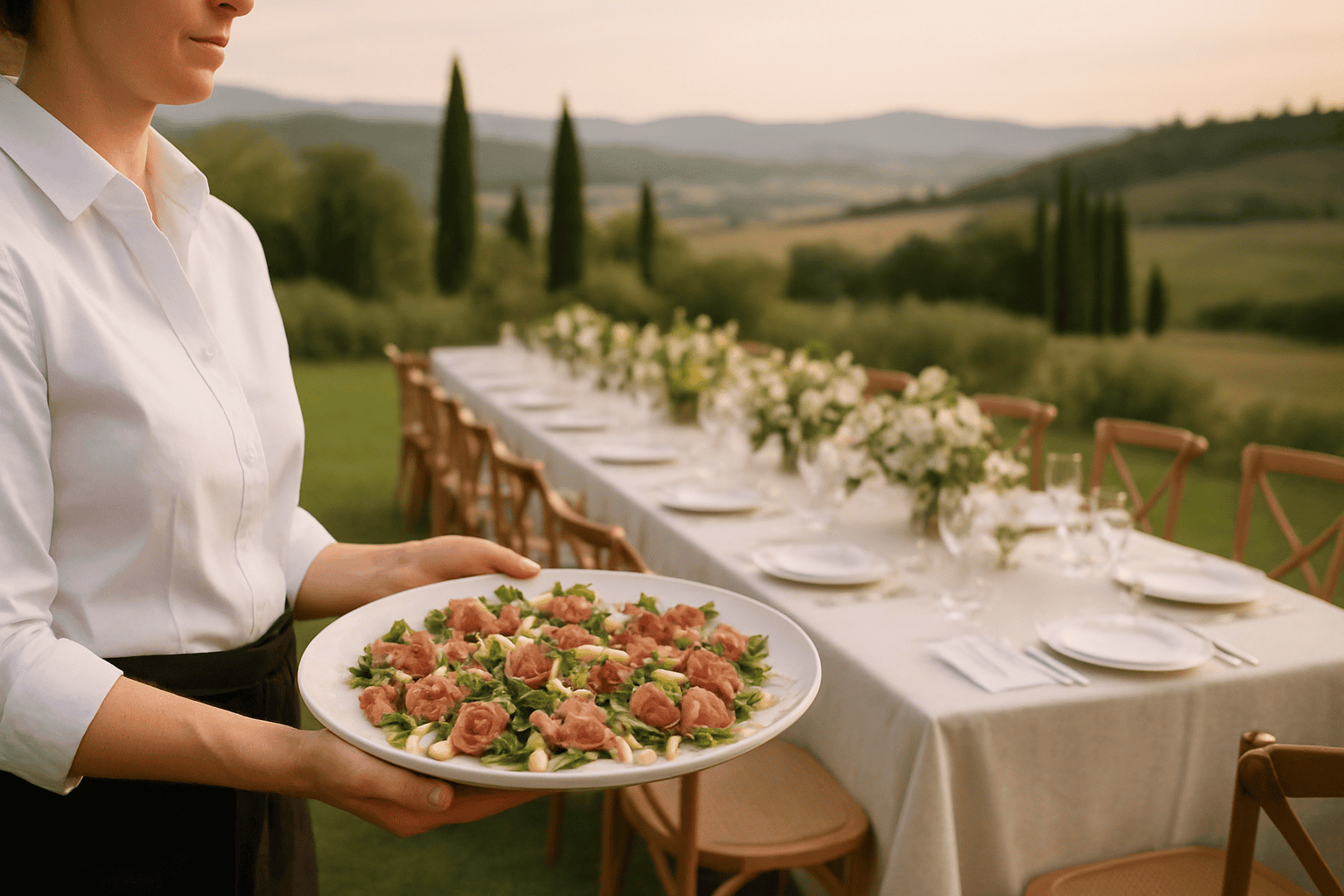
How to choose catering in Tuscany: tasting, seasonality, and allergies
Choosing catering in Tuscany for a wedding: what really matters (beyond the menu)
When you start to choose catering in Tuscany for a wedding, it’s easy to be guided only by photos of the dishes or by the idea of “traditional cuisine.” In reality, catering is a set of choices: the event’s pace, space management, service quality, the ability to adapt to different venues (villa, hamlet, agriturismo, beach), and attention to guests’ needs.
In Tuscany, where the raw ingredients are often the star and venues have a strong character, catering becomes the bridge between style e hospitality: it translates the atmosphere you want into a concrete experience, without logistical friction and without avoidable surprises.
If you are planning a intimate wedding, luxury or destination, consider this article as a practical guide: tasting, wedding seasonal menu and management of wedding allergies are the three pillars that make the difference between a “nice” event and a truly memorable one.
For a broader view of the organization and key steps, you can also start with this resource: How to organise a wedding.
Wedding catering tasting in Tuscany: how to turn it into an informed choice
The tasting isn’t a simple “sample”: it’s the moment when you verify the consistency between promise and result, and above all the catering’s ability to interpret your event. In Tuscany, where gastronomic identity is strong, the tasting also helps you understand whether the caterer knows how to enhance local products without falling into the predictable.
What to ask before the tasting (to arrive prepared)
To make the tasting useful, it’s best to arrive with a few decisions already sketched out: wedding style, approximate number of guests, type of venue, and event time. Then ask targeted questions:
- Service structure: aperitif with stations, table service, a mix of the two, timing between courses.
- Kitchen management at the venue: in-house kitchen, mobile kitchen, regeneration. If you’re not sure, check the product sheet or in the catering technical proposal.
- Beverage proposal: pairings, well-curated non-alcoholic alternatives, management of the toast and after-dinner.
- Staff and coordination: who runs the dining room, who is the point of contact on the day of the event, how they coordinate with the wedding planner and venue.
How to really evaluate: taste, temperature, pace, and “staying power”
During the tasting, taste is fundamental, but not enough. Also consider:
- Menu balance: alternation of textures, freshness, intensity of flavors.
- Temperature and texture: some dishes are perfect in the kitchen but lose quality if served in a dynamic setting.
- Consistent presentation with the style: rustic-chic, elegant, minimal, traditional.
- Service pace: an excellent menu can “wear you out” if the timing is long or not very smooth.
A good sign is when the catering proposes micro-adjustments based on season, location, and guest profile, without rigidly sticking to a standard format.
Tasting and customization: how far does it make sense to go
Customizing doesn’t mean complicating. In Tuscany an essential but well-crafted approach often works: a few well-thought-out dishes, recognizable ingredients, clean technique. If you want to include family or cultural references (for example a “home-style” dish or a special moment), ask the catering how they would integrate it into the flow of the event.
When a request increases logistical complexity (for example show cooking in spaces that aren’t equipped), it’s useful to have the pros and cons explained. If an operational detail isn’t clear, check the product sheet or in the written proposal.
Seasonal wedding menu in Tuscany: how to choose dishes that enhance territory and comfort
A wedding seasonal menu in Tuscany is not a trend: it’s the most natural way to get flavor, harmony, and an experience that “makes sense” in context. Seasonality also helps build a more balanced menu: in summer you look for freshness and lightness; in autumn and winter comfort and depth.
Tuscany offers an enormous variety of landscapes and micro-territories. To help you find your bearings, a general overview of the region can be useful: In-depth: Tuscany (Wikipedia).
Spring: freshness, colors, lightness
In spring, dynamic aperitifs and dishes that play on aromatic herbs, tender vegetables, and crunchy textures often work well. The goal is to give energy without weighing you down, especially if you have the ceremony and reception on the same day.
- Aperitif: fresh bites, citrus notes, refined finger food.
- First courses: green aromas and light textures.
- Sweets: fruit and delicate creams, without excesses.
Summer: managing the heat and dishes that “hold up”
In summer the challenge is twofold: flavor and staying power. An excellent menu must consider temperatures, exposure times during the aperitif, and guest comfort. Ask the catering how they handle:
- Storage and service during outdoor aperitifs.
- Light alternatives for those who eat little or suffer from the heat.
- Drinks well distributed and not concentrated in a single spot.
A detail often underestimated: the cake and dessert. Ask how they are handled in case of high temperatures and, if necessary, check the product sheet the planned logistics.
Autumn: depth, comfort, atmosphere
Autumn in Tuscany is perfect for weddings with a warm, enveloping tone. Here the wedding seasonal menu can become part of the scenery: more intense colors, rounder aromas, slower moments of conviviality.
- Aperitif: more structured proposals, with a balance between hot and cold.
- Main courses: full flavors but not heavy, well-calibrated portions.
- After dinner: comfort corners (coffee station and small pastries) well integrated.
Winter: elegance, warmth and management of indoor spaces
In winter, the quality of the service is seen in the ability to maintain a pleasant rhythm in enclosed spaces. A well-designed winter menu must warm without becoming monotonous. Also consider the impact on timing: coats, moving between rooms, photo moments. The catering must be able to “hold” the event’s energy.
Wedding allergies and intolerances: how to ensure inclusion without “second-rate” menus
The management of wedding allergies, intolerances and dietary choices (vegetarian, vegan, gluten-free, lactose-free) is one of the points that most influence the perception of care. It’s not just about “having an alternative”: it’s about making every guest feel part of the experience, without embarrassment and without obvious differences.
Information gathering: when and how to ask guests
The best way is to include the request for dietary needs already in the invitation or on the wedding website. Keep the question simple and clear. Example approach:
- Allergies (specify which)
- Intolerances (specify which)
- Preferences (vegetarian/vegan, etc.)
Avoid last-minute “word of mouth” collection: they increase the risk of mistakes and make it harder for the catering to plan in an elegant way.
Key questions to ask the catering about allergies and cross-contamination
Without going into regulatory aspects, there are practical questions that help you understand the organizational maturity of the catering:
- How are alternative dishes identified
- during service? Who is responsible for floor control
- and coordination with the kitchen? Are the alternatives designed as equivalent dishes
- in terms of presentation and satisfaction?
How do you handle the aperitif with stations, where guests move around freely?
A good catering service offers solutions that don’t isolate the guest: for example, alternatives integrated into the same plating or discreet service routes.
Allergies and children: simplicity and the right timing
- If there are children, a simpler menu and faster timing are often needed. Ask how the catering handles: Early service
- for the little ones, if necessary. Essential dishes
- but well prepared, without sacrificing quality. Snacks
or small breaks during long events.
Logistics and style: what to check when choosing catering in Tuscany for a wedding choose Tuscany wedding cateringTuscany offers wonderful venues, but not all are “easy” to manage: narrow roads, historic spaces, large outdoor areas but far from technical points. For this reason, when you need to
, the logistical side matters as much as the food.
Site visit at the venue: the step that prevents unexpected issues
- Flows: where guests are welcomed, where the aperitif is served, where dinner is held, where the cake is cut.
- Distances between the kitchen and service points.
- Alternative plans in case of uncertain weather.
- Staff spaces: support surfaces, changes, storage.
If the venue has specific constraints (hours, unusable areas, access limits), ask that they be taken into account in the proposal. If they are not stated, check the product sheet or in the venue’s documents.
Service style: luxury, intimate, destination (and what really changes)
Style isn’t just aesthetic: it changes the direction of the experience.
- Luxury: obsessive attention to detail, impeccable service, calibrated timing, consistent mise en place.
- Intimate: greater personalization, more conversational moments, service that accompanies without “intruding”.
- Destination: guests from out of town, often more dietary needs and a greater need for clarity (language, timing, directions).
The ideal caterer is the one who can adapt their structure to your format, not the one who forces you into a fixed script.
Step-by-step planning: from the first call to the wedding day
Organizing catering doesn’t just mean choosing dishes: it means building a decision-making path that reduces stress and second-guessing. Here you’ll find a realistic timeline, designed for events in Tuscany with venues that are often in high demand.
From 12 to 9 months before: vision, style and first selections
- Define style of the wedding and time (lunch, dinner, weekend wedding).
- Estimate guests and gather initial information about wedding allergies common within the group (even just approximately).
- Select a few caterers consistent with the venue and with your idea of service.
From 8 to 6 months before: tasting and menu draft
- Book the tasting with clear objectives (not “taste everything”).
- Set a draft of wedding seasonal menu consistent with the season.
- Evaluate alternatives for guests with specific needs, especially for the aperitif.
From 5 to 3 months before: defining service, timing and mise en place
- Confirm structure: aperitif, dinner/lunch, desserts, after-dinner.
- Align caterer, venue and coordination on plan B and travel.
- Define mise en place and table style in coherence with flowers and design.
From 2 months to 2 weeks before: final list and operational details
- Collect final dietary requirements and send them in an orderly way (name + requirement).
- Confirm the day’s timing and key moments (speeches, cake cutting, party).
- Check who the catering’s operational point of contact is at the venue.
Priorities and smart choices: where to focus for a natural scenic effect
Without getting into pricing, it’s useful to think in terms of priorities: some choices have a huge impact on the experience, others are details that few people notice. In Tuscany, balance between authenticity and care often wins.
The priorities guests notice immediately
- Welcome: a well-managed welcome drink changes the energy of the arrival.
- Aperitif: it’s the most photographed and most “social” moment.
- Fluidity: lines, waiting and confusion lower the perceived quality.
- Attention to needs: anyone with allergies or intolerances will remember forever how they were treated.
Typical mistakes that complicate everything (and how to avoid them)
- Menu too long: it risks weighing things down and stretching the timing.
- Beautiful but fragile dishes: if they don’t hold up to real service, better more robust alternatives.
- Scattered aperitif: too many stations far apart create chaos; better a few clear points.
- “Separate” alternatives for wedding allergies: they make the guest feel different; ask for integrated solutions.
Plan B in Tuscany: weather, spaces and quick decisions without stress
In Tuscany many weddings are imagined outdoors, among vineyards, gardens and historic courtyards. Plan B is not a detail: it’s part of the project. An experienced caterer helps you build alternatives that don’t feel like “fallbacks”.
Weather: credible alternatives, not just “covers”
Ask the caterer how the service changes if you move indoors: does the aperitif remain dynamic? Does dinner keep the same pace? Are there enough support points? If the proposal includes specific structures or solutions, check the product sheet or in the technical plan.
Location constraints: access, spaces, schedules
Some venues have narrow paths or delicate areas. A suitable caterer knows how to work discreetly, without “invading” the spaces. Before confirming, clarify:
- Access and setup times.
- Loading/unloading points and actual distances.
- Available spaces for kitchen and back-of-house.
Agreements and deposits: what to check in the final document
When you receive the final proposal, make sure it’s clear what is included and what isn’t: timing, staff, management of dietary alternatives, logistics at the venue. If any item is ambiguous, ask for clarification and have everything put in writing. If an element is described as an option, check the product sheet or in the service summary.
Guest experience: how to let people experience Tuscany with taste and lightness
A wedding in Tuscany is often a journey: for you and for your guests. Catering can become an element of “storytelling” about the area, without turning into a cooking lesson. The goal is to make guests feel welcomed, oriented, and pampered.
Welcome moment and hospitality: the first impression
If you have many out-of-town guests, think of a simple but well-cared-for welcome: infused water, small touches, an information point. The caterer can also help with a well-managed welcome drink, avoiding lines and confusion.
Transport, shuttles, and parking: coordination with service timing
The catering timeline must align with arrivals. If transfers are planned, consider:
- Realistic arrival times (with buffers).
- An aperitif that can start in a “soft” way, without penalizing those who arrive on time.
- A beverage station that is always active, especially in summer.
Clear directions and wedding website: fewer questions, more relaxation
When guests know where to go and what to expect, the event runs more smoothly. A wedding website or a recap message with map, times, and dress code reduces stress. Also include a reminder about dietary needs: it’s an elegant way to collect data useful to the caterer and properly manage the wedding allergies.
Final check before confirming: mini-checklist to choose the right caterer
Before signing, do one last check. It helps you understand whether you’re choosing in a solid way, not just emotionally.
- Tasting: did it convince you also on timing, temperature, and menu consistency?
- Seasonal wedding menu: is it really suitable for the season and the location?
- Wedding allergies: is there a clear method to manage alternatives and service?
- Operational point of contact: do you know who will lead the dining room and coordination on the day of the event?
- Plan B: is it credible and does not distort the experience?
Do you want professional support to coordinate catering, venue and timing in Tuscany? If you are planning a wedding with attention to detail and want direction that makes everything flow smoothly (from the tasting to dietary requirements), explore the section How to organise a wedding and find out how we can design together an elegant, authentic and stress-free experience.
FAQ
When should you do the tasting to choose the catering in Tuscany for a wedding?
Ideally after defining the location, period, and style of the event, so the tasting can be built around a realistic seasonal wedding menu. If availability is limited, book as soon as you have a shortlist of consistent suppliers and ask for a proposal based on the expected season.
How can you tell if a seasonal wedding menu is truly suitable for Tuscany and the chosen venue?
Assess consistency with the climate and spaces (outdoor aperitif, distances from the kitchen, service times) and ask the catering how it ensures performance and quality under real conditions. If some logistical details are not explicitly stated, check the product sheet or the technical proposal.
How to manage wedding allergies and intolerances without creating differences among guests?
Collect requirements in advance (invitation or wedding website) and ask the caterer for a clear method to identify dishes and coordinate front of house and kitchen. The goal is to offer equivalent alternatives in terms of aesthetics and satisfaction, integrated into the service and not treated as “second-class” options.
Is table service or buffet islands better for a wedding in Tuscany?
It depends on style and flow: seated service is more regular and formal, islands create sociability and dynamism. Often a mix works: aperitif with well-organized islands and dinner at the table. Ask the catering how they manage queues, temperatures and alternatives for wedding allergies.
What signs indicate that a catering service is suitable for a destination wedding in Tuscany?
Clarity in communication, ability to coordinate with venues and planners, attention to international guests (timing, directions, dietary preferences), and a credible plan B. A good sign is when the catering proposes tailored solutions without rigidly sticking to a standard format.
From the blog
 Tuscany
Florence: civil ceremony in the city and reception in the villa (timeline and transportation)
Organizing a civil ceremony in Florence with a reception in a villa is one of the most requested formats in Tuscany: it combines the […]
Read more Tuscany
Wedding weekend in Tuscany: welcome dinner, pool party, and farewell brunch
Wedding weekend Tuscany: why choose welcome dinner, pool party, and wedding brunch A wedding weekend in Tuscany is not “just” a […]
Read more Tuscany
Val d’Orcia: iconic locations and tips for “golden hour” photos
Val d’Orcia and golden hour: why this format works for a wedding Val d’Orcia has a rare quality: it is […]
Read more