
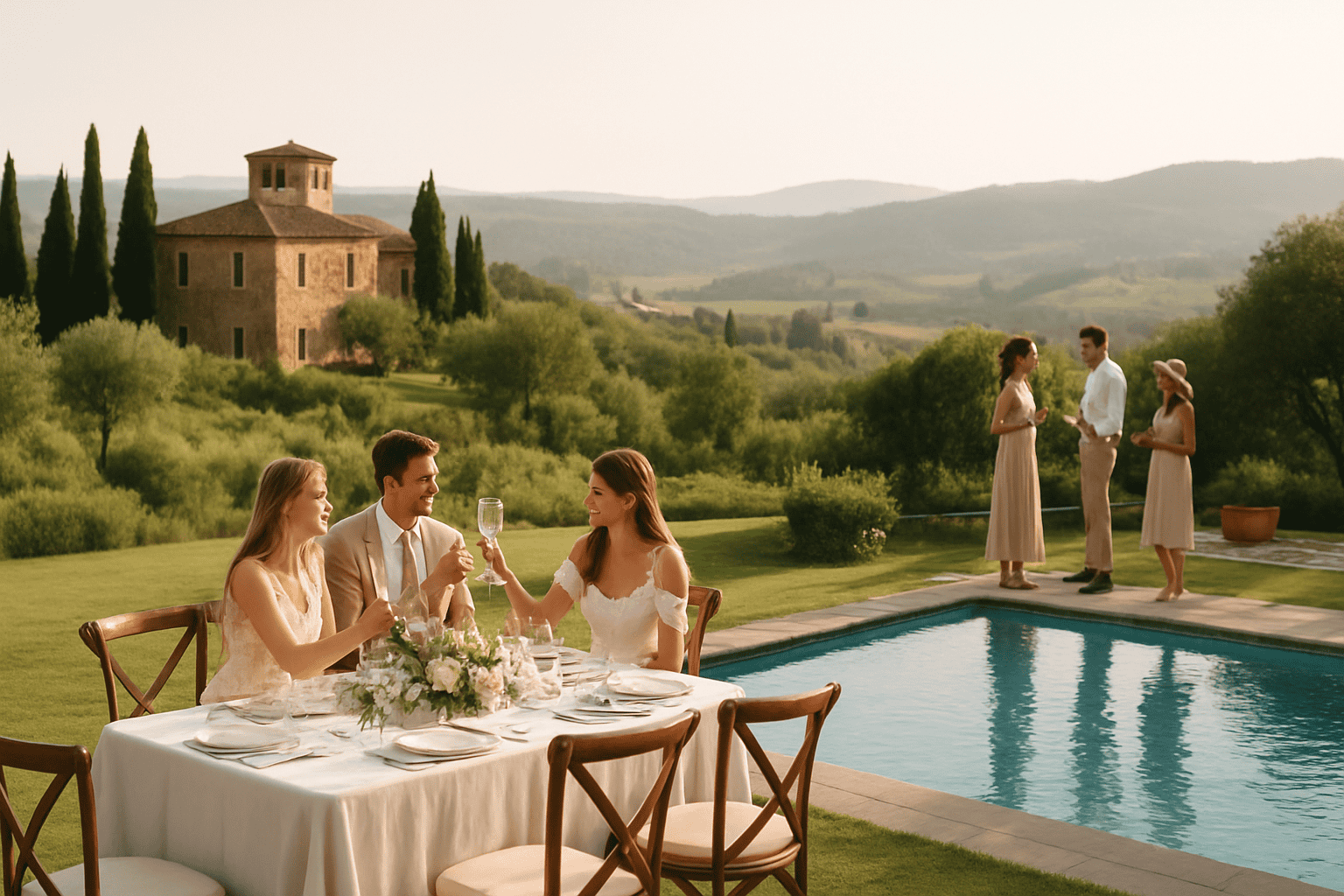
Wedding weekend in Tuscany: welcome dinner, pool party, and farewell brunch
Wedding weekend Tuscany: why choose welcome dinner, pool party and wedding brunch
A wedding weekend Tuscany it's not “just” a wedding: it's a complete experience, designed for those who desire an intimate but refined atmosphere, typical of destination wedding. Tuscany naturally lends itself to this format thanks to iconic landscapes, villas and estates surrounded by greenery, villages, vineyards, and a hospitality culture that makes it easy to turn an event into a true shared stay.
The heart of the weekend is the sequence of moments: welcome dinner Tuscany (welcome and first toast), main day with ceremony and reception (often with a pool party or soft activities) and wedding brunch farewell (a relaxed and warm closing). This rhythm creates continuity: guests get to know each other, settle in, experience the location without rushing, and arrive at the wedding day already “inside” the atmosphere.
Goal and style: luxury, intimate, destination
The format works because it allows you to fine-tune the style on three levels:
- Discreet luxury: design details, mise en place, lighting and music designed to enhance the location without weighing it down.
- Intimacy: more time together means more real connections, especially when guests come from different groups (families, friends, colleagues).
- Destination: the trip becomes part of the narrative, with experiences consistent with the territory (food, wine, rhythms, views).
If you’re considering villas and estates suitable for hosting multiple moments in the same place, it can be useful to explore the selection dedicated to Luxury weddings in Tuscany, so you can understand which spaces are best suited to a welcome dinner, pool area, and final brunch.
What to expect in terms of timing and logistics
A well-designed weekend doesn’t mean “more complicated”, but more spread out. In practice:
- arrivals, check-in and first activities are spread over 24–48 hours;
- stress on the wedding day is reduced (many things have already been experienced and explained);
- flows are managed better: transfers, parking, schedules, any outfit changes.
The key is to choose a location with flexible spaces (indoor/outdoor) and define a program that also leaves empty time: these are what let the weekend breathe and make it truly enjoyable.
Step-by-step planning for a wedding weekend in Tuscany
La pianificazione di un wedding weekend Tuscany it starts with a simple question: what are the three non-negotiable moments and what atmosphere do you want for each? From there you build a realistic timeline and a list of essential vendors, avoiding overlaps and rushed decisions.
Realistic timeline (from 12 to 2 months)
Below is a practical outline (suitable for both intimate events and more structured weekends). Timings may vary depending on the season, the location’s availability, and the complexity of the project.
- 12–10 months before: choice of area (Chianti, Val d’Orcia, Lucca hills, coast), location selection with spaces for multiple events, definition of weekend style and concept (palette, mood, dress code).
- 10–8 months before: booking key vendors (catering/banqueting, photo/video, music), defining the wedding flow and the welcome moment, first assumptions about transfers and accommodations.
- 8–6 months before: designing setups (ceremony, tables, lighting), beverage plan and wine experience, defining extra activities (pool party, tastings, soft visits), draft wedding website.
- 6–4 months before: menus and tastings, defining the music schedule, space layout, choosing stationery and signage (useful for a weekend with multiple moments).
- 4–2 months before: confirming the detailed timing (arrivals, welcome dinner, wedding day, brunch), room assignments and guest management, final briefing with the venue and vendors.
To keep everything under control without losing pieces, a structured list like this can help Organizing a wedding: checklist, to adapt to the weekend format by adding the extra moments (welcome dinner and farewell brunch).
Checklist of essential suppliers (without complicating)
A weekend doesn’t necessarily require double the vendors, but it does require a coherent direction. Generally, the essentials are:
- Location manager o referente: to coordinate access, spaces, schedules, technical areas.
- Catering/banqueting: able to manage multiple moments with different styles (a more convivial welcome dinner, a more scenic reception, an easier brunch).
- Setups and floral design: to create visual continuity, reusing elements intelligently (for example, ceremony flowers rethought for lounge areas, if compatible with logistics).
- Lights and audio: essential in Tuscany, where outdoor spaces are often the stars; light “writes” the evening’s atmosphere.
- Music/entertainment: with a different setup across the three moments (soft welcome, party, relaxed goodbyes).
- Photos and videos: to tell the weekend as a single story, not as separate events.
- Transport: shuttles and arrival/departure management, especially if guests don’t have cars.
The practical advice is to define from the start who “holds the thread” between the various moments: a single creative and organizational direction avoids inconsistencies and reduces last-minute micro-decisions.
Guest and transfer management
In a destination weekend, the guest experiences Tuscany as a journey. The difference between “nice” and “memorable” often lies in practical details:
- Staggered arrivals: plan a wide welcome window and an information point (even digital) for those arriving at different times.
- Clear transfers: schedules, pick-up points, contacts, and simple rules (what to do if you miss the shuttle, who to call).
- Guests with different needs: families, seniors, friends who want to explore; offering options without obligations is the most elegant solution.
If the venue is on a hill or in a rural area, consider realistic travel times and a communication plan that takes nothing for granted.
Budget and priorities for a Tuscany welcome dinner, pool party, and wedding brunch
Talking about budget in a wedding weekend means thinking in terms of scenic priorities and in terms of “signature moments”. The most common mistake is spreading energy everywhere, ending up with three nice events but none truly iconic. Better to choose an emotional and scenic peak (usually the wedding day) and build around it two coherent moments, more relaxed but well cared for.
Main items to consider
Without getting into numbers, the areas that impact the most over a weekend are:
- Food & beverage: because there’s more than one moment (welcome dinner, reception, brunch).
- Set-ups and furnishings: especially if you want to differentiate the settings (communal table for the welcome dinner, a more structured setup for the wedding day, a lounge for the pool moment).
- Logistics and transport: shuttles, schedule management, any welcome staff.
- Lighting, audio, music: they determine the perception of quality, especially in the evening.
- Production and coordination: direction, timing, supplier and guest management.
Where to invest to maximize the scenic effect
If the goal is a “wow” impact without weighing down the weekend, focus the investment on:
- A memorable setting for the welcome dinner: for example, a long table under warm lights, in a courtyard or among the olive trees, with a convivial rhythm. The welcome dinner Tuscany is the moment when guests loosen up: it should be welcoming, not excessive.
- The reception lighting: candles, light points, string lights, architectural lighting. In Tuscany, light enhances stone, vegetation, and views more than any “extra” element.
- An experiential detail: a tasting corner, a small performance, a well-designed cocktail station. It must be consistent with the place, not a random add-on.
- The farewell brunch: focus on comfort and perceived quality (shaded areas, comfortable seating, fresh mise en place). The wedding brunch is the moment for conversations and goodbyes: if it’s comfortable, it lasts a very long time (in the best sense).
Mistakes that increase costs (without improving the experience)
- Overly packed schedules: more activities doesn’t mean more value; it often means more transfers, more staff, and more stress.
- Three “identical” events: replicating the same level of formality and setup for the welcome dinner, wedding day, and brunch can become dispersive. Better to differentiate.
- Underestimated logistics: if guests don’t know where to go or when, last-minute fixes will be needed (and the energy shifts from the party to management).
- Choices not suited to the location: some areas are wonderful but delicate or impractical; before imagining a setup, check with the venue what is actually feasible (if a detail isn’t certain, check the product sheet or in the technical specifications of the involved supplier).
Plan B and risk management for a Tuscany wedding weekend
In Tuscany the weather can be generous, but a successful weekend is one that stays elegant even if the wind changes. Plan B is not a fallback: it is a second project, with its own aesthetic.
An effective Plan B is not “just any room”: it is an alternative that maintains aesthetic coherence and flow.
For every moment of the weekend, define a credible alternative:
- Welcome dinner: if the first idea is outdoors, plan for an indoor room or an elegant marquee with warm lighting and controlled acoustics.
- Pool party: it can turn into a “pool lounge” with music, cocktails and relaxation even without swimming, or into an informal lunch on a covered terrace (if available).
- Wedding brunch: it is often the most flexible; it’s enough to ensure shade/comfort and a simple flow between buffet and tables.
The secret is to design materials and styling that work in both versions: palette, furniture, lights and signage must be ready to migrate without disruption.
Venue constraints: what to clarify in advance
Every villa or estate has rules and characteristics. Before confirming the concept, clarify:
- Available spaces for each moment (and the related access times for setup and teardown).
- Indoor plan real: capacity, comfort, any technical limits.
- Noise and music management: better to know right away where the band/DJ can be and how to set up the audio.
- Parking and access: essential for shuttles and suppliers.
When something isn’t defined, avoid assumptions: ask for written confirmation from the contact person and, for technical elements (lights, marquees, flooring), check the product sheet from the supplier.
Contracts and deposits: how to protect the project
Risk management also goes through contractual clarity. Without getting into legal aspects, it’s useful to make sure that every supplier and the venue share:
- times setup/teardown times and staff presence;
- deliverable (what is included and what is not);
- modification conditions in case of weather or schedule changes;
- communication plan (who contacts whom, and when).
A smooth weekend starts with an organized backstage: the fewer ambiguities there are, the more natural the event feels.
Guest experience in Tuscany: welcome moment, activities, hospitality and wedding brunch
When guests travel for you, hospitality becomes part of the event’s language. In a wedding weekend Tuscany the goal is to make everyone feel “welcomed” without turning the schedule into a guided tour.
Welcome moment and welcome dinner in Tuscany: how to create connection right away
The first impression sets the tone for the weekend. A few simple but effective ideas:
- Arrival with a welcome point: someone who greets, directs, answers questions (even just during a time slot).
- Welcome drink: a quick gesture that kicks off the vacation, especially for those arriving from far away.
- Light dress code: clear but not rigid guidance (useful in countryside settings or stone venues).
La welcome dinner Tuscany it works best when it’s convivial: long tables, sharing, background music, warm lights. It shouldn’t “steal the spotlight” from the wedding day: it should open the story and bring guests into the mood.
Pool party: energy, relaxation and consistency with the location
The pool party isn’t mandatory, but in Tuscany it can become a much-loved moment because it balances elegance and lightness. To make it consistent:
- Smart timing: it often works well as a midday or afternoon moment, leaving breathing room before the evening.
- Comfort first and foremost: shade, water, seating, towels (if provided), clear paths between rooms and the pool.
- Music and beverages: a relaxed set, well-curated cocktails and non-alcoholic options; the atmosphere should stay “vacation,” not a forced afterparty.
If the weather or guests’ preferences suggest an alternative, you can turn the moment into a scenic aperitivo or an informal tasting, keeping the same spirit.
Wedding brunch: the farewell that closes the weekend with elegance
The wedding brunch it’s often the most authentic moment: no tension, no tight schedule, just conversations, spontaneous photos and thank-yous. To make it work:
- Soft timing: a wide time window avoids rushing and allows those leaving early to stop by even just to say hello.
- Bright and fresh setup: light colors, airy flowers, comfortable tables; if outdoors, shade and natural ventilation are essential.
- Closing cues: a short speech, a final toast, a softer playlist. It helps to close without melancholy.
It’s also the ideal time to handle practical details: collecting belongings, information on transfers, saying goodbye to guests who are leaving. If well organized, everything happens without interrupting the magic.
Transport, shuttles, parking: moving people around without stress
Tuscany is splendid, but it often requires travel on scenic roads and not-immediate travel times. To avoid friction:
- Shuttles with repeated schedules: better more clear runs than a single “perfect” run.
- Simple meeting points: easily recognizable and communicated in advance.
- Organized parking: if many arrive by car, plan signage and flow management.
When guests don’t have to worry about driving or finding their way, they truly experience the event.
Clear directions and a wedding website: the difference between chaos and smoothness
In a weekend with multiple moments, communication is part of the design. A wedding website (or a well-made digital document) should include:
- schedule with times and dress code for each moment;
- map and directions on how to get there;
- useful contacts (transfers, coordination, emergencies);
- Guest FAQ (weather, recommended shoes, travel times).
If you want to add cultural context for international guests, you can also share a reference link about the area: In-depth: Tuscany (Wikipedia).
Organizing a wedding weekend in Tuscany with a single direction
A successful weekend is one where every moment feels natural, but behind it there is precise direction: spaces, timing, lighting, hospitality, and communication speak the same language. If you want a coherent, elegant, and tailor-made project, explore the approach and the ideal locations for Luxury weddings in Tuscany: from the welcome dinner through to the farewell brunch, the goal is to give your guests a complete, authentic, and unforgettable experience.
FAQ
How many days are needed for a well-organized wedding weekend in Tuscany?
It usually works well over 2 or 3 days: arrival and welcome dinner, wedding day, farewell brunch. The ideal duration depends on distances, flight times, and the venue's availability.
How to make the welcome dinner in Tuscany elegant but not "too" formal?
Focus on conviviality and atmosphere: long tables, warm lights, soft music, and a menu designed for sharing. The goal is to welcome guests and encourage socializing, leaving the wedding day as the scenic highlight.
Should the wedding brunch be planned with a fixed time?
Better to have a wide time window, so those who leave early can stop by and those who want to sleep in can arrive calmly. Clearly communicate times, location, and format (served or stations) on the wedding website.
What should you plan as a weather plan B for a wedding weekend in Tuscany?
A credible alternative is needed for every moment: an indoor or covered space for the welcome dinner, a lounge/aperitif option if the pool party is not feasible, a shaded area or a bright room for brunch. Always check with the venue and suppliers what is actually feasible.
How to manage transportation and shuttles without stressing guests?
Define simple pick-up points, repeated schedules, and clear contacts. In Tuscany, travel times can be surprising: it's better to communicate realistic buffers and provide a point of contact for any unforeseen issues.
Is it better to do everything in the same location or split it between multiple places?
The same location reduces logistics and increases the smoothness of the weekend; multiple venues can provide variety but require more complex transfers and coordination. The choice depends on the desired style and practicality for the guests.
From the blog
 Tuscany
How to choose catering in Tuscany: tasting, seasonality, and allergies
Choosing catering in Tuscany for a wedding: what really matters (besides the menu) When you start choosing catering […]
Read more Tuscany
Florence: civil ceremony in the city and reception in the villa (timeline and transportation)
Organizing a civil ceremony in Florence with a reception in a villa is one of the most requested formats in Tuscany: it combines the […]
Read more Tuscany
Val d’Orcia: iconic locations and tips for “golden hour” photos
Val d’Orcia and golden hour: why this format works for a wedding Val d’Orcia has a rare quality: it is […]
Read more