




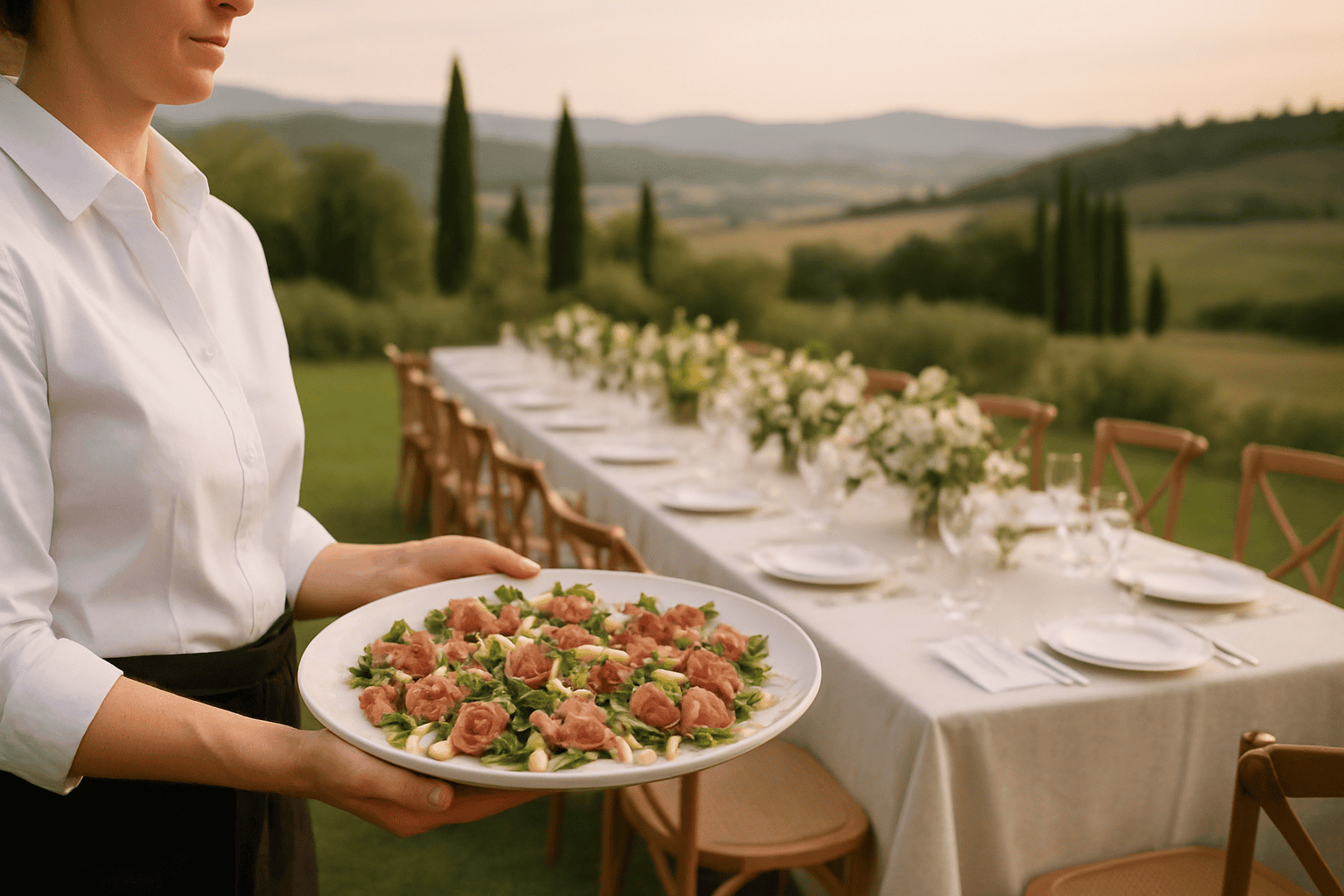
Choosing catering in Tuscany: where to start (style, location, expectations)
When it comes to choose Tuscany wedding catering, the question is not only “what will we eat?”, but what kind of experience you want to make your guests experience. In Tuscany, cuisine is part of the landscape: hills, vineyards, villages, villas, and farmhouses create a setting in which the catering must be able to interact with the place, the season, and the rhythm of the day.
Even before the tasting, clarify three elements:
- Event style: essential luxury, intimate and convivial, destination wedding with international guests, or a more traditional style wedding.
- Type of location: historic villa, estate with outdoor spaces, farmhouse, period residence, garden or panoramic terrace. Each setting changes logistics, setups, and service times.
- Guest expectations: number, age, dietary habits, presence of children, need for faster times or longer moments of conviviality.
A catering truly suitable for Tuscany does not “impose” a format, but builds a path consistent: from the aperitif to the dessert, from the wine to the corners, up to the management of dietary needs. And above all, it knows how to move between often scenic but not always simple spaces (distant kitchens, access restrictions, outdoor areas, historic flooring).
For a general overview of the territory and its characteristics, you can consult In-depth: Tuscany (Wikipedia).
Wedding catering tasting: how to really evaluate it (not just “if it’s good”)
The tasting is the moment when many couples fall in love… or change their mind. But to choose clearly, a method is needed. A sample can be excellent and still not suitable for your event: for this reason, it is worth evaluating consistency, rhythm, and management, in addition to taste.
Before the tasting: prepare a mini-brief
Arrive at the meeting with clear indications. Even a few lines help the catering to propose a realistic menu in line with the day.
- Ceremony time and expected duration of aperitif, dinner/lunch, party.
- Service style: placée, family style, islands, mix between seated and standing.
- Desired atmosphere: elegant, rustic-chic, contemporary, traditional.
- Preliminary list of dietary needs (even if provisional): here the topic immediately comes in wedding allergies.
During the tasting: also observe what is not on the plate
In addition to the quality of raw materials, consider:
- Menu balance: alternation of textures, temperatures, intensities, perceived portions.
- Feasibility at the venue: ask if the dishes tasted can be replicated in the chosen space (internal kitchen, catering kitchen, distance between kitchen and dining room).
- Service timing: a perfect menu on paper can lose appeal if the timing is prolonged.
- Attention to detail: plating, cleanliness, handling of requests, listening skills.
A good sign is when the catering asks you questions: about guests, atmosphere, flows, spaces, and not just “meat or fish”.
After the tasting: the questions that make a difference
- Which dishes change with the season? (useful to set a true wedding seasonal menu)
- How do you manage alternatives for allergies and intolerances without “isolating” the guest?
- Who will be present on the day of the event (room manager, chef, coordination)?
- What is the operational plan for aperitif, dinner, and party (flows, stations, supplies)?
If a detail concerns specific equipment or facilities, check the product sheet or in the catering technical proposal.
Wedding seasonal menu in Tuscany: how to build it between tradition and lightness
Seasonality in Tuscany is not a trend: it is a natural way to give identity to the reception. A wedding seasonal menu well thought out menu enhances the territory without being “heavy” and allows consistency between what is seen (countryside, vineyards, olive groves) and what is tasted.
Spring: freshness, herbs, colors
In spring, proposals that play on freshness and scents work well: tender vegetables, aromatic herbs, light textures. It is also a period when many guests appreciate a more dynamic pace: curated aperitifs, dishes that are not too structured, a sweet but not excessive finale.
Summer: heat management and smart service
The Tuscan summer can be splendid and intense: here catering must demonstrate expertise in managing temperatures, timing, and stations. Overly elaborate dishes can suffer; better to focus on balance, hydration, and continuity of service, especially during aperitif and party.
Autumn: comfort, harvest, warm atmospheres
Autumn is the realm of atmospheres: colors, lights, more enveloping sensations. It is the ideal time for a menu that alternates comfort and refinement, with a progression that accompanies the day without weighing down. If you plan an outdoor reception with a cool evening, consider with the catering how to manage coverings, hot drinks, and service times.
Winter: intimacy and “living room” rhythm
In winter, the setting often changes: indoor spaces, candles, historic rooms, more intimate timing. The menu can become more intense, but it is important to maintain a smooth structure. Even the welcome (welcome drink, small tastings) becomes an essential part of the experience.
Tradition yes, but with a contemporary direction
Many couples desire references to Tuscan tradition, but with a personal touch. The point is not to “do everything typical,” but rather to select what truly represents the territory and insert it into a harmonious path. An experienced catering service will be able to offer you elegant alternatives, maintaining recognizability and lightness.
Wedding allergies and intolerances: how to manage them without stress (and without improvising)
The management of wedding allergies and intolerances is one of the most important criteria when choosing catering. It is not only about the guest's safety: it affects timing, mise en place, communication with the dining room, and perception of care. It is essential that the catering adopts strategies for allergen-free menus, ensuring that each dish is prepared with safe ingredients free from common allergens. Clearly communicating these choices to guests not only shows attention but also helps create an atmosphere of inclusion for everyone. Furthermore, proper management of allergies and intolerances can enhance the gastronomic experience, allowing each participant to enjoy the courses without worries.
Collect information the right way
Avoid scattered messages and incomplete lists. Better a single channel (RSVP, form, wedding website) and a clear question: “Allergies, intolerances or dietary needs?”. Then, organize the responses into categories and share them with catering and planner in advance.
- Allergies (to be reported with utmost attention)
- Intolerances
- Dietary choices (vegetarian, vegan, etc.)
Dignified alternatives: same style, not a separate dish
A common mistake is treating special menus as an uncomfortable exception. In a well-curated wedding, alternatives must be consistent with the main menu in aesthetics and level, so the guest does not feel “different” or neglected.
Ask the catering how they set up:
- the presentation of alternative dishes;
- the coordination between kitchen and dining room;
- the management of aperitif and buffet, where the risk of confusion is greater.
Discreet signage and communication with the dining room
There is no need to turn the reception into a “label path,” but sober signage and an informed dining room reduce errors and anxieties. Agree with the catering on how to identify dishes and how to instruct the staff. If the catering uses technical sheets or internal labels, check the product sheet or in the documentation they provide you.
Choosing Tuscany wedding catering: logistics, timing, and coordination at the venue
Tuscany offers spectacular venues, but often requires precise management: narrow access roads, distances between areas, outdoor spaces to be set up, kitchens not always close to the dining room. For this reason choose Tuscany wedding catering it also means evaluating the ability to manage the day smoothly.
Site inspection: what to check together
- Loading/unloading points and staff routes (without interfering with guests).
- Support spaces for aperitif, service, and party.
- Evening lighting and flows between areas (ceremony, aperitif, dinner, cake cutting).
- Plan for the heat or for the cool evening, depending on the period.
Realistic timing: the secret to a “no waiting” reception
A competent catering service helps you build a timing that takes into account photos, transfers, speeches, and special moments. In Tuscany, where multiple areas of the venue are often used, it is essential that the timings are compatible with the flows: an aperitif that is too long can tire guests, a dinner that is too quick can take away the magic.
Staff and management: who makes decisions on the spot?
Always ask who the operational contact is on the wedding day and how they communicate with the planner, venue, and other suppliers. The difference between a “beautiful” event and an “impeccable” event often lies in the ability to solve minor unforeseen issues without the guests noticing.
Step-by-step planning: from the first call to the wedding day
An organized process reduces stress and second thoughts. Here you will find a practical guide to reach the catering choice clearly, without losing creativity.
From 12 to 9 months before: vision and first selections
- Define style, mood, and structure of the day.
- Gather inspirations on table setting and type of service.
- Select catering services compatible with the venue and number of guests.
From 8 to 6 months before: tasting and menu draft
- Do the tasting with a checklist (taste, timing, listening, alternatives).
- Set a draft of wedding seasonal menu consistent with the date.
- Start gathering information on wedding allergies and preferences.
From 5 to 3 months before: confirmations and operational details
- Confirm the service structure (aperitif, seated, party).
- Align catering and venue on spaces and flows.
- Define the direction of key moments (entrances, toasts, cake cutting).
From 2 months to the last weeks: finishing touches and guest communication
- Gather the latest dietary requirements and organize a clean list.
- Share an updated schedule with all involved suppliers.
- Prepare clear instructions for guests (parking, shuttles, timings).
Budget and priorities: where to invest for a “wow” effect without waste
When evaluating catering, it’s easy to focus only on the menu. In reality, the final effect depends on a combination of choices: service, mise en place, rhythm, presentation, and consistency with the location. Setting priorities helps you achieve a more spectacular and harmonious result.
The items that most impact the perceived experience
- Quality of service: timing, coordination, attention to guests.
- Structure of the aperitif: it’s the first impression and often the most photographed moment.
- Table setup: dishes, glasses, napkins, details consistent with the mood.
- Party direction: transition from dinner to party without “gaps”.
Where to invest to maximize the scenic effect
In Tuscany, the natural scenery is already powerful. To enhance it, it often works to focus on:
- clean presentations and materials consistent with the location;
- well-positioned corners (not too many, but thought out in the flow);
- lighting and atmosphere in synergy with the service, especially at sunset.
Mistakes that increase costs (and do not improve the event)
- Adding too many options without direction: “lots of food” does not mean “great experience”.
- Changing the menu many times without a criterion related to season and timing.
- Underestimating the logistics of the location: what seems simple on paper can become complex on site.
Plan B and risk management: weather, location constraints, and clear agreements
A wedding in Tuscany often relies on outdoor spaces: gardens, courtyards, terraces, rows of vines. For this reason, Plan B is not optional. A reliable catering service works with you on alternative solutions that maintain style and comfort.
Weather: credible alternatives, not “fallbacks”
Ask how the service changes in case of rain or wind: not just where to move the tables, but how to rethink the aperitif, flows, and timing. A well-designed Plan B avoids last-minute rushes and maintains the atmosphere.
Location constraints: access, spaces, schedules
Every location has rules and limits. It’s not necessary to go into technical details, but it is essential that catering and location are aligned on what is possible. If the location provides specific documentation, check the product sheet or in the official information they send you.
Clear agreements: what to define to avoid misunderstandings
Without going into legal aspects, it is useful that everything impacting the coordination is written and shared: schedules, spaces, operational responsibilities, handling unforeseen events. Clarity reduces stress and protects the quality of the experience.
Guest experience: welcome, transfers, and communication (also for destination weddings)
In Tuscany many weddings have guests coming from outside the region or abroad. In these cases, catering becomes part of the hospitality: not just “serving,” but helping people feel welcomed and guided.
Welcome moment and small gestures that change perception
A well-thought-out welcome can start even before the reception: a welcome drink, a refreshment corner, a pace that doesn’t leave guests waiting. These are details that make the event smoother and more “refined,” especially if there are transfers or technical timings.
Transport, shuttles, and parking: integrating logistics into coordination
If you plan shuttles or transfers, align the schedules with service moments (aperitif, dinner, party). The goal is to avoid staggered arrivals that break the atmosphere. Here too, catering and planner can collaborate to synchronize welcome and service.
Clear directions and wedding website: fewer questions, more peace of mind
Simple communication reduces unforeseen events: correct addresses, schedules, dress code if required, advice on terrain and shoes, and a section dedicated to dietary needs. If you are building the entire wedding project and want broader guidance, you can find useful tips here: How to organise a wedding.
Questions to ask the catering before confirming (practical checklist)
Before making a decision, use this checklist to objectively compare different proposals. It helps you understand who is really suitable for your wedding in Tuscany, beyond the effect of the tasting.
- Menu and seasonality: which dishes change with the date? How is a wedding seasonal menu managed without losing identity?
- Allergies and alternatives: how do you manage wedding allergies during aperitif and table service?
- Logistics: have you already worked in similar locations? How do you organize kitchen, stations, and flows?
- Day management: who coordinates the dining room and kitchen? Who makes decisions if the weather changes or the schedule shifts?
- Style: how do you adapt mise en place and presentation to the mood (and not the other way around)?
One last piece of advice: choose the catering that “reads” Tuscany with you
The right catering is not the one that offers the longest menu, but the one that builds an experience consistent with your location, the season, and the people you love. If you want professional support to coordinate supplier choices, timing, and style of the reception in Tuscany, Chiara B Events can assist you with comprehensive and detail-oriented management, so you can experience the organization more serenely and arrive at the wedding day confident in every choice.
FAQ
How do I know if a catering service is suitable for my venue in Tuscany?
Request an inspection focusing on access points, support spaces, kitchen-to-dining room distance, and flows between ceremony, aperitif, and dinner. Assess whether they propose a realistic timing and operational solutions consistent with the environments.
What should I evaluate during the tasting of the wedding catering?
In addition to taste, observe menu balance, feasibility at the location, service times, and listening skills. Ask questions about how the menu changes with the season and how alternatives for dietary needs are managed.
How to set a seasonal wedding menu in Tuscany without being too “heavy”?
Build a progression with dishes balanced for intensity and textures, adapting the pace to the season (warmth, freshness, longer times outdoors). Select a few well-integrated local references, instead of including too many similar courses.
How to manage wedding allergies and intolerances without stress for guests?
Collect information with a single RSVP channel, organize a clean list and share it in advance. Ask for alternatives consistent with the main menu and agree on discreet communication between the kitchen and dining room, especially for aperitif and buffet.
Is it better to have plated service or buffet for a wedding in Tuscany?
It depends on style, number of guests, spaces, and timing. The seating plan gives a more regular and formal rhythm, while a structured aperitif with islands can enhance views and conviviality. Often the best solution is a mix, defined based on the flows of the location.
