




Wedding in an olive grove: seating, shading, and lighting for a perfect evening dinner
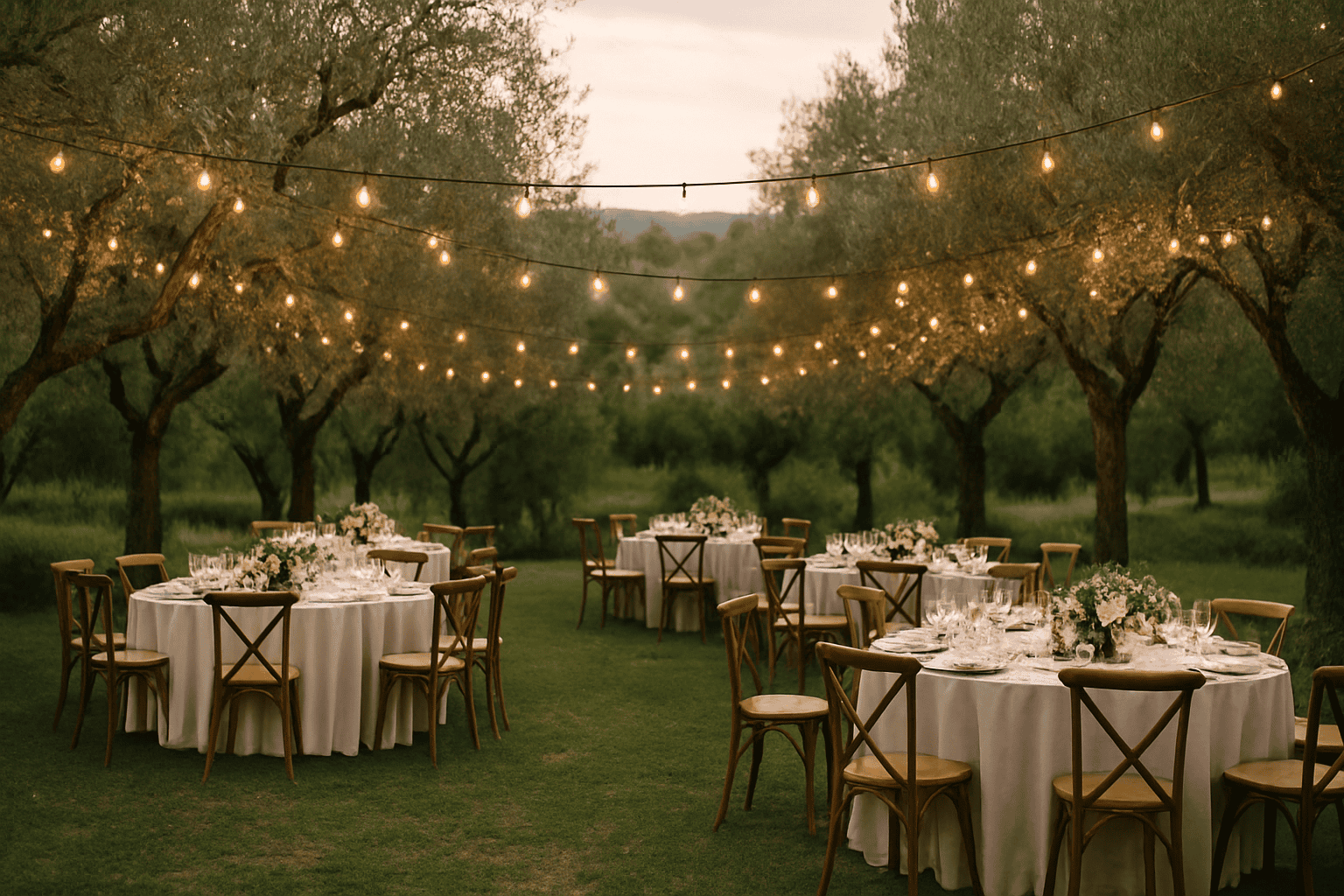
Wedding in an olive grove in Tuscany: why the evening dinner really works
A wedding in olive grove has an immediate charm: the natural geometry of the rows, the silvery green of the leaves, the scent of the earth and that feeling of authenticity that in Tuscany seems “already a set”. But the reason why this format conquers Italian and international couples is not only aesthetic: it is a complete experience, especially when the day culminates with a olive grove wedding dinner lights carefully designed.
The evening dinner among the olive trees works because it combines three elements that, together, create atmosphere and comfort:
- Natural rhythm: aperitif at sunset, dinner under warm lights, after dinner with a change in light intensity.
- Intimacy: even with large numbers, the olive trees “break up” the space and make the whole more intimate.
- Scenic versatility: with a good olive grove setup you can move from a country-elegant style to a contemporary luxury without distorting the context.
Goal and style: luxury, intimate, destination
In Tuscany, the olive grove is often part of estates and villas with a strong identity. The best result is achieved when the project does not “cover” the location, but enhances it. In practice: natural materials, palettes consistent with the landscape, and awedding lighting designed to accompany the evening (not just to “provide light”).
This format is perfect for:
- Destination wedding with guests who want to experience Tuscany, not just visit it.
- Couples who want a long, convivial dinner, with moments of surprise (speeches, show cooking, cake cutting among the trees).
- Those looking for discreet luxury: curated details, high comfort, natural atmosphere.
If you are exploring exclusive settings, it may be useful to take a look at Luxury weddings in Tuscany, to guide you among estate styles and possible scenarios.
What to expect: timing, logistics and the “direction” of light
The difference between a “beautiful” dinner in an olive grove and a memorable dinner in an olive grove lies in the direction: seating, shading, and lighting must work together. From a practical point of view, consider that: The atmosphere must be cared for down to the smallest details, with tables elegantly set and tablecloths that recall the colors of the surrounding nature. Soft lighting can transform the landscape, making every moment even more magical. Dining in a farmhouse: a unique experience that encompasses the taste of tradition and the beauty of the places, creating unforgettable memories.
- The sunset determines the timing: the aperitif must start with still pleasant natural light, and the dinner must “light up” gradually.
- The ground may be uneven: careful verification is needed for the stability of tables and seats, and for laying cables and light points.
- Thermal comfort changes quickly: shading for late afternoon and a lighting plan that does not dazzle when darkness falls.
In Tuscany, the magic is also cultural. For an overview of the territory and its best-known areas, you will find a In-depth: Tuscany (Wikipedia).
Step-by-step planning for a flawless olive grove setup
A successful project comes from a realistic timeline. The olive grove is not a “ready room”: it is a living environment, with constraints and opportunities. Good planning means avoiding last-minute rushes and, above all, ensuring that wedding lighting, seats and shading are consistent with the style and logistics.
Realistic timeline (from 12 to 2 months)
12–10 months before
- Location selection with inspection during a time slot similar to that of the event (late afternoon/evening).
- Concept definition: palette, mood, table style, “tone” of light (warm, neutral, more theatrical).
- First layout draft: aperitif area, dinner, cake cutting, after dinner.
9–6 months before
- Catering choice and service flow definition (timing, steps, possible stations).
- Preliminary project of wedding lighting: light points, paths, service areas, any suspended elements among the olive trees.
- Furniture selection: tables, seats, lounge, any bar stations.
5–3 months before
- Key supplier confirmation: florist, lighting designer/lighting technician, rentals, music.
- Layout tests: definition of passage spaces and distances for comfort and service.
- Shading study: sails, light tensile structures, temporary pergolas (check compatibility in the product sheet and with the location).
2 months–2 weeks before
- Operational walk-through with all departments: access, unloading, staff routes, critical points.
- Confirmation of weather plan B and plan C (wind, evening humidity, temperature variations).
- Guest details definition: signage, welcome, shuttle timing.
Essential supplier checklist (and what to ask)
For a olive grove setup In the evening, some suppliers are crucial. When selecting them, always ask for examples of projects in similar natural contexts and clarify who is responsible for what.
- Lighting: design, installation, intensity management during the evening, dismantling.
- Furniture rentals: comfortable seats for a long dinner, tables suitable for the terrain, possible platforms.
- Floral & styling: arrangements that withstand heat and evening, and do not hinder conversation.
- Catering: ability to work outdoors with consistent quality, coordination with light/sunset times.
- Music and audioUniform diffusion without “empty zones”, microphones for speeches, volume management.
Guest and transfer management: Tuscany is beautiful, but it needs to be orchestrated
Many weddings in Tuscany involve guests staying in multiple venues. The management of transfers affects punctuality and the energy of the evening. Plan:
- Arrival windows staggered to avoid queues and stress.
- Clear welcome points (hostesses or coordination) and simple directions.
- A timing that respects the sunset: if guests arrive late, the transition from natural light to artificial lights loses its magic.
To not forget anything in the preparation, an operational guide like Organizing a wedding: checklist, can help you fit suppliers and deadlines without overlaps.
Wedding dinner in olive grove lighting: how to define priorities and scenic investments
When it comes to budget, the most common mistake is spreading resources over too many “cute” details and underestimating what really makes a difference in photos and live: comfort, layout e wedding lighting. In an olive grove, light is the invisible architecture that holds everything together.
Main items to consider (without surprises)
The areas that generally have the greatest impact are:
- Furniture and seating: stability, comfort, aesthetic coherence.
- Shading: essential if the aperitif or part of the dinner starts with strong light.
- LightingLighting
- Logistics: ambient, functional, accent (tables, paths, trees, service areas).
Where to invest to maximize the scenic effect (without excess)
Logistics
- : setups, timing, access, any support surfaces.For a perfect evening dinner, some choices pay off much more than others:
- Layered lighting: a single type (e.g., only string lights) is rarely enough. The ideal is to combine diffused light + accent points on the olive trees + functional light for service and paths.
- A layout with a “view”: imperial table or round tables? It depends on the terrain and number of guests, but the rule is to create perspectives: visual corridors, focal point, cake area that seems part of the dinner and not an improvised corner.
- Light shading: they must not “close off” the sky. Minimal sails and covers can protect without suffocating (check the product sheet for performance and fixing methods).
In terms of atmosphere, the goal is not to illuminate like daylight, but to create an environment where guests can see well, the food is enhanced, and the location remains the protagonist. A wedding lighting well-designed guides the gaze: table, faces, olive trees, paths.
Typical mistakes that increase costs (and how to avoid them)
- Layout decided too late: changing the arrangement right before the event may require more furniture, more wiring, more setup hours.
- “Decorative only” lights: if you do not also plan functional lighting, you risk last-minute additions for safety and service.
- Underestimating the ground: if the area is uneven, you might need stabilization solutions or a different table distribution.
- Unplanned cake cutting: if it is not integrated into the lighting plan, it ends up being illuminated improvisedly, losing impact.
Plan B in the olive grove: weather, wind, and alternatives without losing style
In Tuscany, the climate is often favorable, but an outdoor evening event must have credible alternatives. A good Plan B is not just “let’s move inside”: it is a second aesthetic and logistical project that maintains the event’s identity.
Weather: alternative solutions consistent with the olive grove setup
The most effective alternatives are those planned from the start:
- Light covers integrated into the concept (sails, transparent or minimal structures): they protect without killing the atmosphere. Check the product sheet for performance with wind and rain.
- Indoor backup area already “designed”: if the location has a greenhouse, a room, or a porch, define an alternative layout with a dedicated lighting plan.
- Modular transition: aperitif in a sheltered area and dinner in the olive grove if the weather improves, or vice versa.
Location constraints: access, ground, trees, and context protection
Every olive grove is different. Before confirming a project, clarify with the location:
- Which areas are usable and with what limits (passages, vehicles, setup times).
- Whether suspended installations between trees are allowed or if self-supporting structures are needed.
- Where cables and light points can pass without interfering with roots and soil.
These aspects directly affect thewedding lighting and the choice of shading: better to know beforehand, so you don't have to redesign close to the event.
Contracts and deposits: operational clarity to avoid stress
Without going into specific legal aspects, the best approach is to have clear documents on:
- Responsibilities assembly and disassembly (who does what, and when).
- Rescheduling conditions in case of bad weather.
- Technical confirmations: available power, access, loading/unloading times (if you're not sure, check with the venue).
Guest experience: seating, shading, and wedding lighting designed for comfort
The memory of a dinner in an olive grove is not just “how beautiful it was”: it’s how you felt. Comfort and smoothness are what turn a setup into an experience. Here seating, shading, and lights are not separate details: they are a single system.
Welcome moment and hospitality: the beginning sets the tone
If guests arrive in an olive grove at sunset, the welcome must be immediate and intuitive. These work very well:
- Welcome drink in a shaded area or under denser trees, with lounge seating for those who want to rest.
- Small orientation points (hostesses, elegant signage, lanterns along the paths) to prevent anyone from “getting lost” among the rows.
- Background music already playing, to provide continuity between arrival and aperitif.
Transport, shuttles, and parking: logistics that save the atmosphere
In many Tuscan estates, access to the olive grove can be scenic but not always immediate. To protect the experience:
- Provide a clear drop-off point and a path lit with warm, non-glare lighting.
- If there are shuttles, define schedules and meeting points that are easy to remember.
- Manage returns: after dinner is often the moment when the perception of “care” makes the difference.
Clear directions and wedding website: fewer questions, more magic
Well-made communication reduces interruptions and unforeseen events. Even without going into technical aspects, a wedding website or a well-structured guest information sheet can include:
- Arrival times and points.
- Recommended dress code (useful in olive groves, especially for shoes and evening).
- Notes on internal movements and timing of the evening.
When guests know what to expect, they enjoy every moment more: from the aperitif to dinner, until the moment the lights change intensity and the olive grove becomes a “living room” under the stars.
Wedding lighting in an olive grove: how to create atmosphere without dazzling
Light in an olive grove must do three things: enhance, orient e welcome. The most common risk is choosing a single solution and hoping it will be enough. In reality, the most elegant effect comes from a composition of layers.
Three levels of light that work for the evening dinner
- Ambient light: creates the “dome” above the dinner and visually unites the tables. It must be warm and uniform.
- Accent light: highlights some olive trees, a bar corner, the bride and groom’s table, or a focal point. It is what makes photos three-dimensional.
- Functional light: paths, steps, catering work areas. It must not steal the scene, but it must be there.
Shadows and reflections: the secret of a “cinematic” olive grove
Olive leaves reflect light in a particular way. For this reason, softer light often works, with well-directed points and without excess. An expert lighting designer can help you avoid:
- Areas too dark between tables.
- Glare when guests look up.
- Too strong contrasts that “flatten” faces in photos.
If you are building your idea of olive grove wedding dinner lights, imagine the evening as a sequence: arrival (orientation), aperitif (socializing), dinner (intimacy), cake cutting (theatricality), after dinner (energy). Each phase can have slightly different lighting while remaining consistent. Each phase of the evening contributes to creating a unique atmosphere, playing with warm and soft lights for the moment of intimacy, and vibrant and dynamic colors during the after dinner to encourage the party. It is essential to design lighting for special events, as the right lighting can completely transform the mood and the guests' experience. Remember to also consider details, such as light points that can highlight decorative elements and create a breathtaking effect.
Useful links to organize a wedding in an olive grove in Tuscany
To explore locations and inspirations in an exclusive way, explore Luxury weddings in Tuscany. If instead you want an operational view of the activities to manage, consult Organizing a wedding: checklist.
A tailor-made project for your olive grove setup in Tuscany
If you want an evening dinner among the olive trees that combines aesthetics, comfort, and a wedding lighting truly spectacular setting, the decisive step is to turn the idea into a complete project: layout, timing, lighting plan, shading, and guest management. Chiara B Events creates weddings in Tuscany with a keen eye for detail and a contemporary taste, enhancing the location without forcing it. Tell us your vision: together we will build an elegant, smooth, and unforgettable experience.
FAQ
What is the best time for a dinner in an olive grove in Tuscany?
It usually works to start with an aperitif close to sunset and let the dinner “come in” when the natural light fades. This way, the wedding lighting can gradually turn on, creating atmosphere without sharp breaks.
What kind of lighting is needed for an olive grove wedding dinner with truly spectacular lights?
The most effective approach is layered: ambient light to visually unify the dining area, accent light to highlight some olive trees or focal points, and functional light for pathways and service. A single type of light is rarely enough in a natural setting.
How to choose seats and tables for a comfortable olive grove setup?
First consider the ground and the duration of the dinner. Comfortable and stable seating makes a difference during a long service; for tables, stability and the management of passage spaces for guests and staff are very important.
Are shading devices necessary even if dinner is in the evening?
Often yes, because the aperitif and the arrival of guests can take place while there is still daylight. Sails or light coverings can protect without blocking the view of the sky; for performance and compatibility, check the product sheet and with the location.
What is the best plan B for a wedding in an olive grove?
The best plan B is the one designed from the start: a coherent aesthetic alternative (light covers or already set up indoor area) with a dedicated lighting plan. Avoid improvised solutions that force you to rethink layout and atmosphere at the last minute.
How to prevent guests from getting disoriented among the rows during the evening?
Provide clear paths illuminated with warm, non-glare light, elegant signage, and a welcome point. A wedding website with practical directions reduces questions and interruptions, keeping the evening smooth.
