




Valle d’Itria: wedding weekend among white villages and farmhouses (logistics included)
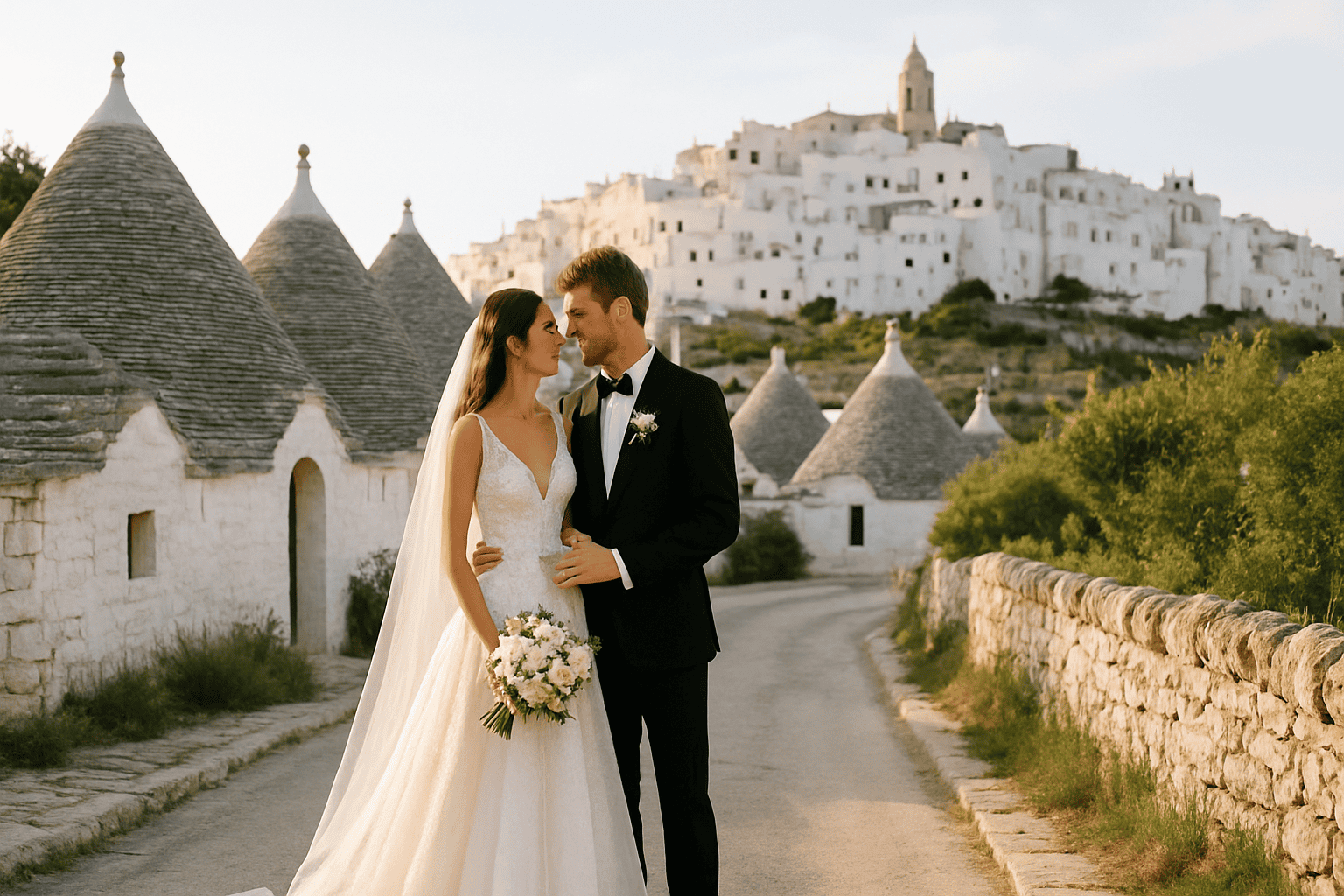
Wedding weekend in Valle d’Itria: why choose white villages and farmhouses
A wedding weekend in Valle d’Itria it is not “just” a wedding: it is a way to make guests experience a territory made of light, light stone, olive trees, and inner courtyards where time seems to slow down. Between farmhouses immersed in the countryside and iconic villages, the weekend format works because it distributes emotions and key moments over several days, avoiding last-minute rushes and clashes. Every moment spent in this enchanting setting becomes an indelible memory, while guests immerse themselves in the local culture and gastronomy. A wedding weekend in Valle d’Itria thus becomes the ideal context to realize a dream wedding in Sicily, where the beauty of the places merges with the love being celebrated. The evenings come alive with rhythms and traditions that tell stories of passion and conviviality, making every moment unique and special. In this magical context, guests can discover hidden corners and breathtaking views, enriching the experience with outdoor activities and food and wine tours. Every dream wedding in Favignana is further enriched with the possibility to explore enchanting islands and delight the palate with fresh fish dishes. These unforgettable moments, intertwined with local traditions, create an atmosphere that will remain in everyone's heart, turning every celebration into an extraordinary event. Moreover, every detail is cared for with passion, creating an atmosphere of elegance and refinement that makes every moment even more memorable. This approach is also reflected in experiences such as a luxury wedding in Chianti, where the enchanting landscape and local traditions come together to offer unique celebrations. The combination of natural beauty and impeccable service is what makes every wedding weekend in Valle d’Itria a dream event, capable of enchanting every guest. Every wedding weekend in Valle d’Itria is enriched with details that tell a true romantic wedding story, in which the bride and groom can personalize every aspect of their big day. From the choice of flowers to the musical atmosphere, every element contributes to telling a unique and personal story. A wedding in this context is not only the celebration of a union but an experience that will remain etched in the hearts of all, indelibly linking the guests to the magic of this territory. Furthermore, a luxury wedding in Tuscany offers the opportunity to explore some of Italy’s most iconic landscapes, with hills dotted with vineyards and historic villages. Every detail intertwines with the beauty of the territory, creating an unforgettable experience that celebrates not only love but also local culture and tradition. The bride and groom and their guests will find themselves immersed in an atmosphere of timeless elegance, making their big day a true dream come true.
The Valle d’Itria, in the heart of the Apulia, is particularly suited to this style: relatively short distances between different locations, strong natural settings, and a recognizable aesthetic identity (white, tuff, trulli, dry stone walls). If you want to better frame the geographical and cultural context, you can read In-depth: Puglia (Wikipedia).
Goal and style: intimate, destination, detailed
The wedding weekend is born for those who desire:
- an atmosphere destination (even with many Italian guests) without the rigidity of the “single day”;
- a tone intimate but scenic, where every moment has its own rhythm;
- a coherent experience: from the graphic design of directions to the logistics of transfers, up to the choice of locations.
In Valle d’Itria you can build a story alternating countryside and village: a pre-event among the white streets, a main day in a farmhouse, a more relaxed post-event. The effect is natural, not “forced”.
What to expect in terms of timing and logistics
The decisive point is time management: the weekend works when it reduces unnecessary travel and makes it clear to everyone “where to be and when”. In practice:
- you choose a base (farmhouse or strategic area) for most guests;
- you define 2–3 main moments (welcome, wedding day, final goodbyes) with realistic times;
- you plan transfers and parking so that the guest does not have to “manage on their own”.
If the idea is a wedding in a village, like a ostuni wedding, or a symbolic experience among trulli and stone, like a alberobello wedding, logistics must be planned with even more care: access points, ZTL zones, loading/unloading areas, and pedestrian routes can greatly change the perceived experience.
Step-by-step planning for a wedding weekend in Valle d’Itria
A successful weekend is built with a clear schedule and decisions made in the right order. Below you’ll find a practical outline: it’s not “rigid,” but it helps you avoid skipping steps that later impact guests and suppliers.
Realistic timeline: from 12 to 2 months before
12–9 months before
- Define the concept: style, number of guests, level of formality.
- Choose the base area (e.g., between Ostuni, Cisternino, Locorotondo, Alberobello) and the type of venue: masseria, historic residence, distributed structure.
- Book the main venue and immediately check indoor/outdoor options (ask about check the product sheet or in the venue contract what is included).
8–6 months before
- Select key suppliers: catering/banqueting, photo/video, music, floral design, lighting.
- Set the event map: welcome, wedding day, post-wedding.
- Start collecting guest needs (allergies, mobility, children) to design hospitality and menu.
5–3 months before
- Define logistics: transfers, parking, possible shuttles, meeting points.
- Design wedding communication: save the date, invitations, directions, wedding website.
- Conduct an operational site inspection (or a detailed meeting) for routes, evening lighting, acoustics, service spaces.
2 months before
- Confirm the timetable and “plan B.”
- Finalize seating plan and kitchen/service timing.
- Prepare a single document for guests and suppliers: contacts, maps, schedules, venue rules.
Essential supplier checklist (without forgetting the invisible details)
Besides the classics, in a wedding weekend the “direction” roles matter a lot. Here is a thoughtful checklist:
- Location manager or operational contact of the venue (crucial for timing and access).
- Transport: shuttles, private transfers, arrival/departure management.
- Setups and lighting: in a masseria the evening atmosphere changes everything; consider light points, candles, strings, lanterns according to what the venue allows (check the venue product sheet).
- Music: live, DJ or both; pay attention to allowed spaces and volumes.
- Coordination: a figure who brings together suppliers, timing, and guests, especially if multiple locations are involved.
Guest and transfer management: the real difference between “nice” and “perfect”
On the weekend, guests arrive at different times and have different needs. To avoid dispersion:
- choose a base of stay (or multiple nearby facilities) and create a simple map;
- organize at least one coordinated transfer at critical moments (welcome and wedding day);
- provide a single contact point (number or concierge) for emergencies and quick info.
If you are considering an event in a village with strong scenic impact, like a ostuni wedding, consider that the experience is wonderful but requires very clear instructions: where to leave the car, how to reach the square or terrace on foot, which shoes to recommend. These are details that protect the elegance of the event.
Budget and priorities for a weekend among farmhouses and villages of the Itria Valley
Talking about budget without numbers may seem abstract, but it is actually useful: the key is to decide where to invest to get the maximum effect and where to simplify without losing perceived quality.
Main items to consider
- Location and spaces: main day, possible welcome location, spaces for plan B.
- Food & beverage: lunch/dinner, welcome, brunch or final farewells.
- Setups: flowers, mise en place, furnishings, lights, scenic elements.
- Music and entertainment: management of moments (ceremony, aperitif, party).
- Photos and videos: coverage over multiple days if you want a complete story.
- Logistics: transfer, shuttles, parking management, coordination.
Where to invest to maximize the scenic effect (without excess)
In the Itria Valley the natural scenery is already powerful: that’s why it’s worth investing in what enhances it:
- Evening lights: they transform courtyards, olive groves, and dry stone walls into a film set.
- Targeted floral design: a few strong points (ceremony, imperial table, entrance) often work better than decoration “everywhere”.
- Experience timing: a long aperitif at sunset, a relaxed dinner, a party that starts when energy is high.
If you dream of a alberobello wedding, attention also goes to the context: choosing views and moments when the village is most enjoyable, evaluating spaces for photos and small rituals, and above all building a path that does not tire the guests.
Mistakes that increase costs (and stress)
- Too many moves between different locations: each transfer requires time, coordination, and margin for unforeseen events.
- Unrealistic schedules: if the timeline is “tight”, you pay in delays, overtime, and stress.
- Duplicated setups: replicating the same level of decoration across three events can be inefficient; better to differentiate (easier welcome, more scenic wedding day).
- Insufficient guest communication: when people don’t know where to go, calls, waits, and emergency solutions multiply.
Plan B and risk management in masserias and villages of the Itria Valley
The beauty of a wedding in Puglia is often linked to the outdoors. For this reason, Plan B is not a detail: it is an integral part of the project. A well-thought-out Plan B does not “ruin” the style, it protects it.
Weather: alternative solutions that don’t feel like a fallback
To avoid being caught unprepared:
- choose a location with indoor spaces consistent with the style (rooms, covered courtyards, porticoes);
- consider a hybrid solution: ceremony in a sheltered spot, dinner indoors, party in a covered area;
- define in advance who decides when the plan change is activated.
Always ask to check in the product sheet or location proposal which areas are actually available and how they are set up in case of rain: the difference between “there is an indoor space” and “there is a nice indoor space” is huge.
Permissions and constraints of the location: what to clarify immediately
Each masseria or village may have different rules. Without going into regulatory aspects, it is useful to clarify from the start:
- usage hours of spaces and noise management;
- access for suppliers and technical vehicles;
- possibility to fix elements (hangings, nails, structures) or limits on candles and fires;
- plans for parking and loading/unloading.
This is even more true if you imagine an event in historic centers: a ostuni wedding may require a very precise access and route project to maintain fluidity and comfort.
Contracts and deposits: aligning expectations and responsibilities
The operational advice is simple: put in black and white what is essential for you. In particular:
- included spaces and optional spaces;
- setup/breakdown times;
- conditions in case of weather plan change;
- responsibility for damages, cleaning, material management.
If something is not clear, ask for an integration: a weekend involves multiple moments and multiple people, so “gray areas” become riskier.
Guest experience: hospitality, transport, and communication for a weekend in Valle d’Itria
When guests feel guided and welcomed, they perceive the wedding as “easy” and refined. Hospitality is the part that is often not seen in photos but is remembered for years.
Welcome moment, activities, and rhythm of the weekend
A well-balanced wedding weekend alternates socializing and breathing space. Some ideas (to adapt to your style): Organize activities that stimulate conviviality, such as informal dinners or walks in the beautiful Tuscan landscapes. A wedding weekend in Tuscany offers the opportunity to explore local traditions, with tastings of wines and typical products that will enrich the experience. Don’t forget moments of relaxation, where guests can enjoy the tranquility of the place and recharge to celebrate love at its best.
- Informal welcome the first day: a simple moment to let people meet, without a too strict dress code.
- Local experience the day before or after: a walk in a village, tasting, countryside visit. If you offer activities, make them optional and with clear instructions.
- Final greetings: a brunch or a farewell moment that closes the story lightly.
If you dream of a alberobello wedding, you can think of a welcome that enhances the uniqueness of the place without turning it into a marathon: a few iconic points, relaxed times, and a comfortable return to the base.
Transport, shuttles, parking: how to avoid chaos and delays
The rule is: the fewer decisions you leave to the guest, the more premium the experience is. In practice:
- define a pick-up point simple (main hotel, dedicated parking, easily reachable square);
- allow wide time windows for arrivals and returns;
- if there are guests with specific needs, organize dedicated transfers;
- communicate clearly alternatives and emergency plans (taxi, driver contact, last run times).
In the white villages, especially with narrow streets and pedestrian paths, parking is often the first source of stress: anticipate the problem with maps, instructions, and on-site support.
Clear directions and wedding website: communication that saves the weekend
For a multi-day event, a wedding website (or a well-made digital document) is almost essential. It should include:
- day-by-day program with realistic times;
- addresses and maps (with exact arrival point);
- dress code and practical advice (shoes, shawls, possible stone paths);
- useful contacts for emergencies and logistics;
- Guest FAQs: transfers, parking, check-in/check-out.
If you want a broader guide on method, priorities, and coordination, you can find useful resources here: How to organise a wedding. Integrating this information into your planning makes the weekend smoother and more enjoyable for everyone.
Frequently asked questions about wedding weekends in Valle d’Itria (including logistics)
Below you will find answers to the questions that most often arise when planning a weekend among farmhouses and white villages: from choosing the base to transportation, up to alternative plans in case of uncertain weather.
Plan your weekend in Puglia with a unique direction
If you want to turn the idea of a wedding weekend in Valle d’Itria into a harmonious, elegant, and easy-to-live experience for your guests, the starting point is a direction that combines aesthetics and logistics. Tell me your vision (farmhouse, white village, trulli, mix of locations) and let's build together a realistic schedule, a clear guest plan, and a coherent project in every detail.
FAQ
How many days are needed for a wedding weekend in the Itria Valley?
It usually works well over two or three days: a welcome (even informal), the wedding day, and a final moment of farewells. The ideal duration depends on distances between locations and the pace you want to give to the guests.
Is it better to choose a farmhouse as a base or to split the guests across multiple properties?
A single base simplifies transfers and communication. If this is not possible, it is advisable to choose nearby structures and define a common pick-up point for shuttles and main moments.
How to manage the logistics of an Ostuni wedding in the historic center?
A very clear communication is needed about parking, meeting points, and pedestrian areas. It is useful to have a presence on site and coordinated transfers during critical times to avoid delays and stress.
Does an Alberobello wedding require special attention?
Yes, especially for managing flows and timing: it's better to plan short routes, iconic but not dispersive moments, and comfortable returns to the base. Photos and small rituals also need to be fitted into a realistic schedule.
What should a good plan B in a farmhouse include?
Internal spaces consistent with the style, a clear decision on when the floor change is activated, and an alternative setup already designed. It is important to check in the product sheet or in the location proposal what is actually available.
What is the most common mistake in planning a wedding weekend in Puglia?
Underestimating travel: too many location changes and tight schedules cause delays and complications. A weekend works better when it reduces unnecessary transfers and guides guests with simple directions.
