
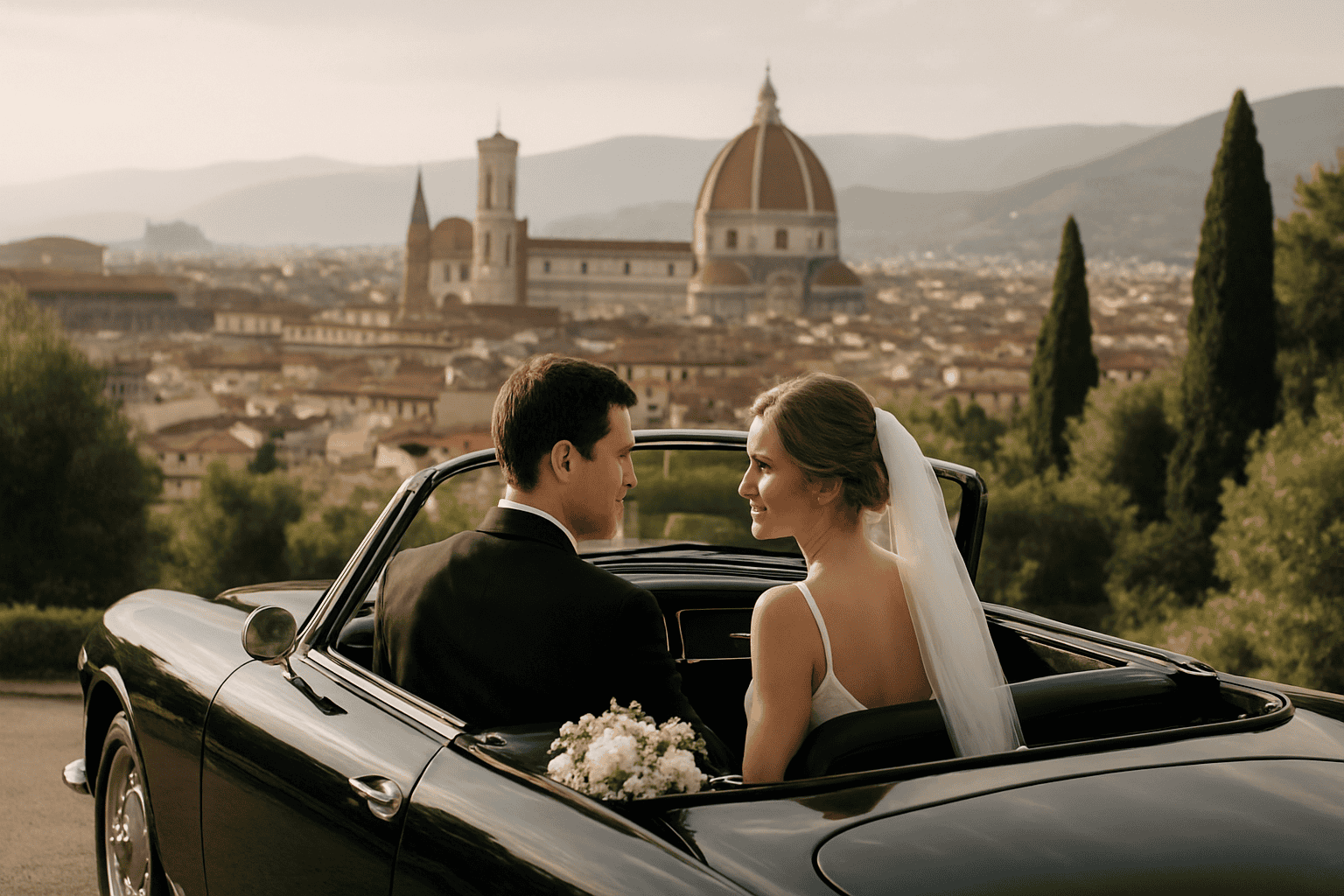
Florence: civil ceremony in the city and reception in the villa (timeline and transportation)
Organising a civil ceremony at Florence with reception in the villa is one of the most requested formats in Tuscany: it combines the scenic power of the historic center (perfect for photos, atmosphere, and symbolism) with the freedom of spaces and rhythms that only a countryside villa can offer. The result can be intimate and refined, or more festive and “destination”, but in any case requires precise direction: realistic timeline, guest transportation in Florence well thought out and clear communication.
In this guide you’ll find an operational framework: what to expect in terms of timing, how to coordinate vendors, how to avoid the typical snags of the “city → villa” transition, and how to build a smooth experience for you and your guests. For a broader overview of the context and the options in the city, you can also start with Wedding in Florence: guide.
Why choose a civil ceremony in Florence and a villa reception
Goal and style: luxury, intimate or destination (without forcing it)
This format works because it allows you to separate two moments with different needs:
- The ceremony in the city: more formal, intense, with an iconic and easily accessible setting.
- The reception in the villa: more relaxed, with spaces dedicated to aperitif, dinner, party, and decompression areas.
The key is not to “glue” two events together, but to build a journey. A wedding in Florence can be elegant and minimal, or rich and theatrical: the difference is made by coherent choices (palette, flowers, music, lighting) and above all by invisible logistics that guide guests without stress.
What to expect in terms of timing and logistics
The transition from the historic center to the villa introduces variables: travel times, access windows, management of cars and luggage, coordination of photographers and music. For this reason it’s useful to think about:
- Time slots (ceremony, photos, transfer, aperitif) with realistic buffers.
- Clear meeting points clear for shuttles and taxis.
- A communication plan (wedding website, messages, signage) that reduces last-minute questions.
If you’re considering the “ceremony in the city + villa” formula, keep in mind that the most delicate part isn’t the aesthetics: it’s the direction of the transitions. When it’s well designed, guests experience everything as natural, and you enjoy the day without chasing the clock.
Step-by-step planning for a wedding in Florence: timeline and vendors
Realistic timeline (from 12 to 2 months before)
Every project has its own story, but a “healthy” timeline avoids compressions that then fall on transportation and coordination. Here’s a practical outline, adaptable based on the season and the availability of the venues (always check in the product sheet or the venue’s proposal).
12–10 months before
- Defining the concept: style, approximate number of guests, priorities (photos, food, music, staging).
- Selecting the ceremony venue and the villa for the reception (with site visits, even virtual).
- First draft of logistics: where guests will sleep, how they will get around, which meeting points.
9–7 months before
- Booking key vendors: catering/banqueting, photo/video, music, floral design, lighting.
- Defining the day’s “flow”: ceremony, photos, transfer, aperitif, dinner, party.
- Choice of transport type: shuttles, minivans, car with driver, mix with taxis.
6–4 months before
- Detailed design of the villa spaces: symbolic ceremony (if planned), aperitif, dinner, cake cutting, dancefloor, quiet area.
- Definition of the weather plan (covers, indoor spaces, tensile structures if available).
- Draft wedding website and guest messages (how to get there, dress code, times, contacts).
3–2 months before
- Confirmation of final times, music schedule, photo timing, special moments (entrances, speeches).
- Confirmation of transport and pick-up points with precise directions.
- Logistics run-through: who opens, who closes, who manages the flows, who is the guest point of contact.
For a complete view of the organizational steps, it is useful to pair this timeline with an operational list: Organizing a wedding: checklist.
Checklist of essential vendors (with a focus on logistics)
Beyond the classic vendors, in this format some roles become crucial for smoothness:
- On-site coordination: a director who manages timing, entrances, vendors and unforeseen events.
- Transport: a reliable partner for shuttles/minivans and a backup plan.
- Setups and lighting: in a villa they greatly change the perception of the spaces, especially at sunset.
- Music: different setups are often needed (ceremony, aperitif, dinner, party) with compatible setup times.
If the ceremony is civil, it is best to clarify from the outset the requirements and timing of the process: Civil wedding: requirements and timing.
Guest management and transfers: the map before the magic
The critical point of a civil ceremony Florence villa reception is almost always the same: guests arrive on time in the city, but then they “fray” during the transfer. To avoid it, work on three levels:
- Simple decision: either everyone on the shuttle, or a declared mix (shuttle recommended + alternatives).
- Readable instructions: a single page with times, meeting points, assistance contact.
- Reduction of choices: fewer options = fewer delays.
Budget and priorities for a city ceremony and a villa in Tuscany
Main items to consider (without surprises)
You don’t need to get into numbers to understand where the financial effort is concentrated: in a wedding between Florence and a villa, the items that weigh the most are often linked to location, food & beverage, fittings, music e logistics. Logistics, in particular, is not “just transport”: it includes setup times, access, coordination staff, and alternative solutions.
Where to invest to maximize the visual impact (and the perception of quality)
If you want an immediate impact without weighing down the project, focus on elements that guests actually experience:
- Entrance and the first 20 minutes: welcome, beverages, ambient music, elegant signage.
- Evening lighting: in a villa everything changes; it creates depth, intimacy, and rhythm.
- Dinner layout: the arrangement of the tables can make even a minimal setup feel scenic.
- Signature moments: a single well-orchestrated “wow” moment is worth more than many disconnected details.
A coherent project doesn’t mean “a lot”: it means intentional choices, with direction that makes them readable and harmonious.
Typical mistakes that increase costs (and how to avoid them)
- Too tight timeline: if timelines are tight, urgencies, extra setup costs, and stopgap solutions increase.
- Transport underestimated: too few shuttles or unrealistic schedules lead to last-minute taxis and cascading delays.
- Too many location changes within the villa: moving guests many times requires more staff and more coordination.
- A “vague” weather plan: deciding at the last minute often means choosing the least elegant and most stressful option.
Plan B and risk management: weather, location constraints, and agreements
Weather: credible alternatives, not just “fallbacks”
In Tuscany the weather can be generous, but it shouldn’t be taken for granted. An effective plan B shouldn’t “save” the event: it should maintain the style. Some smart choices:
- Identify an indoor or covered space that truly works for both aperitif and dinner.
- Design modular setups (that can be moved without losing impact).
- Define a decision time with the venue and suppliers (check the product sheet or the agreed terms).
When plan B is thought through in advance, even a schedule change remains elegant and orderly.
Venue constraints: access, schedules, noise and technical spaces
Each villa has its own operating rules: access for vehicles, loading/unloading areas, technical spaces for catering and music, and sometimes limits on volume or hours. It’s not a problem: it’s a design parameter. The important thing is:
- Clarify right away where vehicles can park and where setups take place.
- Plan guest routes separate from technical routes, when possible.
- Align the schedule to the context: better a well-designed party than an unrealistic program.
Agreements with suppliers: clarity on deposits, schedules and responsibilities
To reduce risks and misunderstandings, you need orderly documentation: shared schedule, points of contact, access and teardown times, responsibilities in case of delays. Every supplier should know:
- when they arrive and where they enter from;
- who the operational point of contact is;
- what the day’s “non-negotiables” are (ceremony, entrance, dinner, cake cutting).
A single direction prevents the couple from becoming the information dispatch center on their wedding day.
Guest experience in Florence: welcome, transport and communication
Welcome moment and hospitality: making everyone feel in the right place
When guests are coming from out of town, hospitality makes the difference between a “nice event” and a “memorable experience”. Some high-impact touches:
- Welcome message with essential information (times, dress code, contacts).
- Tips on Florence for those staying several days: neighborhoods, pace, what to see (without overload).
- Un punto di riferimento (concierge or point of contact) for logistical questions.
If you want to include a short cultural section on the wedding website, you can refer to a general and neutral source such as In-depth: Florence (Wikipedia), while keeping all practical information on a dedicated, up-to-date page.
Guest transport in Florence: shuttles, parking and stress-free flows
Managing the guest transportation Florence is what most affects the perception of smoothness. An effective strategy often includes:
- Centralized pick-ups: one or two easy-to-reach points, communicated precisely.
- Departure window: not a single time, but a time range with a clear last call.
- Planned returns: multiple runs or a mixed solution (shuttle + taxi), based on the guests’ profile.
- Parking at the villa: if available, it must be managed with signage and staff; check the location’s product sheet.
A detail often underestimated: the transfer must not be “dead time”. With the right music, a bottle of water ready and simple directions, it becomes a natural transition between the solemnity of the city and the villa’s atmosphere.
Clear directions and wedding website: fewer messages, more peace of mind
A well-made wedding website or information page reduces questions and anxiety. To be truly useful, it must be essential and up to date. Recommended structure:
- Timings: ceremony, transfer, aperitif start, end of event (if you want to indicate it).
- How to get there: maps and written instructions, plus a support contact.
- Transport: pick-ups, shuttles, alternatives, returns.
- Dress code: practical (shoes, terrain, possible shawl), without rigidity.
- Guest FAQ: “can I arrive with my own car?”, “where do I leave my suitcase?”, “what time does it end?”.
The tone must be consistent with the event: elegant but clear. And above all: a single official source, to avoid different versions circulating in chats.
Frequently asked questions about a civil ceremony in Florence and a villa reception
Below you’ll find answers to the most common questions about timing, transfers and organization. If you want a tailor-made plan, it’s always best to check availability and constraints directly with the venue and suppliers.
Do you want full coordination between Florence and your villa in Tuscany?
If you’re imagining a civil ceremony in Florence followed by a reception at the villa, we can build together a realistic timeline, a smooth transport plan and a guest experience cared for in every detail, maintaining a consistent style and without stress. Find out how we work in the dedicated section on the Wedding in Florence: guide and contact us to evaluate the solution best suited to your idea of Tuscany.
[w4y_bf_related_posts post_id=”34905″]
FAQ
How much time is needed between the civil ceremony in the city and the aperitif at the villa?
It depends on the actual distance, traffic, and the shuttle pickup point. In general, it’s useful to allow a buffer that includes post-ceremony photos, an orderly guest exit, and a departure window (not a single time). Define timings and routes with the transport provider and the venue, checking any constraints in the product sheet or in the agreed terms.
Is it better to have a single shuttle for everyone or mixed transport (shuttle + car)?
A single shuttle reduces delays and simplifies coordination, especially for guests unfamiliar with the area. A mix can work if communicated very clearly (pick-up points, parking at the villa, taxi alternatives) and if there is a point person who handles questions. The best choice depends on the number and profile of the guests and on the availability of parking at the venue.
How to prevent guests from getting lost on the transfer Florence → villa?
Centralize the departure points, communicate a single official source (wedding website or info page), include maps and written instructions, and plan a “last call” before departure. If possible, assign a guest point person to coordinate on site and reply to messages without involving the couple.
What to include in the wedding website for a wedding in Florence with a villa?
Clear schedules, how to get there, transportation (shuttles and alternatives), support contact, practical dress code, and a mini-FAQ. Keep the text essential and up to date, avoiding scattering information across multiple chats or documents.
What is the most elegant plan B in case of uncertain weather at the villa?
An elegant Plan B is the one already designed: an indoor or covered space that truly works for aperitif and dinner, modular setups that can be moved without losing coherence, and a shared decision time with the venue and suppliers. Always check availability and alternative solutions directly with the venue.
When to definitively define guest transportation in Florence?
It is advisable to set the transport strategy during the concept phase (to understand flows and pick-up points) and confirm it operationally once times and the schedule are stable. The goal is to communicate final instructions to guests with sufficient advance notice, reducing last-minute changes.
From the blog
 Tuscany
 How to choose catering in Tuscany: tasting, seasonality, and allergies
Choosing catering in Tuscany for a wedding: what really matters (besides the menu) When you start choosing catering […]
Read more Tuscany
 Wedding weekend in Tuscany: welcome dinner, pool party, and farewell brunch
Wedding weekend Tuscany: why choose welcome dinner, pool party, and wedding brunch A wedding weekend in Tuscany is not “just” a […]
Read more Tuscany
 Val d’Orcia: iconic locations and tips for “golden hour” photos
Val d’Orcia and golden hour: why this format works for a wedding Val d’Orcia has a rare quality: it is […]
Read more