
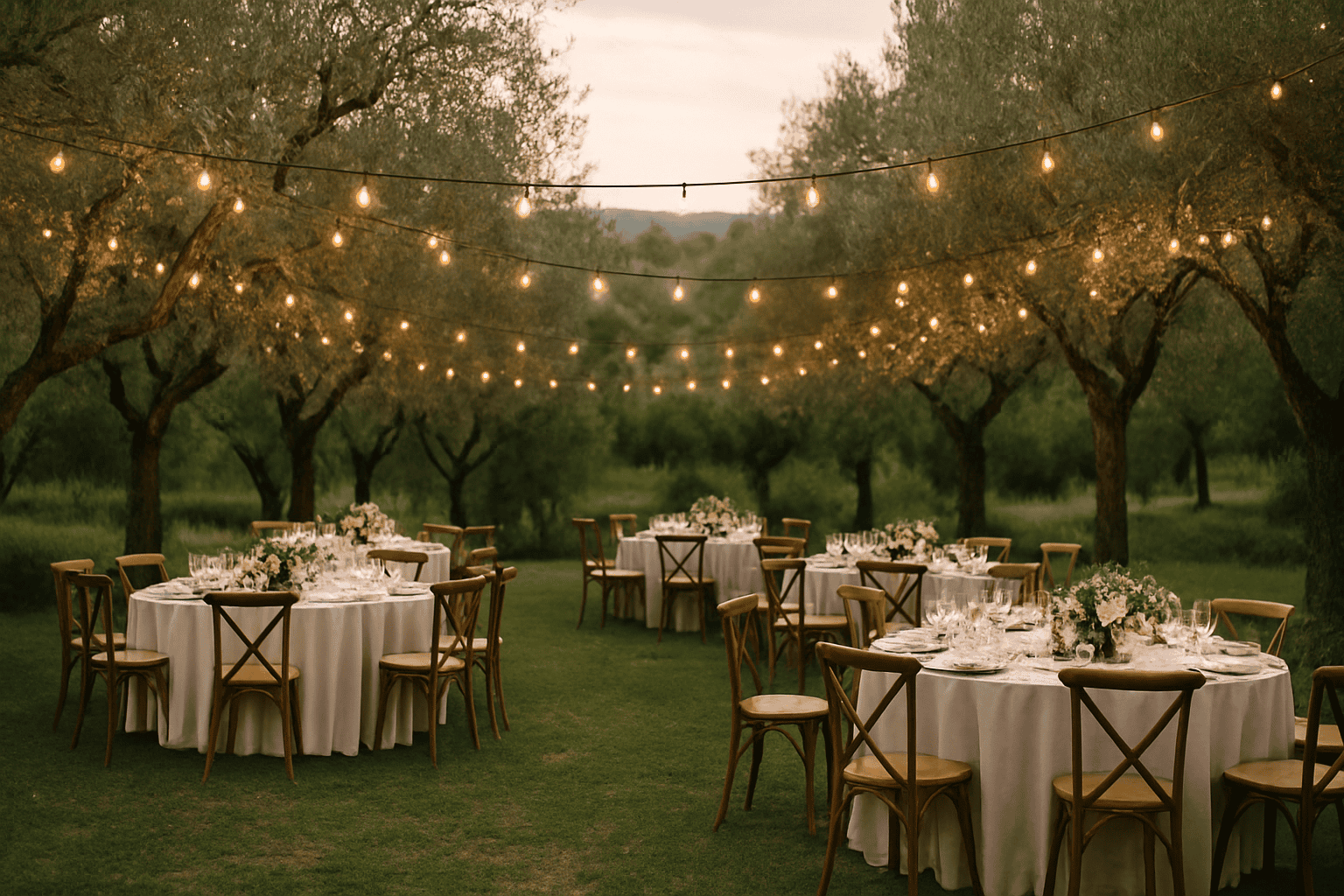
Wedding in an olive grove: seating, shading, and lighting for a perfect evening dinner
A evening dinner among the olive trees it has an immediate charm: scent of earth, silver leaves that capture the light, tables that seem suspended between nature and design. In Tuscany, this format has become an icon of destination wedding because it combines authenticity and refinement, but requires precise technical choices: comfortable seating, coherent shading and above all a wedding lighting carefully designed to enhance the landscape without dazzling guests.
In this article you’ll find a practical guide to designing a olive grove setup that truly works: from the table layout to managing pathways, all the way to the olive grove wedding dinner lights perfect for photos and atmosphere. The focus is Tuscany, with its estates, its rhythms, and its logistical peculiarities. For a general overview of the area, you can consult In-depth: Tuscany (Wikipedia).
Why an olive-grove wedding dinner with evening lights really works in Tuscany
Goal and style: luxury, intimate, destination
The success of a dinner in an olive grove doesn’t depend only on the “postcard” look, but on the consistency between concept and comfort. In Tuscany, the olive grove is often an integral part of the property: not just a backdrop, but a living environment. This makes it possible to build an experience that can be:
- Discreet luxuryauthentic: natural materials, soft palettes, tailored details without excess.
- Intimateconvivial: communal long tables, warm low lights, conversations that flow without intrusive music.
- Destinationnarrative: a complete story, from the welcome moment to after-dinner, with direction that guides guests.
The key point is that the olive grove “calls for” a specific aesthetic: clean lines, light volumes, and lighting that doesn’t turn the dinner into a theatrical set. The best result comes when the light seems to arise from the landscape, not drop from above like an alien installation.
What to expect in terms of timing and logistics
An olive grove is wonderful, but it’s not a hall: the ground is often uneven, distances are wider, and support points (power, storage, access roads) aren’t always nearby. For this reason, it’s useful to set from the outset:
- A realistic layout (tables, service route, bar area, music/after-dinner zone).
- A shading strategy for the aperitif or the pre-dinner phase, especially in hot periods.
- A lighting plan that supports the transition from sunset to night, without visibility “gaps”.
When these elements are planned, dinner flows naturally: guests find their way, the service runs smoothly, and the atmosphere stays elegant even in night photos.
Step-by-step planning for an olive grove setup: seating, shading, and wedding lighting
Realistic timeline (from 12 to 2 months)
For a wedding in an olive grove in Tuscany, a “clean” timeline avoids last-minute rushes and hasty choices. Here’s a useful outline:
- 12–10 months before: choosing the venue and technical site inspection (access, slopes, distances, usable areas). Defining the concept (style, palette, evening mood).
- 9–7 months before: booking key suppliers (catering, floral design, lighting, music). First draft of layout and guest flows.
- 6–4 months before: detailed design of wedding lighting and shading; defining seating and tables; studying routes (entrance, services, restrooms, smoking area).
- 3 months before: menu tasting and service timing; defining Plan B; draft wedding website and guest communications.
- 2 months before: final confirmation of layout, transfer logistics, call sheet; review of the lighting design based on sunset time and the event sequence.
The most underestimated step is consistency between dinner timing e lighting scenography: if the aperitif ends when it’s already dark, the lights must be ready to support the atmosphere without “all turning on at once” abruptly.
Essential supplier checklist
An olive grove requires a well-coordinated team. Beyond the classic suppliers, some roles become central here:
- Light designer / lighting service: essential for a olive grove wedding dinner lights balanced lighting plan (paths, tables, trees, bar area).
- Set-ups and furnishings: tables, seating, shading elements, any platforms or solutions for leveling (check the product sheet to see if the furniture is suitable for uneven ground).
- Floral & styling: arrangements and materials that dialogue with nature without “covering it up”.
- Catering with outdoor experience: managing temperatures, timing, service on natural ground.
- Logistics and transport: shuttles, parking, managing arrivals/departures.
If you’re structuring the project on your own, an operational outline like Organizing a wedding: checklistcan help you, useful so you don’t miss steps between creativity and logistics.
Guest and transfer management
In Tuscany, many estates are surrounded by greenery: wonderful, but not always “a taxi ride away”. Managing transfers directly affects the experience and also the success of the evening dinner. Some choices that work:
- Staggered arrival with a welcome drink in a shaded area, so guests don’t immediately find themselves seated at the table.
- Shuttles with clear schedules (departure and return) to avoid sudden departures during dinner.
- Discreet signage but readable: lit pathways and essential signage.
The light here is not just aesthetic: it is orientation. A good wedding lighting plan always includes paths, steps, changes in level, and transition points between olive trees.
Budget and priorities for an evening dinner in an olive grove: where to invest between lights, seating, and shading
Main expense items (no surprises)
Without getting into figures, the areas that tend to weigh the most in an olive grove setup are those that transform a natural space into a place “ready to host”:
- Furniture and seating: quantity, comfort, aesthetic coherence, and stability on natural ground.
- Shading: light but effective solutions for pre-dinner/aperitif and for any waiting moments.
- Wedding lighting: not just decorative bulbs, but a complete plan (tables, paths, trees, service area).
- Logistics: transport, setup times, access, back-of-house management.
The practical rule: if the guest perceives comfort and flow, the event “seems” more polished. And often the difference is made by invisible details, like a well-lit path or seating chosen to support a long dinner.
Where to invest to maximize the scenic effect (without overloading)
To achieve a photographic and welcoming result, it’s worth focusing the investment on three “axes”:
- Light on faces: during dinner, guests need to see each other well. The most elegant effect is warm, diffused brightness, with light points that don’t create harsh shadows.
- Light on the olive trees: a few well-placed accents make the scene feel deep. Too much light on the trees can flatten the atmosphere.
- The perimeter: defining the boundaries of the dinner (with lights, greenery, styling elements) prevents the space from feeling scattered.
In practice, the olive grove wedding dinner lights it works when the table is the star, the olive grove is the frame, and the paths are safe. The rest is “noise”.
Mistakes that increase costs (and how to avoid them)
- Layout too ambitious for the space: tables far from the service point or winding paths increase complexity and time.
- Lighting conceived only as decoration: then “emergency” lights get added at the last minute, often less elegant.
- Shade solutions chosen without considering wind and orientation: some solutions require specific anchoring or positioning; check the product sheet.
- Transport underestimated: guests arriving late or not knowing how to get back affect the timing and the energy of the evening.
Plan B and risk management in an olive grove: weather, venue and contracts
Weather and alternative solutions without losing the atmosphere
Plan B is not a fallback: it’s a second aesthetic direction. In Tuscany, even in the most stable seasons, an outdoor evening must include credible alternatives. The most effective options are those that maintain the feeling of “being on the estate”, even if you move:
- Covered area (loggia, lemon house, tensile structure already provided by the venue): allows you to save the dinner without disrupting the timing.
- Quick transformation: setups designed to be repositioned, with flowers and styling that work both in the olive grove and in an indoor space.
- Duplicable lighting design: part of the lights must be able to “follow” the dinner in case of an area change.
If Plan B is consistent, guests experience it as part of the experience, not as an unexpected event. And the photographic story remains uniform.
Permits and venue constraints (without operational surprises)
Every estate has rules and limits: schedules, usable areas, access for vehicles, power points, restrictions on fixings or installations. The key is to ask everything in advance and translate it into setup choices. For example:
- If it’s not possible to fix elements to the ground, the shade solutions must be rethought with suitable bases (check the product sheet).
- If the olive grove area is far from the kitchen, the dinner layout must reduce service times.
- If some paths are narrow, a more precise setup logistics plan is needed.
These constraints don’t “take away” creativity: they steer it toward more elegant and sustainable solutions for the evening.
Contracts and deposits: what to clarify with suppliers
For an outdoor event, it’s essential that the documents with suppliers are clear about:
- Setup and teardown times (and vehicle access).
- Responsibilities in case of an area change due to weather.
- Agreed alternatives for furnishings, lighting and shading if some solutions were not installable.
Good coordination avoids improvised decisions when the light fades and dinner is about to begin.
Guest experience in Tuscany: welcome, comfort and wedding lighting for a smooth evening
Welcome moment, activities and hospitality
Before sitting down at the table, guests need time to “settle into” the atmosphere. In an olive grove, this transition is even more important because the space is wide and natural. Some high-impact (and low-intrusion) ideas:
- Welcome drink in a shaded area, with light lounge seating to avoid crowding.
- Discreet corners (guestbook, natural photo moment, guided tasting) that don’t interrupt the flow.
- Soft timing: give guests time to explore, take photos and socialize before dinner.
Hospitality is also about practical details: availability of water, clear directions, and a gradual transition from sunset light to dinner light. Here, wedding lighting becomes the evening’s “visual soundtrack.”
Transport, shuttles, parking
A perfect olive grove can be far from hotels and villages. To prevent logistics from draining energy from the event:
- Parking well signposted and lit, with a simple route to the welcome.
- Shuttles with pick-up points communicated in advance.
- Return scheduled: multiple time slots help those who want to stay after dinner and those who prefer to return earlier.
The light must accompany these moments: from arrival to return. A dark or confusing path can ruin the perception of an otherwise impeccable event.
Clear directions and wedding website
For a destination wedding in Tuscany, communication is part of the experience. A wedding website (or a set of well-structured messages) should include:
- How to get there and where to park/shuttle.
- Recommended dress code (suitable for natural terrain and an outdoor evening).
- Essential timing (welcome, dinner, after-dinner, returns).
- Useful notes: comfortable shoes, an optional evening wrap, practical suggestions.
When guests know what to expect, they experience the olive grove with ease. And you can focus on the atmosphere: tables, shadows and above all lights.
Frequently asked questions about olive grove setup and wedding lighting in Tuscany
Below you’ll find concise answers to the most common questions about seating, shading and lights for an evening dinner among the olive trees, with particular attention to the typical needs of Tuscan venues.
Ideas and inspiration for weddings in Tuscany among olive groves and estates
If you’re looking for iconic venues and atmospheres consistent with an elegant evening concept, you can explore a dedicated selection of Luxury weddings in Tuscany: is an excellent starting point to understand which spaces are best suited to a dinner in an olive grove and to scenic yet natural lighting.
CTA: Do you want to turn a Tuscan olive grove into an impeccable evening dinner, with a coherent setup and a lighting design that truly enhances the location? Rely on the direction of ChiaraB Events: from the creative idea to logistics, we build a tailor-made, elegant and seamless experience, designed for you and your guests.
FAQ
What is the best solution for wedding lighting in an olive grove?
It works as a layered design: soft light on the tables to clearly see faces, subtle accents on the olive trees for scenic depth, and illuminated paths for orientation. The goal is a warm, natural atmosphere, avoiding glare.
How to choose seating for a long dinner in an olive grove?
Prioritize comfort and stability on natural ground: ergonomic seating, materials consistent with the style, and solutions suitable for uneven surfaces. If you have doubts about compatibility and support, check the product sheet.
Which shades are most suitable in Tuscany for an aperitif and pre-dinner?
Lightweight solutions integrated into the landscape are effective, positioned according to sun and wind. It is important to assess orientation and anchoring methods: for technical details and installation requirements, check the product sheet.
How can you avoid the dinner in the olive grove seeming scattered?
Define a clear perimeter with layout and lighting points, keep tables and the bar area in visual relation, and create a simple flow between welcome, dinner, and after-dinner. Light helps to “draw” the space and guide guests.
Do you need a Plan B for a wedding in an olive grove?
Yes, because an outdoor evening must include an aesthetic and functional alternative. The ideal Plan B is a covered or sheltered space that maintains the style of the event, with setups and lights that can be repositioned without disruptions to the direction.
How to manage transfers and returns at a Tuscan estate surrounded by greenery?
Arrange shuttles with schedules communicated in advance, provide well-signposted parking and a return in multiple time slots for those who stay after dinner. Enhance the lighting along arrival and exit routes for safety and comfort.
From the blog
 Tuscany
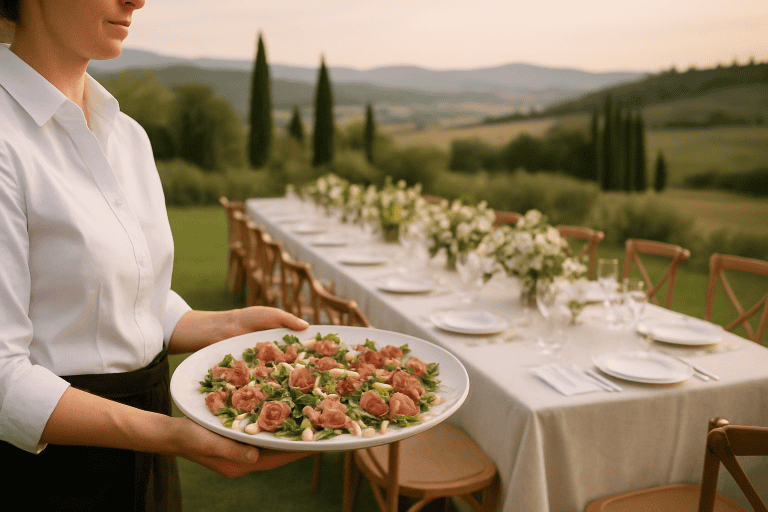
How to choose catering in Tuscany: tasting, seasonality, and allergies
Choosing catering in Tuscany for a wedding: what really matters (besides the menu) When you start choosing catering […]
Read more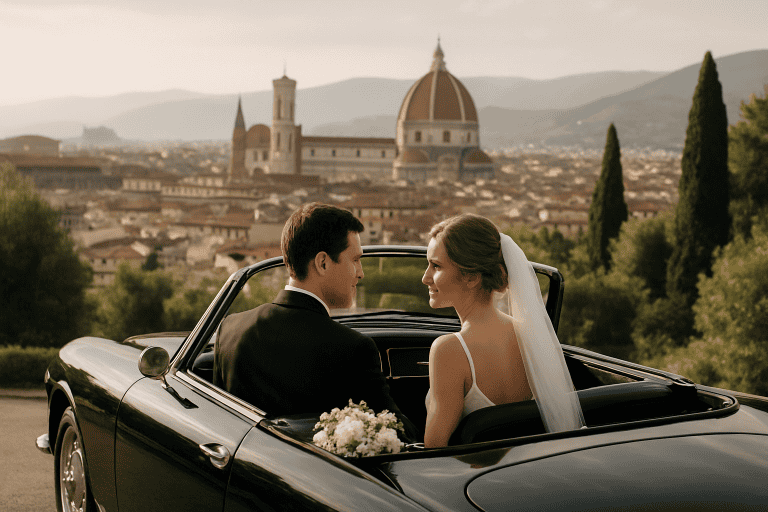 Tuscany
Florence: civil ceremony in the city and reception in the villa (timeline and transportation)
Organizing a civil ceremony in Florence with a reception in a villa is one of the most requested formats in Tuscany: it combines the […]
Read more Tuscany
Wedding weekend in Tuscany: welcome dinner, pool party, and farewell brunch
Wedding weekend Tuscany: why choose welcome dinner, pool party, and wedding brunch A wedding weekend in Tuscany is not “just” a […]
Read more