
Sicilian Wedding Traditions - Symbols, Rites and Meanings
Sicilian wedding traditions: a heritage of symbols and rites
Talking about Sicilian wedding traditions means entering a universe made of ancient gestures, whispered words, objects laden with memory, and rituals that change from town to town. In Sicily, more than elsewhere, the wedding is often experienced as a collective event: it doesn’t concern just two people, but intertwines families, neighborhoods, communities, and even the landscape (from the sea to the alleys of historic centers).
Many customs have survived to this day by transforming: some remain faithful to the original form, others have adapted to civil ceremonies, destination wedding or contemporary receptions. The common thread, however, is always the same: to give meaning to the passage, celebrate the union, and wish prosperity.
If you are organizing a wedding in Sicily (or you want to bring a Sicilian detail to your special day), here you will find a practical and inspirational guide among symbols, rites and meanings, with ideas for integrating them elegantly without turning the celebration into a forced reenactment.
The value of symbols in the Sicilian wedding: luck, protection, prosperity
Sicilian folk traditions often have a specific function: to protect the couple, to ward off bad luck and invite abundance. Even when people no longer literally believe in certain omens, the symbol remains an emotional language: it communicates care, roots, belonging.
Among the recurring themes we find:
- Fertility and abundance: elements linked to the land, to fruit, to wheat, to sweets.
- Protection: small “superstitious” gestures or family blessings.
- Community: participation of the neighborhood, greetings, music, hospitality.
- Identity: dialect, craftsmanship, local colors and scents.
The secret to making them current is to choose a few elements consistent with the style of the event: a symbolic detail well told is worth more than ten traditions inserted without context.
The serenade and the rites before the wedding: when love is announced to the town
In some areas of Sicily, the serenadesurvives (or is reintroduced in a romantic key)
: a musical moment, often on the evening before the wedding, in which the groom or a group of friends shows up under the bride’s house. It is a rite that speaks of waiting and of a public declaration, but also of lightness: a festive interlude before the intensity of the following day.
- If you wish to include it today, you can do so in a discreet and well-curated way:
- choosing a repertoire that combines tradition and personal taste;
- limiting the duration so as not to tire guests and the neighborhood; welcome moment turning it into a small
for those arriving from out of town.
Alongside the serenade, there are other pre-wedding “rites of passage”: preparations at home, family blessings, small good-luck gestures passed down by grandmothers. Some details vary a lot: if you are following a specific tradition from your town, it’s worth consulting older relatives to respect its original meaning.
The trousseau and family gifts: memory, continuity, and affection The theme of the trousseau is central in traditional Sicilian culture: fabrics, embroidery, linens, and objects carefully kept as a sign of preparation for married life. Today the meaning changes, but the idea remains powerful:.
bringing a story with you
- In a contemporary key, you can reinterpret this custom with measured choices:
- wear a family accessory (a hair clip, a veil, a piece of jewelry) as an emotional “red thread”;
- use an embroidered fabric as a scenic detail or for a corner dedicated to photos;
include in the ceremony a brief moment of symbolic handover, without weighing down the timeline. If you are considering textile or decorative elements inspired by tradition, it can be useful to explore ideas and themed coordinated sets in wedding setup inspirations
and compare them with the style of the location.
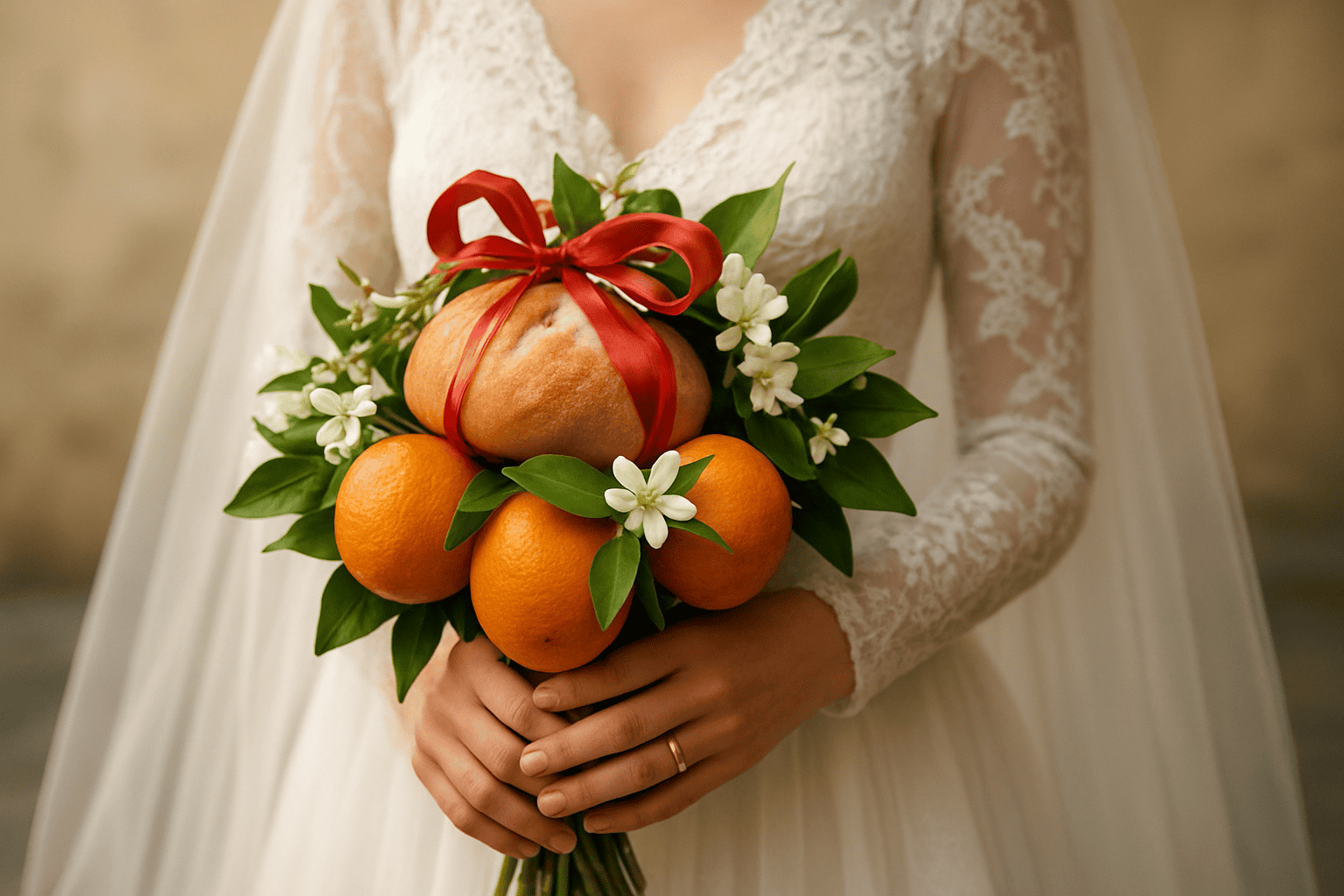
Orange blossoms and Mediterranean scents: Sicily’s invisible language orange blossoms are a classic symbol linked to weddings, associated with purity and good wishes. Alongside them, many couples choose Mediterranean notes: citrus fruits, orange blossom, rosemary, jasmine, aromatic herbs.
Incorporating these references can be simple and refined:
- bouquet and boutonnière with touches of aromatic greenery;
- centerpieces with citrus fruits and foliage (consider seasonality);
- small fragrant details in welcome corners or lounge areas.
If you want a harmonious result, the ideal is to choose a consistent palette: white and green for a bright effect, or warm colors inspired by the earth and sunset. For ideas on palettes and moodboards, you can take a look at style ideas for Mediterranean weddings.
The ritual of bread, wheat, and abundance: wishes that become a gesture
In many cultures of the South Italyand in Sicily in particular, bread and wheat are symbols of life and prosperity. Even when there isn’t a single “one ritual” the same for everyone, gestures tied to the idea of nourishment and the future recur: offering, sharing, breaking, distributing.
You can translate this meaning into concrete moments during the day:
- a route with shelters welcome with references to traditional breadmaking;
- a corner dedicated to local products (without turning it into an exhibition, but as a story);
- a graphic detail in the invitations or place cards that evokes wheat ears and agricultural motifs.
If you want an interpretation faithful to a specific local tradition, it’s useful to ask for confirmation from someone who knows it well: some customs change even between neighboring towns.
Sugared almonds and Sicilian sweets: sweetness as a promise
Sugared almonds, in Italy, are a wedding classic; in Sicily, sweetness often takes on an even more theatrical role thanks to the culture of pastry-making and the care of hospitality. It’s not just about “offering a sweet,” but about welcome and celebrating with generosity.
For an elegant result, aim for a simple narrative:
- a neat confetti table consistent with the event’s colors;
- a dessert corner that evokes tradition without excessive theatrics;
- a wedding favor that enhances the concept of giving (more than the accumulation of objects).
If you are choosing materials, ribbons and packaging, you can find useful inspiration in ideas for wedding favors and elegant packaging. For specific details (ingredients, finishes, variants), check the product sheet.
Traditional Sicilian music at the wedding: rhythm, belonging, celebration
Music is one of the most immediate ways to evoke Sicily. There’s no need to turn the reception into a village festival: it’s enough to include one or two moments well placed, able to engage without forcing.
Some ideas work well in different settings:
- an entrance or exit with pieces that recall the folk repertoire;
- a short set during the aperitif, as the event’s “sound signature”;
- a moment of guided group dancing, if the audience is receptive.
The golden rule is to read the room: tradition is beautiful when it becomes sharing, not when it makes people uncomfortable. If you are planning the setlist, it can help to compare notes with tips for musical entertainment at the wedding.
Outfits, accessories and colors: Sicilian references without stereotypes
When you think of Sicily, ceramics, majolica, deep blues, citrusy yellows, warm reds come to mind. Bringing these colors into the wedding is possible, but the risk is falling into a “postcard theme”. The most refined way is to use the references as accents.
Here’s where they can work well:
- accessories (shoes, clutch, earrings) with a chromatic detail;
- coordinated stationery with motifs inspired by majolica or Mediterranean decorations;
- table setting with a single element of color (napkin, place card, candle).
If you love ceramics, you can echo their aesthetic with delicate patterns and tactile finishes, without necessarily using heavy objects or ones that are too “theme-y”. The goal is to make Sicily felt as an atmosphere, not as a costume.
Welcoming and hospitality: the heart of a wedding in Sicily
One of the most authentic traditions is the idea that guests should be welcomed with warmth and care. In a Sicilian wedding, hospitality is often a stated value: you can see it in the time devoted to the welcome, in the attention to detail, in the willingness to make everyone feel part of the celebration.
You can translate this spirit into concrete choices:
- a route with shelters welcome corner with clear directions and a small welcome gesture;
- a readable schedule of the day (also in the form of an elegant sign);
- thoughtful touches for those coming from afar: suggestions on places, timing, logistics.
To make the welcome consistent with the style of the event, it can be useful to design everything as a journey: from the guests’ arrival to the final farewell. If you are building the event’s direction, take a look at ideas for organizing a wedding weekend in Sicily.
Superstitions and small good-luck gestures: what to keep, what to avoid
Superstitions are part of popular culture and, in Sicily, they can be shared lightly. Some couples follow them with conviction, others mention them as a tribute to their grandmothers. In both cases, the best approach is respectful: don’t ridicule what is important to someone.
Rather than listing prohibitions, it’s useful to think in categories:
- protective gestures: small family rituals before leaving the house;
- care along the way: avoid surprises with a realistic timeline;
- symbolic objects: a “good omen” detail chosen with affection.
If you want to include a superstitious element, tell it in an intimate way: a line in the ceremony booklet, a shared memory, a dedication. That way it becomes part of the couple’s story, not a list of rules.
How to integrate Sicilian traditions into a modern wedding
The point is not to “do everything”, but to choose well. A modern wedding can embrace tradition naturally if each element has a purpose: to move, to unite, to tell a story.
A simple method to decide:
- Select 3 levels: a ritual (e.g., serenade or blessing), a symbol (e.g., orange blossom/wheat), an aesthetic detail (e.g., palette or pattern).
- Define the tone: elegant, rustic-chic, contemporary, intimate. Tradition must adapt to the tone, not the other way around.
- Involve the family only where needed: ask for a specific contribution (a story, an object, a piece of music), avoiding pressure on the whole project.
In this way, Sicilian traditions become added value: a distinctive hallmark that guests remember because authentic.
Scenographic details inspired by Sicily: ceramics, majolica and light
Among the most beloved references are ceramics and majolica, but Sicily is also light: dazzling white, sharp shadows, warm sunsets. The set design can work with these contrasts in a very contemporary way.
Some elegant solutions:
- majolica patterns used only in small touches (menus, seating chart, place cards);
- natural materials (linen, wood, stone) for a restrained Mediterranean effect;
- candles and warm light points to evoke Sicilian summer evenings.
If you are considering graphic suites or decorations, always check finishes and variants: verify in the product sheet for details such as available colors and materials.
Useful links to organize a Sicily-inspired wedding
- Ideas and inspiration for a wedding in Sicily
- Setup guide: colors, flowers and table settings
- Wedding favors and details for an elegant wedding
- Practical tips for the wedding-day timeline
Do you want to give your event an authentic yet contemporary Sicilian touch? Discover the selection of proposals and inspirations by ChiaraB Events: choose the details that tell your story and create a wedding that smells of the Mediterranean, with a style curated in every detail.
FAQ
What are the most common Sicilian traditions at a wedding?
Among the most common are the serenade (in some areas), the use of symbols of prosperity such as wheat and bread, references to orange blossoms, and a strong emphasis on hospitality. Many customs vary from town to town, so it is useful to ask for confirmation within the family or from someone who knows the local tradition.
How can you incorporate Sicilian traditions into a modern wedding without overdoing it?
It works to choose a few coherent elements: a ritual (or a musical moment), a symbol (orange blossom, wheat, Mediterranean scents) and an aesthetic detail (a palette or patterns inspired by majolica tiles). The important thing is that each choice has meaning for the couple and integrates with the style of the event.
Is the serenade still relevant in Sicilian weddings?
In some areas yes, or it is reintroduced in a more discreet and romantic form. It can become a short, well-planned moment on the evening before the wedding, especially if included with respect for the context and attention to timing and guest involvement.
Which fragrances and flowers most evoke Sicilian tradition in weddings?
Orange blossoms (zagara) are a classic choice. Citrus fruits, jasmine, and aromatic herbs such as rosemary are also often used to evoke a Mediterranean atmosphere, in bouquets, setups, and welcome details.
Is it possible to use tiles and ceramics without creating an overly obvious “themed” look?
Yes: the key is to use them as accents, for example in the graphics (menus, table settings, place cards) or in small color details, keeping a neutral base and natural materials. This way the effect remains elegant and contemporary.
From the blog
 Tips
Tips
Wedding Ideas: Trends and Tips for a Perfect Wedding
Organizing a wedding today means choosing among endless possibilities without losing sight of what really matters: telling your […]
Read more Tips
Tips
Getting married on Lake Garda: the perfect wedding between water and mountains
Between luminous shores, stone villages, and mountain profiles that change color with the sun, getting married on Lake Garda […]
Read more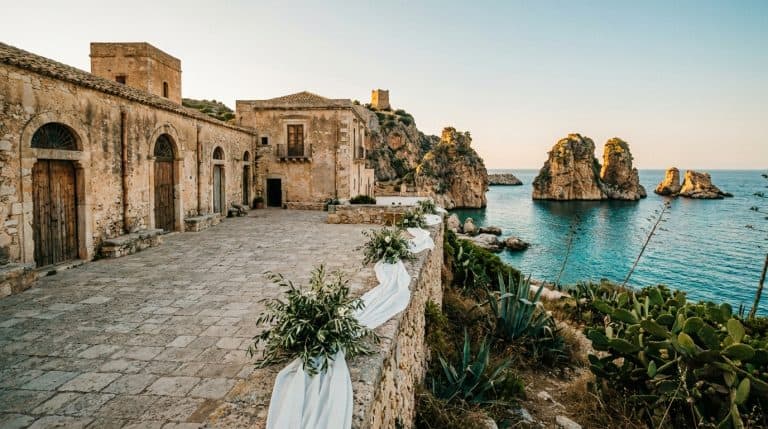 Tips
Tips
Getting married at the Tonnara di Scopello - History and Charm of a Unique Location
Tonnara di Scopello: a wedding venue between history, sea, and stone Choosing to get married at the Tonnara di Scopello means […]
Read more