

How to Choose the Perfect Wedding Planner for Your Wedding
Choosing the right wedding planner means giving your wedding solid, coherent, and stress-free direction. It’s not just about “organizing,” but about turning ideas, wishes, and real constraints (timing, logistics, priorities) into a complete project, with a clear method and communication that makes you feel supported from start to finish. In this guide you’ll find practical criteria to understand how to choose the perfect wedding planner for your style and for the type of support you need, avoiding misunderstandings and rushed decisions.
How to choose the perfect wedding planner: start with your goals and wedding style
Even before evaluating portfolios and proposals, clarify what you want to achieve. Many misunderstandings arise because the couple and the planner imagine “the same wedding” differently. Putting a few choices down in black and white helps you identify the most suitable professional.
Define the priority: guest experience, aesthetics, or practicality
Ask yourself which aspect matters most to you. Some wedding planners are very strong on visual impact and design, others excel at logistics management and the timeline, and others still at creating a smooth experience for guests. There is no universally better approach: there is the one most consistent with your idea of the day.
- Guest experience: welcome, flow, comfort, well-paced moments.
- Aesthetics and styling: moodboard, palette, setups, visual coherence.
- Organization and control: deadlines, vendor coordination, plan B.
Gather “thoughtful” inspiration (not just images)
A photo board is useful, but even more useful is explaining why you like them. Is it the light? The intimate atmosphere? Essential elegance? A wedding planner who works well will be able to translate your preferences into concrete choices without copying. If you want to start with an organized base of ideas, it may also help you read inspirations and trends for elegant weddings and save what truly reflects you as a couple.
Wedding planner services: what level of support do you really need
“Wedding planner” can mean different things. To choose well, check precisely what the proposal includes: don’t assume that two professionals offer the same type of assistance.
Full wedding planning vs day-of coordination
In general, services can cover the entire journey or focus on final coordination. The difference lies in how many decisions you want to handle personally and the level of direction you want.
- Complete organisation: support from defining the concept through managing the day.
- Partial support: assistance in some areas (for example vendors or styling) and review of the plan.
- Day-of coordination: operational oversight of the timeline and vendors during the event (check in the product/service sheet whether site inspections and briefings are included).
Destination weddings and out-of-town weddings: what changes
If you’re getting married far from home, the wedding planner also becomes a bridge between the venue, vendors, and guests. In these cases, the ability to manage distances, site inspections, and alternatives matters a lot. If you’re considering a wedding in a specific location, take a look at tips for organizing a destination wedding to understand which questions to ask right away.
Portfolio and style: how to read a wedding planner’s work without being fooled by photos
Images are important, but they’re not enough. A portfolio can be beautiful and not right for you, or more essential but perfectly aligned with your taste and your idea of the event.
Look for consistency, not just the “wow effect”
See whether the work shows a recognizable signature or an ability to adapt to different styles. Both can be positive: it depends on how much you want a wedding “in your style” or “in her style.” What matters is that the wedding planner can justify the choices and maintain consistency between the ceremony, reception, and details.
Assess the variety of settings and space management
Check whether she has experience with environments similar to yours: villas, modern spaces, gardens, historic venues. Not to “replicate” a wedding, but because each setting requires different sensitivity: flow, light, focal points, setup management.
Ask for a project story, not just a gallery
During the first contact, ask her to describe a wedding: what the requests were, what issues emerged, how they were resolved. A solid professional doesn’t just show results: she explains the process and the decisions.
Work method and communication: the real indicator of a reliable wedding planner
Many couples choose “by feel,” but peace of mind is built with a method. The perfect wedding planner for you is the one who makes you understand such as you will work together, with which tools and with what timelines.
Timeline, checklist, and responsibilities: what to clarify right away
Ask how the process is set up: when priorities are defined, how deadlines are managed, how coordination with vendors happens. If there are shared documents (timeline, planning, day-of schedule), ask for an “anonymized” example or a detailed description. If some elements are included only in certain packages, check in the product/service sheet.
Communication style: frequency, channels, and decisions
It’s not a detail: it’s what determines the quality of the experience. Some couples want frequent updates and ongoing discussion; others prefer a leaner approach. Clarify:
- how often you will speak;
- which channels you will use (email, calls, chat);
- how urgent matters are handled;
- who makes the final decision and how the options are presented.
Stress management and unexpected issues: ask for concrete examples
A wedding is a complex event: even with the best planning, unexpected issues can arise. Ask how a weather change, a delay, a technical problem, or a last-minute change is handled. You don’t need to look for “perfection,” but for a professional who can stay clear-headed and protect the couple’s experience.
Questions to ask at the first meeting with a wedding planner (and what to really listen for)
The first meeting isn’t an interrogation: it’s a way to see whether there’s alignment. The right questions help you assess professionalism, clarity, and compatibility, without getting lost in secondary details.
Questions about the project and the vision
- How do you turn our ideas into a coherent concept?
- How do you manage the balance between aesthetics and practicality?
- What are the typical steps in your process?
Questions about vendors and coordination
- How do you select vendors and how do you coordinate them?
- How do you handle briefings, site visits, and the day-of schedule?
- Who will be present on the day of the event and in what role? (check the product/service sheet to see whether a team is included)
Questions about boundaries and expectations
- Which tasks remain our responsibility and which are yours?
- How do you handle changes of mind and revisions?
- Which points, in your experience, create the most misunderstandings?
Listen not only to the answers, but to how they’re given: a reliable wedding planner is clear, not evasive, and knows how to guide you without imposing.
Reviews and word of mouth: how to interpret them usefully
Reviews are a compass, but they need to be read with discernment. Look for specific elements: punctuality, handling of unexpected issues, clarity, listening skills, coordination with vendors. Generic phrases (“everything was perfect”) say little; details say a lot.
Positive signs in testimonials
- Descriptions of process (not just the result).
- References to calm, order, clarity in decisions.
- Ability to mediate between different tastes (often between families or between the spouses).
When to ask for references or additional examples
If your wedding has particular characteristics (many guests to manage, multiple moments across the venue, accessibility needs, a symbolic ceremony with specific rituals), ask whether they have already handled similar events and how they set up the direction. If the professional has a page dedicated to case studies or real weddings, it can be useful to consult stories and real weddings to understand approach and style.
Contract, transparency, and boundaries: what to check before confirming
The “formal” part is what protects the relationship and makes everything easier. There’s no need to be distrustful: you need to be clear. Before confirming, read carefully what is included and what is not.
Scope of service and deliverables
Check that they are indicated in an understandable way:
- included activities (planning, coordination, styling, site visits);
- number and type of meetings/calls (if applicable);
- materials delivered (timeline, checklist, floor plans, moodboard) if included;
- on-site presence and operating hours (check in the product/service sheet).
Handling changes and variations
It’s normal to change your mind about details, colors, or the overall setup. The important thing is to understand how revisions are handled: what steps are предусмотр, how the timeline is updated, and how changes are communicated to vendors.
Alignment on style and final decisions
Clarify from the start how disagreements are handled: if a choice isn’t feasible, the wedding planner should propose coherent alternatives, explaining reasons and impacts. This is a sign of professional maturity.
Common mistakes when choosing a wedding planner (and how to avoid them)
Some mistakes happen often because enthusiasm takes over. Avoiding them will save you time and, above all, stress.
- Choosing only based on photos: ask about process, method, and real cases.
- Not clarifying what you want to delegate: define responsibilities and expectations.
- Ignoring communication compatibility: the “how” matters as much as the “what”.
- Not talking about unexpected issues: ask for examples of management and a plan B.
- Confirming without carefully reading what is included: check the product/service sheet and the documents provided.
Useful links to organize your wedding with more confidence
If you are building your vision and want to arrive at the first meeting with clearer ideas, these in-depth resources can help you ask better questions and define priorities:
Do you want tailored support for your wedding?
If you want attentive direction, a clear method, and a discussion that turns ideas into a coherent project, discover the approach of ChiaraB Events and choose the solution best suited to your wedding style: from organizational support to day-of coordination, you will find a path designed to help you experience the preparations with greater peace of mind.
FAQ
How far in advance is it advisable to contact a wedding planner?
It depends on the date, the complexity of the event, and the professional’s availability. In general, it’s helpful to contact her as soon as you’ve defined the period and type of wedding, so you can set priorities, the timeline, and the search for vendors calmly.
Is it better to have a wedding planner specialized in a specific style or a more versatile one?
If you want a highly recognizable aesthetic and you like the professional’s “signature,” a specialization can be an advantage. If, instead, you want a tailor-made project, versatility and adaptability are essential: evaluate the portfolio and, above all, the process by which she translates your ideas.
What are the signs that a wedding planner is really organized?
Clarity on work phases, tools and responsibilities; ability to explain how they manage deadlines and suppliers; organized communication; concrete examples of handling unforeseen issues; documents such as timelines and checklists (if included, check the product/service sheet).
What should I prepare for the first meeting with a wedding planner?
A brief description of the type of wedding you want, any inspirations with notes on why you like them, details about a location already chosen or preferences, the couple’s priorities and what you want to delegate. Even a list of doubts and practical constraints helps make the meeting more productive.
Does the wedding planner also handle coordinating the vendors on the wedding day?
Often yes, but it’s not automatic: it depends on the package or service chosen. Always ask who will be present on location, with what tasks and for how long, and check in the product/service sheet what is actually included.
From the blog
 Tips
Tips
Wedding Ideas: Trends and Tips for a Perfect Wedding
Organizing a wedding today means choosing among endless possibilities without losing sight of what really matters: telling your […]
Read more Tips
Tips
Getting married on Lake Garda: the perfect wedding between water and mountains
Between luminous shores, stone villages, and mountain profiles that change color with the sun, getting married on Lake Garda […]
Read more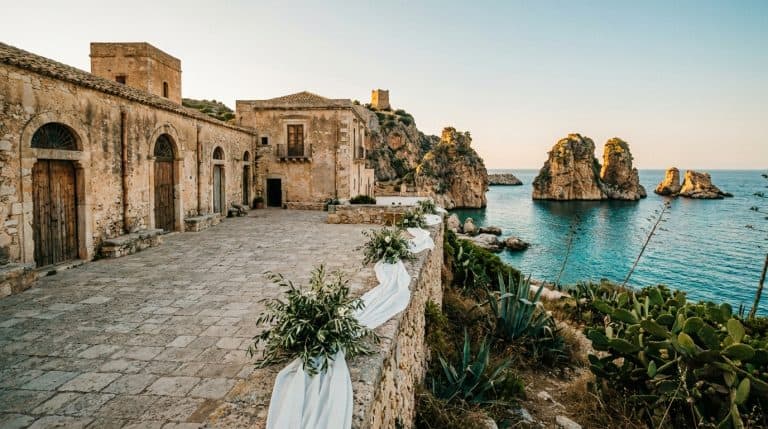 Tips
Tips
Getting married at the Tonnara di Scopello - History and Charm of a Unique Location
Tonnara di Scopello: a wedding venue between history, sea, and stone Choosing to get married at the Tonnara di Scopello means […]
Read more