
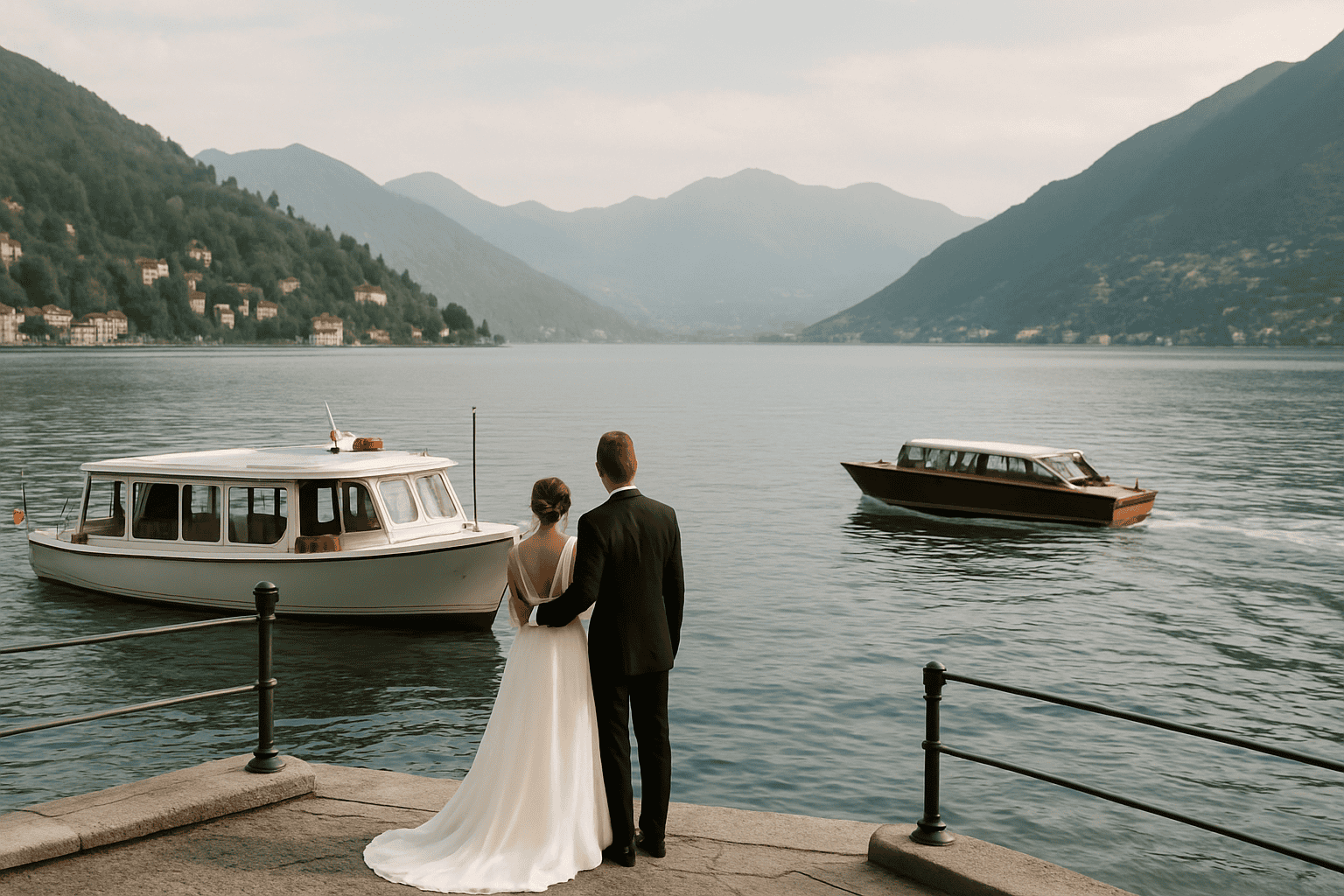
Transport and parking on Lake Como: shuttles, taxi boats, and realistic timing
Transport and parking on Lake Como: what to really expect (timing, style, logistics)
When it comes to wedding on Lake Como, the imagery is clear: iconic villas, scenic arrivals, views that seem “already ready” for photos. In practice, however, the difference between a smooth day and a day full of micro-delays almost always lies in logistics. And on Lake Como logistics has its own rules: narrow roads, villages with limited access, parking not always immediate, and times that vary greatly from one point to another.
This article is for those looking for concrete information about lake como wedding transport: how to set up shuttles and transfers, when to consider an arrival by lake, how to communicate simple directions to guests and, above all, which realistic timing to consider so you don’t have to “rush” on the most important day.
If you’re building a complete vision of the event, you can also start with Wedding on Lake Como: guide, useful for orienting yourself among venues, style, and first decisions.
Objective and style: luxury, intimate, destination (stress-free)
A wedding on Lake Como can be luxury without being rigid, underwear without being “small”, destination without making life difficult for guests. The point is to design a transportation system consistent with the experience you want to create:
- A cinematic arrival (by lake or with dedicated cars) for the couple and, if desired, for some key moments.
- Simple flows for guests: few changes, clear schedules, easy meeting points.
- Time buffers that are realistic: on the lake, “close” doesn’t always mean “fast”.
Timing and logistics: the golden rule of buffers
Lake Como is magnificent also because it’s “alive”: local traffic, boats, uphill access, little roads that barely cross. For this reason, when planning it’s best to think like this:
- Every transfer deserves a buffer (a margin) for unforeseen events and for the time to go up/down.
- Photos and scenic moments need room: an arrival by boat or an elegant step out of the car isn’t “just 2 minutes”.
- Guests move at different speeds: families, heels, elderly people, children, jet lag.
If you want to give some geographic (and cultural) context to those coming from outside, here you’ll find a general reference: Insight: Lake Como (Wikipedia).
Step-by-step transport planning on Lake Como for a wedding
Logistics work when they’re addressed early, not when they become a “detail” right before the event. Below is a practical outline to set up transfers, wedding shuttlesparking, and movements between the ceremony, reception, and after party.
Realistic timeline (from 12 to 2 months before)
12–9 months before
- Define the event map: ceremony and reception in the same place or in two different locations?
- Decide the arrival style: by land, by lake, or combined.
- Identify where guests will sleep (a few hotels concentrated or many scattered properties).
8–6 months before
- Request proposals for transfers: shuttles, cars with driver, possibly taxi boat como for specific moments.
- Check access and loading/unloading points with the venue (times, walking distances, any stairs or slopes).
- Set a first draft of the timing: arrivals, ceremony, cocktail, dinner, cake cutting, returns.
5–3 months before
- Confirm the transport plan and create a simple “guest version” (without technicalities).
- Establish a clear meeting point for the shuttles and an on-site point person (even just to coordinate departures).
- Define the parking strategy: where cars can park, and for how long.
2 months before
- Finalize times and departure windows (outbound and return) with a buffer.
- Gather needs: guests with reduced mobility, families with children, late arrivals.
- Prepare ready-to-send messages for any changes (weather, traffic, change of pick-up point).
Essential supplier checklist (only what is really needed)
To avoid overlaps and operational “gaps,” consider these key roles:
- Coordination (planner or day-of point person) to align venue, transport, and timing.
- Shuttle service for guests, especially if hotels are in different areas or if the venue has limited parking.
- Lake service if you want an iconic arrival or if some routes are smoother on the water.
- Welcome (even just one person) to indicate where to get off, where to wait, when to depart.
Guest management and transfers: how to avoid confusion
Managing guests isn’t just “moving them”: it’s making them feel guided. It works well when:
- the times are communicated with short phrases and repeated in multiple places (digital invite, wedding website, WhatsApp message, sign in the hotel);
- the pick-up points have a unique name (e.g., “Main hotel entrance” and not “in front”);
- there is a departure window (not a single minute) to absorb normal delays.
Priorities and smart choices: where to invest in logistics (without talking about prices)
In the context of a wedding on Lake Como, logistics is not an “invisible” item: it affects photos, atmosphere, punctuality, and peace of mind. Talking about budget does not mean listing figures, but deciding priorities consistent with the experience.
Main items that affect the organization
In general, the areas that require the most attention are:
- Guest transfers (shuttles, cars, schedule coordination).
- Couple transfers (arrival/exit, any travel for photos).
- Parking management (directions, venue permits, support staff if needed).
- Communication plan (wedding website, messages, maps, instructions).
Where to invest to maximize the scenic effect
If the goal is a “wow” impact without complicating everything, often the best solution is to concentrate the scenic effect in one moment and make the rest extremely practical.
- Couple’s arrival: even a short stretch by lake or a well-managed entrance can become the iconic moment.
- Evening exit: if you want a cinematic finale, plan an orderly departure (without guests waiting in the dark or without directions).
- Coherent choices: if guests arrive by shuttles, avoid asking them to make complex changes between cars, boats, and walking routes.
Mistakes that increase complexity (and cause delays)
- Too many micro-legs: hotel → pick-up → boat → shuttle → venue. Each step is a potential bottleneck.
- Schedules too “tight”: if the ceremony starts immediately after the expected arrival, one unexpected event is enough to push everything back.
- Parking taken for granted: on the lake, availability and walking distance can vary a lot. Better to check with the venue and include clear directions.
- Late communication: if guests find out the transport plan the night before, questions and delays increase.
Plan B and risk management: weather, access, venue constraints
A well-made transport plan isn’t the “perfect” one, but the one that holds up when something changes. On Lake Como, the most common risks involve weather, traffic, access, and boarding/disembarking times.
Weather: credible alternatives (without turning the experience upside down)
If you plan travel by lake, always build a land alternative that doesn’t feel like a punishment. A few tips:
- Define in advance when the alternative plan is activated (e.g., based on the day’s conditions). If it’s not certain, check the product sheet or in the supplier's proposal.
- Prepare ready-to-send messages for guests: “Today departure from X at Y, expected arrival by Z”.
- Protect the key moments: the ceremony and entrance to the reception must remain stable even if the mode of transport changes.
Permits, access, and venue constraints
Each venue has operating rules: access times, loading/unloading areas, limits for large vehicles, walking distances. During the site visit (or operational call) always ask:
- where the shuttles can stop to drop off guests;
- how long the walking route is and whether there are stairs or uphill sections;
- whether there is a dedicated area for cars with drivers;
- how to manage staggered arrivals (guests arriving earlier or later).
Contracts and deposits: what to clarify to avoid surprises
Without going into legal or numerical aspects, it’s useful for agreements with suppliers to clearly include:
- times and windows of service (not just a single time);
- pick-up/drop-off points finalized and what happens if they change;
- alternative plan in case of non-ideal conditions (if applicable);
- contacts and contact channels on the day of the event.
Guest experience on Lake Como: welcome, shuttles, parking and clear directions
Logistics are part of hospitality. When guests feel guided, the day flows and the atmosphere stays light. This is where three elements come into play: welcome, transportation and communication.
Welcome moment and hospitality: starting the day off right
If guests are coming from out of town, a simple welcome can reduce questions and increase comfort:
- welcome message with useful times and contacts;
- guidance on clothing and shoes (useful if there are walking stretches or gardens);
- mini-map with the shuttle meeting point and the arrival point at the venue.
Transportation, shuttles and parking: practical choices (and when to consider the taxi boat)
For many events, the most effective combination is: wedding shuttles for the guests + a special moment for the couple. This way you get order and punctuality, without giving up the scenery.
When it makes sense to consider a service like taxi boat como?
- For an iconic entrance for the couple or for a short photo transfer.
- To connect two points that by land are less straightforward (to be assessed case by case).
- For a destination experience in which the lake becomes part of the story, not just the backdrop.
Parking: if some guests arrive on their own, avoid generic directions. Better to specify:
- where it is recommended to park;
- how long it takes on foot to reach the entrance;
- whether there is a closer drop-off point for those with specific needs.
In a context of lake como wedding transport, the goal is not “to get everyone there”, but to get everyone there at the same pace: no guests waiting too long, no ceremony starting with half the audience late.
Clear directions and a wedding website: the communication that saves the timeline
A wedding website (or a well-made digital document) can drastically reduce messages and phone calls. Include:
- a concise schedule for the day;
- how to get there (on their own or by shuttle);
- meeting point with a clear name and simple directions;
- operational contact (not the couple) for last-minute questions.
If you are building your overall organization, a structured outline like Organizing a wedding: checklist, can also help you integrate transportation and timing into the rest of your decisions.
CTA: let’s plan together an elegant, hassle-free logistics plan on Lake Como
If you want a wedding where transportation, shuttles, parking and scenic arrivals are part of a smooth experience (and not a source of stress), we can build a tailored plan: realistic timings, clear communication for guests, and solutions consistent with the style of the event. Learn more in the section dedicated to Wedding on Lake Como: guide and contact us to start planning your day with method and sensitivity.
[w4y_bf_related_posts post_id=”34894″]
FAQ
How much advance notice is needed to arrange transportation on Lake Como for a wedding?
Ideally, the strategy is set together with the choice of the location, so as to check access points, loading/unloading areas, and distance from accommodations. In the following months, shuttles and transfers are confirmed and the schedule is finalized about 2 months before, leaving room for last-minute updates.
Is it better to use shuttles or have guests drive themselves?
It depends on where the guests are staying and how easy it is to park near the venue. Shuttles work very well when hotels are clustered or when parking is limited, because they reduce delays and confusion and make the experience more consistent.
When does it make sense to use a taxi boat in Como for a wedding?
It is particularly suitable for a scenic arrival of the couple, for a short photo transfer, or to connect two points when the lake experience is consistent with the style of the event. Feasibility and operating conditions must be confirmed with the supplier: check the product sheet.
How do you clearly communicate parking and assembly points?
Use unique names for the pick-up points, short instructions repeated across multiple channels (wedding website, message to guests, hotel info). Also indicate the walking time from the parking area to the entrance and an operational contact (not the couple) for last-minute questions.
What is the most common mistake in transfer timing on Lake Como?
Scheduling times that are too tight and without buffer. Between traffic, walking routes, boarding/disembarking times, and differences among guests, it only takes a small unforeseen event to delay the ceremony or entrance. Better to plan departure windows and realistic margins.
From the blog
 Lake Como
 Floral arrangements on Lake Como: elegant palettes and seasonality
Floral arrangements Lake Como: why elegant palettes and seasonality really matter When talking about floral arrangements Lake of […]
Read more Lake Como
 How to manage a wedding weekend on Lake Como: welcome dinner and brunch
Wedding weekend Lake Como: why welcome dinner and farewell brunch are the right choice A wedding weekend lake […]
Read more Lake Como
 Historic villa vs luxury hotel on Lake Como: which choice is really worth it?
Historic villa vs luxury hotel on Lake Como: how to really choose the right venue Choosing between historic villa […]
Read more