
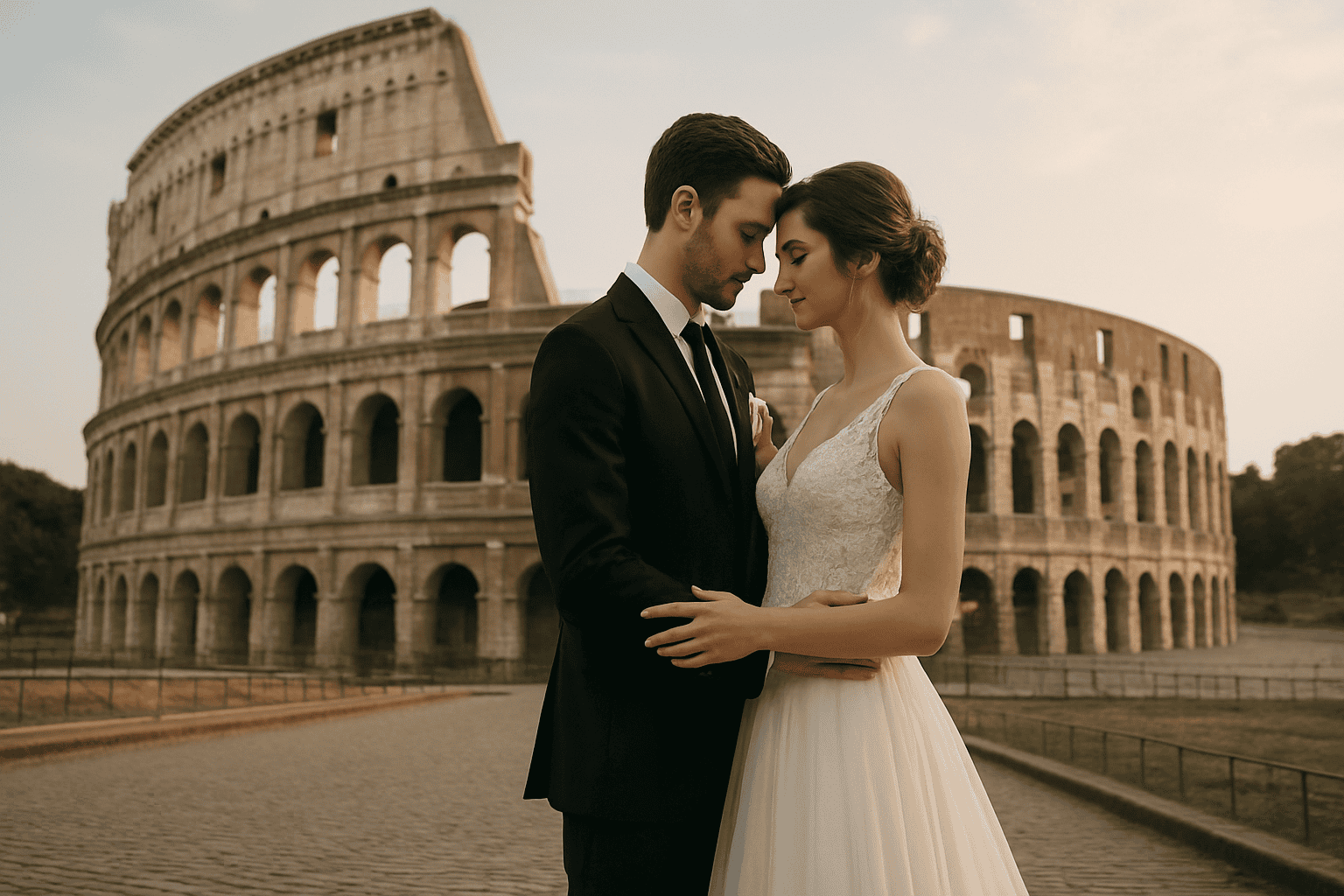
Photo permits in Rome: what to ask for and how to avoid problems at iconic locations
Wedding photo permits Rome: why to find out before shooting
Rome it is a natural set: squares, fountains, staircases, historic parks, views that already look like a set. Precisely for this reason, however, taking photos in iconic places is not always “free”. Le photo rules Rome they can change based on:
- type of place (public space, monumental area, museum, historic park, private property);
- use of the images (personal, editorial, commercial);
- equipment and impact (tripods, lights, stands, drones, outfit changes, vintage cars);
- number of people involved (couple, photographer, assistants, makeup artist, videomaker);
- need to occupy space or manage flows (even just “stopping” for a long time in one spot).
When it comes to wedding photo permits Rome, the goal is not to make life harder: it is avoid interruptions, on-site discussions, canceled shoots or last-minute location changes. Good preparation allows you to experience the shooting Rome with ease, respecting spaces and people, without giving up the “wow” effect.
If you are organizing a wedding in the city (or a destination wedding in Lazio), it can be useful to first frame the overall vision: How to organise a wedding it is a practical starting point to line up priorities, timelines and vendors.
Rome photo rules: what to ask before a shoot in iconic places
The right question is not only “do you need a permit?”, but what type of authorization e what conditions may be required. Before confirming a date or building the itinerary, clarify these aspects (even with a simple email):
1) Who the request should be made to (and who really manages the space)
Rome is a mosaic of different bodies and management. A place may seem “public”, but have specific rules because it falls within a protected area, a museum complex or a concession. To avoid wasting time, always ask:
- who is the competent authority to authorize photos and videos;
- whether there is a dedicated procedure for shoots (forms, emails, portals);
- whether the request must be made by the photographer/videomaker or by whoever organizes the event.
2) Use of images: personal, editorial or commercial
Many misunderstandings arise here. A couple’s photo shoot can be perceived as “private”, but if it is intended for promotion, portfolio, advertising or publications, it may fall under a different use. Ask transparently:
- whether the images will be used only as a personal keepsake;
- whether they will be published on websites, social media or suppliers’ promotional materials;
- whether releases or special conditions are required.
Clarity avoids surprises and helps you choose locations where the photo rules Rome are compatible with your needs.
3) Equipment and “impact” on the location
In many contexts, it’s not the camera that makes the difference, but the whole setup: tripods, lights, microphones, stands, outfit changes on site, small setups, cars stopping for shots. Before a shooting Rome, check:
- Before confirming a location, check: tripods and lights;
- whether the use of drones (often subject to specific restrictions);
- whether it is possible to do or dedicated access are needed; or prolonged stops;
- whether a security presence or an on-site contact person is required.
4) Recommended times and flow management
Rome is not only beautiful: it’s alive. Some iconic places are extremely crowded at certain times of day. Even when no formal permits are needed, you may be required to:
- avoid peak hours;
- not obstruct passages and access points;
- not create gatherings with large teams.
A well-built itinerary reduces stress and downtime, and makes it easier to get clean shots without “forcing” the situation.
Shooting Rome: objective, style and logistics without surprises
Every couple has a different aesthetic. Some dream of a story luxury and cinematic, others prefer an atmosphere intimate and discreet, some come to Rome for a destination wedding and want a shoot that combines icons and authentic corners.
Whatever the style, logistics are what make the experience smooth. In practice, it means deciding in advance:
- how many spots to include (better few, but coherent and reachable);
- how you get around (on foot, car with driver, taxi, shuttle);
- how much time to dedicate to each stop, including buffers;
- are allowed wedding photo permits Rome for one or more locations;
- a plan to manage make-up, touch-ups and small unexpected issues.
A practical tip: if the goal is an elegant result without rushing, build a route that alternates an iconic place with a “breathing” one (less crowded). That way the team works better and the couple truly enjoys the moment.
Step-by-step planning for permits and photo rules in Rome
To avoid last-minute rushes, planning must include not only the wedding, but also what revolves around it: pre-wedding, post-wedding, engagement, elopement. Below you’ll find a realistic outline, to adapt to your situation.
Realistic timeline (from 12 to 2 months before)
- 12–9 months before: define the style of the shoot and priorities (icons vs hidden corners). If the wedding is civil, fit the logistics around the ceremony and documents: Civil wedding: requirements and timing.
- 8–6 months before: select the photographer/videomaker and make a first list of locations. Start gathering information on photo rules Rome for the most sought-after places.
- 5–4 months before: choose the final route and check any formal requirements (authorizations, access, equipment limits). If a place requires specific procedures, move ahead of time.
- 3 months before: confirm schedules and travel logistics. Plan alternatives in case of crowds or unstable weather.
- 2 months before: finalize operational details (meeting points, transfer times, quick contacts). Align all suppliers on the same plan.
Essential supplier checklist (for a smooth shoot)
For a shooting Rome when well managed, the difference is in the details. Here’s an essential checklist, without weighing the team down:
- Photographer and/or videomaker: confirm style, timing, technical needs (lights, tripods, audio).
- Hair & make-up: allow for retouching and realistic timing, especially if there’s a lot of walking.
- Planner or coordination: useful for managing requests, access, and changes in real time.
- Transport: if there are multiple stops, consider a service that reduces waiting and stress.
Guest management and transfers (if the shoot is part of the day)
When the photo session is integrated into the wedding day, the question becomes: what are the guests doing while the couple is shooting? To avoid downtime and nervousness:
- organize a welcome moment or an aperitif in a convenient area;
- set a clear and easily reachable meeting point;
- if there are transfers, consider shuttles or precise directions for those arriving on their own.
Priorities and smart choices: what really affects the result (without talking about prices)
When planning a session in iconic places, it’s easy to focus only on the “background”. In reality, the final result depends on a balance between aesthetics and feasibility. Some decisions have a huge impact:
- Time: light and crowds completely change the atmosphere.
- Number of stops: too many locations turn the session into a marathon.
- Lean team: less bulk often means more freedom and less friction.
- Permits and rules: knowing in advance what is allowed prevents stops and restarts.
Where to invest to maximize the scenic effect
If you want a “cinema” impact, focus on choices that increase perceived quality without complicating logistics:
- coherent styling with the city’s architecture and palette;
- itinerary with rhythm: an icon + a quiet corner + a panoramic viewpoint;
- breathing times for natural poses and spontaneous moments;
- subtle lighting plan only where it’s truly useful (and where it’s allowed).
Common mistakes that complicate a shoot in Rome
- Arriving without having checked the rules: even a simple tripod can cause problems in certain contexts.
- Relying on “everyone does it anyway”: every day is different and checks can vary.
- Not allowing for buffer time: traffic, events, marches, cordoned-off areas can change the plan.
- Ignoring the crowd factor: some photos require patience or smart alternatives.
Plan B and risk management: weather, constraints and wedding photo permits Rome
Rome can be unpredictable: sudden rain, wind, strong sun, events in the city. A Plan B isn’t a fallback, it’s a strategy to protect the experience and the result.
Weather and alternative solutions (without distorting the style)
If the weather changes, you don’t need to “give up” on photos: you need change scenario. Some possible alternatives:
- choose spots with arcades or coverings that maintain an elegant mood;
- move part of the service to a private indoor space (hotel, residence, venue) if available;
- reduce the stops and focus on a more controllable set.
If you have doubts about what is allowed in a specific facility, check the product sheet or in the official information of the venue, especially regarding equipment and accessible areas.
Permits and constraints of the venue: how to avoid being stopped on site
When a venue requires authorizations, the golden rule is: don’t take anything for granted. Before confirming, clarify:
- whether the space allows photos and videos and under what conditions;
- whether there are limits on number of people and equipment;
- whether time slots or mandatory routes are предусмотрены;
- whether a contact person or dedicated access is necessary.
This approach reduces the risk of having to “improvise” and makes it easier to comply with the photo rules Rome without giving up style.
Agreements with suppliers: clarity on timing, travel, and responsibilities
Without getting into legal aspects, it is useful for everyone to know what to expect. Align in advance:
- duration of the shoot and stops;
- who handles any requests and communications with the venues;
- meeting point and movement plan;
- what happens if a stop becomes impracticable (crowds, barriers, weather).
Guest and couple experience: how to make the shoot in Rome enjoyable for everyone
A photo shoot in iconic places can be a wonderful moment, but only if it doesn’t turn into a “mission”. The experience needs to be planned: for the couple and, if involved, also for the guests.
Welcome moment, activities and hospitality (if there are guests waiting)
If guests are present, avoid downtime. Some simple ideas consistent with Rome:
- a welcome moment with clear indications on timing and movements;
- a short, light activity (guided walk, coffee break in a convenient area);
- an elegant and easy-to-reach meeting point.
Transport, shuttles and parking: reducing stress in the city
Rome is wonderful, but getting around requires attention. To make everything easier:
- choose stops close to each other or connected in a linear way;
- avoid continuous changes of transport;
- define a clear plan for those arriving independently (without relying on improvisation).
Clear directions and wedding website: fewer questions, more peace of mind
When information is clear, everyone collaborates better. Even for a simple shooting Rome, it can help to share:
- timings and meeting points;
- essential route map (without too many details);
- dress code or practical suggestions (comfortable shoes, walking times);
- a note on respecting the places and passageways, in line with the photo rules Rome.
For those who want to put the city and its neighborhoods into context, and better understand distances and areas, a general reference can be useful: In-depth: Rome (Wikipedia).
Frequently asked questions before a shoot in Rome (and how to prepare well)
Requests vary from place to place, but some questions always come up. If you address them beforehand, the shoot becomes simpler and more enjoyable.
- Is a permit always required? No: it depends on the location, the use of the images, and the equipment.
- Can you improvise on site? Sometimes yes, but it’s the quickest way to waste time or have to change plans.
- Is it better to have few locations or many? In the city, often a few well-chosen stops give a more elegant result.
- How can you avoid the crowd? Strategic times, alternative stops, and a route with some buffer.
Do you want a stress-free shoot in Rome, with a clear plan consistent with your wedding style? Relying on expert coordination helps you manage logistics, timing, and location constraints, enhancing the city without surprises: ChiaraB Events can support you in designing the experience, from the creative vision to operational organization.
FAQ
Do you always need a permit for a photoshoot in Rome?
Not always. It depends on the type of place (public space, museum area, private property), on the use of the images, and on the equipment used. Before confirming the itinerary, check with the location manager which Rome photography rules apply to your case.
What exactly should I ask when I contact a venue for wedding photos in Rome?
Ask who the competent authority is, whether photos and videos are allowed, what limits there are on the number of people and equipment (tripod, lights, audio), what times are recommended, and whether there are any special conditions for the use of the images (personal, editorial, promotional).
What are the most common mistakes with wedding photo permits in Rome?
The most common are: taking for granted that “it can be done”, showing up with unplanned equipment, planning too many stops without any buffer, and not having alternatives in case of barriers, events, or crowds. A prior check reduces the risk of being stopped on site.
How can I avoid the crowds during a Rome photoshoot at iconic locations?
Aim for strategic times, limit the number of stops, and alternate an iconic place with a quieter one. Allow time buffers and a backup location in case an area is too crowded or not feasible.
How to manage logistics if the shoot is integrated into the wedding day?
Define a clear meeting point, plan linear movements, and communicate realistic timings. If guests are waiting, organize a welcome moment or an aperitif in a comfortable area, so the couple can dedicate themselves to photos without creating downtime.
From the blog
 Rome
Rome
Luxury elopement in Rome: shooting itinerary between historic center and rooftop
Luxury elopement in Rome between historic center and rooftop: goal, style, and rhythm of the day A luxury elopement in Rome […]
Read more Rome
Rome
Castelli Romani: villas and historic residences for an elegant wedding near Rome
Villas in the Castelli Romani for weddings: why this format really works Choosing the Castelli Romani for an elegant wedding means […]
Read more Rome/Lazio
Country wedding in Lazio: chic garden party and plan B
Garden party chic in the countryside in Lazio: what to really expect A countryside wedding in Lazio in garden party style […]
Read more