
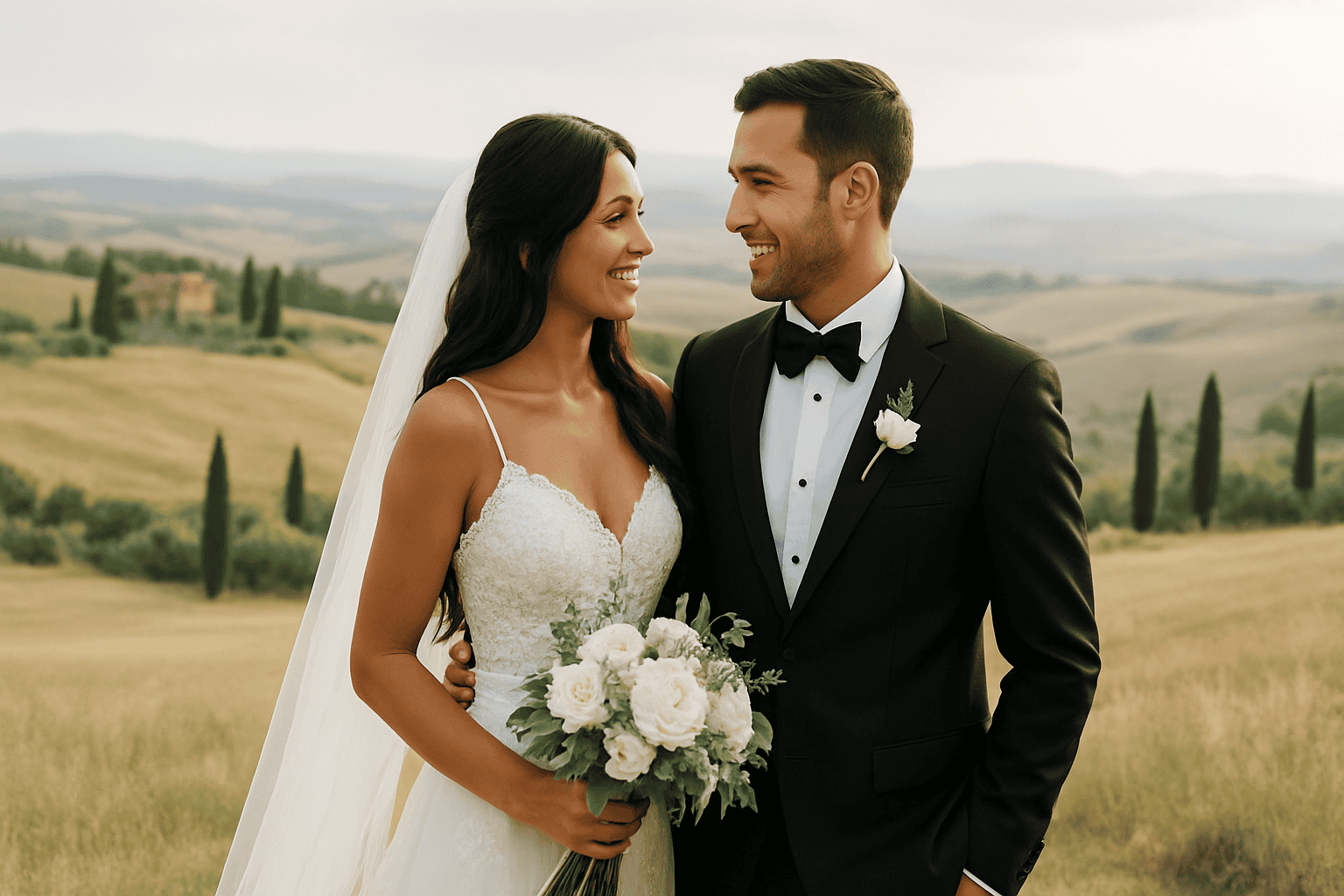
Wedding Guide in Tuscany for International Couples
Wedding in Tuscany for international couples: what to really expect
Organising a wedding in Tuscany when you live abroad it’s an exciting project, but it requires method: clear timelines, consistent choices, and a common thread that ties together location, style, and guests. Tuscany is one of the most desired destinations because it offers iconic landscapes, villages, country villas, and hospitality that can be elegant without feeling rigid.
For an international couple, what makes the difference is the ability to turn distance into an advantage: faster decisions, structured communication, and an experience designed also for those coming from far away. In this guide you’ll find a practical overview: from the concept to logistics, all the way to the details that make the event smooth and memorable.
How to choose the right area: Chianti, Val d’Orcia, the coast and art cities
Saying “Tuscany” is easy; choosing the most suitable area is the strategic part. The territory changes a lot in terms of atmosphere, distances, and pace, and the choice influences everything: guests’ arrival, transfers, natural scenery, and the style of the photos.
- Chianti: hills, vineyards, and a natural “country chic” feel. Ideal if you want a wedding immersed in greenery with a warm, convivial welcome.
- Val d’Orcia: wide-open views, soft light, and postcard-perfect villages. Perfect for a romantic, cinematic aesthetic, with slow, contemplative moments.
- Tuscan coast: a brighter, more Mediterranean atmosphere, great if you want a weekend with summer energy and a more relaxed mood.
- Florence and art cities: urban elegance, historic palaces, and an immediate cultural experience for guests. The ideal choice if you want a sophisticated wedding with services close at hand.
A good criterion is to start from the experience you want to create: country weekend, city wedding o destination wedding itinerant. If you already have a specific image in mind, it can help to read the section inspirations and styles for weddings in Tuscany to understand which area supports it best.
Wedding venues in Tuscany: villa, village, agriturismo or relais?
The venue is not just “the backdrop”: it’s the container for the entire direction. For international couples, the key question is: how much do you want to simplify logistics without giving up the atmosphere? Some properties allow you to handle the ceremony, reception, and part of the accommodation in the same place; others require more travel but offer specific settings.
Country villa
It’s usually the most versatile choice for an elegant wedding: outdoor spaces for aperitif and dinner, indoor areas for a possible Plan B, and an architecture that works well with both classic and contemporary style.
Hamlet or estate
Great for a wedding weekend: it gives a “micro-destination” feel and helps guests feel part of a shared experience. It’s ideal if you want to include extra moments like an informal dinner or a brunch.
Farm stay
Perfect for an authentic, convivial atmosphere. It works very well with natural palettes, seasonal flowers, and a simple but well-curated table setting. Before deciding, it’s useful to check in the product/venue sheet the availability of covered spaces and how evening noise levels are managed.
Relais or historic residence
A suitable choice for those who want a more intimate wedding, with attentive service and a refined aesthetic. It’s often the most “turnkey” solution for international guests who appreciate comfort and ease.
If you want to explore how to read a venue’s features (spaces, flows, Plan B, access), you’ll find useful guidance in how to evaluate a location for a destination wedding.
The best time to get married in Tuscany: weather, light, and the weekend’s rhythm
For a wedding in Tuscany, the “best time” isn’t the same for everyone: it depends on the style you’re looking for and how dynamic or contemplative you want the event to be. In general, many international couples choose periods when the light is softer and the days make it easy to enjoy outdoor spaces.
Consider these aspects:
- Light for photos and video: sunset times and the quality of light affect the visual mood.
- Managing the heat: if you’re planning an outdoor ceremony, think about shade, ventilation, and timing.
- Weekend rhythm: some periods lend themselves to a more relaxed program, others to a tighter schedule.
- Guest availability: for those traveling, choosing dates can make flights and time off easier.
A practical tip: first define the day’s timeline (ceremony, aperitif, dinner, party) and then choose the period that makes it feel most natural.
Documents and bureaucracy for foreign couples: how to navigate without stress
When it comes to getting married in Italy as an international couple, the paperwork can feel like a labyrinth. The key is to tackle it early and with an organized checklist, avoiding last-minute improvisation.
Since requirements and steps can vary depending on citizenship, municipality, and type of ceremony, the safest choice is always verify the information with official sources and with the professionals involved. If you're working with a planning team, ask for a summary document with deadlines, responsibilities, and checkpoints.
To avoid wasting time, it can be helpful to prepare:
- a digital folder with documents and scans in an organized format;
- a shared calendar with deadlines and reminders;
- a contact list (points of contact, offices, translations if needed).
If you want an operational overview of how to set up the process, read practical guide to documents for getting married in Italy.
Wedding planner in Tuscany for international couples: when you need one and what to ask
With guests arriving from multiple countries and remote management, a wedding planner in Tuscany is not just a “plus”: it’s often the person who makes the event sustainable, especially if you want a polished result without turning the organization into a second job.
To choose well, don’t stop at the portfolio: evaluate the method. Some useful questions:
- How do you manage communication (calls, recaps, shared tools, response times)?
- How do you build the budget in a transparent and trackable way?
- How do you select vendors based on style and not just availability?
- Who is present on the day of the event and with what roles?
A good team also helps you “translate” cultural expectations: what is essential for some guests (timing, dress code, formalities) is secondary for others. Direction is precisely what helps these differences coexist naturally.
Style, design and palette: how to achieve an authentic Tuscan wedding (without clichés)
“Tuscany” doesn’t automatically mean lemons and rustic. Authenticity today comes through more subtle choices: materials, textures, colors, and proportions. The secret is to avoid a “theme” effect and instead build a coherent story.
Start from the venue, not from Pinterest
Observe floors, stone, greenery, furnishings, and light. The palette should converse with what already exists, enhancing it. If the venue has a strong character, a more essential and refined design often works best.
Flowers and styling: less quantity, more intention
For an elegant result, focus on a few high-impact points: ceremony entrance, head table, natural photo areas, and one distinctive detail for the party. The goal is to guide the eye, not fill every space.
Stationery and signage
For international couples, signage is also a service: it helps guests move around with ease. Choose a consistent linguistic tone and, if needed, a bilingual version.
If you want to explore design ideas and coordinated elements, you’ll find inspiration in style proposals for destination weddings.
International guests: travel experience, welcome, and transfer management
A successful destination wedding is one where guests feel guided, not “left to figure it out.” The key word is clarity: simple information, sent at the right times, with realistic alternatives.
Wedding website or guest guide
It’s a practical tool to gather everything: how to get there, where to stay, dress code, weather, useful contacts, schedule. Keep a welcoming and direct tone, avoiding overly long texts.
Transfers and timing
When guests don’t know the area, transfers become part of the experience. Plan schedules with buffer time, clear pick-up points, and a simple plan for getting back after the party.
Welcome moment
A small welcome moment (even informal) helps create connection among groups arriving from different countries. It can be an easy dinner or a meet-up aperitivo: the important thing is that it’s easy to reach and not too “demanding.”
Menu and table setting: how to showcase Tuscan cuisine for international palates
Food is one of the strongest memories. For international couples, the challenge is to balance local identity e accessibility: offering Tuscan flavors without making the menu “difficult” for those who aren’t used to it.
- Clarity on the menu: simple descriptions help guests choose with ease.
- Alternatives and preferences: collect dietary needs and allergies in advance, and manage them with an organized system.
- Service pace: well-calibrated timing keeps energy and attention up, especially if there are speeches and special moments.
The table setting also contributes to the story: natural materials, fabrics, and details consistent with the palette make everything feel more “Tuscany” without having to state it.
Music and entertainment: from the ceremony to the party without dips in energy
For a wedding with international guests, music is a common language. The secret is to build a progression: emotion during the ceremony, lightness at the aperitif, warmth at dinner, energy at the party.
To avoid abrupt breaks:
- define the key moments (entrances, cake cutting, first dance, open dancefloor);
- share with whoever manages the music a list of “musts” and “no-gos”;
- think about the acoustics of the spaces and the distance between the areas (ceremony, dinner, party).
If the venue has technical constraints or space limits, check the instructions in the product/venue sheet and plan accordingly.
Plan B and weather management: elegance even when everything changes
Plan B is not a fallback: it is a second project, with its own aesthetic. For a wedding in Tuscany, everything is often imagined outdoors; precisely for this reason it’s worth designing an alternative solution that is as beautiful as plan A.
Elements to consider:
- Covered spaces truly suitable for the number of guests and the type of setup;
- Flows (where the aperitif takes place, where you dine, where you dance);
- Lighting and atmosphere, so as not to lose the evening mood;
- Communication quick to communicate to guests in case of a schedule change.
A good Plan B is noticeable only in how natural it feels: guests experience it as part of the experience, not as a “fix”.
Timeline and day-of direction: the secret to a smooth wedding
When guests travel, punctuality is not just a matter of style: it’s a gesture of care. A well-built timeline reduces stress and makes every moment more enjoyable.
For effective direction:
- allow buffers between one moment and the next (especially for photos and transfers);
- assign clear responsibilities (who gives the cues, who coordinates the vendors, who manages the guests);
- share a simple “guest” version and a detailed “team” version.
If you’re building your schedule, it may help to consult timeline examples for destination weddings to understand how to distribute the moments without tiring the guests.
Useful links for organizing a destination wedding in Tuscany
When you plan from afar, having clear resources saves time and reduces indecision. Here are some in-depth resources that may be useful during the planning:
- Wedding planning checklist in Italy for couples abroad
- Ideas for a wedding weekend: pre- and post-wedding events
Do you want a wedding in Tuscany taken care of down to every detail?
If you're envisioning an elegant, stress-free destination wedding, explore the ChiaraB Events selection: you'll find solutions designed for international couples and a planning approach that combines aesthetics, logistics, and hospitality. Choose the category that best suits your style and start building a truly tailor-made experience.
FAQ
How far in advance is it advisable to start planning a wedding in Tuscany from abroad?
The earlier you start, the more choice you’ll have for venues and suppliers. In practice, it’s best to begin as soon as you’ve decided on the desired season and the approximate number of guests, so you can secure the key elements and build a realistic timeline.
Is it better to choose a venue with accommodations for guests?
If many guests are coming from abroad, a venue with overnight accommodation options (or nearby well-connected facilities) simplifies transfers and time management. Always assess capacity and logistics and, if available, check the details in the venue’s information sheet.
How do you handle different languages during the wedding day?
Essential, bilingual communication works well: a wedding website or guest guide, clear signage, and coordination that can give directions simply. Even the “spoken” moments (speeches, announcements) can be brief and translated naturally.
What should not be missing in a destination wedding for international guests?
Clear travel information, a simple transfer plan, a schedule with buffer time, and a point of contact that is always reachable (planner or coordinator). Small welcoming gestures, such as a welcome moment, help a lot in creating a connection among the guests.
How to avoid the cliché effect in the style of a Tuscan wedding?
Start from the location and the real light of the place, then build a coherent palette and materials. Choose a few distinctive elements (flowers, table setting, lighting) and work on the textures: this way you get an authentic, contemporary result, without a forced “Tuscan theme”.
Should the weather plan B be defined immediately?
Yes, because it affects setups, flows, and timing. A good plan B is designed with the same care as plan A and is communicated to the team in advance, so the schedule change remains smooth and guests experience it naturally.
From the blog
 Tips
Tips
Wedding Ideas: Trends and Tips for a Perfect Wedding
Organizing a wedding today means choosing among endless possibilities without losing sight of what really matters: telling your […]
Read more Tips
Tips
Getting married on Lake Garda: the perfect wedding between water and mountains
Between luminous shores, stone villages, and mountain profiles that change color with the sun, getting married on Lake Garda […]
Read more Tips
Tips
Getting married at the Tonnara di Scopello - History and Charm of a Unique Location
Tonnara di Scopello: a wedding venue between history, sea, and stone Choosing to get married at the Tonnara di Scopello means […]
Read more