
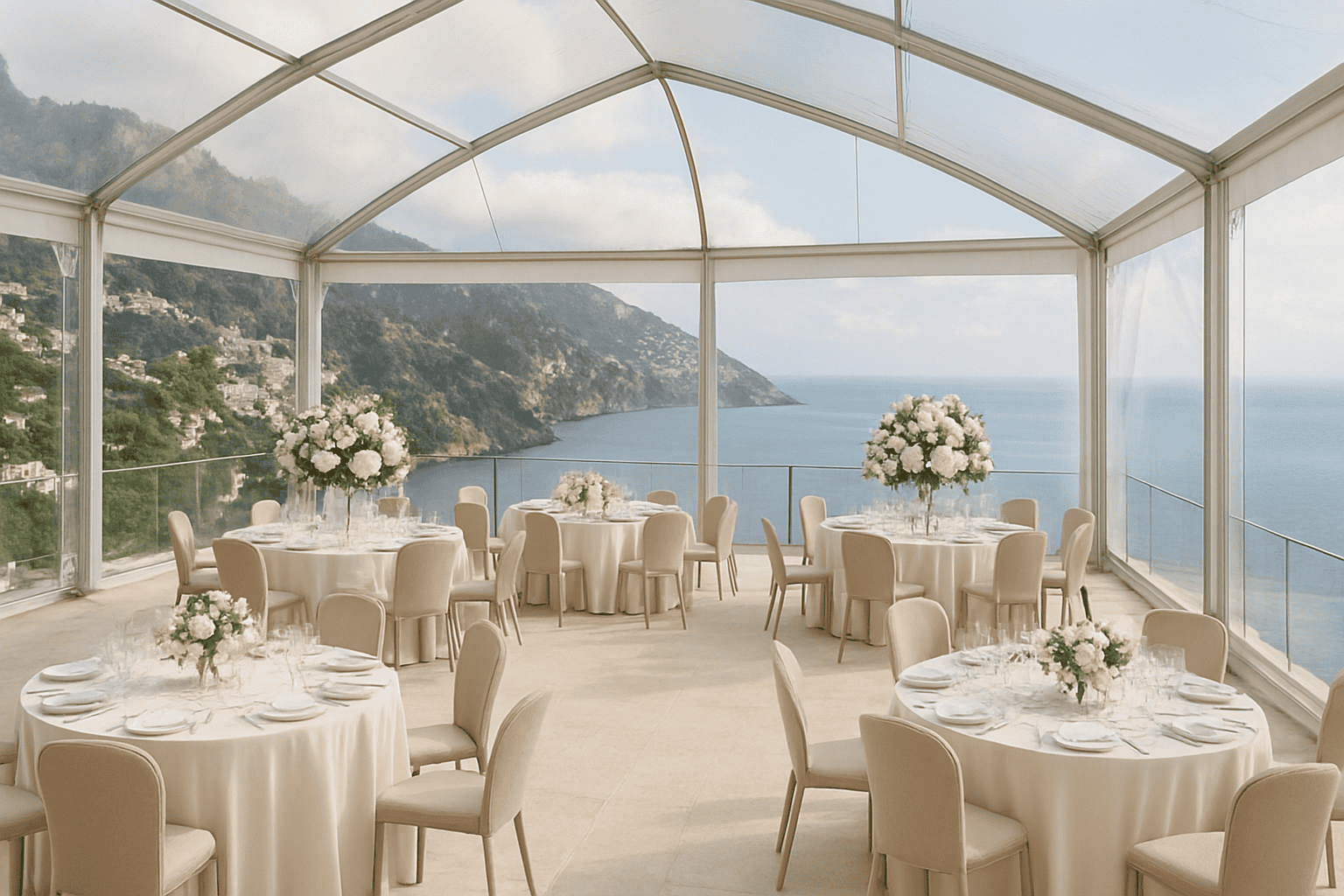
Weather Plan B on the Coast: chic indoor and transparent tensile structures
Amalfi Coast weather Plan B: elegance without compromises
In Amalfi Coast the weather can change quickly: a rising breeze, a cloud coming from the sea, a sudden downpour at the least opportune moment. For a wedding, however, the unexpected must never become the protagonist. A plan b amalfi coast weather well-designed allows you to maintain atmosphere, rhythm, and aesthetic quality, without a “fallback effect”.
The key is to think of Plan B as a second scenic set, consistent with the style of the event: the same level of care, the same materials, the same palette, the same experience for guests. In this context, the indoor wedding solutions and the elegant tensile structures (especially transparent ones) become precious allies: they protect, enhance the view, and preserve the magic of the location.
Goal and style: luxury, intimate, destination
A wedding on the Coast is often a destination wedding, with guests who travel, stay for several days, and expect an experience curated down to the details. Plan B must therefore meet three criteria:
- Aesthetic continuity: the setup must not “betray” the concept, but translate it into a covered setting.
- Real comfort: dry, manageable ventilation/temperature, protected pathways, well-distributed spaces.
- Event pace: the ceremony, aperitif, dinner, and party must flow without forced pauses.
When these points are clear, Plan B is not a lifeline: it is a second direction ready to step onto the stage.
What to expect in terms of timing and logistics
Logistics on the Coast require advance planning and precision: narrow access, loading/unloading times, coordination among suppliers, and often the need to work within time windows defined by the venue. For this reason, Plan B must be designed together alongside Plan A, not “added” close to the date.
In practice, this means:
- define from the outset alternative spaces (indoor or covered) for every moment of the day;
- anticipate duplicate layouts (or easily convertible) for the ceremony and dinner;
- establish a decision-making protocol: who decides, when, with what communication to guests.
Step-by-step planning for a wedding on the Amalfi Coast
An effective operational plan reduces anxiety and improves the quality of the outcome. Planning isn’t just about “checking things off,” but about building a sequence of decisions that makes Plan B natural, credible, and beautiful.
Realistic timeline (from 12 to 2 months)
Every event has its own story, but a reference timeline helps you avoid postponing critical points.
- 12–10 months: choosing the venue and initial checks of indoor/covered spaces; defining the concept and the level of formality.
- 9–7 months: selecting key suppliers (planning, catering, photo/video, music); draft of the event flow with weather alternatives.
- 6–5 months: detailed layout study; defining “transition” areas (entrances, corridors, welcome points) and protected routes.
- 4–3 months: technical meeting with the venue and suppliers; review of Plan B as a complete experience (not just coverage).
- 2 months: finalizing the run-of-show; communications to guests; defining the weather “decision time” and ready-to-send messages.
If an element depends on availability or specific features, check the product sheet or in the technical information provided by the partner.
Checklist of essential suppliers (with a focus on Plan B)
On the Amalfi Coast, the difference is made by integration between the team. A useful checklist, oriented to Plan B, includes:
- Wedding planner / coordination: managing timing, access, run-of-show, and communications.
- Location manager: confirmation of spaces, constraints, areas usable in case of rain.
- Catering: adaptability of the service between outdoors and indoors; managing flows and timing.
- Set-ups and lighting: a lighting design that works both under transparent cover and indoors, without changing the atmosphere.
- Music and entertainment: modular set-up, alternative placements, acoustic management.
- Photos and videos: shot plan in case of rain, photogenic indoor locations, timing for portraits.
The point isn’t to add complexity, but to anticipate consistent alternatives for each supplier, so that no one improvises.
Guest and transfer management
When it rains, the real risk isn’t only aesthetic: it’s friction. Guests who don’t know where to go, waiting under an awning, slippery routes, uncommunicated program changes. A well-written Amalfi Coast weather Plan B includes:
- meeting points clear and sheltered;
- discreet signage but readable;
- staff briefing with clear roles (reception, escorting, time management);
- transfers coordinated with realistic buffers.
If guests perceive order and care, even the set change becomes part of the experience.
Budget and priorities: where to invest for a “wow” scenic effect even indoors
When it comes to Plan B, the most common mistake is to treat it as an extra cost to be reduced to a minimum. In reality, an elegant Plan B avoids last-minute waste and protects the main investment: the overall experience.
Main expense items (no surprises)
The areas that usually have the biggest impact are:
- cover structures and related setups (if planned);
- lighting design (essential to make an interior or a transparent structure chic);
- layout and furnishings (consistency between Plan A and Plan B);
- logistics and coordination (timing, staff, set-change management);
- solutions for guest comfort (protected routes, dry areas, cloakroom, etc.).
You don’t need to “do everything”: you need to do well what is seen and what is experienced.
Where to invest to maximize the scenic effect
If the goal is a refined result even in case of rain, three levers are decisive:
- Light: well-designed lighting direction transforms an interior into a cinematic set and enhances transparency without flattening volumes.
- Materials and textures: fabrics, table linens, floral details and surfaces consistent with the concept make Plan B feel “intentional,” not “forced.”
- Perspectives: orienting tables, the ceremony and photo points toward the view or toward a scenic backdrop reduces the “closed room” effect.
Le elegant tensile structures transparent, when chosen with discernment and integrated into the project, help maintain the feeling of being “on the Coast” even in the rain: natural light, panorama and continuity with the outdoors.
Mistakes that increase costs (and stress everyone out)
- Deciding late: the improvised Plan B leads to quick and less efficient choices.
- Don’t duplicate key moments: if the ceremony and dinner don’t have credible alternatives, you end up turning the schedule upside down.
- Ignoring routes: even a beautiful setup loses value if guests arrive wet or disoriented.
- Not aligning vendors: each team works “their own way” and the direction falls apart.
Plan B and risk management: weather, venue and contracts on the Amalfi Coast
Risk management isn’t a “cold” chapter: it’s what allows you to live the wait with peace of mind. On the Amalfi Coast, where settings are often scenic and spread across levels, Plan B must be designed as a complete route, not as a single covered area.
Weather and alternative solutions: chic indoor and transparencies
The most appreciated options, when aiming for a high-end aesthetic, are two (often combinable):
- Indoor wedding solutions: characterful rooms, covered terraces, interior spaces with views, environments that can be “dressed” with lighting and details.
- Transparent marquees: ideal for protecting without closing in, maintaining the perception of the landscape and natural light.
The choice depends on style, timing and layout. An indoor space can be perfect for an elegant, intimate dinner, while a transparent structure can enhance the aperitif and party while keeping the view. The goal is to avoid the “everything moved in a rush” effect and build a smooth narrative.
If you’re considering a specific solution, check the product sheet details such as available finishes, accessories and compatibility with the venue.
Permissions and constraints of the location: what to clarify immediately
Each venue has rules and characteristics that influence Plan B: usable spaces, access, timings, setup limits, ground management and common areas. Without going into regulatory aspects (which must always be checked with the venue), it’s useful to clarify from the start:
- which areas are available as a weather alternative and under what conditions;
- whether there are emergency plans already well-tested by the venue;
- how setups and teardowns are handled
- what are the best points to ensure comfort and dry routes.
A well-negotiated Plan B with the venue is easier to execute and more elegant to experience.
Contracts and deposits: operational clarity (without rigidity)
You can’t control the weather, but you can control clarity. In relationships with suppliers, it helps for Plan B to be described as a real option: what changes, what stays the same, what the decision timelines are. This reduces misunderstandings and allows everyone to prepare in advance.
A good approach is to define:
- scenarios (sun, rain, wind) with corresponding actions;
- decision time shared (e.g., the day before or the same morning, depending on the situation);
- liability and quick contacts for urgent communications.
If a contractual detail isn’t certain, always ask the supplier for confirmation and check the product sheet or in the available documentation.
Guest experience on the Amalfi Coast: comfort, timing and communication when it rains
A successful wedding isn’t just beautiful: it’s easy to experience. On the Amalfi Coast, with scenic roads and variable travel times, the guest experience becomes even more important, especially in case of uncertain weather.
Welcome moment, activities and hospitality
If guests are coming from far away, the welcome is part of the event. Even with rain, you can maintain a polished reception with simple but impactful choices:
- sheltered welcome area with dedicated staff and immediate directions;
- entrance moment scenographic (light, music, scents, floral details);
- waiting areas comfortable, to avoid crowding and stress;
- micro-experiences consistent with the Amalfi Coast (tastings, corners, small rituals), adaptable indoors.
The secret is to design hospitality as a journey: even if it’s raining outside, inside it should feel like “vacation”.
Transportation, shuttles, parking: reducing friction and downtime
Rain amplifies every logistical difficulty. That’s why it’s useful to plan transport management that minimizes waiting times and walking. Some best practices:
- staggered schedules for arrivals and departures, with clear communications;
- pick-up points easy to find and sheltered when possible;
- support staff to accompany guests through the most delicate transitions;
- return plan already defined, so the party isn’t “cut short” by uncertainty.
If the venue has parking areas or specific access points, it’s best to align everything in advance and update guests in real time.
Clear directions and a wedding website: Plan B communicated with style
Communicating Plan B doesn’t mean “causing anxiety.” It means providing reassurance. A wedding website or a well-written message can include:
- information about dress code and recommended shoes (without alarmism);
- directions on times and transfers with maps and meeting points;
- an elegant note: “In case of variable weather, the event will take place in covered spaces while maintaining the same experience”.
If you want to explore the context of weddings with international guests and travel logistics, you can read Insight: Destination wedding (Wikipedia).
Scenographic ideas for elegant marquees and indoor settings on the Amalfi Coast
When the weather requires cover, the difference between “sheltered” and “chic” is all in the design. The elegant tensile structures and interiors can become a sophisticated frame if you work on atmosphere and proportions.
Transparency, yes, but with visual direction
A transparent structure can be extraordinary because it lets in light and landscape, but it must be managed carefully. Some style tips:
- focal points (head table, ceremony area, entrance) with coherent scenic elements;
- layering of warm lighting and accents to avoid a “flat” effect in the evening hours;
- palette designed to dialogue with the sea and the stone of the Coast, without losing elegance.
The ideal result is a feeling of continuity: you’re protected, but not separated from the view.
Indoor chic: how to avoid the “backup plan” effect
An indoor space can be incredibly refined if designed as the main set. These work well:
- airy layout with comfortable circulation space;
- ambient lighting that enhances architecture and details;
- music calibrated to the room’s acoustics;
- photo corners dedicated, so the rain doesn’t limit the memories.
If the indoor space has constraints (columns, levels, access points), you can turn the limitation into style: the event direction must make it feel like a choice, not a necessity.
From ceremony to party: keeping the flow even with a set change
The most successful Plan B is the one that doesn’t interrupt the celebration. An effective way is to design a natural transition between moments:
- ceremony in a covered area or indoors with a dramatic entrance;
- aperitif in a sheltered space with service points well distributed;
- dinner with tables oriented toward the view or an important backdrop;
- party with dance area and dedicated lighting, without having to “tear down and set up” everything.
This approach reduces downtime and makes the event more seamless, even if the weather remains uncertain.
Organization and direction: how to make Plan A and Plan B coexist without stress
The most elegant way to handle the weather is not to let it weigh on your guests. The direction must be invisible: quick decisions, clear communications, staff present but discreet.
If you are building your overall strategy, it can be useful to start from a structured guide on How to organise a wedding, so you can integrate Plan B into the overall schedule from the very beginning.
The “decision time”: one single choice, communicated well
Setting a time by which to decide avoids last-minute discussions. Once the decision is made, communication must be consistent: the same messages for staff, suppliers, and guests. Better a clear change than a prolonged “maybe”.
Team briefing: who does what, in what order
An essential briefing, written and shared, should include:
- floor plans and routes in versions A and B;
- setup sequence and priorities;
- quick contacts and roles (welcome, logistics, supplier coordination);
- ready-to-use messages for guests (in Italian and, if needed, in English).
When the team is aligned, Plan B becomes an elegant scene change, not an emergency.
CTA: let’s design a truly chic weather Plan B on the Amalfi Coast
If you want a wedding on the Amalfi Coast that remains impeccable even with uncertain skies, we can build together a plan b amalfi coast weather that enhances the location and style, combining indoor wedding solutions e elegant tensile structures in a harmonious way. Tell us your vision: let’s turn Plan B into a second scenario of beauty, ready to take the stage without compromises.
FAQ
When should the weather Plan B be decided for a wedding on the Amalfi Coast?
Ideally it is defined already during the event planning phase and a shared “decision time” (with the planner, venue and suppliers) is established to activate it. The best window depends on the venue and logistics: agree on it in advance to avoid confusing last-minute changes.
Are transparent tensile structures suitable for an elegant wedding on the Amalfi Coast?
Yes, if integrated into the concept with coherent lighting direction and furnishings. Transparency helps maintain views and brightness, but it is important to design focal points and atmosphere. For details and available options, check the product sheet.
What is the difference between indoor wedding solutions and tensile structures for Plan B?
Indoor wedding solutions use interior spaces (halls, rooms with views, covered areas) and focus on lighting and styling for a chic, intimate effect. Tensile structures, on the other hand, create a cover that preserves the feeling of being outdoors. Often the best choice is a combination of the two depending on the moments of the day.
How do you prevent Plan B from seeming like a fallback?
Treating it as a second complete set: the same level of care, a consistent palette, a well-thought-out layout, and a dedicated lighting design. In addition, it requires elegant communication and an aligned team, so the scene change feels natural for guests.
What should you communicate to guests in case of variable weather on the Amalfi Coast?
Clear information on schedules, transfers, and meeting points, plus a reassuring note that the event will take place in covered spaces while maintaining the same experience. A discreet suggestion on clothing and footwear is also useful, without alarmism.
From the blog
 Amalfi Coast
Welcome dinner on the Coast: format, menu and location for the pre-wedding
Welcome dinner Amalfi Coast: goal, style and logistics of the pre wedding dinner The pre wedding dinner (often also called “welcome […]
Read more Amalfi Coast
Positano: guest logistics, stairs, transfers and comfort in high season
Positano and the Amalfi Coast: what makes logistics complex in high season Organizing an event on the Amalfi Coast means choosing […]
Read more Capri
Capri
Capri vs Coast: when one or the other is convenient for budget and style
Capri vs Amalfi Coast for a wedding: what really changes between style and logistics When talking about destination weddings in […]
Read more