
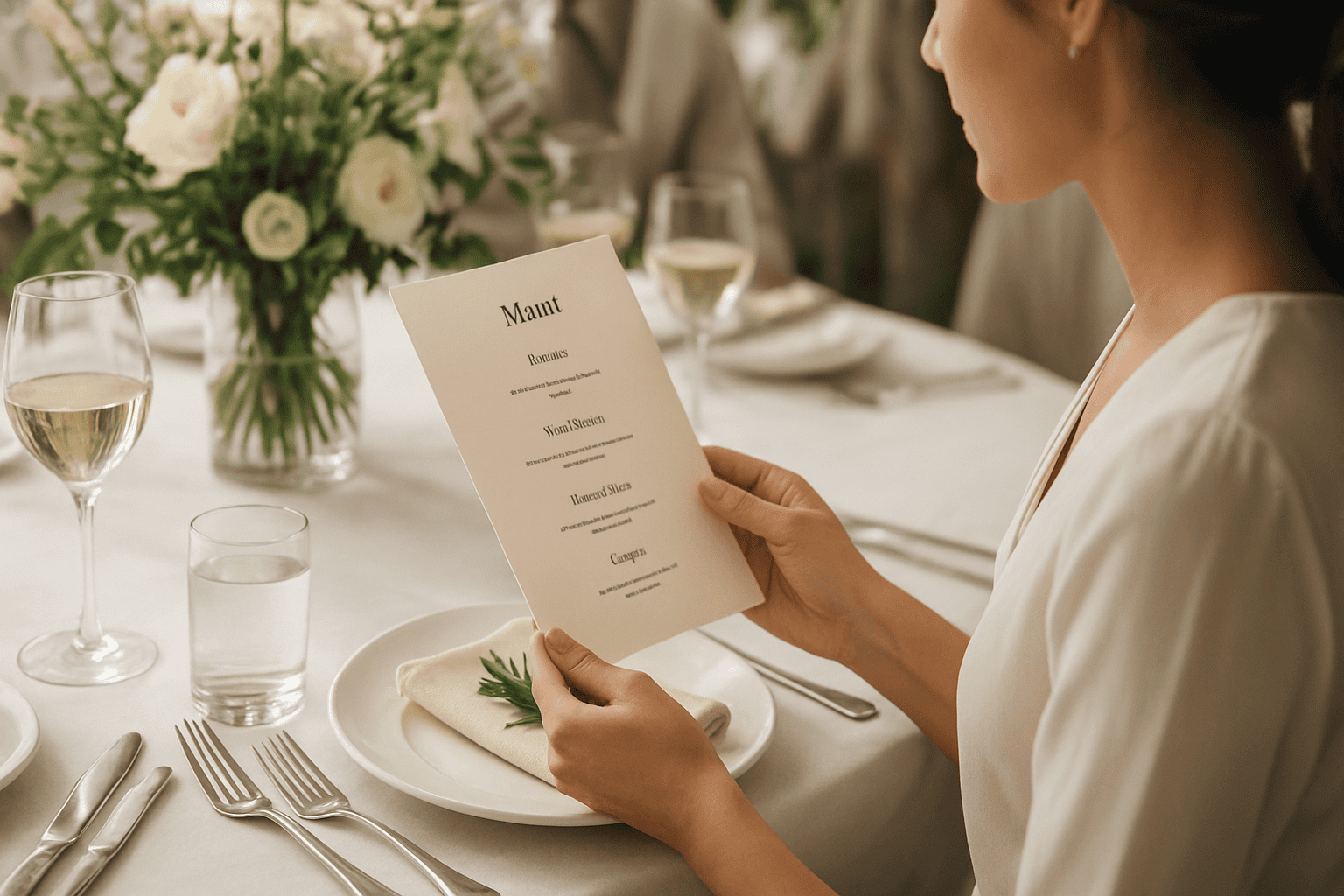
Managing allergies and intolerances: how to set menus and guest communication
Wedding menu allergies and intolerances: why you need a method (not improvisation)
When it comes to allergy and intolerance management at a reception, the goal is not to “add one more option” at the last minute, but to build a clear system: information gathering, menu choices, coordination with the wedding catering and communication to guests. A structured approach reduces misunderstandings, avoids awkward situations at the table and allows you to keep the experience elegant and smooth, even in contexts luxury, intimate or destination.
In practice, an wedding menu allergies intolerances a well-designed one has two characteristics: it is In luxury, the scenic effect is not just “big”: it is consistent with the style of the event (it doesn’t “look like a plan B”) and it is understandable
for those who have to serve it and for those who have to choose it.
Goal and style: luxury, intimate, destination (without making a big deal of it) Whether you are organizing a wedding in a villa, in a masseria, or in an overseas location, managing dietary needs must remain “invisible” in the best sense: no guest should feel like a problem
- and no diner should perceive penalizing differences. This is achieved by working on: dishes designed to be inclusive
- (not simple substitutions); coordinated service
- discreet communication (who brings what, to whom, when);
What to expect in terms of timing and logistics
(clear labels, informed staff, non-intrusive cues). The “behind the scenes” part takes time: data collection, confirmations, cross-checking with the final menu, briefing with front-of-house and kitchen, and a final check of the lists. If the event is destination or includes multiple moments (welcome dinner, brunch, pool party), the complexity increases: it’s not enough to manage the dinner, you need a coherent dietary journey
Step-by-step planning for allergies, intolerances and guest management
throughout the entire hospitality experience. guest managementThis is where the : it’s not just “who’s coming”, but how they are welcomed
Realistic timeline (from 12 to 2 months) to define the menu and communication
- 12–9 months: define the desired cooking style and the type of service (plated, assisted buffet, stations, family style). Start assessing with the caterer the flexibility on variations and alternatives.
- 8–6 months: set up the flow for collecting dietary requirements (digital or paper RSVP, wedding website, form). Prepare a list of “categories” so you don’t receive vague answers.
- 5–4 months: first menu draft and first estimate of the variations needed. Identify critical points (e.g., shared appetizers, sauces, breads, dessert).
- 3 months: almost final menu and alignment with the caterer on “parallel” alternatives (not improvised dishes). Also define the strategy for the aperitif and late night.
- 2 months: RSVP close and guest list consolidation. Start the cross-referencing work: guest name → table → requirement → dish.
- 2–3 weeks: operational briefing with the caterer and dining room manager. Define how to flag variations (without exposing the guest).
- 48–72 hours: final check of the lists and last-minute changes. Print/produce the necessary materials (if planned) and share a summary with the key people.
Essential vendor checklist: who needs to know what
Management isn’t only about the kitchen. To avoid information “gaps,” create a data-sharing checklist (always with tact and only with those who need it):
- Wedding catering: list of requirements, number of variations, menu critical points, service method, any requests regarding cross-contamination (to be evaluated with them based on internal procedures).
- Location: kitchen spaces, access, setup times, any restrictions on open flames or equipment (check the location’s product/service sheet, if available).
- Wedding planner / coordination: information coordination, updates, handling unexpected issues, communication with witnesses and family.
- Setups and stationery: if you plan printed menus or signage, define what to indicate and what not to (privacy and clarity must be balanced).
- Waiting staff: who delivers the special dishes, how they recognize the guest, how they handle questions at the table.
Guest management and transfers: why it also affects food
It may seem like a separate topic, but it isn’t. If guests arrive in waves (shuttles, transfers, arrivals from airports) or if there are pre-event activities, the management of dietary requirements must follow the same flow. An example: if the aperitif starts while some guests are still arriving, plan a food welcome point that doesn’t put those with restrictions in difficulty (easily identifiable options, staff who know what to offer).
For a broader view of the overall organization, you can start from How to organise a wedding and then integrate food management into your specific project.
Budget and priorities: where to invest for an inclusive menu without losing style
Talking about budget doesn’t mean talking about figures: it means understanding where to put energy and quality to achieve a harmonious result. In managing allergies and intolerances, the priorities are not “more dishes”, but better dishes and clearer processes.
Main items to consider (in terms of complexity)
- Menu design: creating coherent alternatives (not “fallback dishes”).
- Ingredients and dedicated preparations: some variations require specific processing or separate lines, to be assessed with the caterer.
- Service: more variations = more attention in the dining room (timing, deliveries, coordination).
- Communication: printed or digital materials, signage for stations, possibly a wedding website with a structured form.
Where to invest to maximize the impact (including visual impact) without confusion
If you want a “high-end” and smooth result, focus your choices on:
- Smart aperitif: it’s the moment with the most variety and the highest risk of misunderstandings. Better a few very clear, well-presented and well-explained options than an indistinct excess.
- A “modular” first and second course: dishes that allow variations without disrupting plating and timing (e.g., garnishes, sauces, manageable sides).
- A dessert with an elegant alternative: often this is where difficulties emerge. Better to plan a well-crafted parallel solution with consistent presentation.
Mistakes that increase complexity (and tension) at the last minute
- Collecting information in a generic way (e.g., “I have allergies” without specifying which).
- Confirming the menu before closing the RSVPs or without a margin for variations.
- Not aligning front of house and kitchen: if the kitchen prepares, but the front of house doesn’t know how to deliver correctly, the risk remains.
- Relying only on printed menus: the menu helps, but it doesn’t replace an operational briefing.
Plan B and risk management: how to avoid issues with menu and service
A good plan isn’t only for “making a good impression”: it’s there to protect the experience. In managing allergies and intolerances, the most frequent risks are communicative (missing information) and logistical (timing and deliveries). Anticipating them is part of the direction.
Weather and alternative solutions: when the setup changes, the food flow changes too
If the aperitif is planned outdoors and then moves indoors, the layout of the stations changes, the visibility of the labels, the guests’ route, and often the beverage management as well. Ask the caterer how signage is handled in case of a move and plan a solution that stays clear even in more compact spaces (for example, with staff dedicated to explaining and directing).
Venue constraints: kitchens, spaces, and internal rules
Every venue has its own operations: access, loading/unloading times, support spaces, the possibility of on-site preparations or the need to bring everything ready. These aspects directly affect the feasibility of certain variations. If you have doubts, check in the product/service sheet about the venue or ask for a technical site inspection with catering and coordination.
Agreements and deposits: what to clarify with the caterer (without unnecessary technicalities)
Without getting into specific contractual aspects, it’s useful to clarify simply and in writing:
- by when when the final dietary notes must be received;
- such as how variations are handled (dedicated dishes, portions, plating);
- who who the operational point person is on the day of the event;
- such as how to handle any last-minute changes (a guest who informs late, a +1, etc.).
Guest experience: communicating allergies and intolerances with elegance (before and during the event)
Communication is what turns a set of requests into a hospitable experience. The point isn’t “to inform a lot”, but to inform well, at the right time and with the right tone.
Welcome moment and hospitality: how to make everyone feel considered
If you have guests who are traveling or coming from far away, often the first touchpoint is a welcome moment (at the hotel or at the venue). Here too, plan simple, easily identifiable options: fruit, selected packaged snacks, offerings that don’t require long explanations. If you include a welcome note, you can add a discreet line such as: “If you have particular dietary requirements, reply to this message by…” or refer to the RSVP form.
Transport, shuttles and timing: when the schedule affects food choices
Delays and waiting can create “sudden hunger”, and at that moment guests choose the first thing available. If you know there will be long transfer times or gaps between the ceremony and reception, plan a refreshment point that doesn’t penalize those with restrictions. Even a small, well-thought-out selection can prevent someone from being left without alternatives.
Clear directions and wedding website: the heart of guest management
To collect useful data, avoid the generic question “Allergies or intolerances?”. Better to guide the guest with a micro-structure:
- What type of need? (allergy, intolerance, dietary choice)
- Which specific ingredients? (e.g. nuts, lactose, gluten, shellfish)
- Useful notes (if the guest wishes to be contacted for clarifications)
If you use a wedding website, you can integrate a form that funnels the answers into an organized file. The important thing is that the data reaches the catering team in a readable way: first and last name, table (when available), requirement, and an operational summary. To better understand the role of the person who coordinates these flows, it can be useful to have a In-depth: Wedding planner (Wikipedia).
Printed menu, place cards and in-room communication: discretion and precision
There isn’t a single solution that works for everyone: it depends on the type of service and the number of variants. Some couples prefer not to indicate anything on the printed menu, others include symbols or generic notes. In any case, the rule is one: the dining room must have a reliable system to deliver the right dish to the right person.
Possible options (to be evaluated with catering and planner):
- Service list by table with names and variants;
- Discreet signals agreed upon (for example an internal code on the seating chart or on the room plan);
- Dedicated staff to deliver special dishes at the most delicate moments (starter and dessert).
If you plan stations or buffets, consider that a simple label is not always enough: having staff present who can answer confidently makes the experience more reassuring and reduces repeated requests.
Frequently asked questions that help avoid mistakes about allergies and intolerances
Before the event, gather the questions that come up most often and turn them into a mini internal guide for those who support you (witnesses, family, coordination). Anticipating doubts is part of good hospitality: it reduces last-minute messages and makes the work of the catering team and the dining room staff easier.
One last step: turning needs into a flawless experience
The difference between “we planned options” and “everyone felt welcomed” lies in the direction: a clear RSVP flow, a wedding menu allergies intolerances designed with the wedding catering, and a guest management that turns data into service. If you want to build an organized, elegant, stress-free event, ChiaraB Events can support you in planning and coordination, integrating menus, logistics, and guest communication into a single coherent project.
FAQ
When should you ask guests about allergies and intolerances for the wedding menu?
Ideally during the RSVP, with a structured and specific question. This way you have time to cross-check the data with the final menu and share an operational summary with catering and the venue, avoiding last-minute requests.
How to set up a wedding menu for allergies and intolerances without creating “fallback dishes”?
Design parallel alternatives consistent with the style of the main menu: the same care in plating, ingredients equivalent in perceived quality, and preparations conceived from the outset. Avoid improvised substitutions and agree with the catering team on which dishes are more "modular".
Is it better to indicate allergens on the printed menu or manage everything through the dining room staff?
It depends on the type of service and the level of discretion desired. Often the most effective solution is a combination: an elegant, clean menu for everyone, plus a detailed service list for the staff, so the delivery of special dishes is ensured without exposing the guest.
How to manage buffets and food stations with guests who have intolerances or allergies?
Make the options identifiable and support the labels with informed staff who can respond confidently. If necessary, provide a dedicated station or an assisted service for certain preparations, so the guest doesn’t have to “guess” what they can eat.
What information does the wedding catering really need to manage variations?
Guest’s first and last name, specific requirement (not generic), any useful notes, and when possible the table or seating area. A clear and up-to-date summary helps the kitchen and dining room staff and reduces delivery errors.
How to handle last-minute changes to allergies or diets communicated right before the event?
Set up a process: a single point of contact who receives changes, a quick channel to inform catering and the dining room staff, and a final check of the lists. Agree in advance with the catering team on how to handle these requests, so they don’t become a source of stress on the wedding day.
From the blog
 Planning
Method, priorities and criteria for turning the initial idea into a concrete wedding project
At first everything seems simple: a date to imagine, a style you like, some saved images, the desire to bring together the […]
Read more Planning
How to choose the right wedding planner for foreign couples: criteria, language and method
Choosing a wedding planner for foreign couples: practical criteria, language, and method When talking about destination weddings, the difference […]
Read more Planning
Destination wedding timeline: complete example from 12 months to 7 days before
Why a 12-month destination wedding timeline makes everything easier A destination wedding is a little journey […]
Read more