
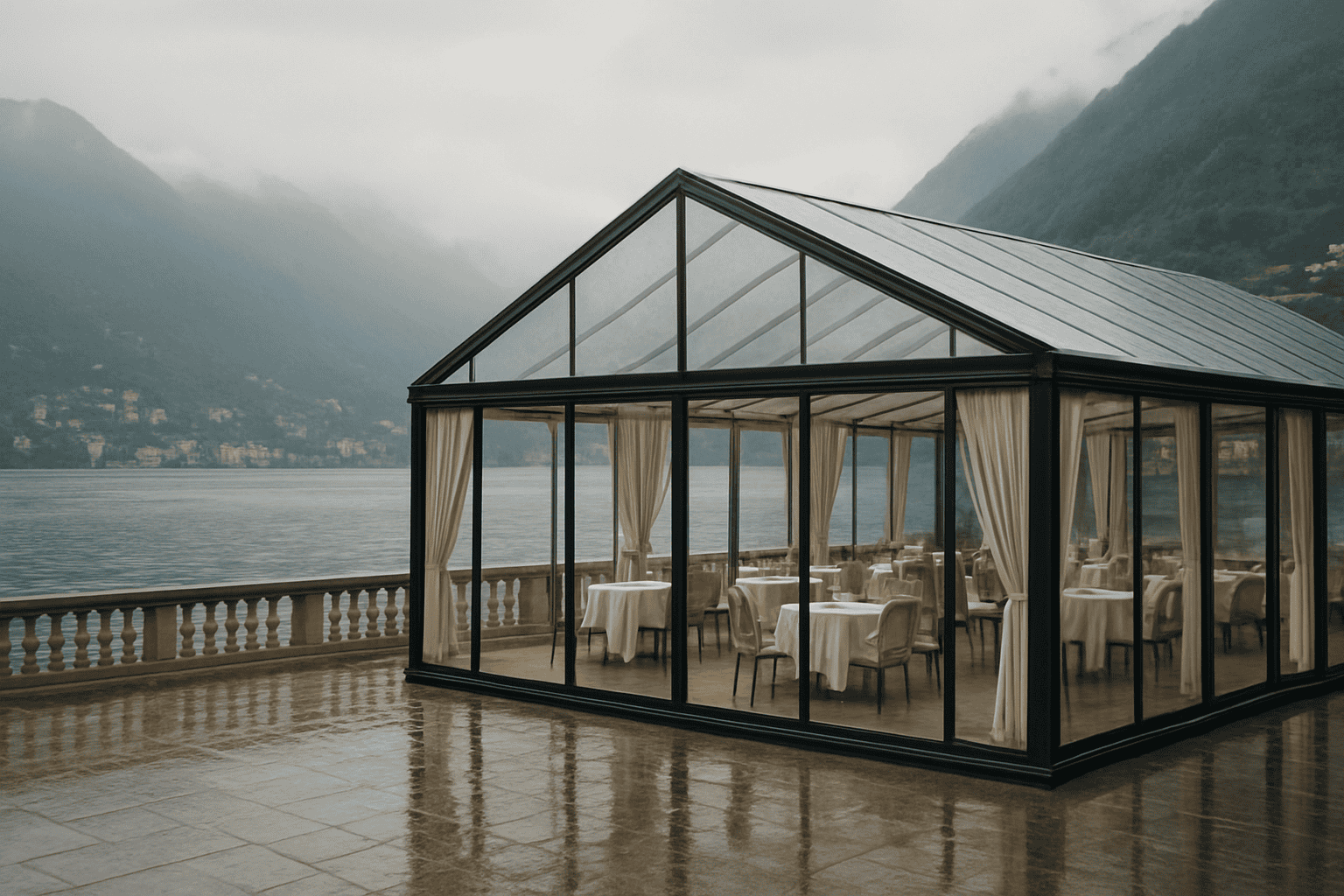
Rain on Lake Como: indoor plan B without losing the wow effect
Rain on Lake Como: how to keep the wow effect with an indoor plan B
When organizing an event on Lake Como, rain is not an “if”, but a “when”. The difference between a ruined day and a memorable memory lies entirely in the quality of the rain plan B Lake Como: not a fallback, but a parallel project, consistent with the chosen style and ready to step in without stress.
The goal is simple: protect the atmosphere (and the timeline) with indoor solutions able to enhance views, architecture, and details. In many cases, the real twist comes precisely when the event “moves indoors” into a curated, warm, scenic space. For context and ideas about the area, you can read Insight: Lake Como (Wikipedia).
Goal and style: luxury, intimate, destination even with rain
A well-thought-out indoor plan doesn’t have to “resemble” plan A: it has to work better under different conditions, while still maintaining the same aesthetic language. If the idea is an elegant, destination event, rain can become an ally: more enveloping lighting, more present music, more perceptible details.
To keep the wow effect, work on three levers:
- Visual consistency: palette, materials, flowers, and table setting must “speak” the same language as the original project.
- Scenography at the center: the eye must have a focal point (a backdrop, an imperial table, a floral installation) that replaces the view.
- Real comfort: perceived temperature, dryness, covered routes, and smooth timing. Elegance is also not making the management noticeable.
If you’re building the overall concept of your event in the area, this Wedding on Lake Como: guide helps you find your way among style, location, and overall setup.
Timing and logistics: what to expect when the weather changes
Rain mainly impacts setup times, access, and guest movements. That’s why an effective indoor plan B includes:
- Back-up spaces already “measured”: capacity, table layout, ceremony area, and party area must be designed in advance.
- Protected routes: entrances, corridors, passages between rooms and service areas.
- An alternative timing: if the outdoor aperitif is cancelled, you need a ready and visually striking indoor welcome moment.
The secret is to avoid the “let’s move everything and see” effect: rain must not create improvisation, but a scene change already written.
Step-by-step planning for a stress-free indoor plan
Realistic timeline (from 12 to 2 months)
12–9 months before: choose a venue that has truly usable indoor space, not just “for emergencies”. Ask to see the spaces set up for an event and assess where the ceremony can take place in case of rain.
8–6 months before: define the concept (palette, style, mood). At this stage you also decide whether to integrate elegant tensile structures as a hybrid solution: they cover without completely “closing off”, maintaining light and the perception of the landscape. For specific details on materials and configurations, check the product sheet.
5–3 months before: lock in key suppliers (catering, flowers, lighting, music) and share two layouts: plan A and plan B. Plan B must have its own set design, not a simple “move”.
2 months before: build communication for guests (dress code, recommended shoes, logistics). Prepare ready-to-use texts for any weather updates.
Last 2 weeks: confirm the “go/no go” with a clear decision window (for example: final decision 48 hours before), and align everyone on the alternative timing.
Essential supplier checklist
- Location manager: for access, available indoor spaces, and setup changeover times.
- Catering: manage indoor flows, corners, and service without queues.
- Lighting & audio: indoors, lighting makes 70% of the atmosphere; audio must be calibrated to the spaces.
- Floral & styling: scenic elements adaptable to both layouts.
- Transport: shuttles and alternatives in case of delays.
If you want an operational structure so you don’t miss anything, this resource is useful: Organizing a wedding: checklist.
Guest and transfer management
Lake Como is wonderful, but it requires attention to distances, timing, and access. With rain, the perception of the journey changes: you need more buffer and clearer communication. Provide a covered welcome point, simple directions, and a dedicated person to coordinate arrivals and movements.
Budget and priorities: where to invest to maximize the indoor scenic effect
A well-designed indoor plan B does not mean duplicating everything, but redistributing priorities. The items that most affect the perceived experience are those that you “see and hear” as soon as you walk in.
Main items to consider
- Lighting setup: light points, atmosphere, enhancement of walls and ceilings.
- Scenography: backdrop, sweetheart table, floral installations or emphasized architectural elements.
- Comfort and flow: cloakroom, dry routes, lounge area.
- Music: indoors, sound quality changes the party’s energy.
Where to invest for an immediate “wow”
If you have to choose, focus on what creates impact in photos and in person:
- A focal point visible as soon as you walk in (ceremony or head table).
- Warm, layered lighting (not a single source): indoors should feel enveloping, not flat.
- Tactile details: fabrics, seating, place settings. On a rainy day, comfort becomes luxury.
Mistakes that increase costs (and stress)
- Deciding late the plan B: setups and logistics become an emergency.
- Using a “service” indoor space without any scenery: then you try to make up for it at the last minute.
- Unplanned flows: queues, overcrowded spaces, guests who don’t know where to go.
Plan B and risk management: weather, location, and contracts
Weather and consistent alternative solutions
The point isn’t “being indoors”, but choosing indoor solutions options that maintain elegance and pace. In some venues, a panoramic room can replace the terrace; in others, a hybrid solution with elegant tensile structures allows you to protect without losing light and openness. If you’re considering this option, always check dimensions, finishes, and accessories: check the product sheet.
Venue constraints and spaces that are actually usable
Every venue on Lake Como has different characteristics: access points, stairs, elevators, loading/unloading areas, connecting rooms. Before confirming a plan B, make sure the indoor space:
- is suitable for the number of guests and the desired layout;
- allows for a smooth scene change (ceremony, aperitif, dinner, party);
- has a technical and service area that doesn’t interfere with the experience.
Contracts and deposits: clarity before the rain
Risk management is also organizational. Ask for the plan B to be described clearly: what it includes, which spaces are reserved, what timing is planned for any changes. If a detail isn’t spelled out, it’s better to clarify it beforehand with the suppliers involved.
Indoor guest experience: welcome, comfort, and communication
Welcome moment and hospitality
With rain, the entrance becomes a key moment. A well-designed welcome prevents guests from “landing” in chaos. These work very well:
- A covered welcome point with hostesses or coordination;
- A warm moment (welcome drink, dedicated corner) that turns waiting into an experience;
- A tidy cloakroom for raincoats and umbrellas, so the space stays clean and photogenic.
Transport, shuttles, parking
In case of rain, minimize walking distances and make transfers intuitive. If you plan shuttles, communicate meeting points and times in advance. If guests arrive on their own, clearly indicate where to leave the car and how to reach the covered entrance.
Clear directions and wedding website
A wedding website (or an information page) becomes essential for quick updates: weather, schedules, dress code, maps, contacts. Prepare a “ready” message for the plan change: a few lines, a reassuring tone, simple instructions. The guest must feel that everything is under control.
An indoor plan on Lake Como that looks like it was designed that way from the start
Rain can become part of the narrative, if the rain plan B Lake Como is built with the same care as plan A: layout, lighting, welcome and direction capable of letting the day flow without jolts. If you want a coherent, elegant and tailor-made project on Lake Como, explore the section dedicated to Wedding on Lake Como: guide and contact ChiaraB Events to turn every unexpected event into an impeccable scene change.
FAQ
When is it worth activating the indoor plan B on Lake Como?
It’s worth defining a clear decision window with the venue and suppliers (for example 48 hours in advance), so setups and logistics can start without improvisation. The important thing is that plan B is already designed and not just “hypothesized”.
Are elegant tensile structures suitable for a refined event on Lake Como?
Yes, if chosen with finishes and lines consistent with the style of the event and integrated with lighting and furnishings. Before confirming, check the product sheet for details such as available configurations and accessories.
How can you avoid indoor activities seeming like a fallback in case of rain?
A dedicated setup is needed for Plan B: a focal point, carefully designed lighting, and a layout that keeps the flow between the ceremony, aperitif, dinner, and party. Even the welcome (cloakroom, welcome drink, signage) makes a difference.
What are the most effective indoor solutions for managing guests when it rains?
A covered entrance with coordination works well, dry paths between areas, a welcome moment that turns waiting into an experience, and clear communications (also via a wedding website) about times and transfers.
What should you ask the venue to ensure a truly workable rain plan B?
Ask to see the indoor space set up for an event, check possible layouts, flows between areas, supplier access points, and service areas. It is also useful to agree in advance on how the timeline changes in case of adverse weather.
From the blog
 Lake Como
Floral arrangements on Lake Como: elegant palettes and seasonality
Floral arrangements Lake Como: why elegant palettes and seasonality really matter When talking about floral arrangements Lake of […]
Read more Lake Como
How to manage a wedding weekend on Lake Como: welcome dinner and brunch
Wedding weekend Lake Como: why welcome dinner and farewell brunch are the right choice A wedding weekend lake […]
Read more Lake Como
Historic villa vs luxury hotel on Lake Como: which choice is really worth it?
Historic villa vs luxury hotel on Lake Como: how to really choose the right venue Choosing between historic villa […]
Read more