
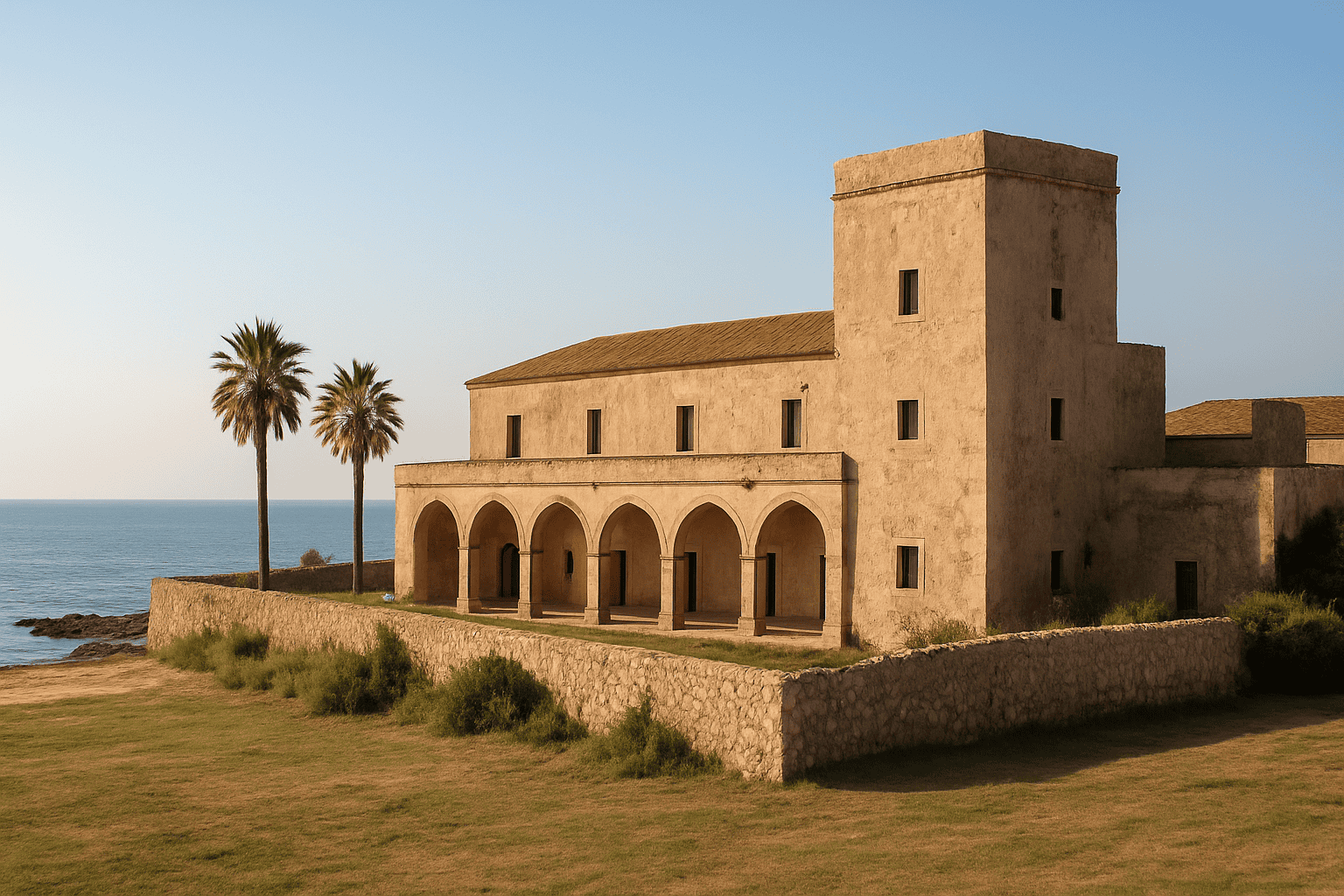
Tonnara or baglio in Sicily: pros and cons for seaside receptions
Tuna fishery or baglio in Sicily: how to choose the right historic seaside venue
Choosing between tonnara e baglio it is one of the most fascinating crossroads for those who dream of a sea reception Sicily with an authentic aesthetic, rooted in the territory and at the same time scenic. Both are historic locations Sicily able to turn a wedding into an experience: not just a party, but a story made of light, stone, wind and details that speak of the Mediterranean.
The difference, however, is not just “sea yes/sea no”. They change spaces, logistics, plan B, guest management and even the kind of atmosphere that is created: more maritime, industrial and iconic in a tuna fishery; more intimate, architectural and “courtyard-centric” in a baglio. In this article you’ll find concrete pros and cons, so you can make a choice aligned with your style and priorities, especially if you’re considering a tuna fishery baglio wedding Sicily with guests arriving also from outside the region.
If you’re planning a travel-style event, with multiple days and moments spread out, you may also find this useful Insight: Destination wedding (Wikipedia) to frame the concept and understand how the organization changes compared to a “classic” wedding.
Tuna fishery or baglio in Sicily: pros and cons for a seaside reception
Before getting into planning, clarify one point: what kind of experience do you want to create? Tuna fisheries and bagli are both powerful settings, but they speak different languages. Below you’ll find a practical read, useful also when you visit the venues and need to ask targeted questions.
Pros and cons of a tuna fishery for a seaside reception in Sicily
The tuna fishery is often a structure tied to the history of fishing and tuna processing. Visually it can offer large volumes, direct sea views, courtyards and converted “industrial” spaces, with a very recognizable character.
- Scenic pro: the sea is the star. Sunsets, the sound of the waves and the open horizon become part of the event design.
- Photographic pro: stone textures, arches, doors, docks and maritime glimpses create natural sets without having to “build” too much.
- Atmosphere pro: perfect for a Mediterranean mood, elegant but not rigid, with a contemporary touch if you love contrasts (ancient stone + modern table setting).
- Con: wind and salt spray: they are wonderful elements, but they need to be managed. Some setups and materials require more “marine-friendly” choices.
- Con: evening logistics: depending on the location, transfers and returns can be more complex; consider access routes, parking, and loading/unloading points.
- Plan B downside: if indoor spaces are limited or highly distinctive, it may be necessary to design an alternative that doesn’t feel like a compromise.
Pros and cons of a baglio among Sicily’s historic venues
The baglio is an architectural complex often organized around a courtyard. It’s a choice that enhances order, geometry and hospitality, with a very defined sense of “place”.
- Pro space management: the courtyard is a natural stage. A symbolic ceremony, aperitif and dinner can follow a logical and fluid sequence.
- Pro plan B: many bagli offer porticoes, halls or covered areas that allow you to rethink the layout without overturning the style.
- Pro guest comfort: there is often more shelter from wind and humidity; the sense of “enclosure” also helps acoustics and livability.
- Con less immediate sea: the baglio is not always right on the shoreline. If for you the sea must be in front of your eyes during dinner, check views and actual distances.
- Con aesthetic constraints: some architectures require a coherent design: the setup must dialogue with the place, not overpower it.
- Con perceived capacity: a full courtyard is beautiful, but density must be calibrated so as not to sacrifice comfort and circulation.
Goal and style: luxury, intimate or destination (and what changes between tonnara and baglio)
When we talk about “style”, it’s not just a matter of palette. It’s the sum of event rhythm, spaces e sensations. In Sicily, tonnara and baglio can support both a intimate wedding and a more complex event, but with different outcomes.
If you want Mediterranean luxury
Luxury in Sicily works when it is measured: natural materials, service quality, carefully designed lighting, and tailored details. The tonnara tends to offer a more “editorial” and contemporary luxury; the baglio a more classic, warm, and architectural luxury.
- Tonnara: perfect for clean lines, contrasts, and lighting installations that interact with the sea.
- Baglio: ideal for long tables in the courtyard, candles, and enveloping atmospheres, with a sense of timeless elegance.
If you want an intimate wedding
With few guests, the priority is to avoid “empty” spaces. In a tonnara, choose intimate areas and a layout that concentrates the moments; in a baglio, the courtyard can be modulated with furnishings and light to create the perfect scale.
If you are planning a destination wedding in Sicily
The destination wedding requires a project that goes beyond the wedding day: welcome moment, activities, directions, transfers, and clear communication. In this scenario, the baglio often helps with managing flows; the tonnara wins when you want the sea to be the common thread of the whole weekend, from the welcome dinner to brunch.
What to expect in terms of timing and logistics for a seaside reception in Sicily
Sicily is generous, but not something you can improvise: distances, roads, schedules, and microclimates vary a lot even between nearby areas. To avoid stress, consider logistics as an integral part of the design.
- Access and routes: during the site visit, check where suppliers and guests arrive, and where service vehicles are positioned.
- Light timing: in a tonnara, the sunset light can be a “moment” in itself; in a baglio, the light often needs to be built with a coherent lighting design project.
- Acoustics: open spaces by the sea can disperse sound; courtyards and porticos contain it more. Evaluate the experience you want (background music, live set, party).
- Climate comfort: breeze and humidity by the sea, heat and stiller air in the courtyard: it changes the choice of fabrics, table setting, and timing.
A practical tip: during the visit always ask to see all the spaces that are actually usable (not just the “prettiest” ones) and check in the location’s product sheet what is included and what is optional.
Step-by-step planning for tonnara or baglio wedding Sicily
Effective planning isn’t rigid: it’s a map. Here you’ll find a path designed for those who want a historic location in Sicily and want to arrive at the day of the event with breathing room, not in a rush.
Realistic timeline (from 12 to 2 months)
- 12–10 months: definition of the vision (style, number of guests, experience), selection of the area in Sicily, shortlist of venues (tonnara/baglio), first logistical checks (distances, hotels, transfers).
- 10–8 months: site visits, venue selection, booking key suppliers (catering, photo/video, music), draft of the day’s schedule and any extra moments.
- 8–6 months: design concept (palette, materials, flowers, lighting), study of space layout and flows, definition of a coherent Plan B, start of guest communication (save the date and first travel info).
- 6–4 months: tastings and style choices, definition of entertainment and timing, accommodation bookings (or room blocks if planned), launch of the wedding website or an info page.
- 4–2 months: operational details: seating plan, signage, supplier confirmations, briefing on access, parking, shuttles, and final review of Plan B.
Checklist of essential suppliers (without losing the vision)
For a reception by the sea or in a historic courtyard, some suppliers become “structural” because they affect comfort and the final result:
- Coordination and direction: essential to manage timing, setups, and scene changes (ceremony, aperitif, dinner, party).
- Lighting setup: in a tonnara to add warmth and depth; in a baglio to enhance arches, facades, and the courtyard.
- Flowers and styling: not just centerpieces: entrances, photo spots, dessert table, lounge areas.
- Audio and music: calibrated for open spaces and the venue’s constraints; ask for modular solutions.
- Transport: shuttles and management of arrivals/departures when not all guests have cars.
If you’re building your journey from scratch, a complete guide on can help you How to organise a wedding, useful for lining up priorities, timing, and decisions without wasting energy.
Guest management and transfers: the detail that changes perception
In Sicily, hospitality is a value. But for guests to truly perceive it, clarity is needed: how to get there, where to park, when to move, what to expect.
- Staggered arrivals: allow a time “buffer” for those coming from far away or running late.
- Meeting points: a simple meeting point reduces calls and confusion, especially for seaside venues with specific access points.
- Advance communication: send maps, directions and schedules in a clear format; avoid fragmented messages across multiple channels.
Priorities and budget choices for historic venues in Sicily (without waste)
There’s no need to “put everything everywhere”. In a tonnara or in a baglio, the place is already a set: the budget works when it supports what guests experience e remember.
Main items to consider
- Venue and ancillary spaces: often include different areas (courtyard, terraces, rooms). Check the product sheet to see what is actually available.
- Catering and service: they affect the overall experience, especially in contexts with more complex logistics.
- Setups and furnishings: seating, tables, lounge, scenic elements. In some historic venues the choice must respect the architectural style.
- Lighting and audio: they determine the atmosphere and quality of the party, especially in open spaces by the sea.
- Transport and hospitality: shuttles, welcome, signage and guest support.
Where to invest to maximize the scenic effect
If you want an immediate and consistent impact, focus resources on a few strategic points:
- Entrance and first impression: arrival sets expectations. In a tonnara it can be the path toward the sea; in a baglio the access to the courtyard.
- Evening lighting: light “stitches” architecture and setup together. It’s often what makes a historic venue truly cinematic.
- Table and convivial area: dinner is the longest part: comfort, space, and atmosphere matter more than a thousand scattered details.
Mistakes that increase costs (and how to avoid them)
- Unplanned layout: if you move too many moments from one area to another without logic, time and labor increase.
- Setups that go “against” the venue: trying to turn a tuna fishery into an enclosed dance hall or a baglio into a beach can require unnecessary work.
- Late communication to suppliers: access, schedules, and constraints must be clear early; otherwise organizational extras emerge.
Plan B and risk management for a seaside reception in Sicily
Plan B is not a fallback: it’s a second project, coherent and beautiful. In Sicily, even when the weather is favorable, wind and humidity can change the perception of an evening. Planning means protecting the experience.
An effective Plan B is not “just any room”: it is an alternative that maintains aesthetic coherence and flow.
- In a tuna fishery: consider covered or indoor spaces that can host at least the key moments (dinner or party). If they don’t exist, ask what alternatives are allowed and check the product sheet for the options.
- In a baglio: porticoes and halls can become an advantage, but they must be “designed” with lighting and furnishings to maintain the wow effect.
- Wind management: plan for stable elements, place cards, and details that won’t blow away; choose candles and flames in a way that’s compatible with the conditions.
Permits and venue constraints: what to ask during a site visit
Every historic venue has rules and limits tied to the protection of the spaces and the management of the event. Without getting into technical aspects, here’s what is useful to clarify before signing:
- Hours and volume: how late the music can continue and in which areas.
- Usable areas: which spaces are included and which are not, and whether there are delicate or inaccessible zones.
- Allowed setups: hangings, fixings, candles, temporary structures.
- Loading/unloading plan: where vehicles arrive and in which time slots.
Contracts and deposits: clarity before falling in love with the venue
When a tuna fishery or a baglio strikes you, it’s easy to decide with your gut. Better to take one more step: ask that everything that matters to you be written down and understandable, including spaces, schedules, operational responsibilities and conditions in case of changes. If a detail isn’t certain, check the product sheet or request a formal confirmation.
Guest experience: how to make a wedding between a tuna fishery and a baglio memorable
A successful wedding isn’t measured only by the beauty of the photos, but by how the guests feel: welcomed, guided, involved. In Sicily this aspect is decisive, especially when there are people coming from far away.
Welcome moment, activities and hospitality (without overfilling)
A reception by the sea or in a historic location can become a mini-trip. The idea isn’t “to do lots of things”, but to create a few well-curated moments:
- Welcome drink: an informal get-together the evening before or in the afternoon, useful for breaking the ice and setting the tone for the weekend.
- Local experiences: small activities consistent with the area (culture, craftsmanship, sea, cuisine). Keep everything simple and optional.
- Information corner: an elegant notice board or a digital message with schedules, maps and useful contacts.
Transportation, shuttles, and parking: the invisible direction
The difference between “how beautiful” and “how exhausting” is often here. In a tuna fishery, the access road or proximity to the sea may require more careful management of flows; in a baglio, the courtyard makes welcoming easier but you still need a clear plan for arrivals and departures.
- Shuttles in time slots: reduce delays and improvised parking.
- Discreet signage: useful especially in the evening or in poorly lit areas.
- Assistance point: a point person for guests (even just upon arrival) immediately improves the perception of care.
Clear directions and wedding website: fewer messages, more peace of mind
A wedding website (or an information page) isn’t a whim: it’s a way to avoid dozens of repeated questions. Include only what’s truly needed, in simple language:
- Times and addresses: with a map and a single, unambiguous arrival point.
- Dress code and practical tips: for example shoes suitable for stone or sand, a shawl for the evening breeze.
- Recommended transportation: shuttles, taxis, parking and realistic timings.
- Useful contacts: a single person or a single channel for operational questions.
Useful links to organize a wedding in Sicily methodically
If you're putting the pieces together (venue, vendors, timing, guests), having a reference guide helps you not to miss important steps and to maintain consistency between aesthetic choices and logistics. You can start from this resource: How to organise a wedding.
Do you want to choose between a tonnara and a baglio with professional direction?
If you are considering a tonnara or a baglio for your wedding in Sicily and want to transform the location into a smooth, elegant, and meticulously detailed experience, ChiaraB Events can help you define priorities, timeline, and creative project, coordinating suppliers and logistics without losing the soul of the place. Visit the dedicated section at How to organise a wedding and let's start building together a truly memorable seaside reception.
FAQ
Better a tuna fishery or a baglio for a seaside reception in Sicily?
It depends on the experience you want to create: the tuna fishery enhances the horizon and a very scenic maritime atmosphere, while the baglio offers a more sheltered courtyard and often simpler flow management. During the site inspection, assess real sea views, alternative spaces, and access for guests and suppliers.
What are the main risks to consider at a seaside location?
Wind, humidity, and weather changes can affect comfort and setups. It is essential to design a coherent plan B (not just “indoors”), choose suitable materials, and clarify in advance which areas of the venue can be used. If a detail is not certain, check the product sheet.
How to best manage guests and transfers in Sicily for a destination wedding?
Centralize the information (wedding website or information page), define a clear destination point, and consider shuttles in time slots to reduce delays and stress. Include maps, realistic timings, useful contacts, and practical guidance on dress code and routes.
What to ask during the site visit to a tuna fishery or a baglio?
Ask to see all the spaces actually available for the ceremony, aperitif, dinner and party; check access points and loading/unloading areas; clarify constraints on setups and music; and have what is included defined in writing. If an element is not clear, check the product sheet or request formal confirmation.
How to avoid choices that complicate the budget in a historic venue in Sicily?
Plan a logical layout to reduce movement and scene changes, invest in lighting and comfort in the areas where guests spend the most time, and avoid setups that go “against” the venue’s architecture. Clear organizational direction reduces unexpected issues and inefficiencies.
From the blog
 Sicily
Etna Wedding among vineyards: how to manage climate, dresses and plan B
Why a wedding on Etna among the vineyards really works (if you plan it well) A wedding on Etna among the vineyards does not […]
Read more Sicily
Wedding in Taormina: how to choose between sea view terraces, villas, and 5-star hotels
Why the “destination wedding” in Taormina really works A wedding in Taormina is not just an aesthetic choice: it is a […]
Read more Sicily
Favignana and Egadi: how to manage transfers and accommodations for a wedding weekend
Wedding weekend in Favignana: why this format works Organizing a wedding weekend in Favignana (or, more generally, in the Egadi Islands) means […]
Read more