
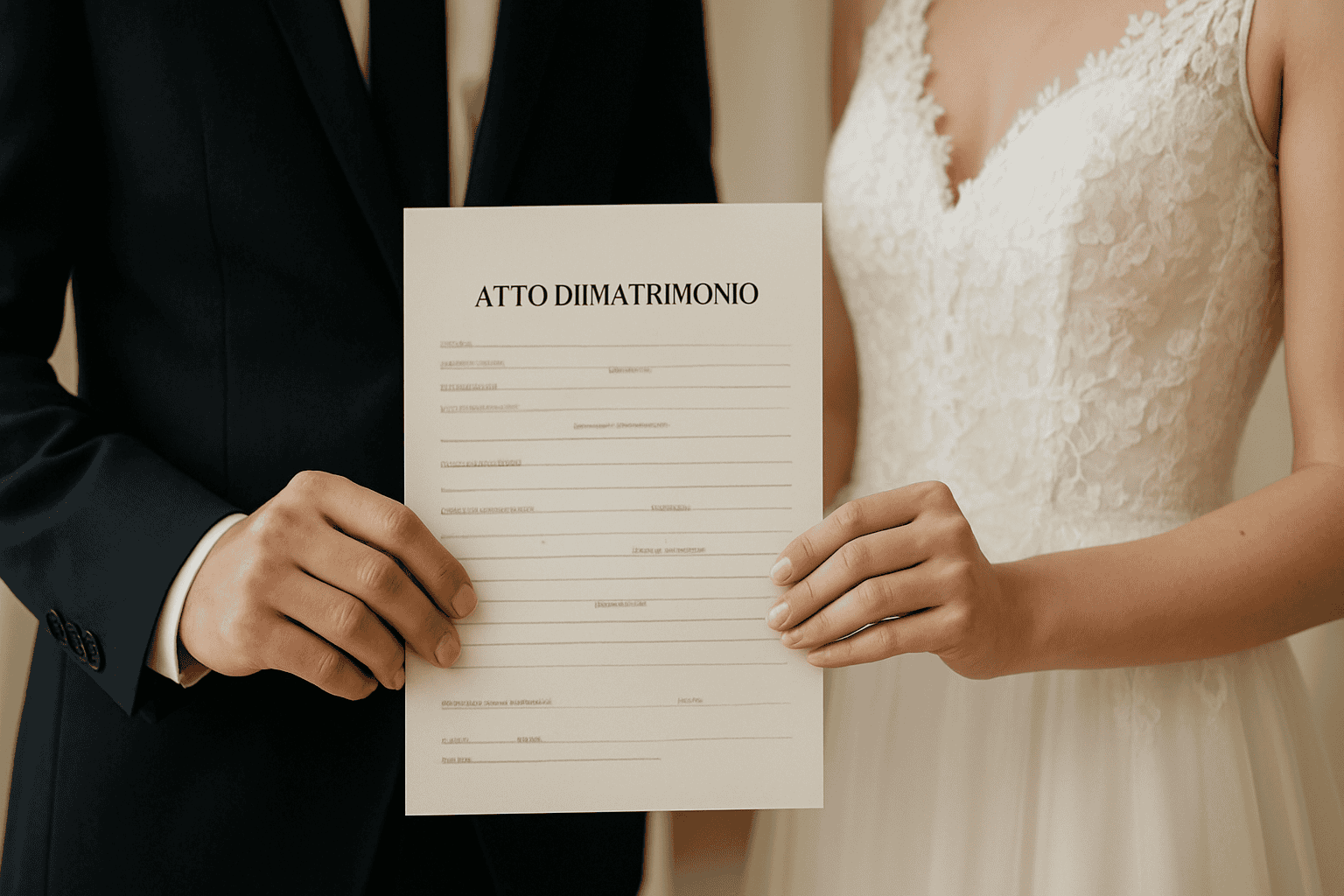
Legal Requirements for Getting Married in Italy – Documents and Procedures
Legal requirements for getting married in Italy: a clear overview
Getting married in Italy means combining emotion and organization: in addition to choosing the date and location, it is necessary to comply with a series of legal requirements and prepare documents and procedures that vary depending on residence, citizenship, and type of ceremony. In this guide you’ll find a practical map to help you navigate steps, timelines, and checks to carry out, with simple but accurate language.
The goal is to help you avoid typical snags (missing documents, expired certificates, errors in personal data) and to understand who does what: Municipality, Civil Registry Office, Parish or minister of worship, consulates and translators.
Types of marriage: civil, religious and concordat
Before talking about paperwork and offices, it’s essential to choose the type of celebration, because the process changes.
- Civil marriage: it is celebrated before the Civil Registry Officer (at the Municipality or at an authorized venue). It has immediate legal effects.
- Religious marriage with civil effects (concordat): a religious rite (for example Catholic) that, by following certain formalities, also produces civil effects. In this case both the parish and the Municipality come into play.
- Religious marriage without civil effects: it has value for religious confession, but does not produce civil effects. If you also want legal recognition, it must be considered a civil marriage.
If you are still evaluating which path is most suitable, you can learn more with a guide to rites and ceremonies and compare pros and cons based on your needs.
Who can get married: personal conditions and most common impediments
The law provides some general conditions for entering into marriage. In practical terms, before starting the procedures, make sure there are no obstacles that require checks or additional documentation.
Essential personal requirements
- Single status: not already being married (except in cases where the previous marriage has been dissolved or annulled).
- Capacity to understand and to will: necessary to give valid consent.
- Absence of impediments: some family or legal situations may require checks.
Situations requiring more attention
Some cases may involve additional steps or longer times, for example:
- previous divorce or annulment (with the need for checks in the registers);
- foreign citizenship or dual citizenship;
- residence in different municipalities or abroad;
- foreign documents to be translated and legalized.
In these situations it is advisable to set up a plan well in advance and, if necessary, coordinate multiple offices. If you want organizational support, you can find ideas on this page dedicated to wedding planning.
Documents for a civil marriage in Italy: what is usually required
For a civil marriage, the main point of contact is theCivil Registry Office of the municipality. The exact documents may change depending on the specific case and local practices, so it is always advisable to check with the municipality before gathering everything.
Personal data and identification documents
Generally required:
- identity document valid;
- tax code;
- complete and correct personal data (watch out for alternative spellings, accents, compound names).
Often much information is obtained directly by the municipality through registers, but it is not always so: if you are resident in different municipalities or if one of you lives abroad, additional steps may be required.
Request for marriage banns (or equivalent checks)
The best-known phase is that of the marriage banns (or the checks provided as an alternative, depending on the case). It is a formal moment: the procedure is started, appointments are scheduled, and it is verified that there are no impediments.
Practical tip: before booking the venue, suppliers, and honeymoon trip, make sure you have a realistic timeline for the paperwork. If you are building the schedule, you may find this organizational checklist.
useful
Documents and procedures for a religious marriage with civil effects
In a religious marriage with civil effects, two paths come into play that must fit together: the ecclesiastical one (or that of the religious denomination) and the civil one. The “civil” part is needed so that the marriage is recorded and recognized by the State.
Process with the parish (or religious body) Usually interviews, documentation, and a preparation course are required. The parish office indicates what is needed and in what order. Some documents may have a limited validity period: to avoid having to redo them, it is advisable to ask right away.
when to request them
Coordination with the Municipality In parallel, the Municipality handles the civil formalities (banns or checks) and the subsequent registration. It is important that names, dates and places
are consistent across all documents: even small differences can block the process or require corrections. If you are organizing a complex ceremony (for example with travel between different locations), it may help to read.
a guide to managing the logistics of the wedding day
Getting married in Italy as foreigners: nulla osta, translations and legalizations
When one or both spouses are foreigners, the procedure may include documents issued by the country of origin and validation steps. In these cases it is essential to act in advance and take into account consular and translation timelines.
Foreign documents and “nulla osta” nulla osta In many situations a document is required that certifies the absence of impediments to marriage under the law of the country of citizenship (often referred to as
or equivalent document). The name and content may vary: for this reason it is essential to check with the Municipality and with the competent authority of the country of origin.
Translation and validation If the documents are not in Italian, a and, in some cases, a form of legalization or certification of authenticity. Here too, the practical rule is: ask the Municipality which formats it accepts and which steps it considers valid, because practices may differ.
Pay attention to personal data
For those coming from different civil registry systems, the most frequent errors concern:
- order of first name and last name;
- transliterations (non-Latin characters);
- places of birth indicated with different wording;
- dates in a different format.
A cross-check before submitting the documents avoids requests for corrections close to the date.
Residence, competent Municipality and choice of the place of celebration
A practical issue is understanding which Municipality handles the procedure and where it is possible to celebrate. In general, jurisdiction depends on the spouses' residence and the organization of the Civil Status Office.
Municipality of residence and procedures
If you are resident in the same Municipality, the process tends to be more straightforward. If you are resident in different Municipalities, it may be necessary to coordinate communications between offices. If one of you is resident abroad, the procedure may include additional checks.
Ceremony venue
For the civil ceremony, the celebration takes place at the Municipality or at an authorized venue. For the religious ceremony, the venue is the one provided for by the denomination. If you want a ceremony in a specific location, check in advance the possibility and the conditions required by the Municipality or by the religious body.
Wedding witnesses: requirements and practical advice
I witnesses are a formal part of the celebration. In addition to the symbolic value, they have a role in signing the documents.
- In general, a identity document valid is required.
- It is useful that the personal data are correct and consistent with the documents.
- If a witness is a foreigner, it may be necessary to check any language or documentary requirements.
Organizational tip: notify the witnesses in advance and collect ahead of time the data required by the office or secretariat that manages the ceremony, so you don’t end up chasing information at the last minute.
Timelines and appointments: how to avoid delays in the paperwork
Marriage paperwork isn’t difficult, but it can become stressful if handled late. The key is to build a logical sequence of actions and check the response times of the offices involved.
A well-thought-out timeline
- First phase: gathering information (Municipality, parish/religious body, consulate if necessary).
- Second phase: preparing documents and booking appointments.
- Third phase: filing/review and confirmation of the celebration date.
- Fourth phase: final check of the details (names, places, times, witnesses) and coordination with the officiant and the venue.
Checks that save time
Before submitting the documents, check:
- consistency of the data between Italian and foreign documents;
- any deadlines of the certificates;
- need for translations and validations;
- availability of witnesses and officiant.
If you are also preparing the guests’ experience (invitations, directions, welcome), you can find ideas and in-depth information in this section dedicated to wedding design and details.
Common mistakes in marriage procedures and how to prevent them
Many problems arise from seemingly small details. Here are the ones that recur most often and how to handle them simply.
Non-uniform personal data
A missing accent, an omitted middle name, or a different spelling of the place of birth can generate requests for additional documentation. Solution: prepare a summary sheet with the correct data and compare it with each document before submitting it.
Documents requested too early (or too late)
Some certificates may have limited validity. Requesting them too early means risking that they are no longer usable; requesting them too late means having no buffer. Solution: ask the relevant office when the best time is to obtain them.
Lack of a single point of contact
When there are multiple parties (Municipality, parish, consulate, translator, venue), it helps if one person keeps track. Solution: create a contact list with emails, hours, and notes about appointments.
Useful links to organize the wedding in a coordinated way
Legal procedures are only part of the journey: they often intertwine with style choices, invitations, the day’s schedule, and guest management. To keep everything consistent, you can also consult:
- tips on how to choose the venue and coordinate suppliers;
- ideas for a detail-oriented ceremony;
- suggestions for guest management and event communication.
Questions to ask the Municipality or the office before submitting the documents
To minimize surprises, bring a mini list of questions with you. Just a few minutes are enough to clarify aspects that, if overlooked, can lengthen the timeline.
- Which documents are required in our specific case? (residence, citizenship, chosen rite)
- Do you need copies or originals? And in what format?
- Is a translation required? If so, with what requirements?
- Are there deadlines to meet? And what are the average processing times?
- How are any corrections handled? (data errors, witness changes, date change)
Write down the answers and, if possible, ask for confirmation by email: having a written reference helps you work with peace of mind.
CTA: make planning easy with ChiaraB Events
If you want to turn documents, deadlines, and coordination into an organized journey (without losing sight of style and emotion), discover the world of ChiaraB Events: let yourself be guided through inspirations, tools, and solutions designed to accompany you step by step toward your “I do”.
FAQ
What documents are needed to get married at the town hall in Italy?
Usually, identity documents and correct personal data are required; the Municipality may obtain some of the information from the registers. The exact list varies depending on residence and personal situation: it is always recommended to check with the Civil Status Office of the competent Municipality.
What is the difference between a civil marriage and a religious marriage with civil effects?
A civil marriage is celebrated before the Civil Status Officer and produces immediate legal effects. A religious marriage with civil effects follows a religious process (for example in a parish) but also requires formalities with the Municipality for registration and civil recognition.
Does getting married in Italy as foreigners always require the nulla osta?
In many cases, a document is required certifying the absence of impediments to marriage under the law of the country of citizenship (often called a nulla osta or equivalent). The need for and the form of the document depend on the personal situation and on the instructions of the Municipality: it is advisable to check before starting the translations.
Do foreign documents need to be translated and legalized?
If the documents are not in Italian, a translation may be required and, in some cases, a validation/authentication procedure. Requirements vary depending on the country of issuance and the office’s practices: it is advisable to ask the Municipality which formats it accepts.
How many witnesses are needed and what requirements must they meet?
Witnesses are required for the celebration and must present a valid identity document. The number and procedures may vary depending on the rite and the instructions of the office or religious body: check when booking the ceremony.
How long in advance do you need to start the paperwork to get married in Italy?
It depends on the Municipality, the type of ceremony, and the presence of foreign documents or translations. In general, it is useful to plan ahead to book appointments and handle any additional requirements: ask the Civil Registry Office for an indicative timeline for your case.
From the blog
 Tips
Tips
Wedding Ideas: Trends and Tips for a Perfect Wedding
Organizing a wedding today means choosing among endless possibilities without losing sight of what really matters: telling your […]
Read more Tips
Tips
Getting married on Lake Garda: the perfect wedding between water and mountains
Between luminous shores, stone villages, and mountain profiles that change color with the sun, getting married on Lake Garda […]
Read more Tips
Tips
Getting married at the Tonnara di Scopello - History and Charm of a Unique Location
Tonnara di Scopello: a wedding venue between history, sea, and stone Choosing to get married at the Tonnara di Scopello means […]
Read more