

Positano: guest logistics, stairs, transfers and comfort in high season
Positano and the Amalfi Coast: what makes logistics complex in high season
Organizing an event in Amalfi Coast means choosing iconic settings, extraordinary light, and an atmosphere that, by itself, already tells half the story. Positano, however, is also a place with very clear unwritten rules: vertical spaces, narrow access points, variable travel times, and intense tourist flows. In high season, these elements are not details: they become the backbone of every decision.
When it comes to Positano wedding, the aesthetic side is only the tip of the iceberg. Underneath is a direction made of schedules, micro-movements, coordination among suppliers, and constant attention to guests’ comfort. The good news is that, with proper planning, complexity turns into a smooth and memorable experience.
For a general overview of the destination, you can read In-depth: Positano (Wikipedia). In the rest of the article, instead, we get practical: stairs, transfers, welcoming, and concrete solutions to experience Positano without stress.
Wedding logistics in Positano: goals, style, and realistic expectations
La Positano wedding logistics it works when the event is designed as a journey, not as a sequence of isolated moments. In a vertical setting, every step (hotel → ceremony → aperitif → dinner → after party) must be conceived as an experience in itself, with realistic timing and ready alternatives.
Goal and style: luxury, intimate, destination
Positano lends itself to events with a refined, international feel, often with guests arriving from multiple countries and staying for a few days. In this scenario, style is not just aesthetics: it is consistency between the venue, the pace of the day, and the level of assistance. An intimate event can be extremely sophisticated, but it still requires precise direction, especially when guests don’t know the destination.
A successful “destination” setup focuses on three points:
- Accessibility: how you actually move between places, not just on the map.
- Clarity: simple instructions, in advance, with a single plan for everyone.
- Comfort: breaks, water, shade, human-friendly timing, on-site assistance.
What to expect in terms of timing and logistics
In high season, the most important variable is predictability: “perfect” schedules exist only if they are protected by buffers. This applies to transfers, supplier arrivals, and guest management. An operational tip: build a timeline that always includes buffer time between one moment and the next, so you can absorb any slowdowns without affecting the atmosphere.
Also, stairs are not a scenic element: they are a logistical factor. If some guests have specific needs (reduced mobility, heels, small children), it’s worth planning alternative solutions and support staff, avoiding last-minute improvisation.
Step-by-step planning for a Positano wedding without surprises
To make an event truly “easy to experience,” you need a method. Planning is not a to-do list: it is a sequence of decisions that reduces risk and improves the experience. Below you’ll find a practical outline, designed for Positano and the Amalfi Coast in high season.
A realistic timeline: from 12 to 2 months before
Every event has different timing, but an effective timeline starts with the choices that influence everything else: venues, flows, and transportation.
- 12–9 months: defining the concept, selecting venues, first draft of the guest experience (arrivals, overnight stays, movements). At this stage you also assess whether it’s better to concentrate the moments in a single place or spread the event across multiple spots.
- 9–6 months: confirming key suppliers and setting up the logistical direction. Here you create the “guest journey” with schedules and alternatives.
- 6–3 months: collecting guests' needs (arrivals, intolerances, assistance needs), defining welcome and communication details.
- 3–2 months: finalizing the schedule, operational briefings, contingency management plan, informational materials for guests.
If you're starting now and want a broader guide to the process, you'll find ideas and method in the section How to organise a wedding, useful for building a complete vision before getting into the destination details.
Essential vendors checklist (with logistics focus)
Beyond creative vendors, in Positano the crucial ones are those who make the day possible. In particular, it's worth making sure there is clear responsibility for:
- Transfer coordination: a single direction that manages timings, meeting points, and last-minute communications.
- Guest reception: dedicated staff to direct, accompany, and resolve questions on site.
- Access and load management: who enters, when, from where; where unloading happens; how to avoid blocking passageways.
- Compatible setups: solutions consistent with spaces and routes, avoiding elements that complicate passage.
A point often underestimated is the briefing: even the best team, without shared information, risks moving in a misaligned way. In Positano, misalignment costs lost minutes and stress perceived by guests.
Guest and transfer management: the rule of “everything clear, once only”
Guests should never have to interpret. Ideal management provides a single source of truth (wedding website or digital document) with:
- times and meeting points with simple descriptions;
- guidance on recommended shoes and routes with stairs;
- assistance contacts for emergencies;
- weather plan and what happens if the program changes.
This approach reduces repeated questions and, above all, prevents everyone from organizing things “their own way,” creating cascading delays.
Priorities and smart choices: where to invest for comfort and scenic impact
On the Amalfi Coast, the scenery is powerful on its own. Precisely for this reason, the best priorities are not always the most obvious ones. In a context like Positano, it's often worth investing first in what protects the experience and then in what decorates it.
Main items to consider (without surprises)
Without going into financial details, the areas that most impact complexity and perceived quality are:
- Transfers and coordination: not just the vehicle, but the direction and assistance.
- Welcome and communication: clear materials, guest management, on-site support.
- Setups and assembly times: compatibility with access points and operating windows.
- Weather plan: credible alternatives that don’t feel like a fallback.
Where to invest to maximize the scenic effect (without weighing down the logistics)
The secret is to enhance what Positano naturally offers: views, light, architecture. Effective choices are those that frame without complicating things.
- Photography timing: schedule the key moments when the light is most favorable and movements are more manageable.
- Smart layout: linear routes, clear focal points, comfortable rest areas.
- Sound experience: consistent audio management avoids “dead spots” and maintains the atmosphere even during scene changes.
When the scenic effect comes from direction, there’s no need to overload the spaces. And in a place with stairs and narrow passages, lightness is a real advantage.
Mistakes that increase complexity (and tension)
- Too many location changes without strong direction: every move adds variables.
- Too tight schedules: even a minimal delay is enough to shift everything.
- Fragmented communications: different messages to different groups create confusion.
- Underestimating stairs: not everyone experiences elevation changes the same way.
The typical result of these mistakes is not just a delay: it’s a drop in energy. And energy, in a wedding, is part of the aesthetic.
Plan B and risk management on the Amalfi Coast: weather, access, and contracts
A well-designed event isn’t recognized when everything goes smoothly, but when the unexpected doesn’t show. In Positano, risk management isn’t a separate chapter: it’s integrated into the timeline and logistics.
Weather and credible alternative solutions
The best plan B is the one that doesn’t look like a plan B. In practice, it means:
- define in advance who decides e when when the alternative is activated;
- provide a solution that maintains atmosphere and comfort (covers, indoor spaces, alternative layout);
- communicate to guests only what’s necessary, avoiding unnecessary anxiety.
If the venue offers different options, check the product sheet or in the venue’s documentation which spaces are actually available and with what operational constraints.
Permits, venue constraints and operational windows
In very popular destinations, some activities may be subject to limitations related to access, schedules or space management. Without going into regulatory aspects, the safest approach is to always ask:
- from where do suppliers enter and where can they park;
- when can you set up and take down;
- which areas are actually usable by guests;
- which alternatives exist in case of weather changes or heavy tourist flows.
This information, gathered early, prevents creative choices that then become difficult to implement.
Contracts and deposits: clarity on responsibilities and program changes
Peace of mind also comes from clarity. It’s useful for every agreement to define in an understandable way:
- operational responsibilities (who coordinates what);
- delivery times and work windows;
- management of program changes;
- communication methods in case of need.
It’s not a “cold” topic: it’s what allows the couple to experience the day without having to make decisions under pressure.
Guest experience in Positano: welcome, stairs and stress-free transport
The difference between a nice event and a memorable event often lies here: how guests feel. In Positano, comfort mainly means reducing friction: waiting, doubts, unexpected climbs, unclear movements. The setting truly works when guests have the energy to enjoy it.
Welcome moment, activities and hospitality (with a realistic pace)
In a destination wedding, the experience begins before the ceremony. A well-thought-out welcome moment helps to:
- align guests on the schedule;
- create connections between people who don’t know each other;
- reduce the organizational load on the wedding day.
If you plan activities in the days before or after, the advice is to keep a light pace: Positano is best enjoyed when there’s room to breathe, not when every hour is full.
Positano transport: shuttles, parking and meeting points
I Positano transportation should be designed as a service, not as a detail. In high season, meeting points and clear instructions make the difference.
To reduce confusion and delays, this works well:
- a single meeting point (or very few, well justified) with precise times;
- departure windows with a buffer, avoiding “everyone at 17:00” if guests are coming from different hotels;
- on-site assistance to direct and respond in real time;
- a plan for those arriving independently, with simple directions on where to be found afterward.
Parking and access can vary depending on the area and the period: for the available solutions and how to use them, check the product sheet of the venue or in the official directions provided by local partners.
Stairs and routes: how to protect comfort without giving up beauty
Stairs are part of Positano’s identity, but they must not become an obstacle. The best strategy is preventive:
- map the routes actual distances between hotel, ceremony, and reception (not just “they’re close”);
- flag in advance the presence of steps and level changes, with practical tips;
- plan assistance for those who need it, without making it feel like a problem;
- organize shoe changes or break moments if the schedule includes walking stretches.
This doesn’t take away spontaneity: it makes it possible. When guests know what to expect, they relax and enjoy the day more lightly.
Clear directions and a wedding website: an elegant guide that avoids a hundred messages
At a wedding in Positano, communication is part of the logistics. A wedding website (or a well-crafted digital document) should include:
- schedule with readable times and addresses;
- dress code with practical notes (stairs, evening wind, paving);
- how to get there and how to move between moments;
- useful contacts and a single channel for updates;
- Guest FAQ (short, concrete, without technical jargon).
The tone can remain elegant and consistent with the event’s style, but the content must be extremely practical. In Positano, practicality is luxury.
Frequently asked questions about wedding logistics in Positano
Below you’ll find quick answers to the most common questions about transfers, stairs, and comfort in high season. If you’re building a complete plan, it’s worth integrating these guidelines into the timeline and guest communication.
Professional coordination makes the difference (even when everything seems simple)
Positano rewards those who plan in a tailored way: few elements, chosen well, and a direction that makes everything feel natural. If you’d like expert support to define routes, transfers, guest welcome, and a Plan B, you can explore the method and dedicated services in the section How to organise a wedding: the goal is to turn the complexity of the Amalfi Coast into an impeccable experience for you and your guests.
FAQ
What is the main difficulty in wedding logistics in Positano during peak season?
The main difficulty is the combination of elevation changes (stairs and walking routes), narrow access points, and variable travel times due to tourist flows. For this reason, a timeline with buffers, clear meeting points, and a single coordination of transfers is needed.
How do you best manage transportation in Positano for guests?
It works well to define a few meeting points, times with buffer, and a single communication channel (wedding website or broadcast message). It is also useful to provide on-site assistance to direct guests and manage any delays without impacting the schedule.
Can the stairs in Positano be a problem for guests?
They can be for some guests (reduced mobility, heels, small children). The solution is preventive: map the actual routes, communicate in advance the presence of steps, suggest appropriate footwear, and provide accompaniment or alternatives when possible.
Is it better to hold the ceremony and reception in a single location?
Often yes, because it reduces variables and makes time management easier. If multiple locations are chosen, a very solid logistical direction is essential, with coordinated transfers and margins between one moment and another.
What should a wedding website include for a Positano wedding?
Schedule with clear times and addresses, meeting points, practical directions on routes and stairs, dress code with useful notes (flooring and evening temperatures), assistance contacts and instructions on what happens in case of weather changes.
How do you build a credible Plan B on the Amalfi Coast?
A credible Plan B is defined in advance, with a clear rule on who decides and when it is activated. It must maintain atmosphere and comfort (alternative layout and suitable spaces) and should be communicated to guests in an essential way, avoiding anxiety and contradictory messages.
From the blog
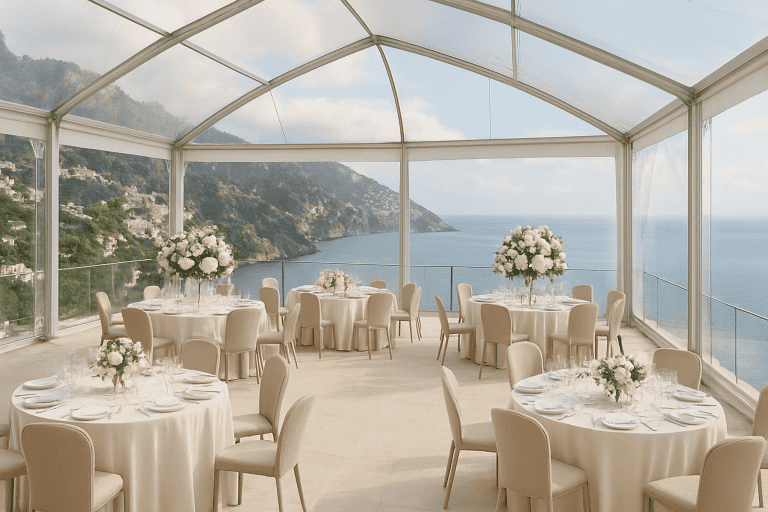 Amalfi Coast
Weather Plan B on the Coast: chic indoor and transparent tensile structures
Plan B weather Amalfi Coast: elegance without compromises On the Amalfi Coast the weather can change quickly: a breeze that […]
Read more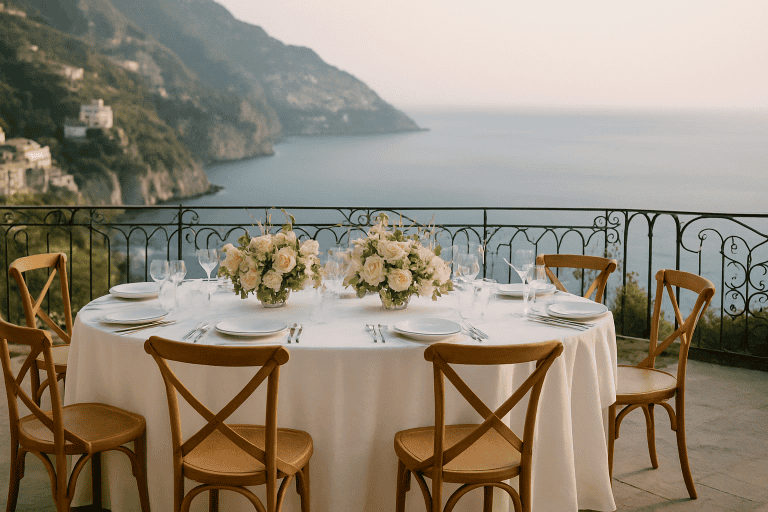 Amalfi Coast
Welcome dinner on the Coast: format, menu and location for the pre-wedding
Welcome dinner Amalfi Coast: goal, style and logistics of the pre wedding dinner The pre wedding dinner (often also called “welcome […]
Read more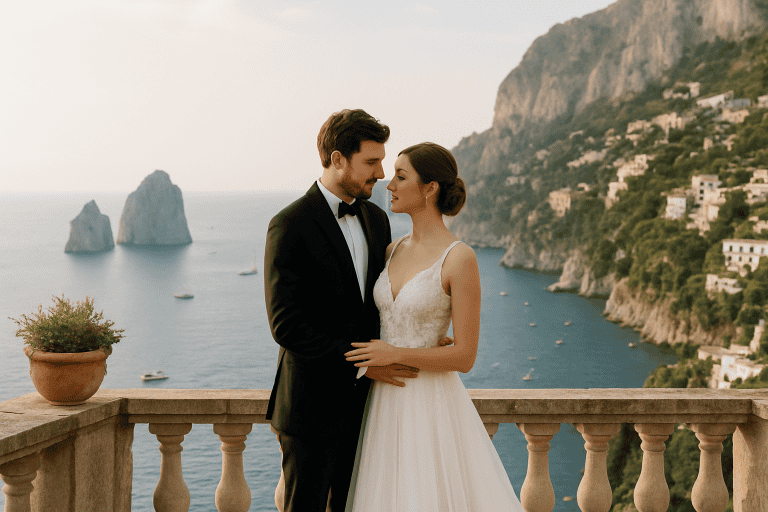 Capri
Capri
Capri vs Coast: when one or the other is convenient for budget and style
Capri vs Amalfi Coast for a wedding: what really changes between style and logistics When talking about destination weddings in […]
Read more