
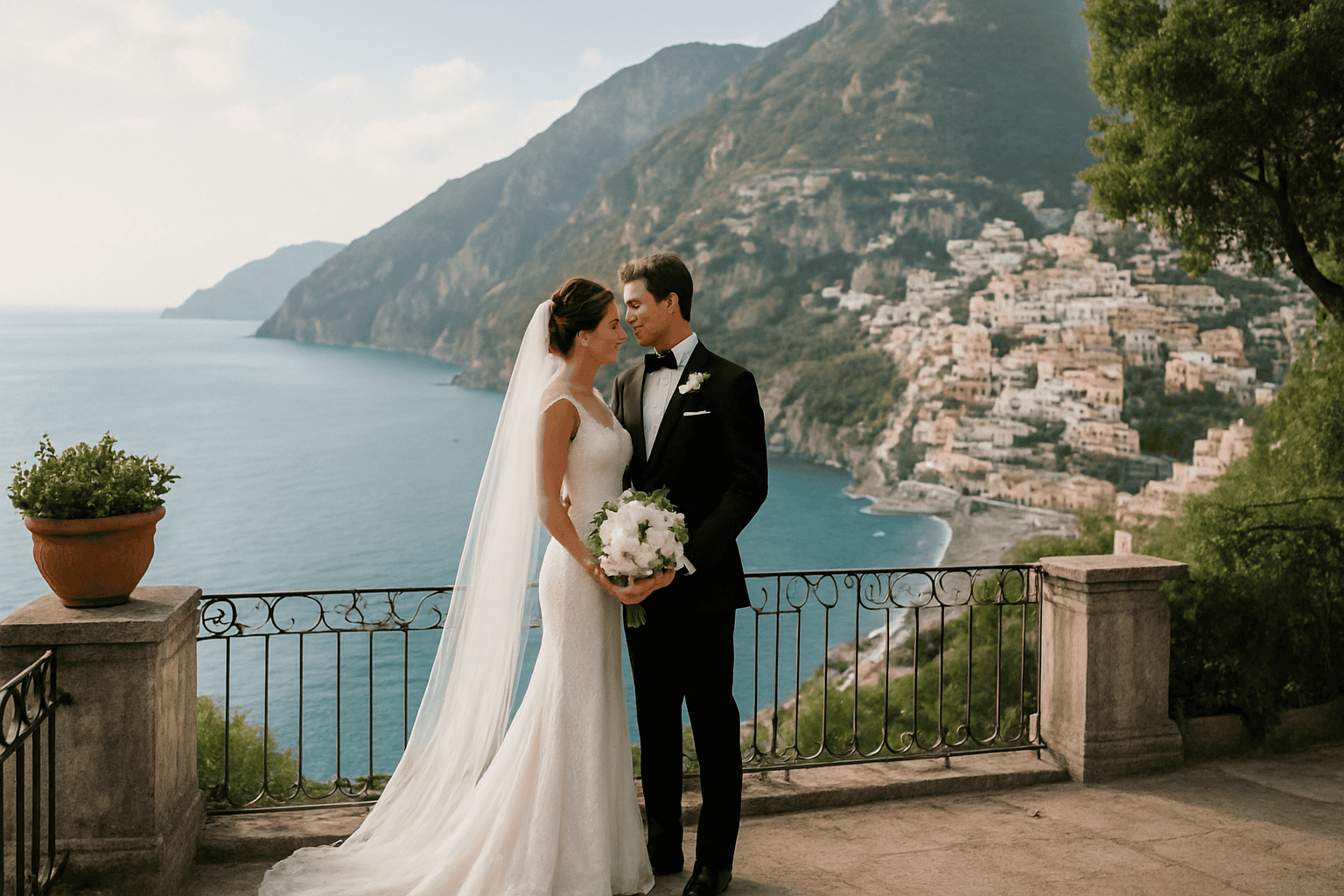
Wedding on the Amalfi Coast: how to choose the location between Amalfi, Ravello and Positano
Wedding on the Amalfi Coast: how to really choose the venue between Amalfi, Ravello and Positano
Choosing the right venue is the decision that influences everything else: style, logistics, the pace of the day and even the guests’ experience. On the Coast, moreover, each town has a distinct character. Amalfi is scenic and vibrant, Ravello is suspended and romantic, Positano is iconic and dynamic. Understanding what kind of wedding you want to experience (and have others experience) is the fastest way to avoid compromises that weigh on you.
In this guide you’ll find a practical path, designed with a commercial intent: it helps you evaluate a Amalfi Coast wedding location with concrete criteria, distinguishing what is “beautiful in photos” from what truly works on the day of the event.
Why this format works for a destination wedding between Amalfi, Ravello and Positano
, the point is not to replicate a catalog image, but to build a coherent story: intense light, tactile materials, scents, rich colors, and a palette that dialogues with the sea, Mediterranean scrub, and local architecture. This is why the format works: because it is already “at home” in the landscape.
La Amalfi Coast it's perfect for weddings destination because it concentrates, within a few kilometers, views, architecture and a Mediterranean atmosphere. But this very richness can be confusing: a sea-view terrace isn’t enough if it doesn’t align with your idea of the day.
Before visiting the venues, clarify three points:
- Number and profile of guests: friends who love to party until late or a more intimate and contemplative group?
- Desired style: elegant and minimal, Mediterranean and floral, classic with local touches.
- Experience focus: emotional ceremony, “wow” dinner, high-energy party, or a full weekend.
When these elements are clear, choosing between Amalfi, Ravello and Positano becomes a matter of consistency, not trends.
What to expect in terms of timing and logistics
The Coast is fascinating also because it is “vertical”: climbs, scenic roads, particular access points, spaces often spread across levels. This means logistics are not a detail, but an integral part of the project.
On a practical level, expect to manage:
- Transfers (between airports/stations, hotels, venue, any after party).
- Setup timing linked to access and loading/unloading.
- Sequence of spaces (ceremony, aperitif, dinner, cake cutting, party) with any changes in level.
If you want an overall picture of the area and its layout, it can also be useful to have a In-depth: Amalfi Coast (Wikipedia) to help you find your way among towns and geographic features.
Step-by-step planning to choose the location on the Amalfi Coast
Realistic timeline (from 12 to 2 months): what to define and when
A well-structured plan reduces stress and unexpected issues. Here is a “realistic” (adaptable) timeline that puts the location at the center, because all operational constraints stem from it.
- 12–10 months before: define an indicative budget and style; shortlist among Amalfi/Ravello/Positano; first calls with venues and site visits (including virtual).
- 10–8 months before: lock in the date and spaces; draft the event flow (ceremony/aperitif/dinner/party); start searching for key vendors.
- 8–6 months before: confirm catering/banqueting (if external), photo/video, music; lighting study and setup plan; first information to guests.
- 6–4 months before: define hospitality (welcome moment, any activities); table and area layout; manage transfers and timing.
- 4–2 months before: weather plan B; review contracts and deadlines; wedding website or information document; finalize details.
The key point: don’t wait to “see how it goes” on logistics and spaces. On the Coast, what isn’t defined tends to become a last-minute problem.
Checklist of essential vendors (depending on the location)
The vendor list changes depending on how “full service” the venue is or whether it requires external management. In general, for a wedding on the Coast it’s worth setting up an essential checklist:
- Planner/coordination for direction and timing (especially with multiple areas and transfers).
- Catering/banqueting (if not in-house) and beverage management.
- Floral arrangements with attention to wind and open spaces.
- Audio/lights to enhance terraces and gardens, and ensure evening comfort.
- Music (live or DJ) calibrated to schedules and spaces.
- Photo/video with knowledge of coastal light and travel times.
A good method is to ask the venue for a technical sheet: check the product sheet (or in the venue’s fact sheet) what is included, what is optional, and what the operational limitations are.
Guest management and transfers: the detail that makes the difference
In a destination wedding, guests remember two things: how they felt and how easy it was to get around. For this reason, the venue should also be evaluated based on its “friendliness” to guests:
- Accessibility: easy arrival or a complex route?
- Proximity to hotels: can guests get back easily?
- Waiting areas: where do guests stay before the ceremony or during a change of setting?
If the venue is wonderful but complex, it’s not a no: it’s a “yes, with a plan.” And the plan includes shuttles, realistic timing, and clear communication.
Budget and priorities: where to invest to maximize the scenic effect
Main items to consider (without surprises)
You don’t need to get into the numbers to think clearly about priorities. The items that weigh the most, generally, are tied to three areas: spaces, direction, hospitality. On the Coast, moreover, logistics can become a significant line item because it requires coordination and time.
During the evaluation phase, ask yourself:
- Does the venue include multiple settings, or do you need to “build” the experience with setups?
- Is the catering in-house or does it require external organization?
- How much does hospitality (transfers, welcome, guest info) affect the final result?
Where to invest to enhance Amalfi, Ravello, and Positano
The Coast offers an advantage: the scenery is already strong. The risk, however, is relying only on the view and neglecting what makes the event “high-end.” In general, the investments that truly increase the perceived impact are:
- Lighting: in the evening it transforms terraces and gardens; it defines atmosphere and comfort.
- Targeted floral design: better a few iconic focal points (ceremony, sweetheart table, entrances) than scattered decorations.
- Timing and direction: a smooth day feels more elegant, even without excesses.
- Guest experience: welcome, directions, transfers. It’s the most underrated “luxury.”
This applies both to a Ravello wedding more contemplative both for a Positano wedding more energetic: the pace changes, not the importance of the direction.
Mistakes that increase costs (and how to avoid them)
Some mistakes are typical when choosing a venue on the Coast without a complete vision:
- Falling in love with a view without checking the operational spaces: where does the catering work? where does the staff pass? where are lights and music positioned?
- Scheduling too many changes of setting: each transition requires time, coordination, and often duplicate setups.
- Underestimating the wind and humidity: they affect mise en place, candles, fabrics, hairstyles, audio.
- Late communications to guests: more last-minute questions = more stress and more running around.
The solution isn’t to simplify “at random,” but to design: a day with a few strong moments, well built, is often more memorable.
Plan B and risk management for a wedding on the Amalfi Coast
Weather: credible alternatives, not just “an indoor room”
Plan B must not be a sad version of Plan A. It must maintain style, comfort and aesthetic quality. When you evaluate a venue, ask to see (or have them describe) Plan B as if it were the first choice.
Elements to check:
- Capacity and layout of the alternative: does it maintain the same dinner and party experience?
- Atmosphere: natural light, view, possibility of customization.
- Transitions: how do guests move in case of a sudden change?
If a detail isn’t clear, check the product sheet of the venue or request an updated technical sheet.
Permissions and constraints of the location: what to ask before signing
Every property has operating rules that impact the result: schedules, volume limits, usable areas, setup methods. It’s not a “bureaucratic” issue: it’s a creative issue, because it defines what you can truly design.
Useful questions:
- Which areas are available for the different moments (ceremony, aperitif, dinner, party)?
- Are there constraints on music, lights, or suspended installations?
- What is the procedure for vendor access and loading/unloading?
Contracts and deposits: clarity on inclusions and responsibilities
Clarity wins here. Before confirming, make sure it’s written what is included and what is not: furniture, staff, cleaning, service areas, any restrictions. If something is communicated “verbally,” ask for it to be formalized.
An orderly approach also protects you in managing unforeseen events: when everyone knows what is planned, decisions are faster and less emotional.
Guest experience: the real difference between a beautiful event and an impeccable event
Welcome moment, activities, and hospitality: building a coherent weekend
Many weddings on the Amalfi Coast become a small trip. Even if the event is just one day, you can create a sense of a “weekend” with micro-moments of welcome: a well-curated welcome, a recommended itinerary, a gesture of hospitality that speaks about you.
Ideas (without turning everything into a tour):
- Welcome moment simple and well organized, with clear information.
- Optional activities for those who arrive early (designed for small groups).
- Mediterranean rhythm: leaving room for free time improves guests’ mood.
This is particularly effective in a Ravello wedding, where the intimate, scenic setting invites a slower, more refined experience.
Transport, shuttles, parking: how to make them work smoothly
Transport is part of hospitality. It shouldn’t be perceived as an obstacle, but as a natural service. Choosing the venue should include a realistic assessment of:
- Clear meeting points clear and convenient.
- Timings consistent with the timeline (without long “gaps”).
- Return plan after the party, to avoid anxiety and early departures.
In a Positano wedding, where the energy is often higher and evening moments are central, a well-designed return plan is what allows guests to truly enjoy the celebration.
Clear directions and wedding website: fewer questions, more enthusiasm
Impeccable communication is a gesture of care. Whether you choose a wedding website or a digital document, the goal is to reduce uncertainty. Include:
- How to get there (with alternatives) and where to meet.
- Dress code with practical suggestions (shoes, evening temperatures, wind).
- Timeline simple and easy to understand.
- Useful contacts for emergencies and transfers.
If you’re setting up full production, you can start from a guide dedicated to How to organise a wedding and then adapt each choice to the specifics of the Coast.
Amalfi, Ravello or Positano: how to choose the venue based on the event’s “mood”
Amalfi: iconic scenery and lively atmosphere
Amalfi is perfect if you want a wedding with a sense of the territory’s “heart”: energy, movement, recognizable views, and a village life you can feel. It’s a suitable choice when you want an elegant event but with vibrancy, and when you like the idea of having everything “close by” in terms of experience (walks, photo spots, spontaneous moments).
To evaluate carefully: organizing flows and managing travel, especially if the day includes multiple moments in different places.
Ravello: suspended romance and an intimate pace (ravello wedding)
Ravello is often associated with a quieter elegance: gardens, terraces, wide perspectives, and an atmosphere that invites you to slow down. A Ravello wedding works very well when you want a highly emotional ceremony, a dinner curated down to the smallest details, and a “postcard-perfect” experience without the need for excess.
Design tip: enhance the sunset and evening light with a thoughtfully planned lighting scheme. It’s one of those settings where lighting really makes the difference between beautiful and unforgettable.
Positano: Mediterranean glamour and a dynamic celebration (positano wedding)
Positano is immediately recognizable: colors, verticality, iconic views. A Positano wedding is ideal if you want an event with a touch of glamour, a more lively pace, and a party that becomes the star. It’s a choice that rewards those who love the idea of a full day, with strong photographic moments and a powerful visual narrative.
To consider: managing guests in terms of access and timing. When logistics are well orchestrated, Positano delivers a natural and continuous “wow” effect.
Planning a wedding on the Amalfi Coast without stress: the right support makes the difference
Between Amalfi, Ravello, and Positano there is no single “best” choice: there is the location best suited to your style, the pace you want, and the best possible experience for your guests. If you want to turn ideas and inspiration into a solid plan (with timeline, logistics, plan B, and full direction), rely on a team that truly knows the area and can coordinate every detail with discretion. Discover the method and services of ChiaraB Events in the section How to organise a wedding.
[w4y_bf_related_posts post_id=”34911″]
FAQ
What is the difference between Amalfi, Ravello and Positano when choosing the location?
Amalfi offers a livelier, more central atmosphere, Ravello is ideal for an intimate and romantic mood with “suspended” views, Positano is perfect for a glamorous and dynamic event. The best choice depends on style, the pace of the day, and guest management.
How to evaluate a location on the Amalfi Coast beyond the view?
In addition to the setting, check operational spaces (service areas, staff passages), the sequence of rooms, accessibility for guests and suppliers, customization options, and the quality of the plan B. If a detail is not certain, check the venue's product sheet.
What should a good plan B for a wedding on the Amalfi Coast include?
An effective Plan B must maintain style and comfort: alternative spaces consistent with the dinner and the party, simple transitions for guests, an atmosphere that can be enhanced with lighting and setups. Ask to see Plan B as if it were the first choice.
How to make logistics easy for guests at a destination wedding?
Plan clear pick-up points and times, arrange a return plan after the party, and communicate everything in advance via the wedding website or a digital document. Practical guidance on the dress code and travel reduces last-minute questions and increases comfort.
When should you start planning a Ravello wedding or a Positano wedding?
It is advisable to start with a timeline of about 12 months to lock in the date and location and then define key vendors, logistics, and hospitality. In any case, the correct sequence is: choose the venue, design the event flow, then confirm the rest.
From the blog
 Amalfi Coast
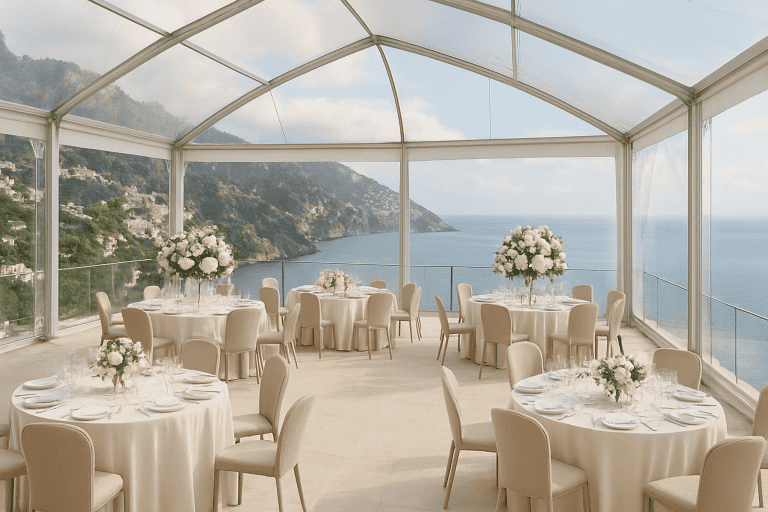
 Weather Plan B on the Coast: chic indoor and transparent tensile structures
Plan B weather Amalfi Coast: elegance without compromises On the Amalfi Coast the weather can change quickly: a breeze that […]
Read more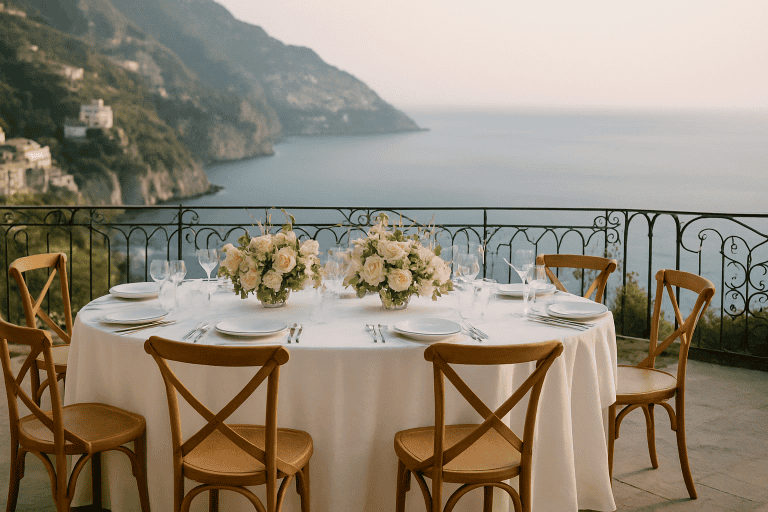 Amalfi Coast
 Welcome dinner on the Coast: format, menu and location for the pre-wedding
Welcome dinner Amalfi Coast: goal, style and logistics of the pre wedding dinner The pre wedding dinner (often also called “welcome […]
Read more Amalfi Coast
 Positano: guest logistics, stairs, transfers and comfort in high season
Positano and the Amalfi Coast: what makes logistics complex in high season Organizing an event on the Amalfi Coast means choosing […]
Read more