
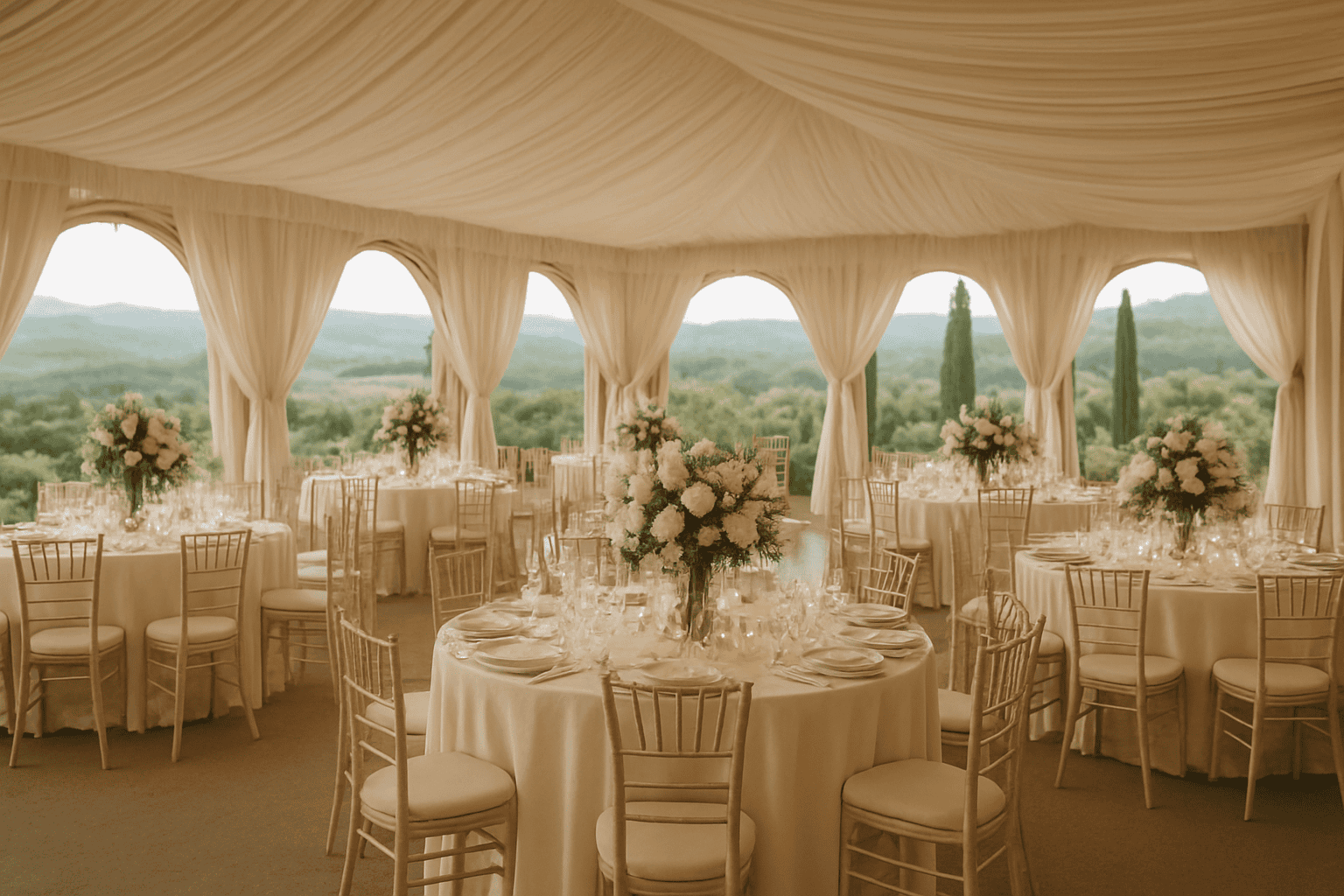
Weather Plan B in Tuscany: elegant tensile structures and indoor solutions
Weather plan B in Tuscany: how to maintain style and serenity
In Tuscany the weather can change quickly: a clear sky in the morning and a thunderstorm in the late afternoon are not rare scenarios, especially in the transitional seasons. For those organizing a wedding, this means only one thing: plan for a weather plan B is not a detail, but a directing choice. The good news is that a well-designed alternative does not “ruin” the aesthetics: on the contrary, it can elevate the experience, offering comfort, continuity, and an even more refined atmosphere.
When it comes to weather plan B Tuscany wedding, the two most effective (and often complementary) routes are: one wedding tensile structure elegant, integrated into the context of the villa or estate, and one indoor location Tuscany with indoor spaces truly suitable for hosting the key moments (symbolic ceremony, dinner, party) without compromises.
Below you’ll find a practical, “professional” guide: what to evaluate, how to plan, how to coordinate vendors and guests, and how to turn the unexpected into an experience consistent with the event’s style.
Wedding format in Tuscany: goals, style, and logistics without surprises
Goal and style: luxury, intimate, destination
The starting point is defining what kind of wedding you want to experience (and give others). In Tuscany, three desires often intertwine: a luxury but not ostentatious, manageable guest count, and a destination (with guests arriving from other regions or from abroad). In this scenario, plan B cannot be “just any room”: it must respect the palette, materials, lighting, the day’s rhythm, and comfort.
A well-thought-out plan B answers three questions:
- Aesthetic consistency: the indoor alternative or under a marquee structure must feel like part of the project, not an emergency solution.
- Functionality: spaces, flows, and acoustics must support the moments (ceremony, dinner, dancing) naturally.
- Realistic timing: the switch from plan A to plan B must be actionable without stress and without “dismantling” the event.
If you’re still choosing the ideal setting, it may help to explore a curated selection of villas and estates: Luxury weddings in Tuscany.
What to expect in terms of timing and logistics
Plan B logistics are not improvised the week before. In general, the difference between a smooth plan change and a chaotic plan change lies in:
- weather decision point: deciding in advance when the decision is made (for example in the morning or a few hours before the ceremony), who decides, and how it is communicated.
- duplicate layout: plan a “twin” (or almost) setup project for outdoors and indoors/marquee.
- adaptable lighting and audio plan: the result changes a lot between garden, lemon house, hall or marquee; you need direction that brings aesthetics and technical aspects together.
In Tuscany, moreover, every setting has its own peculiarities: windy hills, inner courtyards, historic gardens, narrow access roads. Before you fall in love with a view, always check the feasibility of plan B: it’s not enough that an indoor space exists, it must truly be suitable for your event.
Step-by-step planning: from vision to operational plan
Realistic timeline (from 12 to 2 months)
A weather plan B Tuscany wedding effective is born together with plan A. Here is a practical timeline, designed for weddings in a villa/estate with outdoor components.
- 12–10 months: choosing the location with verification of indoor spaces and the areas where a wedding marquee could fit in. Defining the concept and the approximate number of guests.
- 9–7 months: technical site inspection with planner and key suppliers (catering, setups, audio/lights). First draft of layout A/B and study of flows (arrivals, ceremony, cocktail, dinner, party).
- 6–4 months: definition of the design project (flowers, place setting, lighting). Decide whether plan B will be indoors, in a marquee, or hybrid (for example covered aperitif and indoor dinner).
- 3 months: logistics finalization: transfers, parking, any shuttles. Draft communications to guests and wedding website.
- 2 months: detailed run of show and weather “triggers”: who does what, in what order, with what conversion times. Final brief to all suppliers.
The secret is to avoid plan B being a separate chapter: it must be part of the same narrative, with the same aesthetic standards.
Essential supplier checklist
Some suppliers become crucial when the event has a significant outdoor component. During planning, make sure there is clear coordination between:
- Wedding planner/coordinator: overall direction, time management, communications and weather decisions.
- Catering: ability to serve with the same quality in different spaces (indoors/outdoors/marquee) and service management in case of rain.
- Setups and floral design: solutions that work in both conditions (for example centerpieces and structures that don’t suffer from humidity or wind).
- Audio, lighting and entertainment: a project that doesn’t depend on a single placement and that takes indoor acoustics into account.
- Transport and hospitality: if guests are coming from far away, managing transfers becomes an integral part of the experience.
To avoid missing pieces, it helps to work with a complete checklist: Organizing a wedding: checklist.
Guest and transfer management
In Tuscany, beauty often goes hand in hand with scenic roads and estates surrounded by greenery. This can be wonderful, but it requires attention: if it rains, travel times and access can change. Plan for:
- wide arrival windows to avoid cascading delays;
- clear directions (not just a pin, but instructions on where to park and where to enter);
- a covered welcome point for guests’ arrival, even in case of uncertain weather.
These details make the difference between a “romantic day in the rain” and an uncomfortable day.
Priorities and investments: maximize the scenic effect even with plan B
Main items to consider (without surprises)
There’s no need to talk numbers to think clearly about priorities. In a wedding in Tuscany with weather alternatives, the areas that most affect the final result are often:
- spaces and cover: choice between indoor, wedding marquee structure, or a hybrid solution;
- lighting: essential to make a covered space elegant and maintain the evening atmosphere;
- setup and flowers: modular design to adapt to different layouts;
- guest comfort: welcome, flows, lounge areas, wet-weather management (umbrellas, rugs, dry zones);
- coordination: strong direction avoids waste and last-minute decisions that reduce quality.
Where to invest to maintain the “wow” impact
When the weather forces a scene change, the goal isn’t to “save what can be saved”, but to keep the magic. Three levers work almost always:
- Narrative lighting: string lights, warm light points, accents on tables and lounge areas. Indoors, lighting defines the character more than flowers.
- Materials and textures: fabrics, table linens, seating and details that dialogue with the venue (stone, wood, terracotta, greenery). In a marquee structure, the choice of materials avoids the “temporary” effect.
- Smart layout: “breathing” spaces, fluid pathways and focal points (couple’s table, drink corner, music area) that guide the experience.
If the event is a destination one, also consider the cultural aspect: Tuscany is a region rich in identity and landscapes; for a general context you can consult In-depth: Tuscany (Wikipedia).
Mistakes that increase stress and waste
- A “for show” Plan B: a space indoors that is too small or not suitable forces sudden cuts (number of tables, dance floor, corners).
- Non-modular setup: if everything is designed only for outdoors, the conversion becomes a race against time.
- Late weather decision: putting it off until the last minute may seem romantic, but it often creates confusion for staff and guests.
- Unclear communications: guests who don’t know where to go, where to leave the car, or how to dress in case of rain.
Weather Plan B in Tuscany: elegant marquee structures and indoor venues
Weather and alternative solutions: choosing between indoor, marquee structure and hybrid option
The heart of the topic is here: which solution guarantees aesthetic continuity and comfort?
- Indoor venues in Tuscany: ideal if the indoor spaces are scenic and spacious, with separate areas for dinner and party. It works very well when the architecture is already “decorative” (halls, lemon houses, orangeries, historic cellars).
- Wedding marquee structure: perfect when you want to maintain the perception of the landscape and natural light, while still having an elegant cover. It is often the most harmonious solution for those who dream of a dinner “in the garden” even with uncertain weather.
- Hybrid solution: for example an indoor ceremony and a covered aperitif, or an aperitif in a sheltered courtyard and dinner in the main hall. It reduces risk and makes the experience dynamic.
The choice depends on three factors: number of guests, desired style e actual characteristics of the venue. If in doubt, always ask to see photos and floor plans of real events set up in Plan B configuration, and check the product sheet (or in the supplier’s technical sheet) the available customization options.
How to make a marquee structure truly elegant
A marquee structure can be refined and “invisible” if carefully designed. Some style tips:
- Correct proportions: enough space for tables, walkways and service area, without a crowded effect.
- Transparency and light: elements that enhance the landscape and don’t erase it, especially at sunset.
- Flooring and comfort: essential to avoid unevenness, mud and a sense of being temporary.
- Dedicated lighting design: not “just any light”, but a scheme consistent with the concept (warm, enveloping, photogenic).
- Finishing details: entrances, side curtains, backstage areas and staff passages well resolved, so the guest sees only beauty.
In practice: the marquee structure shouldn’t look like a fallback, but a designed environment. When it is, guests often experience it as a plus, because it combines views and comfort.
Every location has operational rules: hours, access, music, loading/unloading, parking. You don’t need to get into regulations: you need clarity. Before signing or confirming, ask:
Every villa or estate has its own rules and limits: access, usable areas, hours, loading/unloading points, spaces for catering and staff. To avoid surprises, clarify in advance:
- where the cover can be placed (if planned) and which areas must remain clear;
- which indoor spaces are actually available and with which permitted setups;
- how to manage flows in case of rain (entrances, cloakroom, dry areas).
If the venue offers an indoor Plan B, ask to evaluate it not only “in words”, but with a layout simulation: tables, dance floor, corners, walkways. This is where you understand whether the indoor locations in Tuscany is truly suitable for your event.
Contracts and deposits: how to protect the project (without rigidity)
Plan B works when it is also supported by clear agreements with suppliers. Without going into specific legal aspects, it is useful to make sure that:
- the plan change is предусмотрено and manageable without operational conflicts;
- the decision timelines are compatible with setup and staging;
- responsibilities are defined (who communicates what, who coordinates the conversion, who approves the final layout).
If any point is not clear, ask for written confirmation and check the details in the documents provided by the professional or in the service sheet.
Guest experience in Tuscany: comfort, hospitality, and clear communications
Welcome moment, activities, and hospitality even with uncertain weather
A wedding in Tuscany is often a journey: guests don’t just attend a ceremony, but an experience. Uncertain weather can become an opportunity to take even greater care of hospitality. Some approach ideas (without going into product details):
- covered welcome with a welcome moment that doesn’t depend on the garden;
- indoor lounge spaces for conversation and relaxation, especially if there are guests of different ages;
- flexible activity plan (tastings, small musical moments, visits) that can move between outdoors and indoors.
The key is not to make the plan change feel like a sacrifice: if the guest feels guided and welcomed, the day flows naturally.
Transport, shuttles, and parking: the difference between chaos and smooth flow
In many areas of Tuscany, parking is limited or far from the main spaces. With rain, this issue becomes even more delicate. Consider:
- covered drop-off points or at least close to the entrance;
- protected routes to reach the ceremony or the dining room without crossing muddy areas;
- shuttle plan with clear times communicated in advance.
A well-designed transport plan is an integral part of plan B: it reduces delays, improves guests’ mood, and makes it easier to stick to the timeline.
Clear directions and wedding website: communicating without anxiety
Communication is a tool of elegance. There’s no need to alarm guests with messages about the weather: just set up a clear, reassuring system. Here’s what works:
- wedding website with a “how to get there”, “where to park”, “dress code and recommended shoes” section (especially if there are lawns or gravel);
- single message (via email or chat) with any plan B update, sent at a set time;
- discreet signage on site, to guide guests without confusion.
When everything is clear, even rain stops being a problem and becomes just part of the story.
Questions to ask yourself before choosing plan B (quick check)
Before finalizing, do one last strategic check. If you can answer “yes” to these questions, you’re on the right track:
- Is plan B as beautiful as plan A? If it isn’t, it needs to be redesigned.
- Do dinner and the party really work indoors? Not just “do they fit”, but are they comfortable and scenic.
- Is the wedding marquee (if planned) integrated into the setting? It must harmonize with the architecture and landscape.
- Is there a clear weather decision point? With defined roles and communications.
- Will guests always know where to go? Arrival, parking, entrance, moments of the day.
A plan B in Tuscany can be your best plan
A successful wedding is not one where it never rains: it is one where every choice has been designed to protect the experience. In Tuscany, among historic villas, gardens and hills, a weather plan B Tuscany wedding well-designed allows you to enjoy the day with lightness, without giving up style. Whether you choose a indoor locations in Tuscany with iconic spaces or a wedding tensile structure able to enhance the landscape, the goal remains the same: aesthetic continuity, comfort and smooth timing.
If you want a project curated in every detail, from the creative idea to the direction of plan A/B, explore our vision of Luxury weddings in Tuscany and discover how to turn even unexpected weather into a moment of authentic elegance.
[w4y_bf_related_posts post_id=”34908″]
FAQ
When do you need to decide whether to activate the weather plan B in Tuscany?
Define a “decision point” in advance (for example, the morning of the event or a few hours before the ceremony), agreeing on it with the planner and suppliers. The goal is to allow setups and installations without last-minute rushes and to communicate a single clear instruction to guests.
Is a wedding marquee or an indoor venue better in Tuscany?
It depends on the number of guests, style, and available spaces. A Tuscan indoor venue works very well if the interiors are scenic and comfortable for dinner and the party; a wedding marquee is ideal if you want to maintain the perception of the landscape and ensure elegant coverage. Often the best solution is a hybrid.
How can you avoid making plan B seem like a fallback?
Design plan B together with plan A: an alternative layout already defined, dedicated lighting, modular setups, and clear guest flows. Ask for photos of real events set up in plan B configuration and check the available options in the service/technical sheets.
What should you check at an indoor Tuscan venue to be truly at ease about the weather?
Check the actual capacity and comfort of the spaces for key moments (ceremony, dinner, party), the presence of separate areas for service and entertainment, covered or manageable routes in case of rain, and access points for guests and staff.
What are the most important aspects for the guest experience in case of rain?
Covered reception, clear directions (parking, entrances, schedules), transfer management with realistic timings, and a space plan that avoids crowding. A wedding website with practical info reduces anxiety and makes everything smoother.
From the blog
 Tuscany
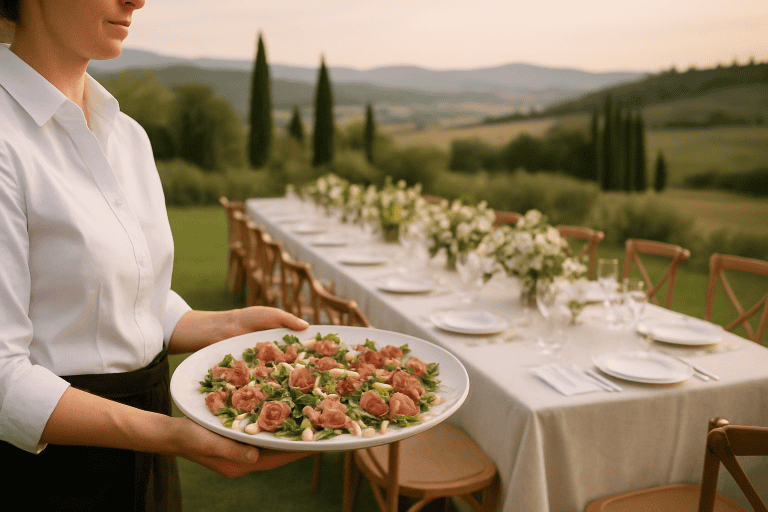
 How to choose catering in Tuscany: tasting, seasonality, and allergies
Choosing catering in Tuscany for a wedding: what really matters (besides the menu) When you start choosing catering […]
Read more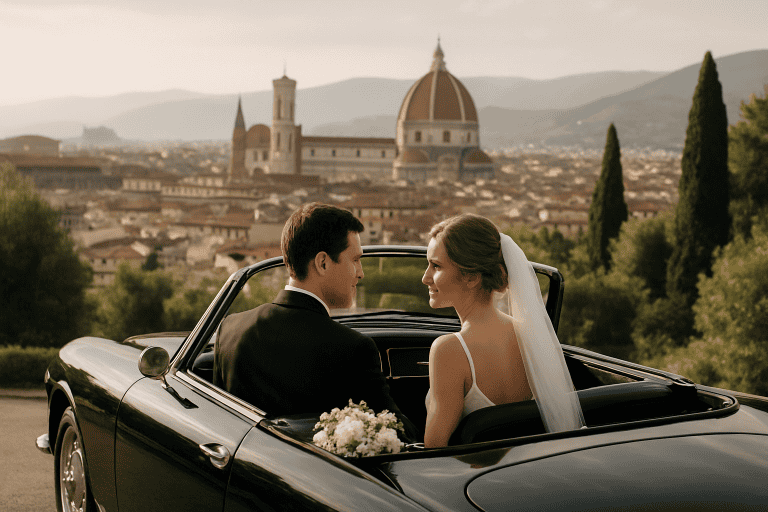 Tuscany
 Florence: civil ceremony in the city and reception in the villa (timeline and transportation)
Organizing a civil ceremony in Florence with a reception in a villa is one of the most requested formats in Tuscany: it combines the […]
Read more Tuscany
 Wedding weekend in Tuscany: welcome dinner, pool party, and farewell brunch
Wedding weekend Tuscany: why choose welcome dinner, pool party, and wedding brunch A wedding weekend in Tuscany is not “just” a […]
Read more